On The Big Bang Theory, Sheldon Cooper called 73 the best number. It sounds like a joke — but the math behind it is surprisingly beautiful.
First, 73 is a prime number. But it also holds a special spot in the list of primes. If you count them one by one, 73 turns out to be the 21st prime number. Now flip the digits of 73 and you get 37 which is the 12th prime number (21 reversed becomes 12).
Second, take the number 21 and factor it: 21 = 7 × 3. Those are the exact digits that make 73.
And finally, write 73 in binary (the language computers use): 1001001. Read it left to right or right to left — it’s the same. That makes it a binary palindrome.
Fast Fourier Analysis in action.
Any complex waveform, sound, or shape can be perfectly reconstructed as the sum of simple rotating circles (epicycles).
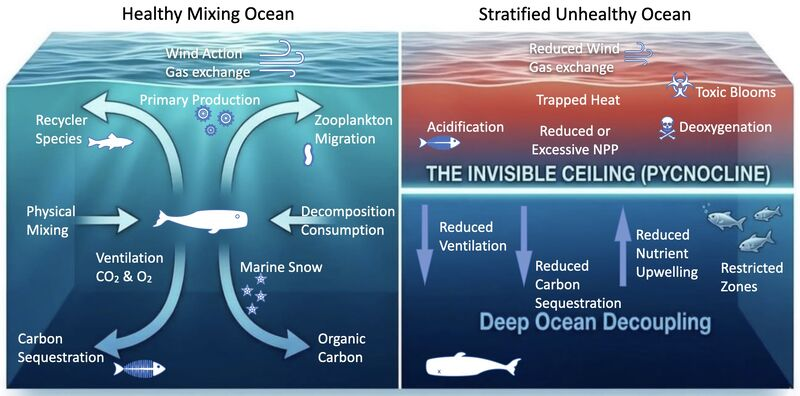
The Oceans are Losing their Breath. They’re no longer just "buffering" climate change; they are reaching a structural breaking point. In this second article in a series on Ocean Stratification (the layering of water that prevents mixing), Jan and I examine a "triple whammy" of environmental failures:
The Deoxygenation Crisis: Warmer surface layers are trapping heat and losing oxygen. Since the mid-20th century, 1%–2% of global ocean oxygen has vanished, creating "dead zones" where marine species literally struggle to breathe.
Chemical & Visual Shifts: We have officially breached the Planetary Boundary for Ocean Acidification, threatening foundational species like coral and shellfish. Simultaneously, the oceans are "darkening" as biomass and particles accumulate in the surface, further trapping heat in a dangerous feedback loop.
A Stalling Carbon Pump: The "biological pump"—the process where marine life moves carbon to the deep ocean—is slowing down. Rising temperatures are creating a "thermal wall" that disrupts the (vertical)migration of carbon-recycling species.
The Bottom Line: The ocean's capacity to absorb our emissions is flattening. As stratification strengthens and marine heatwaves become the "new normal," the transition of our oceans from a stable climate sink to a volatile risk source is one of the most significant challenges of this century.
Links to this new article and the first one covering the physical aspects of Ocean Stratification are in the comments. h/t Tom Harris and Jan Umsonst
The Great Decoupling 2: Changes in Ocean Biochemistry Driven by Strengthening Stratification https://t.co/RRdDtMrMT5