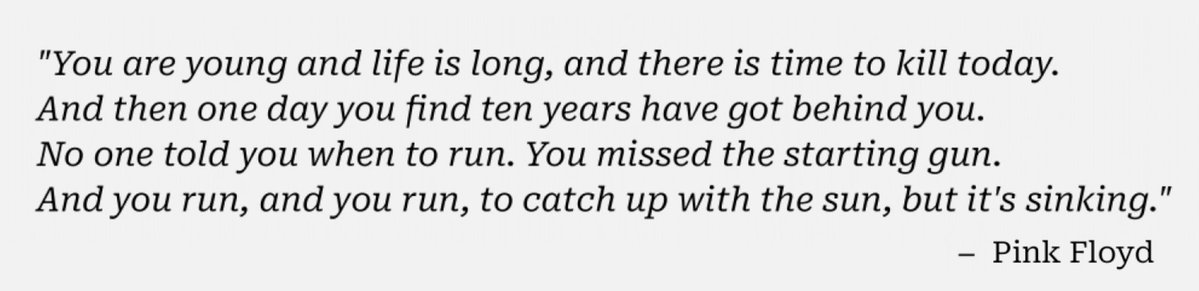
In the time that you remain laid back, someone else is building their glory, their legacy and, more importantly, their akhirah.
Whilst you remain comfortable, someone else is striving.
Whilst you procrastinate, someone else is progressing.
The world is waking up, the successful are winning, the righteous are racing.
*Are you even in the race?*
Do not let comparison destroy you dear brother or sister,
*Use it to awaken you*.
Imagine yourself arriving on the Day of Judgement, imagine the deep sense of heartbreak you will feel when you realise that the people around you were quietly and consistently building their akhirah, whilst you had spent your days and nights lying back in comfort.
Whilst you sleep, someone out there is standing before Allah in the depths and darkness of the night, forsaking the comfort of their bed to call upon their merciful Lord.
تَتَجَافَىٰ جُنُوبُهُمْ عَنِ الْمَضَاجِعِ يَدْعُونَ رَبَّهُمْ خَوْفًا وَطَمَعًا وَمِمَّا رَزَقْنَاهُمْ يُنفِقُونَ
فَلَا تَعْلَمُ نَفْسٌ مَّا أُخْفِيَ لَهُم مِّن قُرَّةِ أَعْيُنٍ جَزَاءً بِمَا كَانُوا يَعْمَلُونَ
“Their sides forsake their beds; they call upon their Lord in fear and hope, and they spend from what We have provided them. No soul knows what has been hidden for them of comfort for the eyes as a reward for what they used to do.”
— Surah As-Sajdah 32:16–17
Whilst you spend hours in bed, someone else is responding to the call of Allah in the last third of the night, when Allah descends to the lowest heaven and calls his servants to ask him for anything they wish, seek his forgiveness and call upon him.
Whilst you engage in idle speech, someone else is turning away from it and simultaneously keeping their tongue moist with the remembrance of Allah, gradually filling their scale of good deeds with words that require almost no effort to utter.
Allah says:
وَالَّذِينَ لَا يَشْهَدُونَ الزُّورَ وَإِذَا مَرُّوا بِاللَّغْوِ مَرُّوا كِرَامًا
“And those who do not bear false witness, and when they pass by idle talk, they pass by with dignity.”
— Surah Al-Furqan 25:72
And the Prophet ﷺ said:
كَلِمَتَانِ خَفِيفَتَانِ عَلَى اللِّسَانِ، ثَقِيلَتَانِ فِي الْمِيزَانِ، حَبِيبَتَانِ إِلَى الرَّحْمَنِ:
سُبْحَانَ اللَّهِ وَبِحَمْدِهِ، سُبْحَانَ اللَّهِ الْعَظِيمِ
“Two words are light on the tongue, heavy on the Scale, and beloved to the Most Merciful: ‘Subhanallahi wa bihamdihi, Subhanallahil-‘Adeem.’”
“Glory and praise be to Allah; Glory be to Allah, the Magnificent.”
— Sahih al-Bukhari 6682
Ask yourself a question, dear brother or sister, and be honest in your answer: you speak every single day, but when was the last time you deliberately set aside a portion of your day simply to make your tongue moist with the remembrance of Allah?
When was the last time you said these words slowly, consciously and sincerely, actually reflecting upon what you were saying and meaning it from the depths of your heart?
Whilst you scroll through social media for ten minutes, someone else is sitting with the Qur’an, earning ten rewards for every single letter they recite.
Our beloved Prophet ﷺ said:
مَنْ قَرَأَ حَرْفًا مِنْ كِتَابِ اللَّهِ فَلَهُ بِهِ حَسَنَةٌ، وَالْحَسَنَةُ بِعَشْرِ أَمْثَالِهَا، لَا أَقُولُ الم حَرْفٌ، وَلَكِنْ أَلِفٌ حَرْفٌ، وَلَامٌ حَرْفٌ، وَمِيمٌ حَرْفٌ
“Whoever recites a letter from the Book of Allah will have one good deed for it, and each good deed is multiplied by ten. I do not say that Alif-Lam-Mim is one letter; rather, Alif is a letter, Lam is a letter and Mim is a letter.”
— Jamiʿ at-Tirmidhi 2910
@craigjellick The weird thing about vision is if you tell most people the long term vision up front they call you crazy and laugh at it. It's better to do something short term and obvious that everyone can grasp while carrying water and chopping wood towards the real vision.
dopamine as reward prediction error is some of the most interesting neuroscience of decision making stuff i know of. i got one shotted by it and spent about 9-12 months working with the glimcher lab at nyu working on related stuff. once you internalize it, it explains a huge amount of human behavior and learning
Dopamine does not spike highest for guaranteed rewards. It spikes highest at reward prediction error. If you want to have fun in life, you should stop avoiding risk and uncertainty.
I'm now building an "improvements" feature into all of my personal vibecoded applications: a freeform text input that's hooked up to an agent that yolo implements whatever is submitted.
It's an interesting experience -- the activation energy barrier to sanding any rough edge or implementing any new feature becomes extremely low. Someone else who uses one of the applications I created has already implemented 150 improvements over the course of a few days. This pattern feels like a new kind of tool -- liquid software? -- and every application that doesn't have this feature now has a slightly rigid and anachronistic flavor. Why can't I just tell it how I want it to be different?
Now, it's not obvious to me how this pattern can or should scale. Does it become unmaintainable after a while? (Maybe model intelligence improvement outstrips my feature appetite such that it's fine?) How does collaborative software work in this model? Can software designed this way be secure and reliable?
Whatever the larger questions about broader deployment, it definitely works great in a personal context. It reminds me a little of the visions of Lisp/Lisp machines, Smalltalk, and HyperCard -- systems that the user can take control of and modify. Those visions never quite worked, though: the vast majority of software today is not end-user modifiable in any useful way. So, while this "liquid" affordance is a very small touch, the way it changes one's relation to the software feels a bit transgressive and empowering in a Lickliderian and Engelbartian way.
I've been thinking about this a bunch lately. Codebases have become organic, perhaps they always were, and we require new abstractions to do excellent engineering.
Cybernetics is back. What's old is new again, and this is the current best way to think about it. For all their flaws, Anthropic has the *exact* right idea with "SuperFans". I mean, I'm sort of in awe of how good that particular blog post was. There's this commitment to excellence that I greatly admire, and a level of AGI-pilled reasoning that meets the moment.
In my opinion, you should work with models you trust and then give them the autonomy to own part of your codebase. This doesn't mean they don't get audited, or manually checked, or interviewed - it just means that each component gets a type of guy who is obsessed with that component.
If you think about this from a higher level of abstraction, what you're really doing is enabling *zones of dynamic attention* where the models are using their fluid intelligence to design a component and then justify that component in the context of all the others. If a new one gets built that may cause issues, that model works with the model for the other component to ensure mutual compatibility. It's almost like the components themselves have come to life and are trying to figure out how best they might fit together.
The old ways of engineering are over. Codebases that are built like this will be far more competitive almost inevitably as the skill of the model surpasses that of the average programmer and sheer parallelization wins the day. Obsession over PRs, dedication to reading every line, these are vestigial neuroses that must be abandoned if we are to succeed well into the future.
Operational excellence without constant human oversight is possible with good enough models and clever enough scaffolds. The hardest part is almost always going to be turning it on and managing the first few problems. These systems will probably never be perfect, but they are the path forward.
1/4
Meet Qwenputer: Qwen3.5-4B with a full RISC-V CPU inside its weights, using the model's own Gated DeltaNet layers as RAM.
It runs C and MicroPython in its forward passes, no external runtime.
On DeepMind math: base 55–90%, base + Python tool 95–100%, Qwenputer 97.5–100%.
TERENCE TAO SAYS AI WILL DO TO OUR BRAINS WHAT CHEAP FOOD DID TO OUR BODIES
for most of history life was the workout. then food got cheap and people had to start watching their diet on purpose
tao says thinking is next:
"you have to watch your mental diet, and you do have to maintain mental exercise"
MIT had students write essays with ChatGPT. minutes later 83% couldn't quote a single sentence they'd "written"
the ones who wrote on their own first and got ChatGPT later used it better, and their brain activity went up
the struggle before the answer is the part your brain keeps
an answer you didn't work for is easy to get and even easier to forget
would you let your kid use AI for homework from day one, or make them struggle first?
سؤال يا غافل، يا لاهي، يا من تتصفح التطبيقات والمواقع بالساعات، أما آن لقلبك أن يصحو ولعمرك أن يُثمر بحفظ كتاب الله؟!
حافظ القرآن يُقدَّم في الإمامة، ويُقدَّم في الدفن عند اجتماع الموتى، وينال رفعة الدرجات، ويلبس والداه تاج الكرامة يوم القيامة!
Hello, Little People Living Inside Of My Computer,
I have made my second ever YouTube video briefly discussing the Chinese government trying to compromise companies in Malaysia.
It was fun.
https://t.co/t6vfU9wxUL
We have discovered a substantial number of vulnerabilities in the German legal system using LLMs.
These may enable access to confidential documents, travel without an otherwise required visa, enforceable leave for soldiers at NATO’s JSEC, and more.
Similar to computer systems, the written law can contain vulnerabilities that invite exploitation. In our blog post, we share a selection of vulnerabilities, and present potential exploits for each. To our knowledge, none of these have been previously recorded. We share only those vulnerabilities whose exploitation we believe would not cause serious harm.
blog post: https://t.co/hsYTiJpNoJ
Llegan más lejos los obstinados que los mas inteligentes.
La repetición es una de las herramientas más potentes que tiene el cerebro para aprender y consolidar recuerdos. Cada vez que repites una acción, una idea o una habilidad, no solo la estás practicando en ese momento, sino que estás enviando una señal clara al cerebro de que eso es importante. Gracias a eso, incluso cuando ya no estás pensando en ello (por ejemplo, mientras descansas o duermes), el cerebro sigue “repasando” internamente esas experiencias de forma automática, especialmente en las áreas corticales.
Esa reactivación offline fortalece las conexiones neuronales y hace que la memoria se vuelva más estable y fácil de recuperar a largo plazo. Por eso, la maestría no llega solo con entender algo una vez, sino con repetirlo lo suficiente para que el cerebro lo integre de manera profunda y duradera.
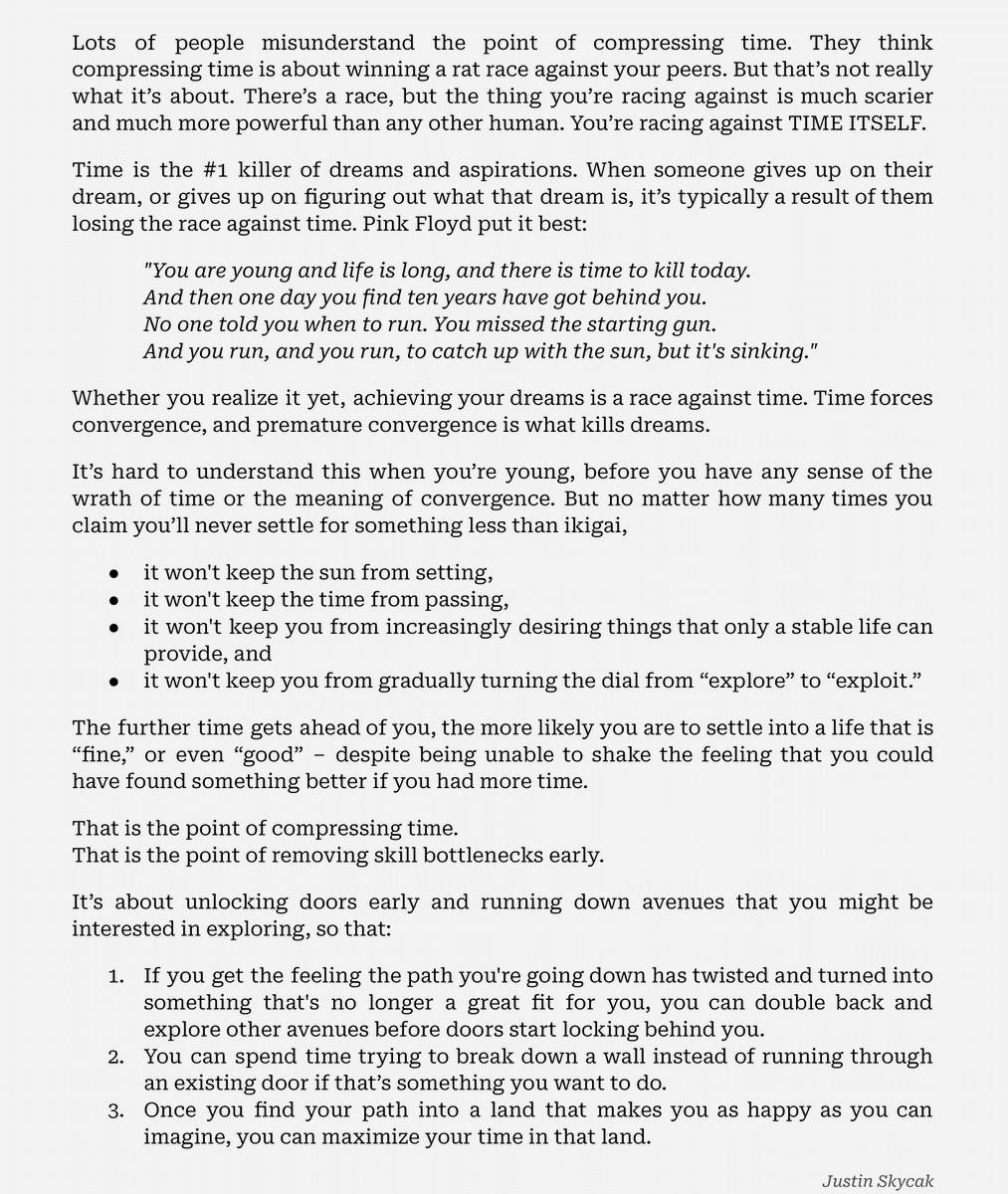
So much of growing up is realizing and accepting that your life is solidifying. And premature solidification is what kills dreams. Yeah it's never too late to break the concrete but damn does it get harder as time goes by. So shape it how you want while it's still liquid.
The longer you delay building the life you actually want, the more likely you are to normalize a weaker substitute. Drift hardens into identity faster than people realize.