I met with Peter Thiel once
I pitched him on a system to detect trends
he told me it wasn't interesting because by the time a trend is in place, it means that it's likely overvalued
I thought I learned a lost then he top blasted all his previous investments and turbo printed
this was probably the first time I internalized that powerful people have no real reason to tell you the truth behind their process. you can just say things. You can show up to Market Wizards and fabricate your entire process and nobody will know.
all rhetoric is just a methodology to reach an objective, especially with the powerful, there is zero truth value
applies to many areas of life
TruthCels will read Warren Buffet's newsletter and buy value stocks and underperform for decades while Buffett full ports AAPL at 26x earnings and sells the highs
everything you think you've learned from people is probably just some sht they said in the moment, either to give them a compliance benefit. cheapen a deal. meme a founder into doing something. who knows
you certainly don't. I certainly don't. the only data worth anything is first party study / collection
🔘 Long-horizon consistency
Environments created remain largely consistent over several minutes, with visual memory extending as far as 1️⃣ minute in the past.
This ability is critical to enable AI agents to learn about the world, and provides humans with an immersive experience.
Check out this 2014 interface experiment on eye-gaze👀+ multitouch🖐️, featured in my recent talks about the origins of Gaze + Pinch in VR. It combines finger chording with gaze-based target selection for some seriously smooth, fast-paced sorting⚡
From: https://t.co/UgnHoRY7OO
@ruskievityazi@aparanjape@COEPTech It has been on the campus for 8 years at least, because I saw it first time in 2016 as a student. It was in a bad shape amongst other model engines in the Mech. Drawing hall till 2020. It looks now after the hall got renovated it is installed somewhere on campus
Great initiative from @idc_iitb with the Design Innovation Centre at @iitbombay
Real world examples of projects developed into finished products in Indian context, and the design-engineering process behind it is aptly presented in this stream linked below
#idc#iitb
In 2010, YouTube had 800M active users + streamed 2B+ videos daily.
But internally, we were flying by the seat of our pants.
One burning question was on our minds:
How were people actually using YouTube?
Here's the story of how one UX researcher ignited sweeping changes to how the company approached building the product:
—
I joined YouTube in 2009 and still recall my first planning meeting with the search team.
We sat around a table and the PM asked:
“So what do you all think would be cool to build?”
In asking a few questions of my own, I realized the team had been building without understanding how people experienced the product.
We lacked the information to make informed choices about what to prioritize across YouTube.
And so we started to grow the research team.
—
In 2010, we convinced @kerryrodden (they/them), Google’s first Quantitative UX Researcher, to join YouTube.
To get oriented, Kerry started asking PMs, Designers, Engineers, Execs, and other UX Researchers what their most pressing questions were. One question came up again and again:
How were people actually using YouTube?
Kerry combed through existing qualitative research, and honed in on understanding how people navigated through the site.
To do this, Kerry jumped into YouTube’s user logs and was delighted to discover that YouTube’s data showed a user’s entire session — revealing a user’s navigation across all the pages they visited.
(Note: User sessions were completely anonymized, so no session data was attached to an identifiable person.
Also, usage data was separated from video content, so we analyzed only page types e.g., watch page or search results page, but not the actual videos or search queries.)
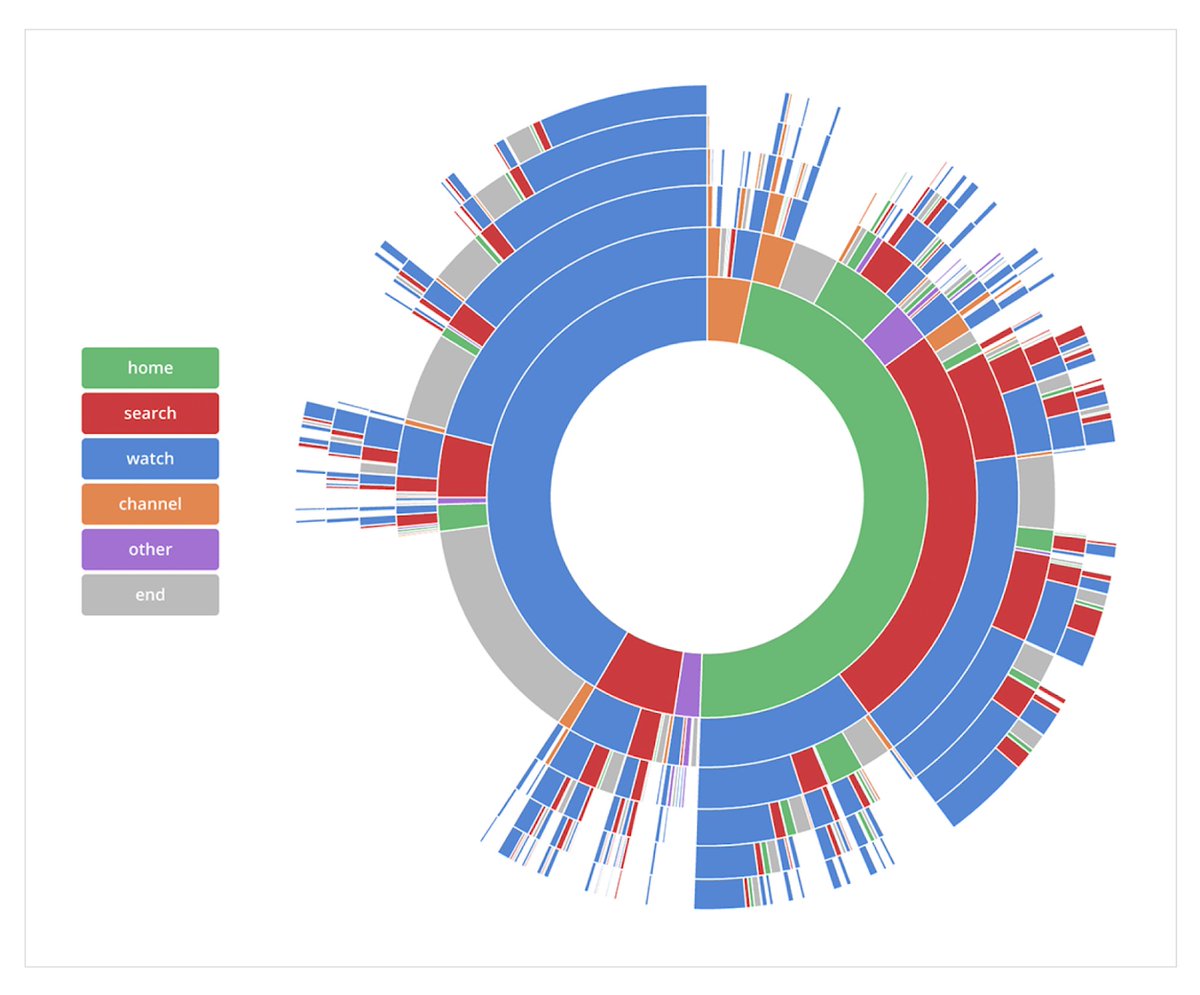
To simplify the data, Kerry categorized all the pages of YouTube into five page types: Home, Search, Watch, Channel, and Other (account, settings, etc.).
Kerry counted usage for each page type and then likelihood of the next page to visit.
e.g. If someone was on the home page, what percentage of the time did they search vs watch a video?
When sharing these eye-opening findings with PMs, Designers, and Engineers, Kerry was met with a barrage of additional questions:
- Where were people most likely to start?
- Where did they go?
- What did a typical session look like?
- How/when/where did sessions end?
These questions led Kerry to analyze whole sessions.
So they calculated where people started, and from each page, where they were most likely to go next.
—
Kerry had overcome the first challenge of making sense of the data.
But their goal was not only to understand how people navigated YouTube, it was also to show the data in a way that everyone inside of YouTube could easily understand.
After exploring several formats, Kerry landed on a radial sunburst format to visualize the data.
In this view, it was easy to see the relative % of sessions that started with each page type and it was also easy to follow a user’s path across an entire session.
Kerry built an interactive version that allowed us to hover and trace any path from start to end, with the percentage of sessions that followed that exact path.
The image below is static, but shows the breakdown of paths people took through YouTube.
(Starting from the inside and working your way to the outermost ring)
—
Kerry’s visualization went viral inside YouTube.
It was turned into posters and hung up on the walls, printed onto t-shirts, and referenced in exec strategy decks and new hire orientation.
The mystery of how people used YouTube had been unlocked.
—
We had all assumed YouTube’s homepage was important.
The homepage had 45M+ visits per day and companies were doing home page buyout ads for huge sums of money.
But Kerry’s research revealed less than half of sessions started on the homepage and people mostly came to the home page to search.
The homepage showed a bunch of videos that were driven by a mass algorithm (and was pretty much the same experience whether a person was logged in or not).
We were missing the opportunity to show 45M people the content they wanted to watch each day.
Kerry’s visualization was an inflection point in YouTube’s history.
Their findings created lasting ripple effects that elevated how well we understood users’ experiences, how we approached building products, and how so many subsequent video-first companies shaped their products.
Ultimately, the team invested in building personalized recommendations, which helped transform the homepage from a search portal into a destination for finding content to watch.
This transition was especially pivotal later, when everyone shifted to mobile.
Personalized recommendations set YouTube up to become the dominant mobile video app, where “homepage” discovery was foundational to its success.
Today, we open the YouTube app and start watching videos without even thinking — it just works.
—
This story has stuck with me for the past 15 years.
It is a great example of what can happen when a single person is devoted to understanding the full user experience and is willing to put in the effort to cross traditionally accepted boundaries.
It is so important to have a clear picture of how people experience your product — both qualitatively and quantitatively.
Understanding this fuller picture can open your eyes to gaps and unexpected behaviors as well as focusing on perfecting the parts of your product where the magic happens.
—
A big thanks to @kerryrodden, as well as @shivar + @mags to jog my memory of different facets of this story.
For more on design insights + stories, follow me at @elizlaraki.
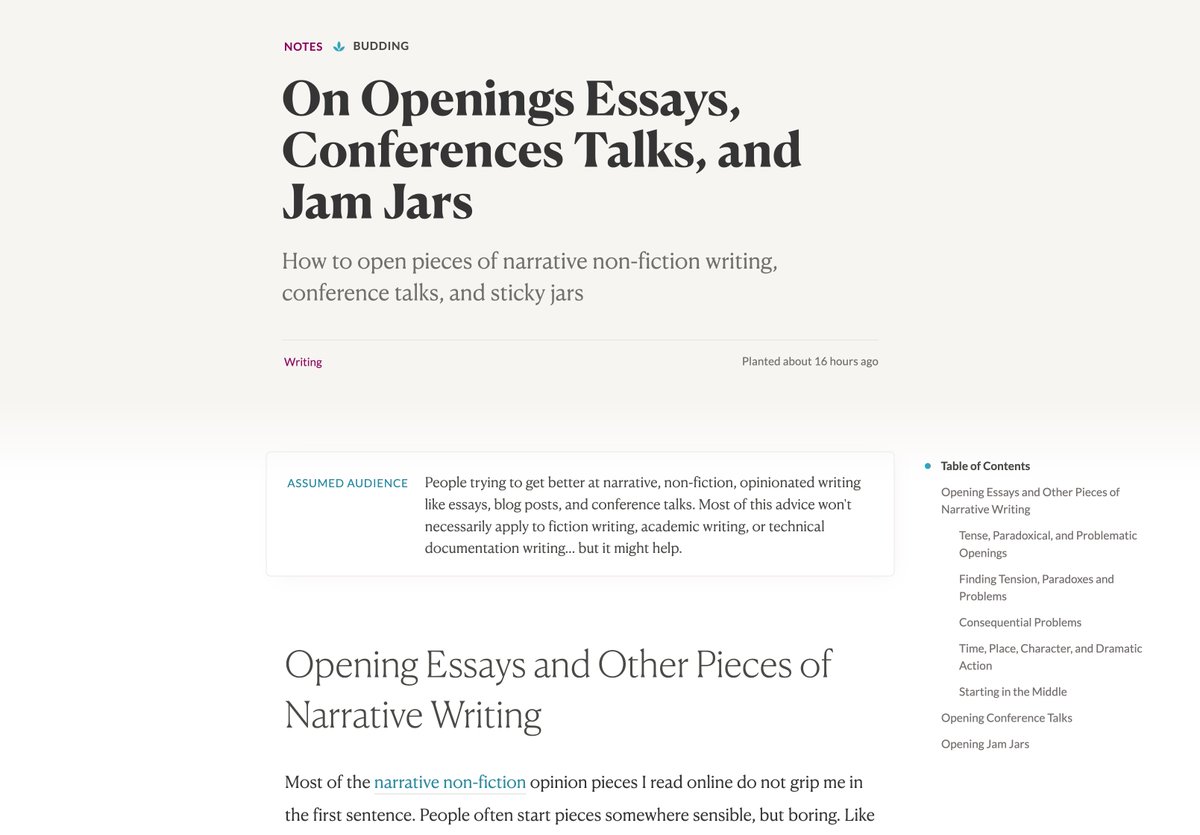
Finally turned my extensive notes on writing compelling openings for essays & conference talks into a coherent whole.
An old professor made me obsessed with this. Openings that clearly state your problems or paradoxes solve most of the writing structure for you.
Link below 👇
The internet used to be ✨ fun✨
https://t.co/GIcfrLWylH
I remember visiting my friend’s websites. They were ugly and quirky and it was awesome. You wondered who’d stop by yours. They were a labor of love and a medium of self-expression, not your LinkedIn.
We can fight this.