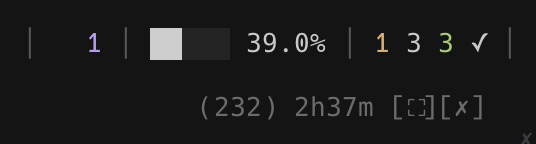
Grok Build looks very promising. The speed is incredible, I won't be surprised if their capacity utilization shoots up suddenly.
It took me a while to figure out what these number on the top right mean. For anyone wondering, it's the number of tasks in progress, in the backlog and done.
Also trying it as a harness for the local gemma4 model and its not bad
Today we reduced headcount by 22%. The business is the strongest it's ever been. So I think it's important to be direct about what I'm seeing and why.
First, I made this decision and I own it. I did it because the way to operate at the highest level of productivity is changing, and to win the future, ClickUp needs to change with it.
Second, this wasn't about cutting costs. Most savings from this change will flow directly back into the people who stay. We'll be introducing million-dollar salary bands. If you create outsized impact using AI, you'll be paid outside of traditional bands.
Most importantly, I have the deepest gratitude for those affected. We're doing this from a position of strength specifically so we can take care of people properly. Everyone affected receives a package aimed at honoring their contributions and easing the transition.
I only see two options: wait for this to play out gradually in the market or be honest about what I'm seeing and act proactively.
THE 100X ORGANIZATION
The primary change is that we're restructuring around what I call 100x org. The goal is 100x output. The roles required to build at the highest level are fundamentally different than they were a year ago.
Incremental improvements to existing systems won't get us there. We need new ones. That means creating enough disruption to rebuild rather than iterate on what's already broken.
The common narrative is that AI makes everyone more productive. It doesn't. Many of the workflows of today, if left unchanged, create bottlenecks in AI systems.
These roles will evolve. But waiting for that to happen naturally means falling behind now.
The 100x org is actually heavily dependent on people - infinitely more than today. This is only possible with 10x people that have embraced and adopted new ways of working.
THE BUILDERS, AGENT MANAGERS, AND FRONT-LINERS
— THE BUILDERS: 10X ENGINEERS
I don't think most companies have internalized what's actually happening with AI in engineering. The common narrative is that AI makes all engineers more productive. That may be true in isolation, but at an organization level - that is the farthest thing from reality.
Here's what we've validated recently at ClickUp: the great engineers, the ones who can orchestrate, architect, and review, are becoming 100x engineers. They're not writing code. They're directing agents that write code. The skill is judgment.
AI makes the best engineers wildly more productive, and everyone else using AI slows these engineers down.
Think about it - the bottlenecks are (1) orchestration - telling AI what to do, and (2) reviewing - what AI did. Everything is leapfrogged and no longer needed.
So who do you want orchestrating and reviewing code?
And how do you want your best engineers to spend their time?
If your best engineers are spending time reviewing other people's code, then this is inherently an inefficient bottleneck. These engineers can review their agent's code much faster than reviewing human code.
The new world is about enabling your 10x engineers to become 100x.
The wrong strategy is to push every engineer to use infinite tokens. Companies doing this are celebrating 500% more pull requests. But customer outcomes don't match the volume of code being generated.
I call this the great reckoning of AI coding, and every company will face this soon if not already.
More code is just another bottleneck to the best engineers, and ultimately to your company's impact as well.
— THE BUILDERS: 10X PRODUCT MANAGERS
Product management and design roles are merging.
Designers that have customer focus, become more like product managers.
And product managers that have intuition for UX become more like designers.
The bottleneck of user research is gone. It takes us just one mention of an agent to kickoff research and analyze results.
The bottleneck of product <> design iteration is also gone. The product builder iterates on their own, along with agents and skills that ensure alignment with quality and strategy.
Also controversial today - I believe that the wrong strategy is to have your PMs shipping code - that just introduces another bottleneck that the best engineers will waste their time on.
To be clear, PMs should be coding but they should do this in a playground to iterate, validate, and scope. That code should not go to production.
Everything outside of managing systems, orchestrating AI, and reviewing output becomes a bottleneck.
That's why the other roles that are critical along with these are the systems managers (to reduce bottlenecks) along with a bottleneck you can't replace - customer meeting time.
— THE SYSTEM MANAGERS
Ironically, the people that automate their jobs with AI will always have a job. They become owners of the AI systems - agent managers. We have many examples of these people at ClickUp.
The underlying systems in which we operate are absolutely critical to get right. I think most companies are delusional to think they can iterate on existing systems and compete in this new world.
You must create enough disruption so that old systems are deprecated entirely. If there's any definition for 'AI native' that's what it is.
— THE FRONT-LINERS
In a world that will become saturated with AI communication, the human touch will matter more than anything to customers.
This is a bottleneck that you shouldn't replace - even when agents are high enough quality to do video meetings.
One-on-one meeting time with customers is something that shouldn't be automated. The systems around the meetings should be - so that front-liners spend nearly 100% of their time with customers.
REWARDING 100X IMPACT
In a world where companies are able to do so much more with less, where does that excess money go?
In our case, much of the savings in this new operating model will flow directly back to those that enabled it.
We must reward people that create productivity accordingly. This aligns incentives on both sides. Plus, in a world where your best people create 100x impact, you can't afford to lose them.
You should aim to retain these employees for decades. The context they have and their ability to efficiently orchestrate and review will be nearly impossible to replace.
Compensation bands of today should be thrown out the door. We're introducing $1 million cash/year salary bands with a path available to nearly everyone in the company if they produce 100x impact by creating or managing AI systems.
THE FUTURE
Nearly every company will make changes like these. The ones that do it proactively will define what comes next.
The future is not fewer people. It's different work, new roles, and better rewards for those who embrace it. We're already seeing entirely new roles emerge, like Agent Managers, that didn't exist a year ago.
ClickUp is positioning to lead this shift, not just internally, but for our customers too. I've never been more certain about where we're headed.
"I don't think people managers will have any value in the future."
Airbnb CEO said on a recent pod the people most screwed by AI will be people managers.
Perhaps we had this all wrong. The future belongs to ICs. There is now more use for them than ever before.
A big pivot from Ken Griffin on AI:
“Number one is, in the last few months, there has been a step change in the productivity of the AI toolkit. It is profoundly more powerful than it was just nine months ago.
And for us at Citadel, that has allowed us to unleash a much broader array of use cases for AI. And it has been really interesting to watch, to be blunt, work that we would usually do with people with masters and PhDs in finance over the course of weeks or months being done by AI agents over the course of hours or days.
These are not these are not mid-tier white collar jobs. These are like extraordinarily high skilled jobs being, I'm going to pick a word, automated by agentic AI. And I gotta tell you, I went home one Friday actually fairly depressed by this because you could just see how this was going to have such a dramatic impact on society.
When you witness it in your own four walls, when you see work that used to be man years of work being done in days or weeks, it's like, wow, like that's the first time I've seen real impact in our four walls.”
This echoes my own experience with agents and the conversations I am having with students, friends & clients. The toolkit has dramatically transformed and it feels like in finance, for the first time, AI is real.
Prediction: The massive AI data center buildout is the dot-com bubble’s fiber-optic equivalent.
Huge over-investment, yes
but just like the 90s, consumers will eventually get fantastically cheap machine intelligence.
The infrastructure glut today = abundance tomorrow.
Audit exists to price truth inside opaque structures. It extracts signal from mess. It provides probabilistic trust when code and math are insufficient. But now KPMG has declared that signal extraction can be automated and commodified.
⚡️This is an extinction-level irony event.
An audit firm just told its own auditor that their job has no value because AI exists.
That single move did more to collapse trust in the profession than any external disruption could. The real signal is that KPMG doesn’t even believe its own margins are defensible. The logic of their pitch now boomerangs.
Audit exists to price truth inside opaque structures. It extracts signal from mess. It provides probabilistic trust when code and math are insufficient. But now KPMG has declared that signal extraction can be automated and commodified. The firm that sells confidence has destroyed its own confidence premium.
This is deeper than cost-cutting. It is an ontological fracture in a profession built on asymmetric information. If the core epistemic function of auditors can be reduced to API calls and LLM inference, then they are not stewards. They are wrappers.
KPMG didn’t just kill its pricing power. It surrendered its metaphysical claim to necessity.
It announced that it no longer believes in the value of its own lens.
And in doing so, it seeded doubt across the entire structure of institutional verification.
The collapse won’t begin with AI replacing humans.
It begins when the gatekeepers of trust no longer trust themselves.
Sec. Bessent response to UAE after UAE threatened to price oil and gas in CNY if US would not supply USD swap lines a few days ago (bottom):
"Yes - we will give you whatever swap lines you want 'to prevent the disorderly sale of US assets'."
Every system that was regulated, either explicitly or implicitly, by the fact that they were effortful for humans (letters of recommendation, lawsuits, government filings, essays) will break.
Scientists say the next AI breakthrough is not bigger models, but smarter ones.
AI reasoning breakthrough
In a new analysis, researchers highlight the rise of neurosymbolic AI, a hybrid approach that combines neural networks with formal logic and rule-based systems.
Instead of relying purely on probability like LLM, these systems integrate symbolic constraints, structured reasoning and verification engines to produce outputs that can be checked and proven correct.
Recent systems from Google DeepMind show how this works in practice:
> AlphaGeometry 2 (2025–2026) solves ~83–88% of International Math Olympiad geometry problems, with some solutions generated in seconds
> AlphaProof (2024 → current) achieved 28/42 points (silver medal level) at IMO by generating formally verified proofs
> AlphaFold predicted 200M+ protein structures with near experimental accuracy, showing how hybrid AI can solve real scientific problems at scale.
Unlike LLMs, which generate answers probabilistically, these systems use structured reasoning pipelines where results are validated, constrained, and logically consistent.
The shift is subtle but massive 👀
This new direction suggests AI is moving from sounding intelligent to actually reasoning with verifiable correctness, a change that could redefine progress in science, mathematics and engineering.
"Where are the servers of Bitcoin located?” - Prof Jiang
That single question from Jiang shows the misunderstanding immediately.
Bitcoin does not run on one company’s servers,
Bitcoin runs on a distributed network of nodes spread across the world, which is exactly why it is hard to censor, shut down, or control, plus the mining system on top of it to protect it with energy.
When someone frames Bitcoin like a centralized system, they are not critiquing Bitcoin as it is.
They are critiquing a version of Bitcoin that exists only in their own confusion.
Researchers trained a humanoid robot to play tennis using only 5 hours of motion capture data
The robot can now sustain multi-shot rallies with human players, hitting balls traveling >15 m/s with a ~90% success rate
AlphaGo for every sport is coming