Thrilled to be joining @CoreWeave for the next phase of our journey!
Today’s a special one; Marimo was the first deal I ever led as an investor, and the first company I worked with as part of the board.
Akshay and Myles gave me two incredible opportunities; first as an investor to lead their seed round (with @antgoldbloom's support), and now as a teammate to lead growth and GTM.
Incredibly grateful for their leadership and the journey so far, and excited about what’s ahead for the OSS project and molab.
More to share on this soon, but for now, thrilled to double down on open source and scale molab with CoreWeave’s backing 🚀
We have big news to share: marimo is joining @CoreWeave! We're doubling down on open-source and scaling molab with serious compute
Our mission is the same: to build the world’s best open-source notebook for working with data
Read the full announcement: https://t.co/BL1QFQW8N9
“Over the next 6 months, it’s very likely that the cell towers go down at some point for a few days.”
“Everyone should try and buy some form of local hardware to be able to run even a very small open source model.”
“If I had more money, I would buy a house in Nevada. And if I had a lot more than that, I would probably buy one in New Zealand.”
Aidan Guo (@aidangch), co-founder of @attentioninc, shares his best prepper-maxxing tips:
The next generation of AI infrastructure will look very different from the last. Peter saw early that Apple silicon would play a massive role in that future.
We’ve been backing him since day one. He sends the most detailed weekly updates I’ve seen and responds maniacally fast. Mount Thor is inevitable.
Agentic AI runs best on Apple platforms. Accessing Apple’s hardware at scale has been hard, until now. We’re making macOS and Apple silicon available as elastic compute resources, optimized for AI research & deployment.
We have one of the largest fleets in the world, support the most demanding workloads (massive 512GB M5 Ultra clusters, anyone?), and we’re just getting started.
Wouldn’t be here without @CRV (@brittwalker_), @conviction (@pranavreddy), @chadbyers, @offlineventures (@davemorin), and others (including many inside @Apple) who believed in us early and remain incredible partners. We seek infinite games; the play continues.
https://t.co/dNlPl5TQz4
Every brand and major service of the web will need to build for their newest and most valuable demographic...
agents, of course.
TollBit is powering Agent Sites for 10,000 of the internet's most popular destinations.
Today we announced our Q3 earnings:
🔹$3.7B revenue, up 168% YoY
🔹$379M adjusted operating income, well above guidance
🔹Double-digit adj. operating margins, a quarter ahead of plan
🔹1.7GW+ of active power, doubling our active footprint YTD
🔹Roughly $9B in customer prepayments and deposits in this quarter
Congratulations to our team, who remain focused on executing for our customers.
Read the full Q3 2026 results. https://t.co/WLTRurYFSQ
Models have IQ but no experience.
Frontier models show up on day one with superhuman intelligence but no expertise on the thousands of tasks your company actually does. @trajectorylabs exists to close that gap through continual learning.
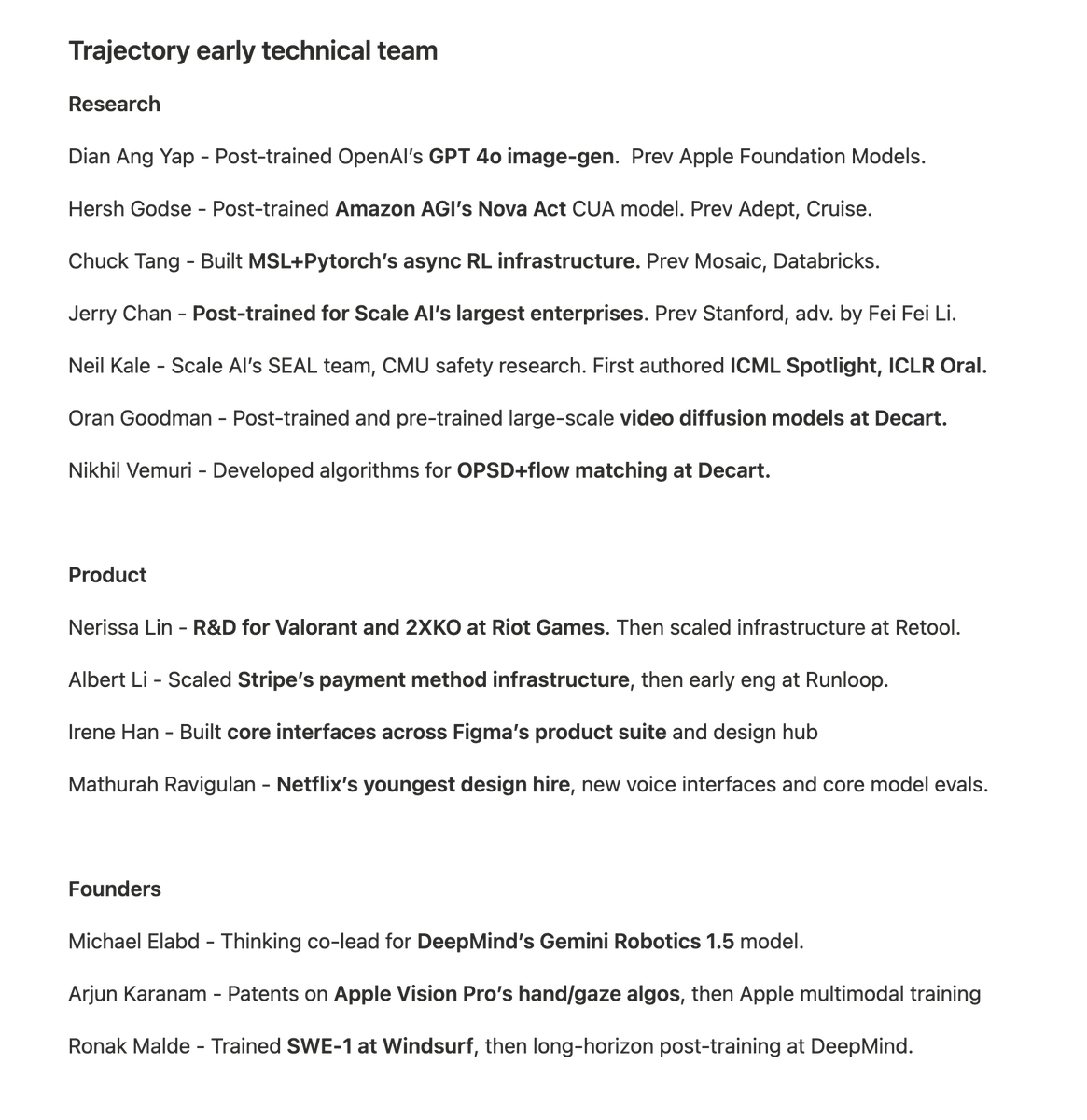
@rronak_ trained SWE-1 at Windsurf, then went to DeepMind. His cofounders @MichaelElabd and @QuantumArjun worked on Gemini Robotics and multimodal models for Vision Pro. All three hit the same wall: big labs train one model for everyone, but nobody trains one for you.
The conversation covers:
— why today’s agents are “pseudo continual learning”: we are in the paper road map era, not Google Maps
— “Group Size 1”, a GRPO variant that learns from one real-world rollout instead of replaying the same task eight times, so you don’t need a simulated environment
— how Harvey trained a model 6x cheaper than frontier that took an open-source baseline up by over 4x on its own legal benchmark
— Continual Grading, a meta-grader that turns rubrics on 100 traces into reward for 10,000
— continual learning vs. recursive self-improvement, and why only one keeps humans in the loop
— why continual learning will make product-building more like tending a garden of products
Chapters
0:00 – Introduction
0:45 – Pseudo continual learning: paper maps vs Google Maps
2:48 – Do we need new architectures? Rich Sutton, David Silver, and the missing layer
4:33 – From a $100M consulting model to a product: lessons from SWE-1 at Windsurf
7:36 – Harvey: 6x cheaper than frontier, 4% to 18% on its own benchmark
8:55 – Why "Trajectory": the unit of work is a task, not a token
10:13 – The primitives of continual learning: traces, replayable environments, reward
12:56 – Group Size 1 and the meta-grader: training without an environment or a labeled reward
16:16 – The platform: train, eval and deploy in one click, and who it's for
18:58 – Rogo and intelligence density
20:14 – What's next: curiosity, and why continual learning beats RSI on alignment
24:19 – Research and product under one roof, and the product builder as gardener
27:26 – Why work at Trajectory, and the optimistic case: from 1% to 99%
We just open-sourced the markdown of structured data.
JSON is great for agents and code, but horrible for people to read.
https://t.co/xNzPnwTPKz turns any JSON file into Notion-like tables, kanban boards and custom mini-apps that you can edit. 🧵
Hey @MTSlive@theojaffee, I helped build GDPx and kickstarted RSI efforts at @spacexai.
Would love to come on the pod and share my perspective on where the frontier is headed and what it'll take to reach superintelligence.
Trajectory is the answer to what real-time learning infrastructure should look like in a field that started with services.
Every enterprise of consequence will own their intelligence in the future, but intelligence is dynamic not static. Post-training needs relevancy, context, and care.
We’ve been so impressed by the qualities of this team that don’t show up on paper that we broke every rule @VineVenturesLP to invest…
…that and @rronak_ promised to tell my wife that I’m “very necessary” at NeurIPS 2026 in Australia. Congratulations on the amazing product launch!
cc: @SinikDemren
Today we are launching the Trajectory platform, the easiest and most intuitive tool to post-train models of your own.
The first step to continual learning is empowering every individual to train, eval, and deploy models with just a few agent prompts.
The second is the frontier research that breaks down barriers to reward functions and environments.
Here, we present Group Size 1 (GS1) and Continual Graders in beta.
We believe in a world where AI gets smarter the more it's used, and Trajectory is the way to get there.
Imagine if everyone had the tools to shape intelligence itself. That day is today.
Today we launch the Trajectory platform - the easiest and most intuitive tool to post-train models of your own. The foundation for continual learning.
With just a few agent prompts, you get access to a full creative suite to train, eval, and deploy trillion parameter models.
On top of that, we believe in a future where you don’t just shape your model once, it also keeps learning on its own from the world around it.
We’re releasing two research previews.
1. Continual grading scales your taste, so your model learns what good looks like from far more than you could ever grade by hand.
2. GS1, a new algorithm that lets models learn directly from what they do in production.
We’ve now raised 60M, with a new round led by @Sequoia at a 300M valuation to democratize the most powerful technology of today - training models - so that the lawyers, doctors, and engineers of the world can own their own intelligence.
You know what good looks like, now go build it. Own your own value function with Trajectory.
Benchmarks are everything. GDPval measured general intelligence. GDPx will measure the path to superintelligence.
Excited to partner with @SemiAnalysis_ as their exclusive RSI provider.
RSI is the most misunderstood domain. I kickstarted the RSI team at @spacexai in early 2026. Here's why I think it matters:
https://t.co/e3LGEcPYxz