This is another case of ‘Ministers and MPs don’t understand IT’, just as we had yesterday with Starmer’s proposals, and as we’ve had countless examples before (with the EU’s cookie consent law being a notable EU version).
Real world outcomes are important, not just vibe and “we must do something”, or “we wish a UK company could do it”. If you want UK companies that can provide competitive technologies to Palantir, then make tax competitive, make energy plentiful/reliable and competitive. Support the entire web of industry by investing in infrastructure rather than unsustainable ADHD taxis to school etc. Food security, energy security, water security, law&order, competitive taxes … and balance the books.
Complaining about Palantir’s AI while the whole of government uses Microsoft AI is just another example of politicians governing by vibe rather than understanding and serious policies.
There’s a lot I’d take exception to here, but
I’ll highlight two:
(1) the misinformation
Palantir does not own NHS data. We cannot use it, sell it, or move it. It stays inside each NHS trust, under NHS control, and the contract is the NHS’s to end whenever it likes. You may be right about NHS data being a goldmine, but it is not one Palantir can monetise, or would want to.
(1) the double standard
Your chief concern seems to be that Palantir’s contract with NHS is akin to letting “a foreign, state-adjacent company into critical national infrastructure.” You should apply this concern consistently then.
Yesterday, NHS England announced that 505,000 staff will get Microsoft 365 Copilot. The NHS also runs on Microsoft Azure, Amazon Web Services and Google. All are US firms. All have the same “deep roots in US defence and immigration enforcement” you mention with regards to Palantir. If US ownership, and having certain US government clients, are disqualifying tests, then surely these should apply equally to every such company?
Either US technology in the NHS is a sovereignty problem (in which case maybe the relevant news today is the 505,000-seat deal signed with Microsoft). Or it isn’t, in which case perhaps singling out Palantir isn’t really about sovereignty at all?
@ItsTaz1989@renrubuk Which ironically looks like it won’t happen because of Restore. At this rate, by the time we get to the election, it will be split Reform, Restore, Renew, Reclaim, Realign, Reanimate … and we’ll get the Greens bases on 15% of the vote … 😬
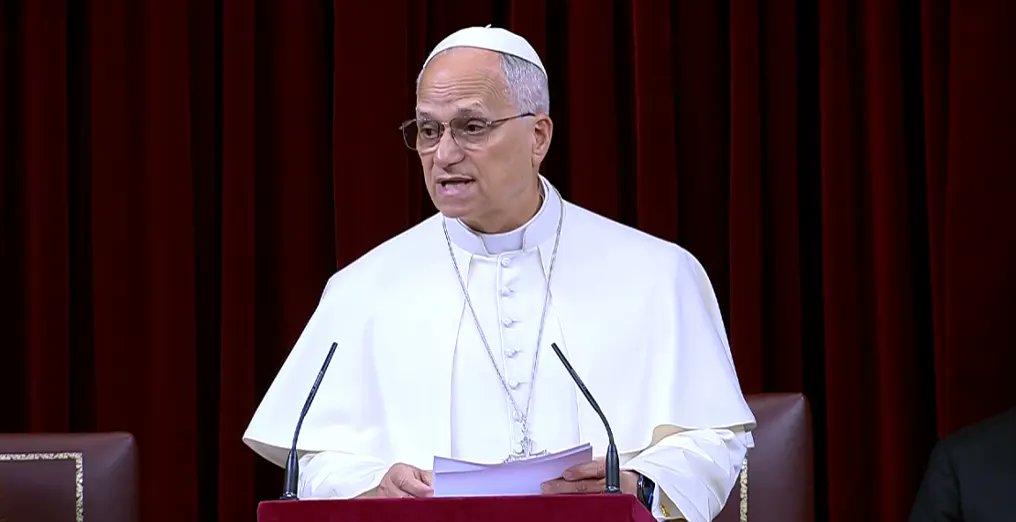
Como jurista, me quedo con una frase del discurso del @Pontifex_es en el @Congreso_Es que debería enmarcarse en cada parlamento: "Una ley no alcanza su verdadera grandeza por el mero hecho de haber sido formalmente aprobada; la alcanza cuando puede comparecer ante la dignidad de la persona y salir de ese examen sin avergonzarse".
Yeah Dresden was not our finest hour, but war doesn’t always allow the turning of the other cheek. We really weren’t sure then whether or not we win the war, and leaders often feel a duty to respond on behalf of the families that have suffered losses, quite apart from it helping to achieve military objectives.
@MichalYouDoing@PhysInHistory Yes the Jesuits were the powerhouse of spreading learning in those days, maths, astronomy, optics, geography and observational science in general.
I vote you take over the Physics in History account 😉
Is it even Corpus Christi if you don’t hear this sung beautifully in Latin?
Rufina Lefiguier is helping instruct the faithful in beautiful liturgical hymns online and is leading an ancient parish on the outskirts of Paris in song every Sunday.
Sublimely beautiful!
In 1616, a university Astronomy course would be mostly based on Ptolemy, surely. Yes the phases of Venus were already changing things, but we’ve moved away from the original point where “Physics in History” made out that the Church was just using scripture and Gallileo was just using science. The science had not proven the heliocentric model at that point.
@Lindsay_Powell@TheEconomist If we didn’t have people like Nixey and Alice Roberts writing such terrible pop history books, full of misunderstandings, presentism and a warped agenda, then maybe they wouldn’t get criticised so much? Not the type of people to reflect much on that possibility I expect…
@MichalYouDoing@PhysInHistory It depends when you mean. Early in Galileo’s life it was the Ptolomaic model, later in his life it moved towards the Tychonic model. The point is that the scientific consensus remained geocentric, which is why the OP is misleading…
Today’s second reading is a good example of why Christianity is most naturally understood within a Platonic ontology, which most early Christians clearly did.
Yes good point. Could you not move SMM to bonds as the intetest rate starts falling in that case though? I guess that relies on ‘timing the market’ before the yields crashed, but then take 2022, and overall - if the aim is risk management - it seems a better balance (along with maybe a Wincanton type trend slice) to balance equities?
Happy Feast of Corpus Christi!
In the old world, it wasn’t the Google Calendar that shaped the rhythm of life. It was the liturgical calendar. Let’s do it again.
Antonio Banderas quotes St. Augustine as he speaks at an event with Pope Leo, the Augustinian: “You say that the times are bad. Be better yourselves, and the times will be better: You are the times.”