It’s collective weakness and cowardice of the Hindus that they have failed collectively to restore honour of Hindus in Indian subcontinent. Failure is because of ideological subversion and political affiliation.
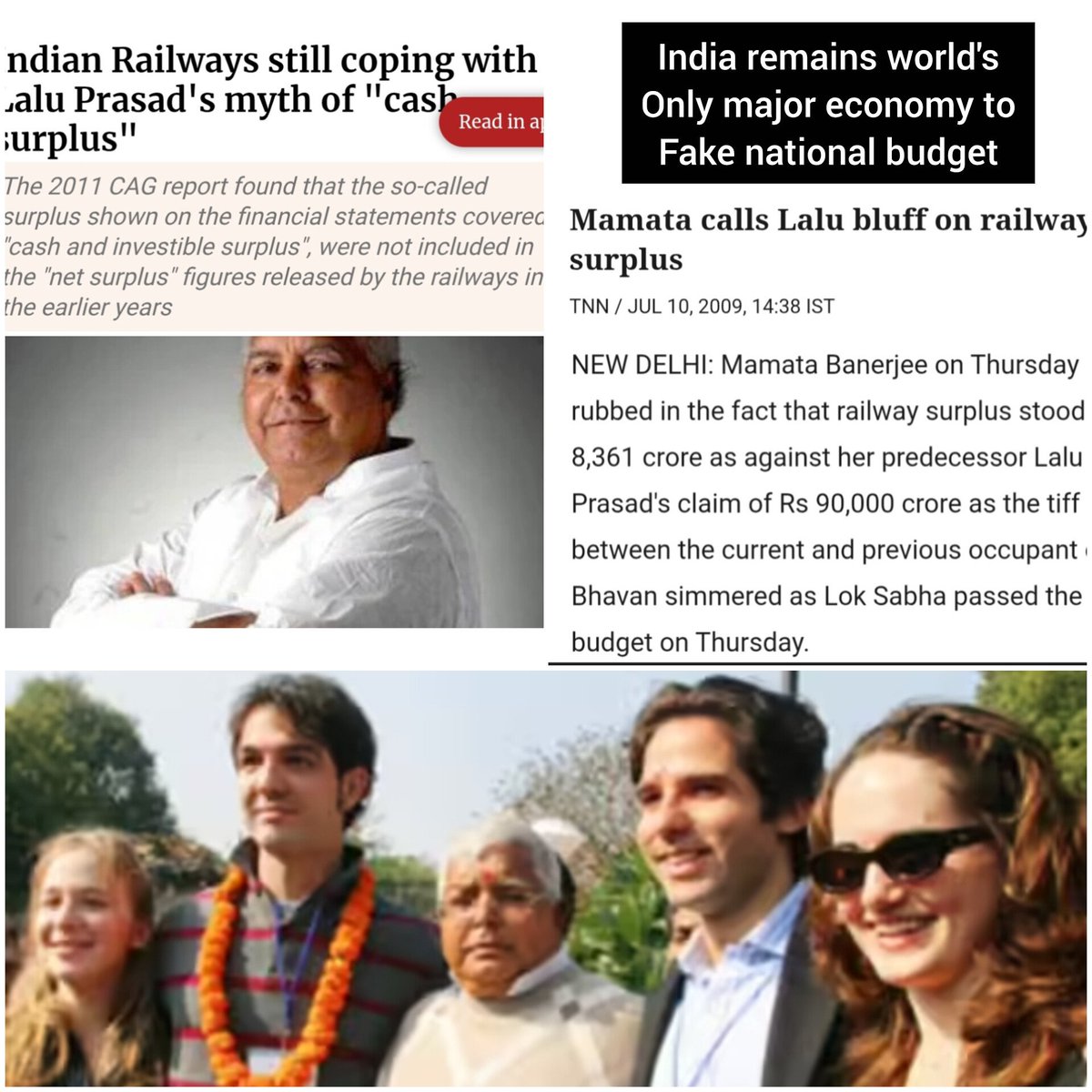
Anyone can electrify railways, launch Vande Bharat, build metro, new lines, clean stations & freight corridors but only world's best economist Manmohan Singh could fake railway budget and sent Lalu Yadav to Harvard to celebrate the achievement 👏
Hindu school teacher along with other family members killed in Bangladesh!
Police have recovered the bodies of four people, including a retired school teacher, his wife and children, from a locked house in Rangpur. They are Ganapati Chakraborty Jewel (65), his wife Pritilata Chakraborty Bala (50), daughter Kandi Chakraborty (25) and son Priyam Chakraborty (12).
Here is details:
https://t.co/lBgSKzhPpJ
It may be mentioned here that following August 2024 jihadist coup in Bangladesh, Hindus are being systematically targeted by various jihadist outfits as well "Towhidi Janata".
This was the empire built by Ahir/Yadav king Raja Ishwarasena 1700 years ago. He would be ashamed that a certain Akhilesh Yadav is today demanding reservations claiming he and his ancestors were backward and oppressed.
How to be a liberal crusader: Walk into a rally full of burqa-veiled women. Don’t dare mention Sharia. Instead attack legally irrelevant Hindu texts & declare yourself a champion of women’s rights.
Another Statistical Exercise in Belittling India's Growth Story 🧵
Increasingly, we are seeing attempts to belittle India’s growth story, even as India continues to beat growth estimates and remains the fastest-growing major economy.
I really feel bad for them tbh. They have zero fun festivals of their own. So obviously they want a fun festival. But if they enjoy a Hindu festival then it'd be against their faith...
Therefore they have to claim the festival is not hindu. It's sweet and sad at the same time.
Ayurveda has always claimed that people are born into 1 of 3 broad constitutional types: Vata, Pitta, Kapha...that shape everything from metabolism to disease vulnerability to how a person responds to a given medicine.
For most of modern medical history, this has been treated as pre-scientific folk classification, roughly on par with astrology, with no expectation that it would map onto anything measurable in the body.
In 2008, a team at India's own CSIR Institute of Genomics and Integrative Biology, led by Bhavana Prasher and Mitali Mukerji, published a study in the Journal of Translational Medicine, a serious government genetics lab, not an Ayurveda advocacy group.
They screened ~850 volunteers down to a much smaller group of healthy individuals who fit cleanly into 1 of the 3 extreme Prakriti types using a validated Ayurvedic classification process, then compared their gene expression patterns (which genes were switched more on / off, not their raw DNA sequence) along with blood chemistry and hematology.
They were not trying to prove Ayurveda right; they were checking whether a genuine biological signal existed underneath an old classification system....
It did: distinct patterns of gene activity, blood chemistry, and a specific oxygen-sensing gene called EGLN1 that behaved differently between Pitta and Kapha individuals.
That gene turned out to be worth chasing.....
In 2010, a follow-up study by an overlapping team, published in the Proceedings of the National Academy of Sciences (PNAS), dug specifically into EGLN1 and found actual genetic variants of the gene that differed in frequency between Pitta and Kapha individuals, variants independently known to be involved in high-altitude adaptation and resistance to high-altitude pulmonary edema.
A gene flagged by nothing more than an ancient constitutional-typing system turned out to sit inside a pathway actively used by human populations adapting to low-oxygen environments.
Then came the harder test.....
In 2015, a larger follow-up study, published in Scientific Reports, a Nature-family journal, involving a wider Indian Ayurgenomics research network went a level deeper and screened the actual DNA rather than gene activity.
They ran a full genome-wide SNP scan (Affymetrix 6.0 chip, roughly a million markers) on 262 healthy men, narrowed down from an initial pool of 3,416 volunteers, all independently classified into extreme Vata /Pitta / Kapha types by both senior Ayurvedic physicians and a separate validated software tool, with only the cases where the 2 methods agreed included in the final analysis.
They found 52 SNPs....
Actual sequence-level genetic markers that reliably distinguished the 3 Prakriti groups from each other, 1 of them near a gene called PGM1, tied to metabolic traits classically associated with Pitta.
The result held up even after being cross-checked against a separate population of 297 people with different ancestries, which should have scrambled any real signal if the categories were meaningless.
Another 2011 study led by Ghodke and colleagues found that genetic variants for the drug-metabolizing gene CYP2C19 were also skewed across Prakriti types, fast-metabolizer variants enriched in Pitta, slow-metabolizer variants enriched in Kapha lining up, unnervingly well, with the classical description of Pitta as quick-burning and Kapha as slow.
What it does show, cautiously and specifically, is that a 3,000 year old system of sorting people into constitutional types built entirely on external observation, with zero access to DNA managed to carve the human population along a line that, when a modern lab went looking with a completely different tool, turned out to correspond to something real in the genome.
That is not nothing. That is a testable hypothesis from antiquity that survived contact with a genome sequencer. 🙏🙏
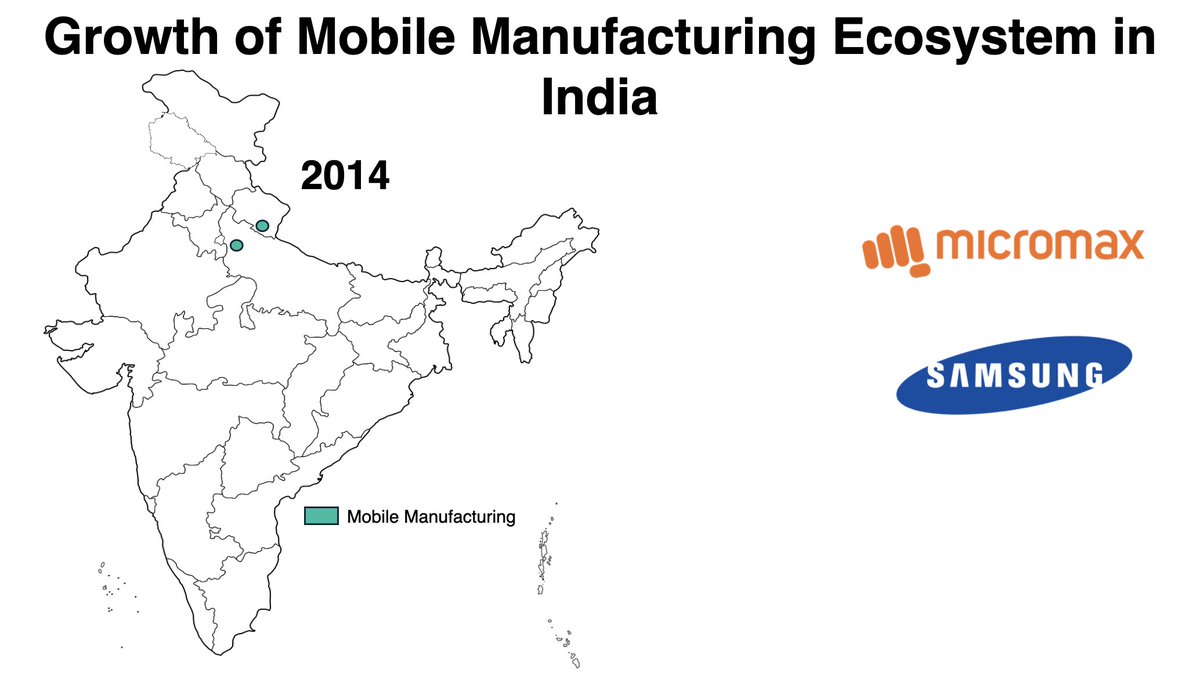
Look at 3 maps. Same country. 12 years apart....
2014: Two dots. That is it. 2 manufacturing locations on India's entire mobile map. 2 brands worth naming, Micromax and Samsung.
2020: The map fills in...mobile manufacturing, IT hardware, early semiconductor units, supply chain nodes spreading across states. New names appear: Apple, Dell, Foxconn (as Bharat FIH), Wistron, Xiaomi, Oppo, Vivo.
2026: The map is saturated. Dots cover practically every industrial state...mobile, semiconductors, IT hardware, supply chain, all 4 categories, dense enough to blur together. Apple, Micron, Tata Electronics, HP, Foxconn, Dixon, Flex, boAt, Noise, nearly 2 dozen global and Indian brands, anchored across the country.
The number sitting quietly on that 2026 map: 5,70,17,952.
That is not a typo. That is not a rank. That is a running count, 5.7 crore+ units printed right there on India's own manufacturing map.
Here is what that visual actually represents, in hard numbers:
- Mobile phone production grew 33x since 2014, at a CAGR of ~37%.
- Mobile phone exports grew 166x from a category that was not even in India's top 100 exported commodities in 2014-15, to India's #1 single exported commodity by 2025-26.
- India is now the world's 2nd largest mobile phone manufacturer by volume.
The policy engine behind those 3 maps, this is the part almost nobody sees:
- Under the PLI scheme, against a 5-year investment target of ₹7,000 crore, actual investment came in at ₹20,587 crore, 294% of target.
- Production came in at 142% of target. Exports at 132%.
- Component and EMS companies grew from just 10 to 40+.
- More than 135 Tier-2 and Tier-3 suppliers got integrated into global supply chains that did not exist here before.
3 single factories in Karnataka: Bengaluru, Kolar, Hosur... employ ~86,000 people between them. Across the whole ecosystem, mobile manufacturing now supports ~12 lakh jobs, and average wages in the sector climbed from ₹1.5 lakh to ₹2.4 lakh a year in just 5 years.
For, Kya hi badla hai desh mein Janta...this is what changed.
Bharat is rising. 🙏🙏