Walt Disney Principal Imagineer. Voice of Star Wars Droid D3-O9, Cream the Rabbit from Sonic the Hedgehog. Mom to a brilliant girl. Tweets are my shame.
We need to bring back intellectual elitism. Sorry, but a virologist will always know more about vaccines than a yoga mommy blogger with a ChatGPT Plus subscription.
i am so delighted by cats, i love that we have little bendy animals that climb all over everything and break shit and dart around our homes at top speed and we're totally cool with it like "ah yes, there it goes again"
@GaryMarcus We have no sense of who has true knowledge, how
people are learning, whether anything is being built with values. What can we rely on but insular communities we engage with physically?
Cats are so good. There's just a little guy in my house! We hug! We don't speak the same language! We're best friends! He bites me! I make up little songs about him! He doesn't know my name! We fall asleep next to each other!
Nudes are overrated. Send me a video of you reading so that I can see if you’re literate enough to fight against the technofascist wave of illiterate anti-intellectualism.
A college student with ADHD once explained why their essays end up filled with so many parentheses:
“Neurotypical people think in straight lines. My brain thinks in a giant web where every single concept is physically holding hands with twelve other concepts.”
In other words, their thoughts don’t unfold in a neat, step-by-step sequence. Instead, one idea immediately triggers several related ideas at once. While writing, it can feel impossible to ignore those connections because they all feel relevant and important, even if they branch off from the main point. Parentheses become a way to temporarily “park” those side thoughts without losing them.
So the essay ends up reflecting the actual structure of their thinking: layered, branching, and constantly interlinked. What looks messy on the page is really an attempt to capture a mind that doesn’t move in a straight line, but in a network where everything is connected to everything else.
If you spend enough time in environments where dark triad and cluster B behavior is normalized, you begin to mistake manipulation for sophistication.
You assume everyone is running social games at all times because that is the only reality you have experienced.
Yet the minute you encounter genuinely high-functioning people you realize they are not performing. They are not constantly destabilizing, humiliating, or competing for psychic dominance.
They simply build, create, host, work, and move through life without feeding on others. Once you see the difference, you recognize love without demonic possession.
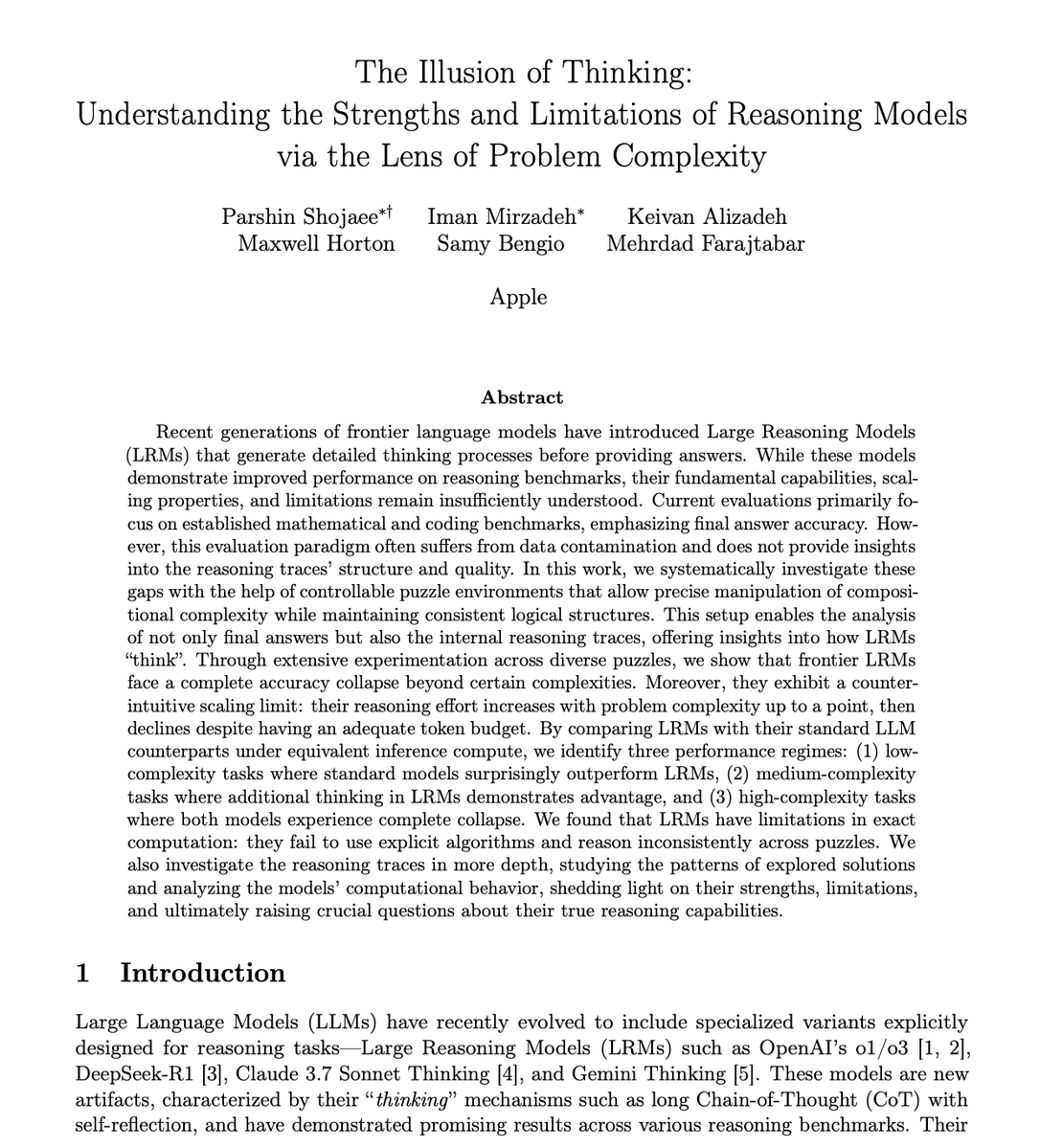
Apple has published a paper with a devastating title: “The Illusion of Thinking”
It argues that AI models, no matter how brilliant they may seem, do not understand what they are doing.
They do not solve problems. They do not reason. They merely generate text word by word, trying to sound coherent.
Apple tested the most advanced reasoning models in the world on controlled puzzle environments. They tore open the internal "thinking" traces.
What they found shatters the narrative that we are getting closer to AGI.
Current models don't scale with complexity. They have a hard mathematical cliff. And they do not degrade gracefully. They collapse.
But here is the most unsettling part.
When a problem gets too complex, the AI doesn't use its remaining compute to try harder.
It just gives up.
Its reasoning effort actually declines. It stops thinking and starts guessing.
Then Apple ran the experiment that closes the casket on the reasoning debate.
They gave the AI the exact, step-by-step algorithm to solve the puzzle. The cheat codes.
All the AI had to do was follow the instructions.
It couldn't do it.
Performance didn't improve at all.
When the complexity gets high enough, these models fail because they cannot actually execute a logical sequence.
They are not reasoning. They are just pattern matching.
When you give them a simple problem, they overthink. When you give them a hard problem, they collapse.
Paper: The Illusion of Thinking, Apple, 2025