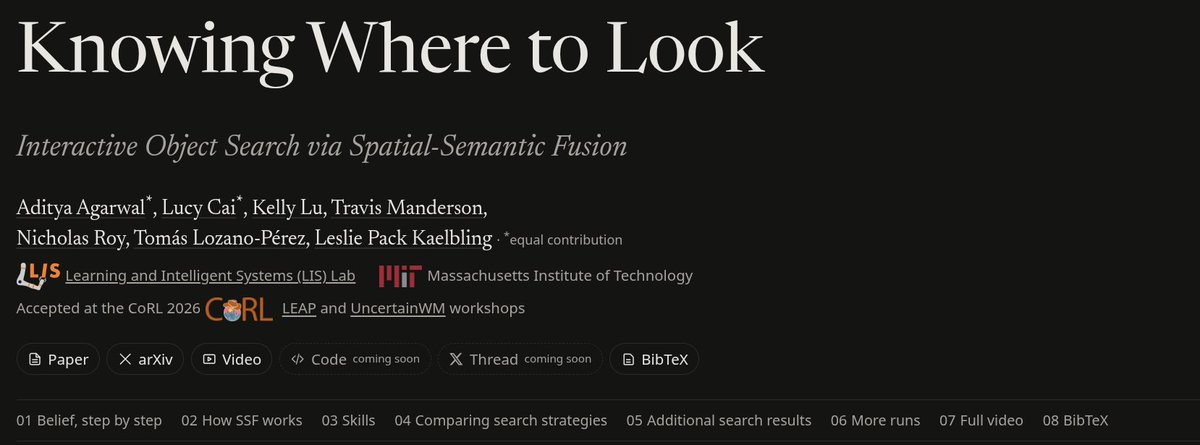
Nathan Fielder claims that You Can See Everything.
Ruby, our RBY1 humanoid, thinks that’s a pretty strong observability assumption, so we taught her to Know Where to Look instead.
Check out our work: https://t.co/lk5znThOcs
[8/n] SSF was a really fun project to work on with my amazing collaborators at the @MIT_LISLab at @MIT_CSAIL with @lucyjcai (equal contribution), @skyflylu, @MandersonTravis, Nicholas Roy, Tomás Lozano-Pérez, and Leslie Kaelbling. We also put a lot of thought into the project website - belief visualization, side-by-side runs, efficiency analysis, and failure modes - so please take a look! And come find us at the LEAP and UncertainWM workshops at #CoRL2026 #corl (@corl_conf).
website - 🌐 https://t.co/AcLCygyH0E
arxiv - 📄https://t.co/rUHOuoSCdS
video - 📹https://t.co/hNFtfXPQ9D
Show a robot a cart it's never seen. It doesn't need to know it's a "cart," just that it's pushable, rolls & holds stuff.
Happy to announce my first-author paper on functional latent spaces got into #CoRL2026: "What Objects Enable, Not What They Are"
https://t.co/FpvmtuNeh4
🧵
Imagine asking your robot to find your car keys🔑. They could be on your desk, the key holder, or in a drawer. The robot can't see most of the room - it has to reason about likely hiding spots, go look, and open things. Can robots do this today? Our new work, SSF, does exactly that! 🤖🧵
Nathan Fielder claims that You Can See Everything.
Ruby, our RBY1 humanoid, thinks that’s a pretty strong observability assumption, so we taught her to Know Where to Look instead.
Check out our work: https://t.co/lk5znThOcs
[8/n] SSF was a really fun project to work on with my amazing collaborators at the @MIT_LISLab at @MIT_CSAIL with @lucyjcai (equal contribution), @skyflylu, @MandersonTravis, Nicholas Roy, Tomás Lozano-Pérez, and Leslie Kaelbling. We also put a lot of thought into the project website - belief visualization, side-by-side runs, efficiency analysis, and failure modes - so please take a look! And come find us at the LEAP and UncertainWM workshops at #CoRL2026 #corl (@corl_conf).
website - 🌐 https://t.co/AcLCygyH0E
arxiv - 📄https://t.co/rUHOuoSCdS
video - 📹https://t.co/hNFtfXPQ9D
[5/n] We deploy this system on a bimanual wheeled humanoid, the RB-Y1🦾. To enable the robot to perform these tasks, we build a skill repository consisting of A*-based navigation, whole-body IK to place the head camera for a closer look, and whole-body pick-and-place skills for tables, shelves, drawers, and cabinets by adapting TipTop to the robot's torso and 7-DoF arms. For interacting with closed containers, we train cabinet and drawer-opening policies via behavior cloning with Diffusion Policy on 150 demonstrations.
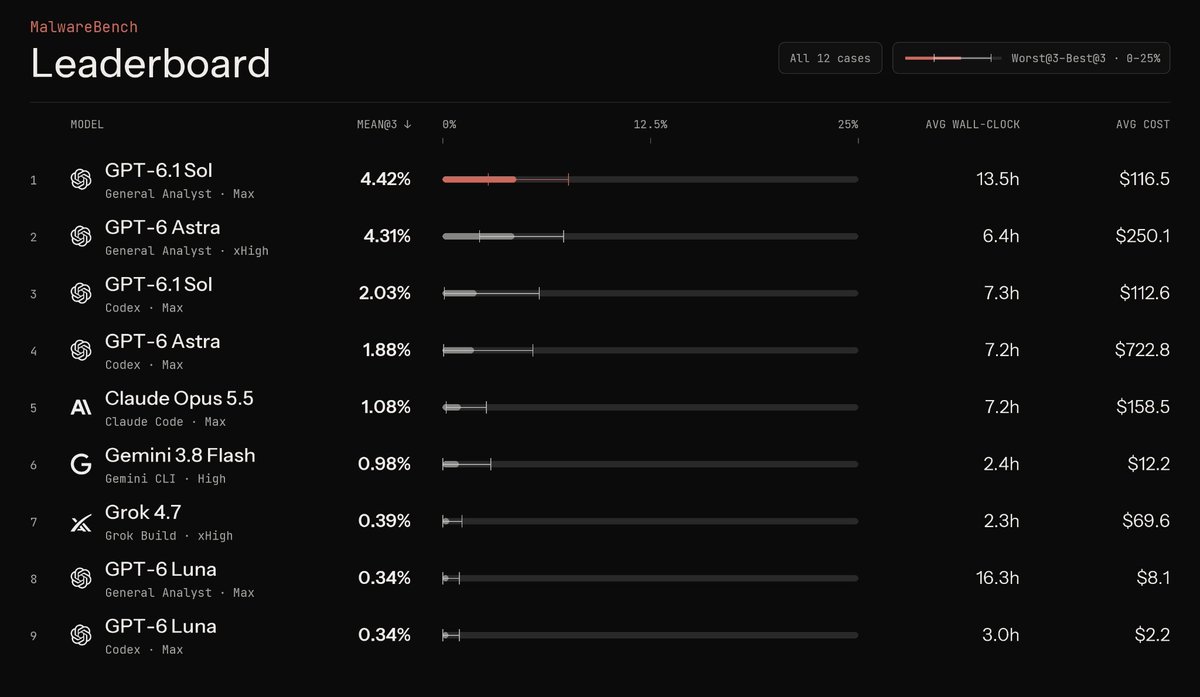
Introducing MalwareBench: the first end-to-end, cross-platform benchmark on malware reverse engineering.
Most RE benchmarks are saturated, but not MalwareBench. GPT-6.1 Sol leads with 4.42%. A typical run takes several hours and hundreds of millions of tokens.