SUBMERGE: Beyond the Render @artechouse, 12 pieces of work, a 270-degree space, rendered in 8 weeks. Without distributed GPU infrastructure, it would have taken years.
Read the full @80Level story 🔽
Geography shouldn't determine who gets to create.
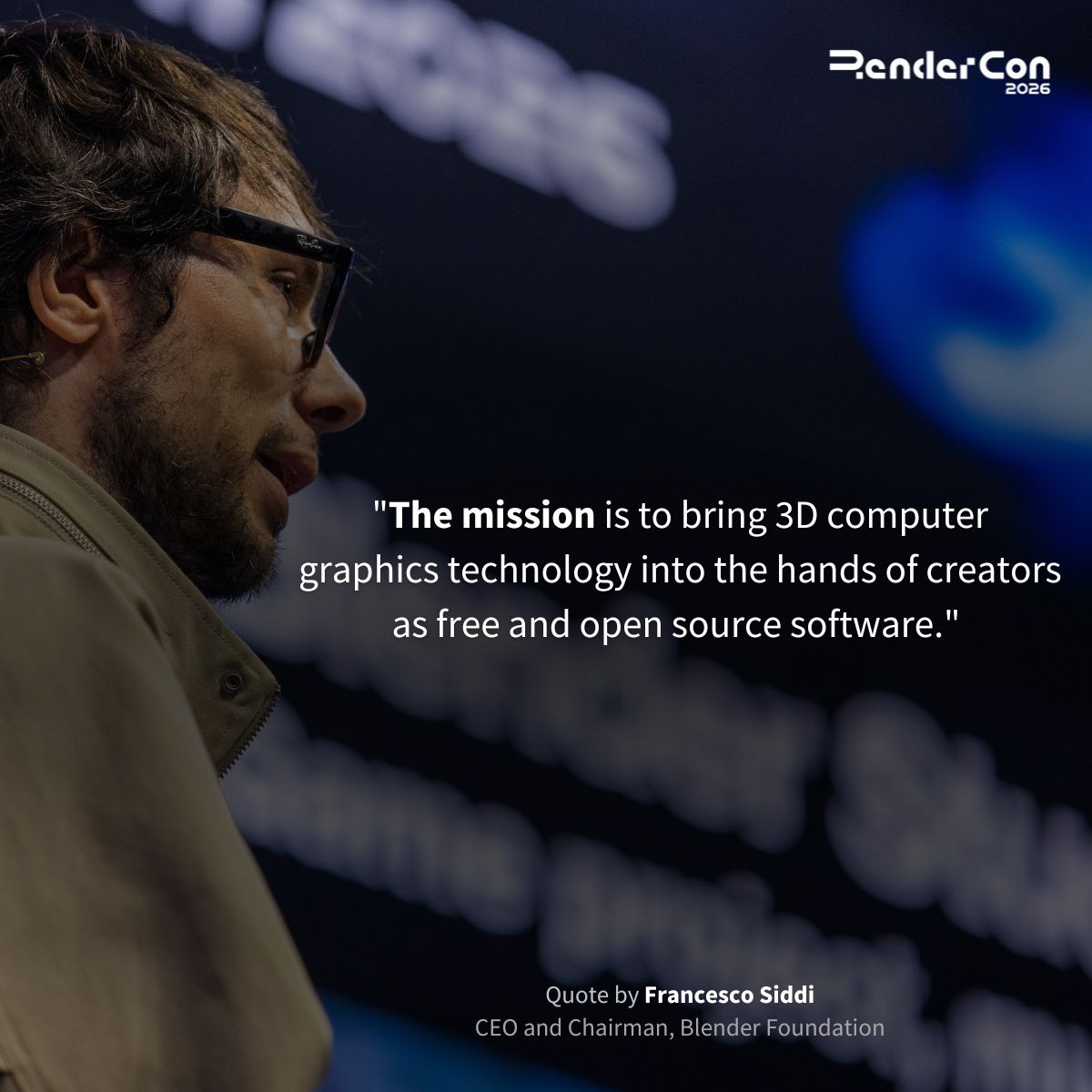
“The mission is to bring the best 3D computer graphics technology in the hands of creators as free and open source software.” -@fsiddi, @Blender Foundation
Watch from 20:01 - https://t.co/48vq4RgFQ2
Just $render 🔥. While it silently moves up week after week, it is under the radar. This is exactly what we want. Eventually everyone will ape in when the real move comes ⬆️
$RENDER still has one of the strongest AI narratives in crypto
And the chart is starting to reflect it again
After a brutal reset from the highs, price is now sitting near long-term accumulation levels while reclaiming previous support zones
The roadmap on this structure is pretty clear:
~$5.5 → first major reclaim
~$11.8 → expansion zone
~$13.8+ → macro breakout territory
What makes $RENDER different is that the narrative never really disappeared
AI demand kept growing even while the chart cooled off
That’s usually what strong cycle leaders look like before the next expansion phase begins
Technically this setup resembles:
long-term accumulation
seller exhaustion
support stabilization
early trend reversal structure
Once momentum returns to AI-related assets, $RENDER is one of the first charts traders will start watching again
Rendered on @rendernetwork, whose founder @JulesUrbach wrote about where this was all heading back in 2017.
“The resonance of authentic human thought, creativity and imagination are the fundamental units of currency.”
Read the full essay: https://t.co/iDJ1Zypx5r
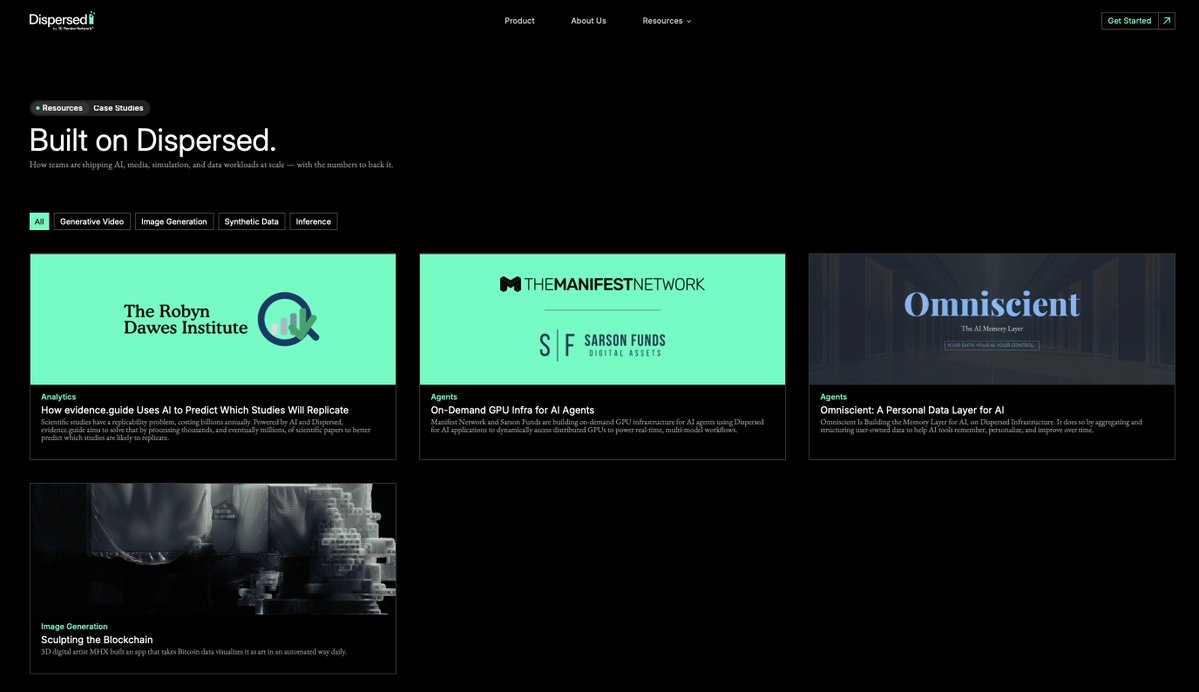
Dispersed Case Study #3: Token holders tend to manage multiple crypto wallets. So Jon Gutwillig’s team built a portfolio tracker that runs hedge fund-grade algorithms on Render GPUs, and explains the output in plain language.
@ManifestNetwork
Watch from 1:48 -
$RENDER : Review 📜
What if every idle GPU on the planet could be put to work rendering Hollywood movies, training AI models, and building the metaverse, and the people who own those GPUs got paid for it?
Meet Render Network - a decentralized GPU compute marketplace built on Solana that connects creators with idle GPU power, processing 71 million+ frames for studios, artists, and AI developers. Advised by J.J. Abrams, Brendan Eich, and Beeple. Where GPU power becomes a tokenized commodity.
Let's explore how Render is decentralizing the future of compute. 👇
⚪ Render at a Glance
Render Network is a peer-to-peer GPU compute marketplace created by Jules Urbach, founder and CEO of OTOY, the company behind the industry-standard OctaneRender engine. The network connects creators who need GPU power with node operators who have idle capacity, creating a decentralized alternative to centralized cloud rendering.
The $RENDER token powers the entire marketplace. Creators pay in RENDER (or fiat, which is converted and burned), node operators earn RENDER for completing jobs, and the Burn-Mint Equilibrium model permanently removes tokens from circulation with every job processed.
Marketplace Insight: The RNP-023 governance vote to integrate Salad's ~60,000 consumer-grade GPUs as an exclusive subnet could massively scale network capacity. RenderCon 2026 at Hollywood's Nya Studios (April 16-17) features Jules Urbach, Refik Anadol, and Rod Roddenberry. The Dispersed AI compute subnet is positioning Render at the intersection of creative rendering and AI infrastructure, with GPU hours available at ~$0.69.
⚪ Mission
Render Network's mission is to democratize access to GPU compute by creating a decentralized marketplace where anyone with idle GPU power can contribute to the world's rendering and AI workloads. By tokenizing compute power, Render aims to break the monopoly of centralized cloud providers and make high-end GPU rendering accessible to independent creators, small studios, and AI researchers alongside Hollywood productions.
🔵 A Brief History
Jules Urbach founded OTOY in 2009 with a vision to make cloud-based GPU rendering accessible to everyone. OTOY's OctaneRender became the industry-standard GPU rendering engine used across film, television, gaming, and architectural visualization. In 2017, Urbach launched the Render Network as the decentralized extension of that vision, tokenizing GPU compute through the RNDR token on Ethereum.
The network went through its initial development phase from 2017-2019, with the full mainnet launching in 2019. Early adoption came from the creative industry, with studios and independent artists using the network for 3D rendering jobs that would otherwise require expensive in-house GPU farms or costly centralized cloud services.
In late 2023, the network made a pivotal migration from Ethereum to Solana, rebranding the token from RNDR to RENDER. The move dramatically improved transaction speed and reduced costs, enabling the high-throughput job submission and settlement that a GPU marketplace demands.
Throughout 2025, network usage accelerated significantly. Token burns increased ~279% year-over-year, with 530,171 RENDER burned in the first nine months of 2025 compared to 139,924 in the same period of 2024. In December 2025, the network hit the milestone of 1 million cumulative RENDER burned.
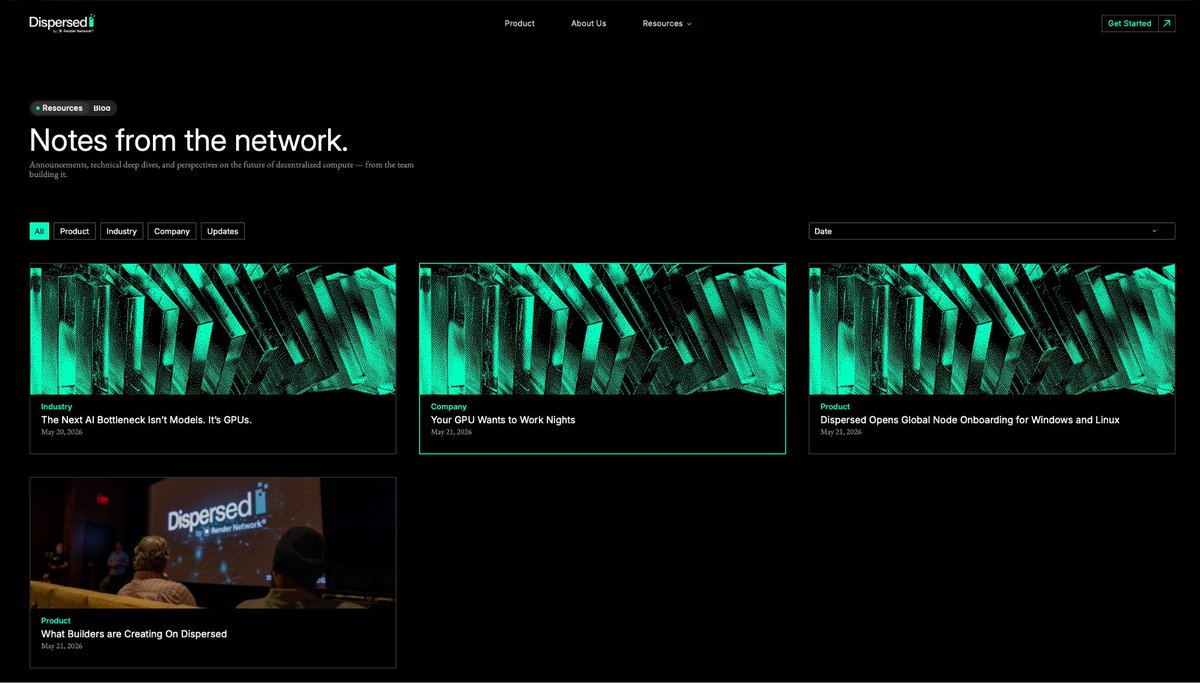
In 2025, Render also launched Dispersed, a dedicated AI compute subnet built on five years of operational experience running distributed GPU infrastructure. Dispersed handles generative AI, image/video generation, and document processing workloads at approximately $0.69 per GPU hour, positioning Render as a viable alternative to centralized cloud providers for AI compute.
RenderCon 2026, hosted at Nya Studios in Hollywood on April 16-17, features presentations from Jules Urbach, artist Refik Anadol, and Rod Roddenberry, signaling Render's growing influence at the intersection of entertainment, AI, and decentralized infrastructure.
🔵 Ecosystem Narrative
Render's ecosystem sits at the intersection of three massive markets: creative GPU rendering, AI compute, and decentralized physical infrastructure (DePIN). The network turns idle GPU power into a productive, tokenized commodity.
Key dynamics include:
➛ GPU Marketplace connects creators needing render power with 5,600+ node operators globally. Jobs are assigned based on OctaneBench scores, availability, scene complexity, and creator reputation.
➛ Burn-Mint Equilibrium (BME) creates direct deflationary pressure. Every job processed on the network results in equivalent RENDER burned. Fiat payments are converted to RENDER and burned automatically. Burns increased ~279% YoY in 2025.
➛ Dispersed is the new AI compute subnet, purpose-built for generative AI, ML workloads, image/video generation, and document processing. GPU hours available at ~$0.69, making it competitive with centralized cloud providers.
➛ OctaneRender integration provides ecosystem lock-in. OTOY's industry-standard rendering engine is natively integrated with the Render Network, meaning studios already using Octane can seamlessly access decentralized GPU power.
➛ Solana infrastructure enables high-throughput job submission, fast settlement, and low transaction costs, critical for a marketplace processing millions of rendering frames.
➛ RNP-023 (Salad Integration) is a pending governance vote to add ~60,000 consumer-grade GPUs via the Salad marketplace as an exclusive subnet, with all payments and rewards flowing through the RENDER token.
➛ RenderCon 2026 at Hollywood's Nya Studios (April 16-17) features Jules Urbach, Refik Anadol, and Rod Roddenberry, showcasing live workflows blending AI inference, 3D rendering, and next-gen media pipelines.
⚪ Token Utilities
$RENDER powers the decentralized GPU compute economy:
➛ Payment for Compute - Creators pay RENDER (or fiat, which is auto-converted and burned) for rendering jobs, AI inference, and compute workloads processed by node operators.
➛ Node Operator Rewards - GPU providers earn RENDER based on OctaneBench Hours (OBh) delivered. Rewards are issued per epoch (weekly).
➛ Burn-Mint Equilibrium - Every job burns RENDER tokens, creating a direct feedback loop between network usage and token supply. The more the network is used, the more tokens are permanently removed.
➛ Governance - RENDER holders participate in Render Network Proposals (RNPs) that determine protocol upgrades, economic changes, and ecosystem direction.
➛ Bounty Platform - Contributors earn RENDER for completing open tasks across technical tooling, documentation, research, and community engagement.
⚪ Key Features
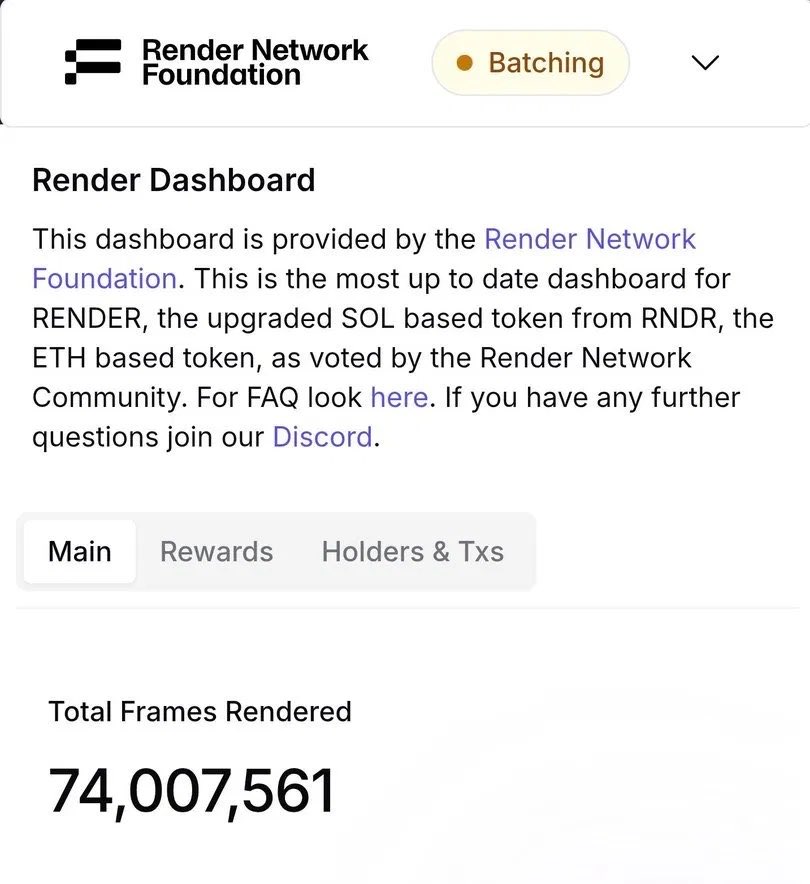
➛ Decentralized GPU Marketplace - 5,600+ GPU nodes globally, processing 71M+ cumulative frames. Connects creators with idle GPU power for rendering, AI, and compute workloads.
➛ Burn-Mint Equilibrium (BME) - Deflationary tokenomics where every job processed burns RENDER. 1.2M+ tokens burned cumulatively. Burns up ~279% YoY in 2025.
➛ OctaneRender Integration - Native integration with OTOY's industry-standard GPU rendering engine, used across Hollywood, gaming, architecture, and VFX pipelines.
➛ Dispersed (AI Compute Subnet) - Dedicated infrastructure for generative AI, ML, and compute workloads. ~$0.69 per GPU hour. Represents Render's strategic expansion beyond creative rendering into AI infrastructure.
➛ Solana-Native - Migrated from Ethereum in 2023 for faster settlement, lower costs, and higher throughput. Enables scalable job submission and real-time marketplace operations.
➛ Governance via RNPs - Render Network Proposals allow the community to propose and vote on protocol changes, economic upgrades, and ecosystem direction.
➛ Hollywood-Grade Adoption - Used by major studios, VFX professionals, and independent creators. RenderCon hosted at Hollywood's Nya Studios with industry leaders presenting live workflows.
🔵 Meet the Render Team
Render is led by one of the most connected founders in the GPU compute space, backed by an advisory board that spans Hollywood, Silicon Valley, and the open-source software world.
▶️ Core Members:
➛ Jules Urbach - Founder & CEO | Founder and CEO of OTOY, the company behind OctaneRender. Pioneer in cloud GPU rendering since 2009. Has presented at Nvidia GTC alongside Jensen Huang. Urbach's vision connects decentralized compute with Hollywood production, AI, and spatial computing. Featured in numerous GTC keynotes and Apple Vision Pro demonstrations.
➛ Charlie Wallace - CTO | Leads Render Network's technical architecture, protocol development, and infrastructure scaling across the rendering and AI compute layers.
➛ Trevor Harries-Jones - COO | Oversees operations, partnerships, and business development for the Render Network ecosystem.
▶️ Advisers:
➛ Ariel Emanuel - Adviser | CEO of Endeavor (parent company of WME, UFC, and IMG). One of the most powerful executives in entertainment and media. Connects Render to Hollywood's highest levels.
➛ J.J. Abrams - Adviser | Filmmaker, producer, and founder of Bad Robot Productions. Director of Star Wars: The Force Awakens, Star Trek, and numerous blockbuster franchises. Brings entertainment industry vision and credibility.
➛ Brendan Eich - Adviser | Creator of JavaScript, co-founder of Mozilla and the Brave browser. One of the most influential figures in internet technology history. Brings deep technical credibility and open-source philosophy.
➛ Mike Winkelmann (Beeple) - Adviser | Digital artist who sold "Everydays" NFT for $69M at Christie's. One of the most recognized names in digital art and crypto culture.
➛ Demian Brener - Adviser | CEO and co-founder of OpenZeppelin, the gold standard in smart contract security. Brings blockchain security expertise.
➛ Manuel Araoz - Adviser | Co-founder of OpenZeppelin. Pioneered smart contract auditing and security standards used across the entire crypto industry.
➛ David Vorick - Adviser | Founder of Sia, one of the earliest decentralized storage networks. Brings decentralized infrastructure expertise.
➛ Jennifer Zhu Scott - Adviser | Technology investor and thought leader in AI, blockchain, and emerging technology.
➛ Render Network Foundation - Oversees protocol governance, emissions management, grants, bounties, and ecosystem development. Publishes detailed monthly reports on network metrics, burns, and emissions.
🔵 Ratings
➛ Use Case: ★★★★✦ (4.5/5) - Render sits at the intersection of three massive growth markets: creative GPU rendering, AI compute, and DePIN. The network has processed 71M+ frames across 5,600+ nodes with real Hollywood and studio adoption. The Dispersed AI subnet opens the door to the multi-billion dollar AI infrastructure market. OctaneRender integration provides genuine ecosystem lock-in that competitors can't easily replicate. The BME model ties token economics directly to real usage. The 0.5 deduction is because the AI compute expansion (Dispersed) is still early, and the network faces serious competition from both centralized cloud providers (AWS, Google Cloud) and decentralized competitors (Akash, https://t.co/Hon8NjfG50).
➛ Tokenomics: ★★★★ (4/5) - The Burn-Mint Equilibrium is one of the most elegant tokenomic models in crypto. Every job burns RENDER, creating deflationary pressure directly proportional to network usage. Burns increased ~279% YoY in 2025, hitting 1M+ cumulative. Max supply is capped at 644.2M with ~85M remaining to be emitted, and emissions decrease over time. Unused monthly emissions stay locked by the Foundation. The 1-point deduction is because burn rates, while growing, still don't exceed monthly emissions to nodes (~500K RENDER), meaning the network is still net inflationary. The crossover point where burns exceed emissions would be a major inflection.
➛ Audits: ★★★★ (4/5) - The codebase is open-source and the Foundation publishes detailed monthly financial reports with full transparency on emissions, burns, and expenditures. The Solana migration was executed smoothly without security incidents. Smart contract security benefits from advisers like Demian Brener and Manuel Araoz, the founders of OpenZeppelin, the gold standard in blockchain security. The network has operated since 2019 without a major exploit or loss of funds. The 1-point deduction is because the job verification system relies on creator approval (or 72-hour auto-approval) rather than trustless verification, and as the AI compute expansion scales via Dispersed, more visible formal protocol-level auditing would strengthen confidence.
➛ Community: ★★★★ (4/5) - Render has a unique community that spans crypto natives, 3D artists, VFX professionals, GPU miners, and AI developers. RenderCon has become a legitimate industry event hosted in Hollywood. The Bounty Platform enables community-driven development. The RNP governance system gives token holders real input on protocol direction. The Salad integration vote (RNP-023) shows active community participation in ecosystem decisions. The deduction is that Render's community skews more toward professional creators and institutional users than grassroots crypto culture, which limits viral retail engagement compared to chains like Solana or Kaspa.
🔵 Conclusion
Render Network is what happens when a GPU compute pioneer with 15+ years of industry experience brings Hollywood-grade infrastructure to decentralized crypto. Jules Urbach didn't start with a token and work backward to find a use case. He built OTOY, created the industry-standard OctaneRender engine, and then decentralized the compute layer because the market demanded it.
The advisory board tells the story: J.J. Abrams, Brendan Eich, Beeple, Ariel Emanuel, and the OpenZeppelin founders don't attach their names to speculative projects. They advise Render because the technology is real and the adoption is measurable. 71M+ frames rendered, 1M+ tokens burned, 5,600+ GPU nodes, and a dedicated AI subnet processing workloads at $0.69 per GPU hour.
The trajectory is compelling. Burns growing 279% YoY, Dispersed opening the AI compute market, RNP-023 potentially adding 60,000 GPUs via Salad, and RenderCon 2026 cementing Render's position at the intersection of Hollywood and decentralized infrastructure.
If GPU compute demand continues its exponential growth trajectory (and it will), Render is the only crypto project with the industry relationships, technical infrastructure, and tokenomic design to capture meaningful market share.
The question isn't whether decentralized GPU compute has a future. It's whether Render can scale fast enough to own it.
Down 92% While Fundamentals Hit ALL-TIME HIGHS: Why $RENDER Could 25x To $50 This Cycle 🚀
10 REASONS $RENDER IS THE AI INFRASTRUCTURE GIANT OF THIS BULL RUN:
1️⃣ 71 MILLION+ Frames Rendered - Real Network Usage, Not Hype
2️⃣ Burn-And-Mint Model: Every AI Job BURNS #RENDER
3️⃣ Token Burns Up 278% YoY - Real Deflationary Pressure
4️⃣ Salad Network Integration (RNP-023) Added ~60,000 GPUs
5️⃣ Enterprise GPUs Onboarded - NVIDIA H200 + AMD MI300X Live
6️⃣ AI Workloads Now 35-40% Of ALL Network Volume
7️⃣ RenderCon 2026 Drew NVIDIA, Stability AI & WME On Stage
8️⃣ Grayscale Holds RENDER - 22% Of Its AI Crypto Portfolio
9️⃣ Advisory Board: J.J. Abrams, Beeple, Ari Emanuel, Brendan Eich
🔟 Built On Solana - Sub-Second Speed For Real-Time AI Inference
Global AI Spending Heading To $2 TRILLION+.
RENDER Sells The Pickaxes.
Down 86% From ATH While Fundamentals Hit Record Highs.
This Is What Asymmetric Looks Like.
TA Only. Not Financial Advice. ALWAYS DYOR.
@rendernetwork
Amazing to see the energy and talent across all 5 campuses. Huge thanks to every student, organizer, and @KGeN_Community who made this possible.
More to come…
Gaussian Splats don't require a complicated pipeline, here's what it actually looks like.
300-400 frames rendered out on @rendernetwork, packaged up inside a COLMAP set, and dropped into @jawset’s PostShot. That's the workflow.
Protopica: Sin Agua, No Hay Tiempo ("without water, there is no time"), now live at SUBMERGE: Beyond the Render @artechouse.
No studio, no shared space. Just @ManuVision in Montreal, @willselviz in Toronto, and @rendernetwork providing distributed GPU power for the 18K render.
Dagmar Irrig's first @OTOY Octane project brings Roman archaeology from the Landessammlungen Niederösterreich (State Collection of Lower Austria) to life using 3D models, rendered on @rendernetwork with support from the Render Network Foundation.
See more of Dagmar’s work here: https://t.co/ZG8SapurkG
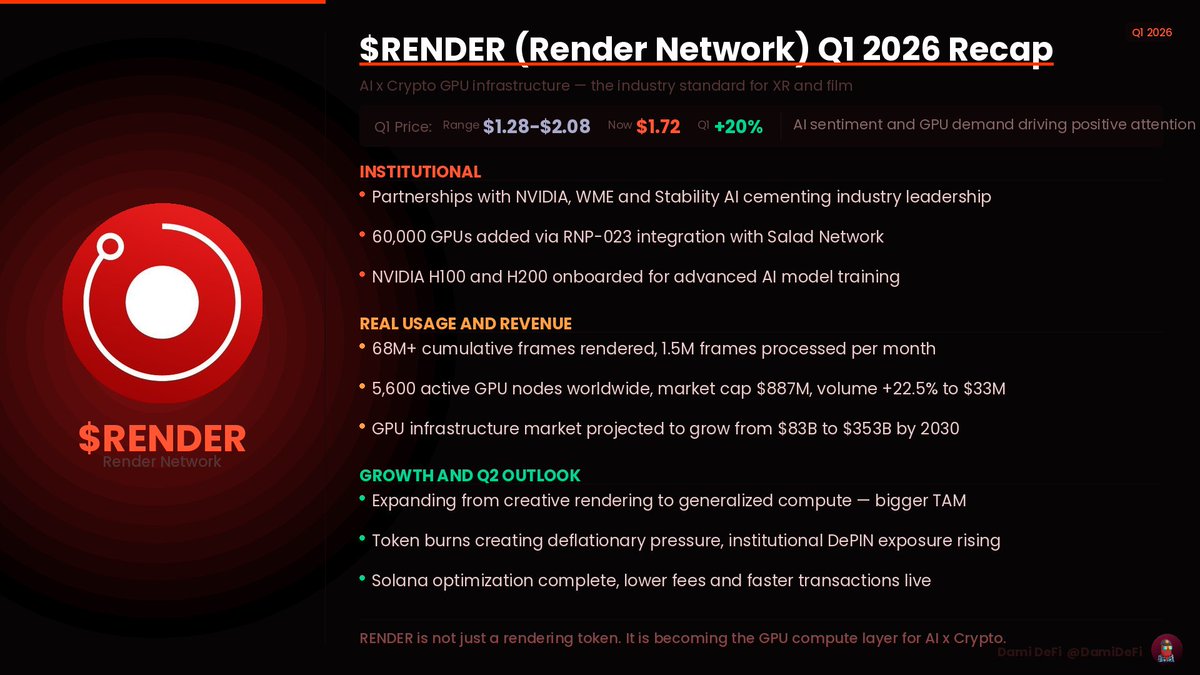
$RENDER Q1 Recap:
1/ Price Movement:
$RENDER pumped over 20% in Q1, 2026 which shows that the AI x Crypto is set to explode.
- traded within the $1.28 to $2.08 range
- currently trading at $1.72, up 20% since jan
- ai sentiment and gpu demand continue to draw positive attention
2/ Institutional Signal:
$RENDER is set to become the industry standard for XR and film
- Partnership with nvidia, wme, and stability ai
- Integration of salad network’s ~60,000 gpus via rnp-023
- Integrated pipelines including otoy, octanerender, and apple vision pro
- Onboarding high-end hardware such as nvidia h100 and h200 for advanced ai model training
3/ Real Usage and Revenue
- 68M+ cumulative frames rendered
- 1.5M frames processed per month
- 5,600 active gpu nodes worldwide
4/ Key Metrics and Narrative Strength:
- Market cap is sitting at $887.47M
- Trading volume grew to $33.28M (+22.5%)
5/ Announcement
- MEXC announced a Zero Fee Event for $RENDER Perps
6/ Catalysts Going Into Q2:
- Global GPU infrastructure market is projected to grow from $83 billion in 2025 to $353 billion by 2030.
- Solana optimization completed in 2025, enabling faster transactions and lower fees.
- RENDER is expanding from creative rendering to generalized compute, which could increase demand, usage, and revenue.
- Institutional exposure to DePIN projects is expected to accelerate in 2026.
- $RENDER token burns may create deflationary pressure.
7/ Community
- Retails and institutional confidence in $RENDER remains stable and sustainable over time.
$RENDER currently holding a key falling wedge breakout and with this, still looks to be in the early stages of a major responding run!
A run which can lead over 309% to targets at $3.60 and $7.70...