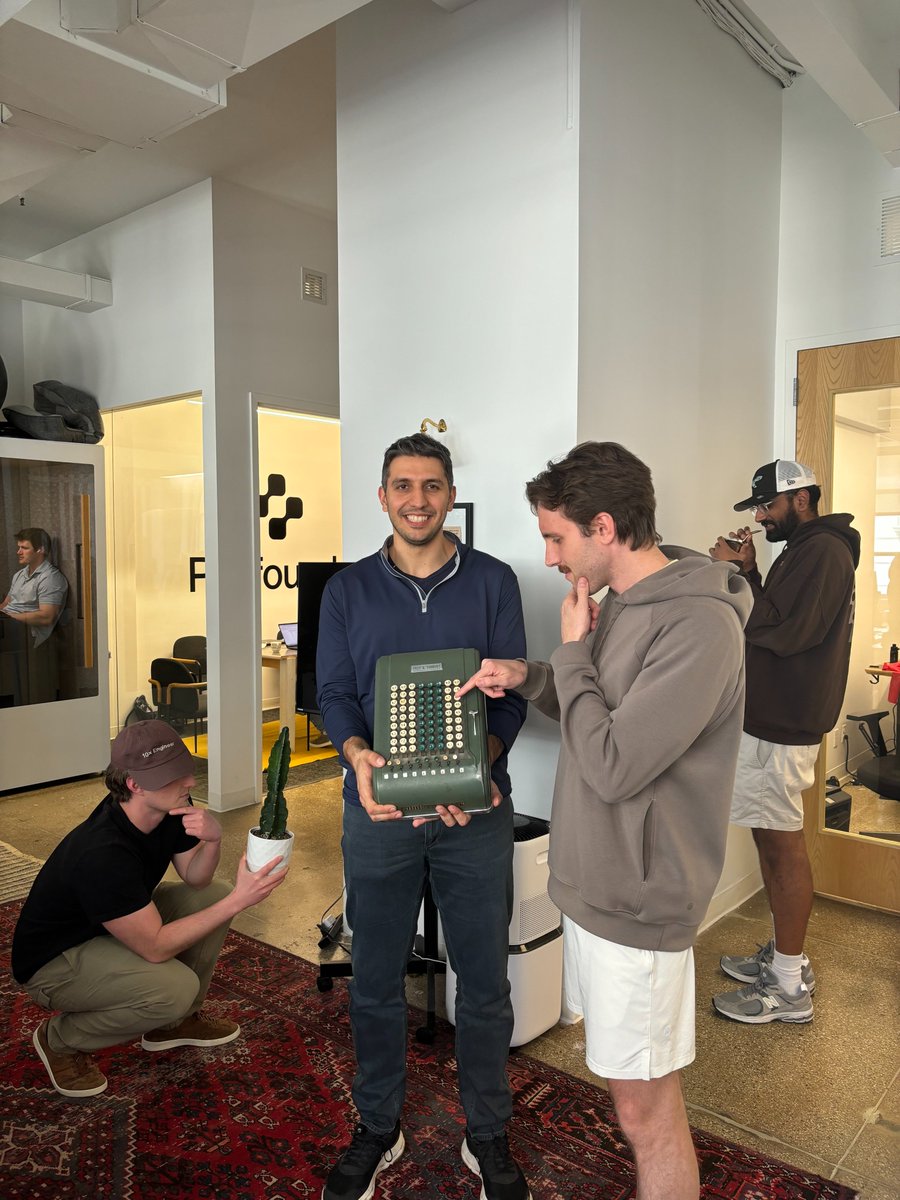
Today, @profound is excited to announce our $96M Series C at a $1B valuation, led by @lightspeedvp with participation from @sequoia, @kleinerperkins, @mattevantic, @saga_ventures and @spc.
When we started Profound 18 months ago, we had two fundamental beliefs about where marketing is heading:
1. Every company will care deeply about how AI talks about their brand.
2. Every marketer will use AI Agents to do their best work, faster.
Those beliefs are becoming reality faster than we imagined.
Now, we serve more than 10% of the Fortune 500 and are the number 1 leader on the G2 grid for AEO.
To double down on that momentum, we’re taking two big swings:
𝗣𝗿𝗼𝗳𝗼𝘂𝗻𝗱 𝗔𝗴𝗲𝗻𝘁𝘀: AI workers that take marketing teams from concept to execution.
𝗣𝗿𝗼𝗳𝗼𝘂𝗻𝗱 𝗨𝗻𝗶𝘃𝗲𝗿𝘀𝗶𝘁𝘆: certifications and cohort-based learning for marketers who want stay at the forefront of AI marketing.
Reply with 𝗔𝗚𝗘𝗡𝗧 for free access to one of our most popular agents. No account required and no strings attached.
Lots of new startup and garage side projects in the AEO space are misleading their customers with deliberately incorrect strategies (eg: creating markdown specific pages of your content) in attempt to differentiate themselves and make noise.
https://t.co/Bd5XtTiJXu
Hey @mcia_
I’m ali, a data scientist at profound and worked on the prompt volume product. A few reasons why keyword volumes could be very different in answer engines vs google search:
1. prompt length and matching: prompts in llms are much longer than google queries, so a keyword is more likely to appear → higher volume.
2. prompt vs conversation counting: in LLMs (unlike google search), a single conversation can include many prompts: someone asks an initial question, gets a response, and follows up several times. Our projections count total prompts rather than conversations (we will add number of conversations soon).
3. generative use cases: unlike google, a big big portion of answer engine usage is people asking for content generation (e.g. “optimize my page for technical seo”), a whole new category of demand not seen in traditional search. so that also means higher volume.
Conversation Explorer goes global.
The questions people ask ChatGPT in Paris are different from those in São Paulo or Milan.
@profound's Conversation Explorer is now the only platform that gives brands this global window into AI-powered consumer intent.
We are growing our data practice at @profound.
Come join us as a Data Engineer to own and scale our data platform.
📍NYC in-person only
📪[email protected]
ChatGPT prompts containing former Scale AI founder and current Meta Chief AI Officer Alexandr Wang increased 7x between May and June 2025.
Data from @profound Conversation Explorer.
Hey @semanticmarker
Thanks for the comment. A few clarifications:
1. In May, we saw ~230K exact matches combined for “link building” and “building link.” Phrase match is higher, since “link” and “building” often appear in varied orders and contexts.
2. Our projections include both desktop and mobile, not just desktop.
3. But the prompt volume in LLMs is still a lot higher than traditional search. We believe this is because users tend to input much longer, more detailed queries.
Thrilled to launch the product I’ve been building with the team @profound: Conversation Explorer, a first-of-its-kind tool that reveals exactly what people are asking large language models like ChatGPT.
If you're a marketer, brand strategist, or researcher, you don’t want to miss this.
Track trending questions, uncover emerging topics before anyone else, and measure sentiment and intent across millions of AI conversations.
Read more: https://t.co/nMV5HYNfCE
Today we're excited to announce the general availability of our Conversation Explorer product at @profound.
For the first time ever, understand what users are searching for in answer engines like ChatGPT.
Back to the fundamentals.
I’m thrilled to welcome my former Uber colleague @skywaveagv to @profound (role: 100x Data Scientist).
Ali is a legend in the NYC data science scene. At Uber, he led critical work across pricing and incentives, shipping production-grade algorithms at scale.
Following Uber, he built products in the consumer spending space at Cybersyn, powering insights for retail and CPG giants.
Now, he’s bringing that firepower to Profound—joining forces with Siddharth Chandrappa to level up how we track & optimize the AI footprint of the world’s largest brands.
Quick hiatus from GenAI companies, the economy can be measured at the property-level. In C-stores, @7eleven has been losing marketshare in Oklahoma City to @Shell among others. Check out the state of gas stations in Oklahoma City below:
Consumers in the Miami - Fort Lauderdale - West Palm Beach metro area have spent $135M on @UberEats since the start of 2024.
South Beach residents alone spent $1.9M on Uber Eats in just two months, 4.5x the amount spent at @DoorDash since Jan 1. How does Uber Eats’ market share in other cities compare? What other delivery services are residents ordering from?
Cybersyn’s consumer spending data provides real-time customer & competitor insights down to the zip code level: https://t.co/GuDpbaPaE8
📣 New Product Launch: Analyze zip-code level sales to support site selection, identify customer retention and demographic trends, and track market share.