BVNK is now part of Mastercard. Together, we’re creating one trusted network for every form of money, enabling customers to move value across currencies, borders and payment systems. Learn more: https://t.co/4JNikZp7F4
Este es un buen punto a recalcar sobre el Coldcard Disaster.
Tras el ataque, los que habían creado su propia semilla se salvaron y esto llevó a que rápidamente se crease la idea de que la entropía generada por uno mismo es siempre mejor que la que puede generar un monedero.
Esto no es así.
Los que montaron su propia semilla en la Coldcard se salvaron simplemente porque por muy mala entropía que tuvieran, por poco que tiraran los dados, por mal que lanzaran monedas, esa semilla por fuerza sería mejor que la que creaba la Coldcard.
Lo que generaba la Coldcard era poco peor que la contraseña típica que te pones en la app del Fantasy Football, por eso son tan robables.
Dicho esto, y por recalcar el final del comentario de Kevin, como no te puedes fiar de que los dispositivos no tengan errores (obvio hoy) o controles desconocidos, lo ideal es multifirma con distintos monederos.
Así que no, para autocustodiar bitcoin no hace falta que te compres unos dados y sigas un conjunto de instrucciones más difíciles que el Catán o aprendas a leer la dirección del viento.
No hay nada malo en hacerlo, pero es muy probable que no sea mejor que lo que hace un dispositivo adecuado.
Tether just released its quarterly USDT attestation for Q2 2026.
Tether had a great second quarter of 2026, with ~1.5B in net operating profit, despite highly volatile global markets.
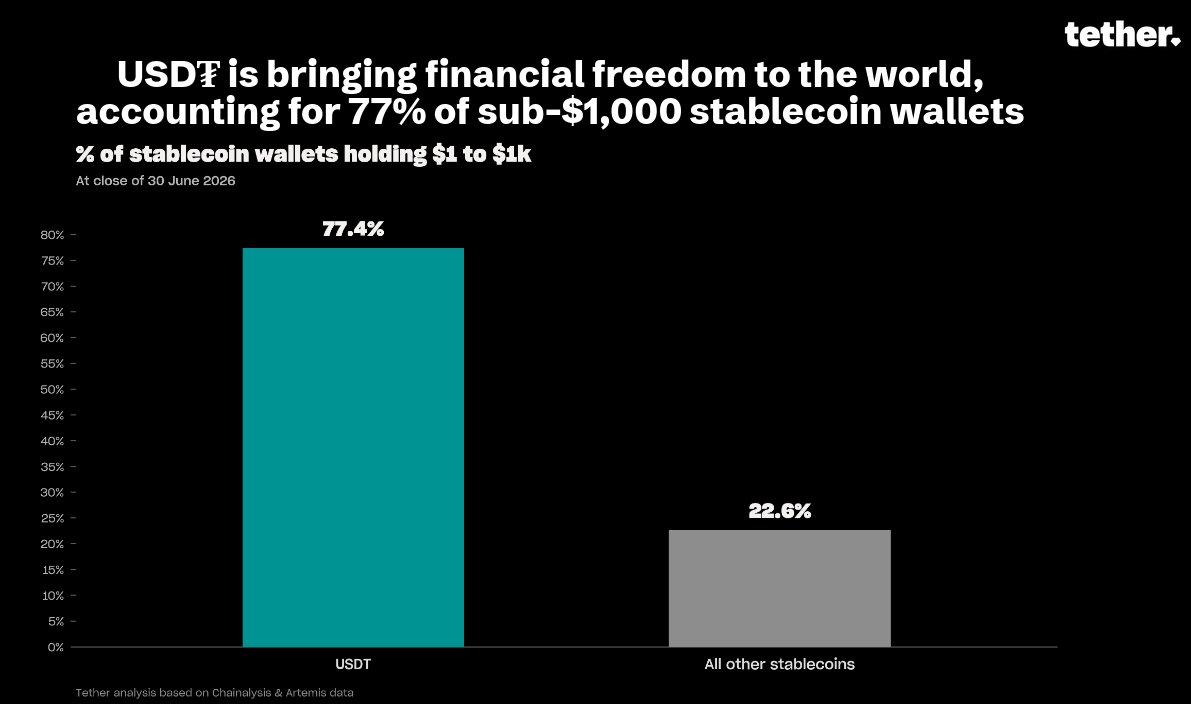
USDT user base continued to grow, reaching the new all-time-high of 650M+, with the widest surge across all emerging markets, fueled by the continued period of geopolitical uncertainty.
Without a doubt, Tether continues to deliver financial inclusion in the developing world like no other company or organization ever has in the history of humanity; we're all incredibly proud of this achievement.
Most of the financial industry today is so excited for overly-inflated AI stock valuations, like moths to a flame. But at Tether we keep dreaming of a stable Society that drives both financial and intelligence inclusion for the 4 billion people left behind.
Highlights as of 30 June 2026:
* ~1.5B in net operating profits for Q2 2026.
* ~184.6B total issued USDT, end of Q2 2026.
* ~4.1B excess reserves, on top of the 100% reserves in liquid assets that back all issued tokens, end of Q2 2026.
These results show that Tether has the liquidity, discipline and scale to remain resilient across market cycles while continuing to serve hundreds of millions of users around the world.
Thank you very much for the continued support ❤️
This is absolutely a tipping point
It’s also reflective of the financial system fully making a move onto the Internet
We will look back at this time in 2026 as one of the biggest turning points in the history of our industry
More than a year ago, the House passed the Clarity Act.
There’s been progress since — thousands of hours of bipartisan negotiations took place at the staff and Member levels. The Senate Committees on Banking and Agriculture advanced their respective titles. And Senate Republicans produced a floor-ready product that, as I type this, is waiting for a vote.
It’s disappointing — but not surprising — that Senate Democrats are choosing politics on the cusp of a major victory for American leadership. Find another instance in history where Congress, when given the choice, opted to push an industry out of the United States rather than smartly regulate it. American Exceptionalism was once a bipartisan goal; if Clarity fails, I have serious doubts.
These same Democrats — many of whom have taken millions of dollars from the crypto industry — proclaim that Clarity lacks safeguards for consumers and falls short in countering illicit finance. Nothing could be further from the truth. Titles II and III materially uplift regulatory and compliance obligations for digital asset intermediaries, placing them on similar footing with traditional financial institutions. The Blockchain Regulatory Certainty Act — which Washington lobbyists have spun up as a boogeyman for certain groups of prosecutors and law enforcement — does nothing other than codify longstanding Treasury Department policy that’s remained consistent across Administrations: non-custodial builders and developers are not, and have never been, subject to registration obligations under the Bank Secrecy Act. And at this point, major law enforcement trades that once opposed the bill, including the Fraternal Order of Police, have now endorsed it.
The Senate needs to vote NOW on this landmark legislation. The truth is that Senate Democrats are afraid to advance the Clarity Act as they fear Senator Warren and the “Anti-Crypto Army” she once promised to build. In the days ahead, Leader Thune will put this theory to the test. Will Senate Democrats be on the side of American Exceptionalism, or will they opt to cede American leadership of a global industry for fear of the bespectacled squirrel’s Left flank?
America will lead or America won’t. It’s not more complicated than that. I believe Satoshi once said it best:
“If you don’t believe me or don’t get it, I don’t have time to try to convince you, sorry.”
Institutions have options: permissioned chains, confidential tokens, and privacy overlays.
Each has tradeoffs. All need independent security audits.
Read more ↓
https://t.co/8A0iIiSids
This is incredible news and a huge signal to all builders!!
Samsung showed their “Samsung Wallet” holding @circle’s USDC at Galaxy Unpacked 👀
This will make Samsung one of the first major mobile brands to bring native stablecoins, enabling fast and trusted digital value transfers
Watch for yourself!
Learn more: https://t.co/IC2UVp4Mr4
This is a major structural shift, and possibly the turning point in the evolution of crypto markets away from speculating on endogenous digital commodities and into crypto market infrastructure underpinning deeper global markets. Thrilled to have Circle and USDC play such a central role here too.
"To record a transaction on a blockchain, the AI agent will need to pay in the cryptocurrency of that underlying network. For example, to record a transaction on the @Solana blockchain, the agent will need to submit $SOL. As agentic payments rise, demand for the cryptocurrencies of the chains supporting such business could surge, creating value for each token holder. Initially, this will likely be driven by the machine-to-machine micropayments being generated by enterprise software systems."
Ondo Finance’s SEC-registered broker-dealer subsidiary, Oasis Pro Markets, has secured regulatory authorization to offer tokenized equities and funds to U.S. investors under SEC and FINRA oversight.
Hundreds of millions of Americans and tens of thousands of U.S. financial institutions will soon be able to benefit from the 24/7 access, near-instant settlement, and fractional ownership that Ondo has already made available to billions outside the U.S. through tokenization.
Oasis Pro Markets can now offer compliant U.S. access, via OTC retailing, underwritten primary offerings, private placements and other activities, to tokenized:
→ Publicly traded equities, including in IPOs
→ Fund interests such as ETFs
→ Mutual funds and index funds
In addition, Oasis Pro Markets can support omnibus account structures through existing broker-dealer and advisory channels, which will enable institutional investors, registered investment advisors, and retirement accounts to access tokenized securities through their current brokers.
This is a landmark moment for tokenization and for the modernization of U.S. capital markets.
Ondo Finance pioneered the tokenization sector starting with U.S. Treasuries and Treasuries funds. It has continued to lead the way by tokenizing publicly listed U.S. stocks and ETFs issued by Ondo Stocks, which has received regulatory approval across key regions, including the EU, and expanded global access to U.S. capital markets. This led to Ondo Stocks becoming the largest tokenized securities platform, with over $20B in cumulative volume and $1B+ in tokenized stocks TVL, exceeding all other platforms combined.
Ondo brought Wall Street to the world through tokenization. Now, with regulatory approvals for Oasis Pro Markets secured, we’re built to bring tokenization to American investors, institutions, and capital markets.
We're excited to announce a partnership with SBI Group, one of Japan's leading financial institutions.
The collaboration covers tokenizing Japanese assets with distribution across the SBI ecosystem, and settlement using the JPYSC stablecoin.
Ondo CEO Ian De Bode on the partnership:
“Japan is one of the most sophisticated capital markets in the world, and SBI sits at the center of it. This collaboration creates a path to bring Japanese assets onchain.”
Yoshitaka Kitao, Representative Director, Chairman, President & CEO, SBI Holdings:
“Ondo Finance has established itself as a global leader in the tokenization of real-world assets and is at the forefront of the tokenized equities market. We believe Ondo will be a key strategic partner as SBI Group forms a global corridor for digital assets.”
Japan's capital markets, now connected to global onchain finance, powered by Ondo.
CIRCLE SE ALÍA CON BIND PARA LLEGAR A LAS EMPRESAS ARGENTINAS
Circle, la firma emisora de USDC, anunció una alianza con el grupo financiero Bind para llevar los dólares digitales al mundo corporativo argentino. El CEO de Circle, Jeremy Allaire, visitó Buenos Aires para cerrar el acuerdo, que busca permitir que empresas e instituciones accedan a USDC para pagos, manejo de tesorería y transacciones transfronterizas.
La operación se da en un contexto de expectativa por una posible desregulación del Banco Central, que hoy restringe a las entidades financieras operar con criptomonedas. Allaire adelantó que espera novedades regulatorias en el mercado local antes de que termine el año.
Testimonios
"Hace dos años este no era el caso. Hoy, cuando miro los indicadores fiscales, macroeconómicos y la estabilidad del entorno empresarial, definitivamente la Argentina es un lugar mucho más claro para la inversión extranjera directa de una empresa global" — Jeremy Allaire, CEO de Circle.
"Ampliar el acceso institucional a USDC representa un paso importante en el desarrollo continuo del ecosistema de activos digitales de Argentina" — Andrés Meta, accionista de Grupo Bind.
"Las empresas recurren cada vez más a los dólares digitales para respaldar pagos, operaciones de tesorería y comercio transfronterizo” — Kash Razzaghi, Chief Business Commercial Officer de Circle.
(+) en Clarín: https://t.co/BdVFE8f7Ft
Today is a historic day for Circle, and I think symbolic of a much bigger evolution in the architecture of the emerging internet financial system.
Circle has received final approval from the OCC to operate as a national trust bank. We have been granted a charter for First National Digital Currency Bank, NA.
Over 10 years ago, as we were forging the concepts of Circle, we believed a new kind of national bank would ultimately be needed to issue full-reserve dollar digital currency. This was before USDC even existed. The vision was clear: a new base layer of money on the internet would be necessary, and for it to reach widespread use, it needed to operate under national banking supervision.
Years later, after launching USDC and achieving strong product-market fit, I wrote that we sought a charter for a full-reserve digital currency bank. Then, through a half-decade of work with policymakers and regulators, we saw the GENIUS Act codify into federal banking law a framework for these safe, efficient, and technologically superior digital dollars.
Launching and operating as Circle National Trust, we will offer custodial services for digital assets, including stablecoins and other tokenized assets, held to the highest standards afforded under Federal national trust bank supervision.
As the GENIUS Act approaches full implementation in early 2027, we are now poised not only to be supervised by the OCC, as required by law, but to bring critical components of USDC's operation and reserves into this structure.
This is all part of building a new fundamental money layer for the internet. A layer that can scale from an AI agent paying another AI agent in fractions of a second for fractions of a cent, to retail transactions, to investments, trading and lending, to the largest wholesale transactions between global systemically important institutions. All of this needs a form of money and regulated infrastructure that can support the entirety of this new internet-native economic system.
A new architecture for money on the internet has arrived. It is now being hardened into an edifice the world can trust and build on. We are thrilled to be the first of a new cohort of firms establishing this kind of banking infrastructure.
Jeremy
Tokenization is more than a technology upgrade. It can reshape how the financial system operates. New IMF analysis explains what changes and why policy choices will matter: https://t.co/niSfVsSwgf