Rubisco is (arguably) the most abundant protein on Earth. (LPP surely comes close, right?) It’s an enzyme that fixes CO₂ into sugars during photosynthesis.
Unfortunately, as most people learn in school, Rubisco is inefficient. Sometimes it confuses O₂ for CO₂ and wastes energy. Plants make up for this in raw concentration; up to half the soluble protein in a leaf is Rubisco.
People have been trying to engineer better Rubiscos for many decades, but it's not easy because the proteins are big, do not fold easily (they need chaperone proteins to help out), are made from 16 subunits in land plants.
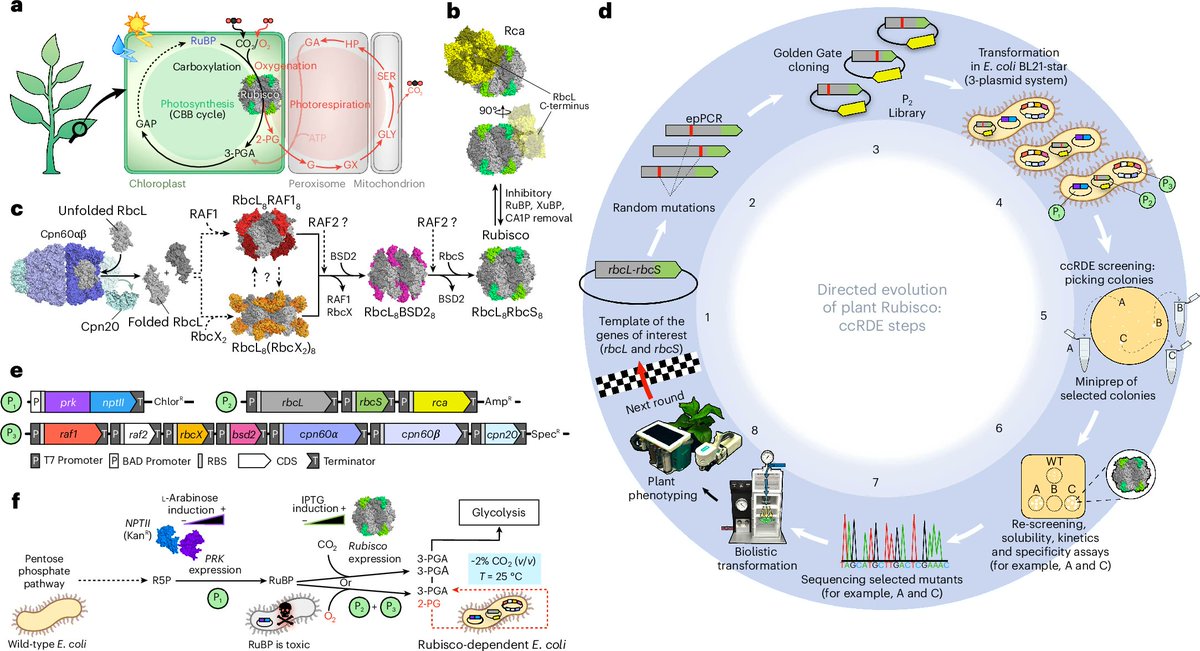
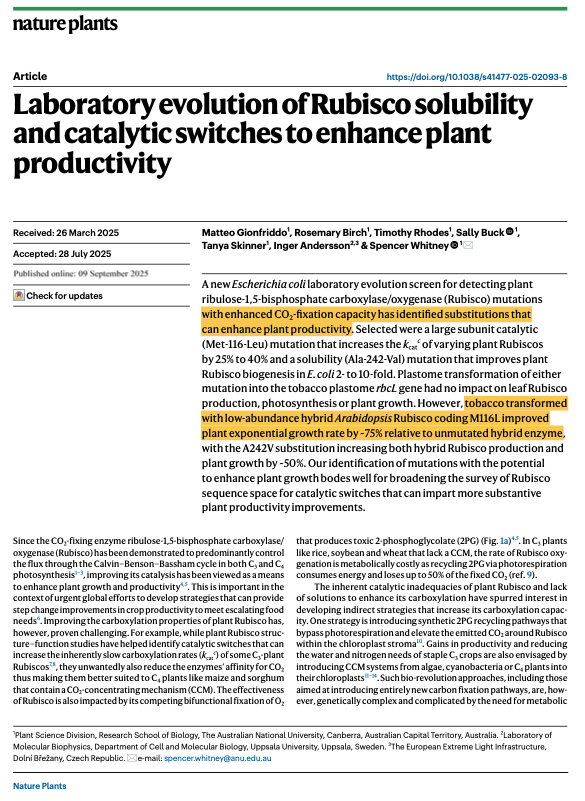
But there's a new paper in Nature Plants that looks really interesting. The TL;DR is that a group in Australia figured out how to express plant Rubiscos (and all SEVEN of their folding chaperones) using a set of 3 plasmids inside of E. coli cells. This enabled them to do "directed evolution" of Rubisco in bacterial cells, and quickly find Rubisco mutants that have higher enzymatic efficiency or that fold better.
In addition to the 3 plasmids, the researchers also coaxed E. coli to make ribulose-1,5-biphosphate, or RuBP, which is the 5-carbon sugar that Rubisco smashes into carbon dioxide to make molecules of 3-PGA for central metabolism.
Now, the clever bit is that you RANDOMLY MUTATE the three plasmids encoding the Rubisco to make millions of variants. Then, you transform those mutated plasmids into E. coli. If the E. coli do NOT make a functional Rubisco, RuBP levels build up and kill the cell; the molecule becomes toxic. But if the E. coli DO make a functional Rubisco, then they keep the RuBP levels in check and live just fine.
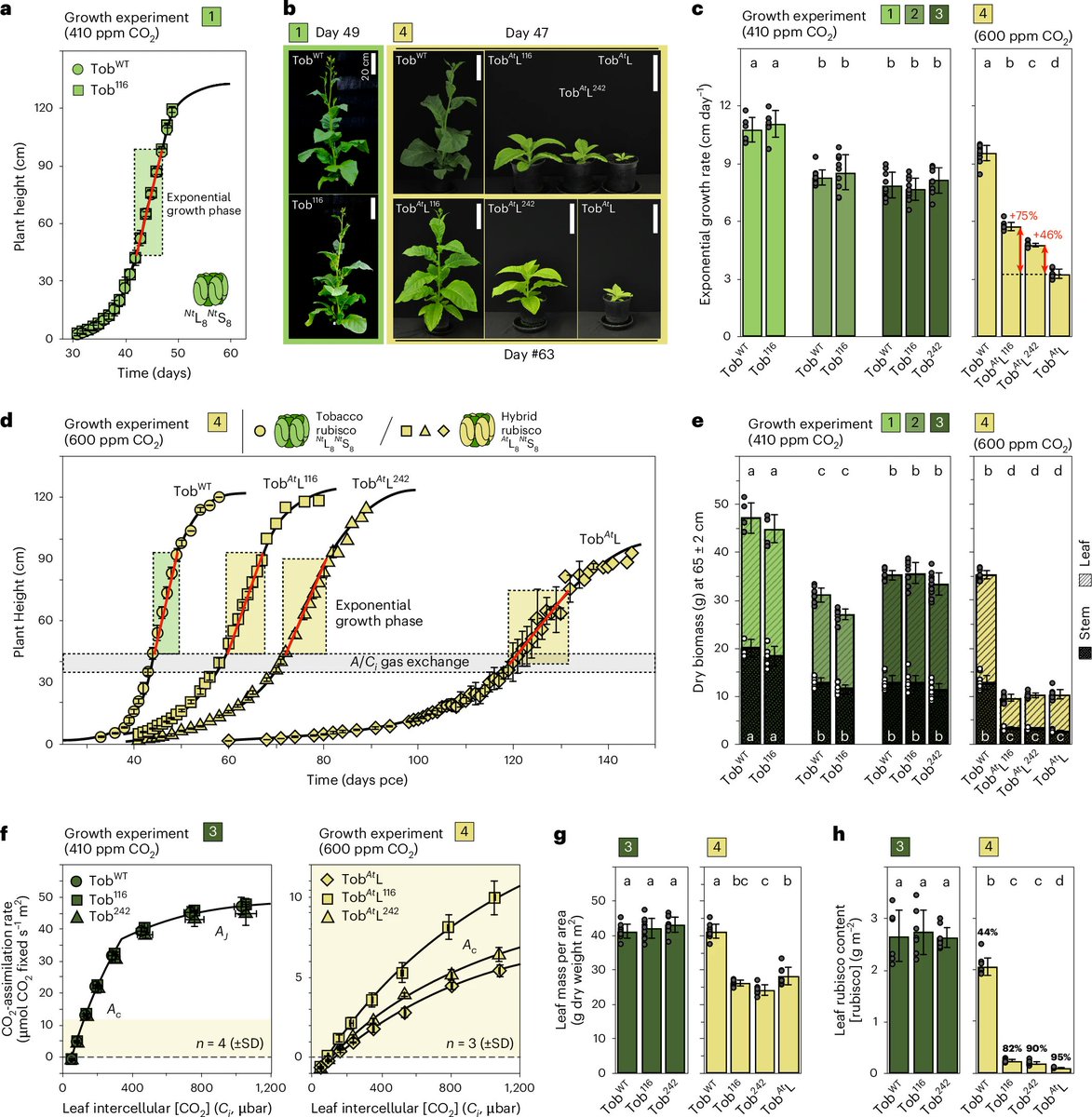
Using this "screening assay," the researchers found 46 fast-growing colonies of E. coli. Two of those colonies encoded really useful mutations. One mutation (M116L) makes Rubisco about 25–40% faster. The other (A242V) makes it fold and assemble much more efficiently.
They put this mutation into a "hybrid Arabidopsis–tobacco Rubisco," put that into tobacco plants, and measured growth. The plants with M116L grew 75% faster than wildtype.
No guarantees this will scale to more useful crops, like wheat and corn and soybeans etc. But it seems like a nice in vitro assay for faster prototyping!
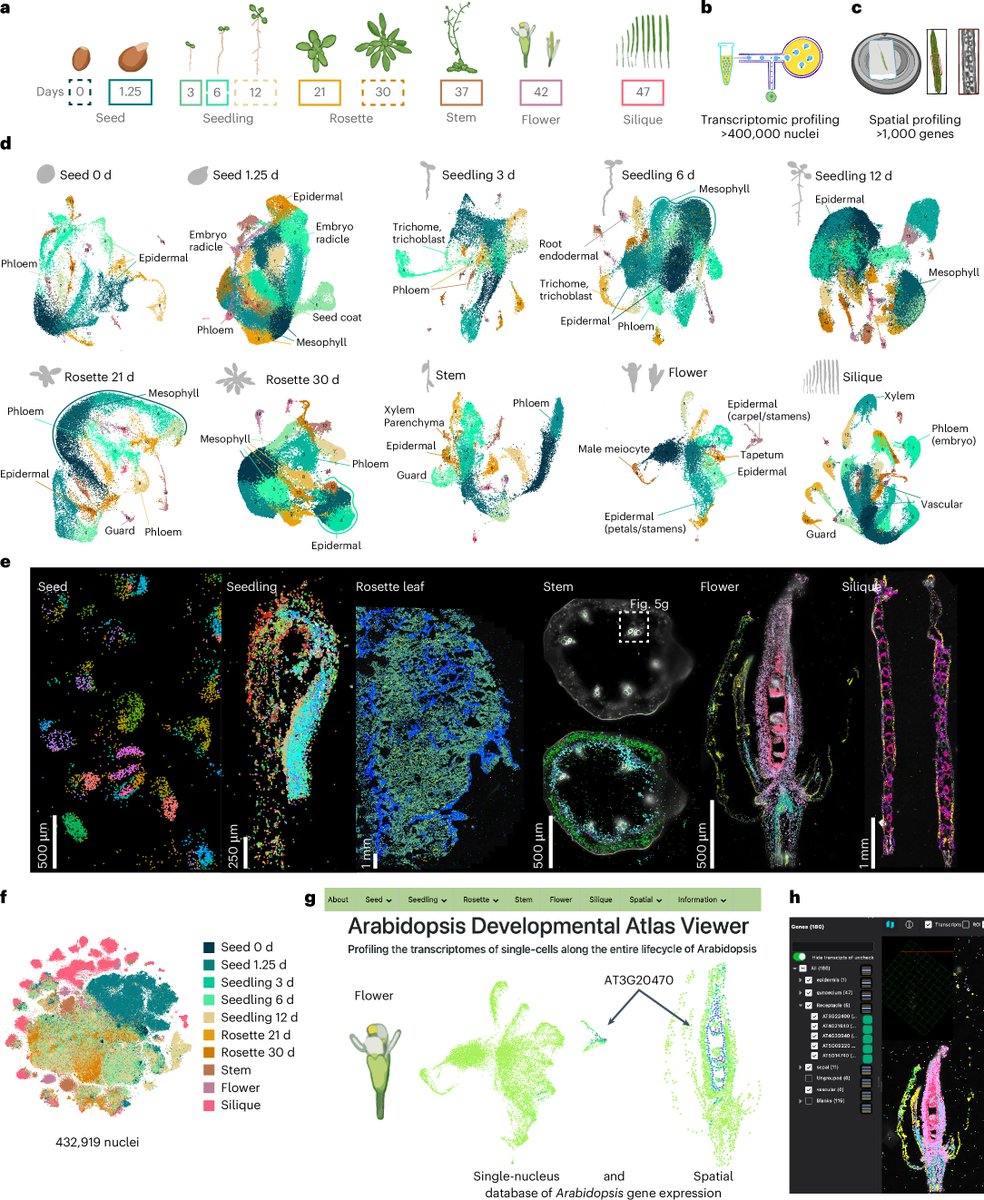
New OA Resource: "A single-cell, spatial transcriptomic atlas of the Arabidopsis life cycle" https://t.co/C8qZzlrW2t
An extensive single-nucleus and spatial transcriptomic atlas of the Arabidopsis life cycle that represents 10 developmental time points in 6 diverse organs.
Visualizing gene structures in R? gggenes, an extension of ggplot2, simplifies the process of creating clear and informative gene diagrams, making genomic data easier to interpret and share.
✔️ Plot gene arrows to represent gene locations and orientations.
✔️ Visualize genomic features, including transcripts and operons.
✔️ Customize labels, colors, and layouts for clear presentations.
Whether you're working on genome annotation, comparative genomics, or molecular biology research, gggenes provides a flexible and user-friendly way to display complex gene structures with clarity.
The visualization shown here is taken from the package website: https://t.co/nutneLhvby
For a deeper dive into creating impactful visualizations with ggplot2 and its extensions, don’t miss my online course "Data Visualization in R Using ggplot2 & Friends!" Click this link for detailed information: https://t.co/ztlEzoEDWv
#RStats #Rpackage #DataAnalytics #ggplot2 #datastructure #DataViz
Thank you @ANUAgrifood & @PlantSci_ANU for hosting an industry engagement session, highlighting uni-industry partnerships driving real-world applications. Thanks to Rebeccah Tyrrell, Zuzana Plšková, Kai Chan, @BotanicGeek, @frdanila, and Bob Furbank—for sharing their insights
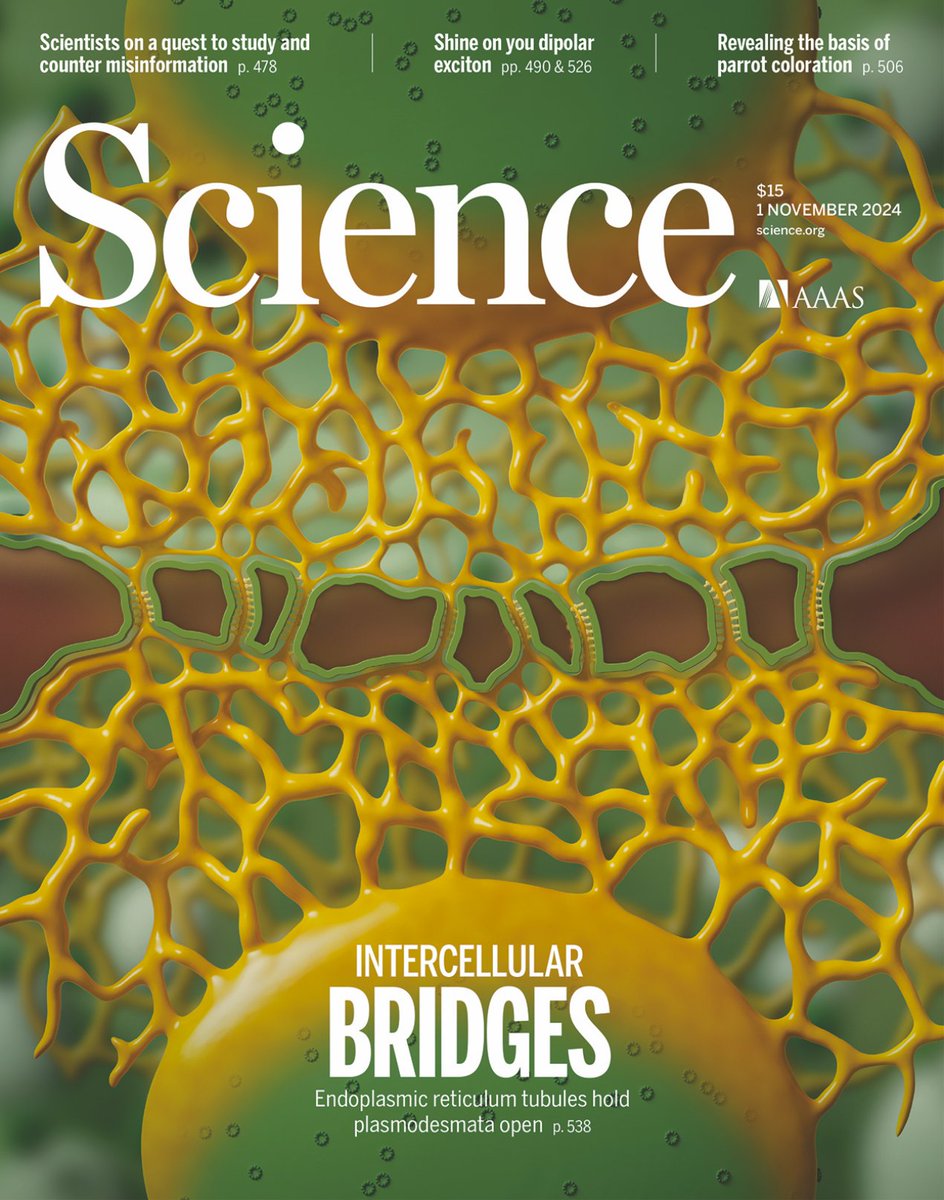
Our latest work as a cover story in @ScienceMagazine ! 🌱 How do plants halt cytokinesis to build plasmodesmata ? Main suspect: the ER .
👀 Stellar work by @PatrickZQLI, with @hortense_moreau, Jules Petit, @felixmendu, @Caillaud_MC, and @BIC_Bordeaux
https://t.co/4JZeoX0vwd
Really nice work by Natalie and @frdanila to track plasmodesmata formation in rice and setaria @ThePlantJournal!
Novel resources to investigate leaf plasmodesmata formation in C3 and C4 monocots
https://t.co/q8iFKl0bTk
miRNAs rules!...only thing is that maaaybe it would have been good to acknowledge the contributions from other fields like plants molecular biology!...
Very proud of James Nix, PhD student @bobfurbank and I supervise, for receiving a poster presentation award at the Asia-Oceania international congress on photosynthesis in Kobe @BiologyANU@futurecropsAU It was an amazing conference! We will see everyone in 4 years in Australia!
Proud of this one from my postdoc @SudeshiS. Extensive characterization of the Snn1 susceptibility gene in #wheat and development of highly effective markers for breeding. https://t.co/BMoUvFNZVV
In this work - out in @ThePlantJournal - we explore use of a ternary vector system and GRF-GIF morphogenic regulators for improved maize transformation and gene editing. In collaboration with @jmdebernardi@UCDavisPlants.
https://t.co/ZhR1281LUM @PSB_VIB
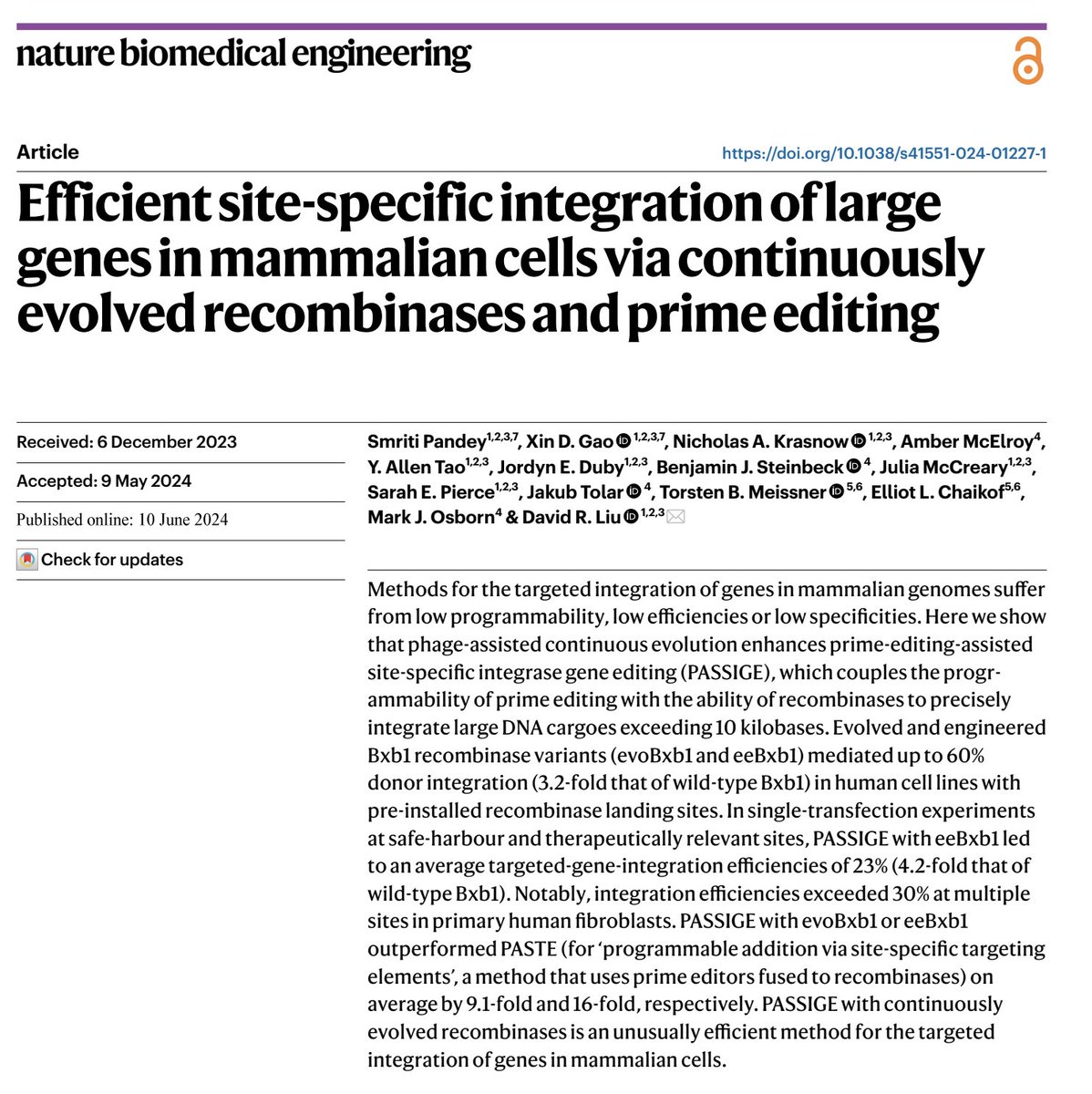
Today we report in @natBME the eePASSIGE system, which uses evolved and engineered recombinases and prime editing to integrate large gene-sized DNA cargoes into the mammalian genome in an efficient, precise, and targeted manner. (1/13)
https://t.co/xvjTwgApde