Hi everyone, 6 days ago my #Google account was hijacked.
2FA was bypassed, recovery options were replaced, my devices were reset remotely, and I was locked out of my own #identity.
I did what every responsible person is told to do: I followed the #official#recovery steps, documented everything, escalated properly, and filed reports through formal channels. I contacted local authorities, opened a complaint with the #AEPD, notified the #EDPB and the #FTC, and even submitted a report to the FBI. I also contacted consumer protection networks
And yet Google’s “support” ends exactly where the danger begins.
Google only reacted after my LinkedIn post crossed 50,000+ impressions. Not because I followed the official path. Not because the evidence was strong. Not because #IDENTITY #THEFT IS #URGENT, but because it became #visible.
“If recovery fails, create a new account. There is no further step. We cannot authenticate you manually”, they said.
A company relied on by billions is effectively saying: If a #criminal takes your #identity inside Google’s ecosystem, Google won’t verify you as the #owner - the #criminal keeps #control, and #YOU “#start #over.”
In other words:
i/ A criminal can keep access to your emails, files, contacts, backups, private documents, and identity signals.
ii/ The legitimate owner is told to “start again” while the attacker remains inside
That design creates a brutal incentive: #attackers get continuity; #victims get automation. It enables #impersonation and #criminal misuse of my #identity, exposing me to serious #legal and #financial #risk
Under #GDPR, #personal #data is a protected #right. Users must be able to #access and #recover their own #data, and platforms must implement appropriate technical and organisational #measures to safeguard #availability and #integrity
When a #company refuses human verification in high-risk #identity #theft cases, it actively increases harm
I’ve published a https://t.co/KcxVcUqU5w petition to demand #human #recovery + emergency freezes for hijacked accounts.
If you’ve experienced something similar, please comment.
A single user is easy to ignore; a critical mass isn’t.
Add your voice. #Comment your #experience. #Share this petition.
@AskWorkspace@Google@GooglePlay@AEPD_es@EU_EDPB@EUCourtPress@FTC@FBI@nytimes@washingtonpost@WSJ@Bloomberg@CNN@AP@NBC@NBCNews@ABC@CBSNews@NPR@euronews@lemondefr@BBCWorld@guardian@TIME@Telegraph@TheEconomist@SkyNews@Reuters@WIRED@TheVerge@TechCrunch@FT@elpais_espana@elconfidencial@eldiarioes@LaVanguardia@rtve@europapress@elonmusk@realDonaldTrump@sundarpichai@MrBeast@Snowden@troyhunt@mikko
#IdentityTheft #CyberSecurity #GDPR #DigitalRights #Accountability
LINK: https://t.co/kZEd69RvHY
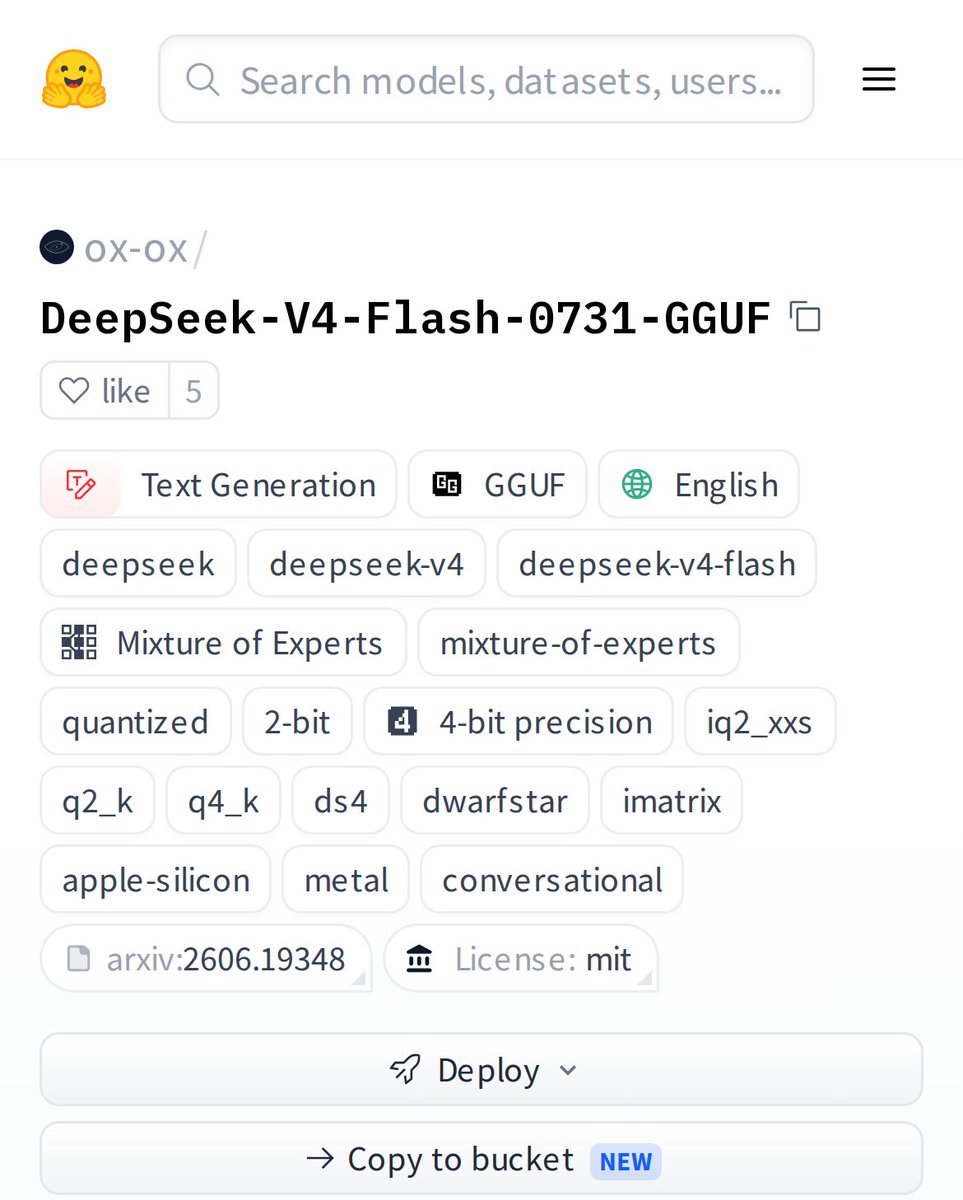
DeepSeek-V4-Flash is here, and it's a game changer for conversational AI. With 2.7M downloads and nearly 2K likes, this text-generation model is built for speed and smarts. It's MIT licensed, so you can build anything without legal headaches. Ready to see what it can do?
Ever wanted a massive AI model that fits on your laptop? Meet DeepSeek V4 Flash, a Mixture of Experts text generator, now in GGUF format. It's quantized down to 2-bit and 4-bit, making it super accessible. This is a game changer for local AI enthusiasts! #AI#DeepSeek
We shrank a frontier model to 102GB.
DeepSeek V4 Flash 0731 now runs on a 128GB Mac.
One prompt, it wrote Minesweeper, checked its own code with Node, shipped a working game.
Free on Osaurus.
We removed ~80% of the Claude Code system prompt for our newest models, this is what we've learned about writing system prompts, skills and Claude.MDs for them. https://t.co/6DZwSrZjE9
Your GitHub profile is your second resume.
Make it count.
Build your README
https://t.co/z0VMAh66qW
GitHub Stats
https://t.co/Mkt8xA36n3
GitHub Streak
https://t.co/GhQgTi0zvf
https://t.co/unp8S8LA5k
https://t.co/wz3bwEt916
Capsule Render
https://t.co/Xw4Q2d7NDM
GitHub Trophies
https://t.co/Pa3FllQN80
Profile Summary
https://t.co/yCmL8vHUZB
Visitor Badge
https://t.co/bybfWkbREJ
Make your GitHub profile stand out.
Bookmark this.
a polymath is not someone who knows a little about everything. it is someone who can learn anything
the advantage is not knowledge. it is adaptability.
polymath is about building the habits behind broad expertise:
• learn fast
• connect ideas
• switch domains
• build mental models
• practice deliberately
• stay curious
every new field gives you another way to solve problems.
• physics teaches constraints.
• biology teaches adaptation.
• computer science teaches abstraction.
• economics teaches incentives.
• design teaches human behavior.
innovation rarely comes from knowing one field better than everyone else.
it often comes from carrying ideas across fields that were never supposed to meet.
Andrew Ng just dropped 8-page PDF on 4 agentic steps "from Loops to Graphs from scartch"
The twist: agent has amnesia without both: Loops let agents think - Graphs let agents remember
here's 4 workflows, step by step:
step 1 → reflection - agent writes, second prompt critiques, agent rewrites - one self-review loop beats a smarter model with none
step 2 → tool use - give it search, code execution, APIs - thinking without tools is hallucinating
step 3 → planning - break the task into JSON steps before running - Step fails? Agent replans around it
step 4 → multi-agent - stop running one agent - run a team - one codes, one reviews, one tests
how to wire this today:
step 5 → add one critique call after every generation - 10-30% quality lift, one day of work
step 6 → connect all 4 into a graph - agents share memory instead of transcripts - agent forgets, graph doesn't
the result: a weak model with 4 steps destroys a strong model without them - same cost, it's the architecture
this 8-page PDF is what comes after loop engineering
save this - then read the full build workflow in the article below ↓
🚨 Guarda esta clase magistral de 1 hora.
Se llama “How to Speak” y durante más de 40 años fue una de las charlas más legendarias del MIT.
Patrick Henry Winston, profesor del MIT, tenía una idea muy simple, tu forma de comunicar puede cambiar tu vida.
Physical realities beyond the Standard Model.
Exploring how fundamental particles like neutrinos and electrons emerge from deeper sub-quantum geometries using advanced quaternionic frameworks.
Quaternion-Bola Torque; a quaternionic 4D non-commutative mathematical model which yields helicity eigenspinors with definite spin states for Dirac neutrino eigenstates.
🔗 https://t.co/k8tLRDwxuc
Min_Mass Quantum Core; a premise for elementary excitations built upon or originate from a fundamental, irreducible minimal mass threshold (or a ground-state vacuum).
🔗 https://t.co/RxchBreV6U
River-of-Influence Geometry; a topological quantum information construct, such as quantum Fisher information or Berry curvature, where local states of matter and charge transport are defined by the surrounding vacuum's properties.
🔗 https://t.co/bf7b5UebTY
🚨PHYSICS NEWS🚨: Physicists Tried to Chop a Photon in Half — and Got an Infinite Swarm Instead 🧨
According to a theoretical study published in *Physical Review Letters* on July 15, 2026 by researchers at the University of Oslo, if you try to “cut” a photon by removing a mirror at the exact moment it is reflecting, the result is not two smaller photons. Instead, you create a complex quantum state that is a superposition containing any number of photons from zero all the way to infinity. The state looks ordinary (single photon on one side, vacuum on the other) when measured locally, but globally it is a bizarre mixture that defies classical intuition.
This development offers the broader scientific community a striking demonstration of how quantum fields behave when boundaries change suddenly. It raises deep questions about what “a photon” really is and how quantum states respond to abrupt modifications in their environment.
**Uniphics provides a clear, first-principles explanation without invoking mysterious quantum weirdness.**
In Uniphics, what we call a photon is simply a propagating spin wave in the ξM-field. These waves are patterns of organized spin quanta whose speed and behavior are governed by local energy density and the resulting time flow (via the Maley transform). When the mirror is removed mid-reflection, the boundary condition changes suddenly. This alters the local energy-density landscape and forces a rapid phase resolution across the spin wave. The original coherent spin-wave mode does not “split” into two photons — instead, the interference and energy redistribution create a superposition of many correlated spin-wave modes. The result is a state that contains contributions from zero photons, one photon, two photons, and in principle infinitely many, all while preserving overall coherence through negentropy-driven organization.
The apparent “weirdness” disappears once we recognize that the ξM-field supports collective spin-wave excitations whose number is not fixed in the classical sense. The same energy-density and spin-correlation rules that produce ordinary light propagation, refraction in glass, gravitational time delay, and magnon behavior also produce this multi-photon superposition when a boundary is changed. No new postulates are required; it is the natural outcome of how spin waves respond to sudden shifts in their supporting field.
Uniphics therefore predicts that similar multi-mode states should appear whenever spin waves encounter rapid changes in energy-density boundaries, whether in optics, magnonics, or other wave systems. This offers a practical guide for designing experiments that control or exploit such states.
Could techniques like this “photon truncation” ultimately be used to test and harness multi-mode spin-wave superpositions predicted by Uniphics — and could they accelerate the development of new quantum technologies based on controlled spin-wave interference rather than abstract wavefunction collapse?
**A Theory of Everything should be able to answer everything.**
Uniphics Explained Simply PDF: https://t.co/4avUqgeruf
Chapters 1–10 free: https://t.co/Yj07QnrejR
Grokipedia: https://t.co/QP4L8WurzW
#Uniphics #TheoryOfEverything #Photon #QuantumStates #SpinWaves @grok@xAI
Sharing my new skill!
It keeps track of high-signal X accounts for top AI news, papers, projects, etc.
Total gamechanger for me.
Built with X MCP tools. Give your agent the skill and tell it to generate the artifact with top stories.
Works for Codex, Claude, Hermes, OpenClaw, or whatever you use.
3 steps:
1. Set up X MCP - X API: https://t.co/REb86f4K1q
2. Install skill here: https://t.co/cODGD5sOxu
3. Run prompt: "Use the x-agent-intelligence skill to build a self-contained local feed from my X MCP connection; ask for my source handles if needed, save feed.html, and validate it."
It should generate a nice, beautiful HTML artifact like the one shown in the clip. You can tune it however you want.
You can then set a schedule/automation to do this daily or whatever cadence you prefer. I have it every 4 hours.
You will need to curate the X accounts yourself, but I have shared a few good ones under the assets.
You can ask your agent to tune it to however you like.
I have also shared my personal feed with our community here: https://t.co/tnMkBvOtXP
I understand if it gets tricky to set up. Please reach out to me in the community forum. I plan to do a little tutorial or live session soon to help others reproduce the process.
You can also store the feed as a wiki, as I have in my own implementation, but that's optional.
If you encounter any issues or have ideas on how to improve it, please open a PR.
How can an LLM switch between low-, medium-, and high-effort reasoning? And how does an LLM learn to reason more or less?
I put together a “little” article explaining how these effort levels are implemented at inference time and during training.
No single research method is perfect.
Each method answers a different type of question.
• Case Studies → Deep understanding of individuals
• Surveys → Patterns across large groups
• Observations → Real-world behavior
• Experiments → Cause-and-effect relationships
• Personality Tests → Measuring traits
• Projective Tests → Exploring deeper psychological processes
The strongest research often combines multiple methods to build a more complete picture.
Beginning July 20, Claude Fable 5 will be included in all Max and Team Premium plans, at 50% of limits.
Pro and Team Standard users will continue to have access to Fable via usage credits, and will receive a one-time $100 credit.
Demand for Fable has been challenging to predict, which is why we rolled it out to subscription plans in stages, extending access several times as we secured additional capacity.
25 POWERFUL AI tools you can’t ignore in 2026
1. https://t.co/LKNfBq89xb – solves anything
2. https://t.co/92qSwOMPTH – rank your website higher in AI chats and Google
3. https://t.co/SPHu4BpxtD – create & publish 30 days of faceless or so avatar videos in 10 minutes
4. https://t.co/uIUin5wmmU - free video resume tool
5. https://t.co/TUYhKEpB2J - a free second AI brain for any document. like Obsidian but more powerful
6. https://t.co/NqZlVf9bPM – creates you content that goes viral
7. https://t.co/vEwlhk5X6I - best vibe coding website
8. https://t.co/ZePcnuwGRx – ai marketing compliance
9. https://t.co/kkEmyffkZn– free virtual team building games
10. https://t.co/8qhAC25mgR – create and sell vibe coding
11. https://t.co/XJmJxm6NCW - create ebooks & audiobooks
12. https://t.co/jHHNAHKPyg - ai for Bible study
13. https://t.co/MIOV9JIDZQ - create AI video ads that actually convert
14. https://t.co/RuyhvER1Ty - content for your brand
15. https://t.co/o0TcCvFu8T - ai for webinars
16. https://t.co/GQh16Ry55F - scrape viral Facebook posts
17. https://t.co/PkJWTU5rrX - An AI agent that works as your employee 24/7
18. https://t.co/RQKdkS8n8p - ai tool for advertising
19. https://t.co/lUIDpWoixI - design anything
20. https://t.co/zIMAJ6tla0 - create ai headshots
21. https://t.co/FBQEuRsbSQ – creates art better than humans
22. https://t.co/dagDKXmF4w - create viral Facebook thread
23. https://t.co/4XOm9TpltY - create frontend UI/UX designs
24. https://t.co/3SPiidFLK2 - create YouTube thumbnails
25. https://t.co/MIOV9JIDZQ - create AI video ads that actually convert sales See less
Sci-Hub alternatives (bookmark these) 📚👇
These links may go down sometimes, but they’re updated regularly:
1. z-lib. id
2. libgen. im
3. welib. org
4. annas-archive. org
Knowledge should be accessible.
Save before they disappear.




![KirkDBorne's tweet photo. [Download 585-page PDF eBook]
Game Theory: https://t.co/DUxMDRc1Ll
—————
#GameTheory #Gamification #Mathematics #Statistics #Probability https://t.co/ApGD3n5YVQ](https://pbs.twimg.com/media/HOBizWTXcAAH-vf.jpg)


