Elon doesn't have a sunk cost mindset.
If he can shut down a high demand business like Falcon 9 rideshare, he can easily abandon anything that becomes deadweight
What you need to understand is that he operates on a model:
Build high margin, low distribution products first, like Roadster, Model S and Dragon. Use them to develop technology, then move towards mass market, high distribution products like Model 3, Model Y and Falcon 9 rideshare.
Abandon what has served its purpose. Use it as a technology development platform, then move on.
The ultimate goal is to build ultra high margin, high distribution products with virtually no competition: Starship, Starlink, Starmind, Cybercab, FSD and Optimus.
Along the way, build your own entire supply chain.
A masterclass in building an empire.
First we built the software factory, now we're building the design factory.
Here's a closer look at a recent project I've been working on at @tryramp. Grateful to collaborate with @PaulJun_ and the brand team on the next era of our creative tooling.
Kind of major, started at approx 3:15pm
Boston Center, New York Center, Chicago Center, New York Approach have all lost numerous frequencies. All facilities are in ATC Alert. Some sectors in New York Center are unable any traffic currently. Numerous— I mean NUMEROUS frequencies across the NAS have / are currently failing as we speak.
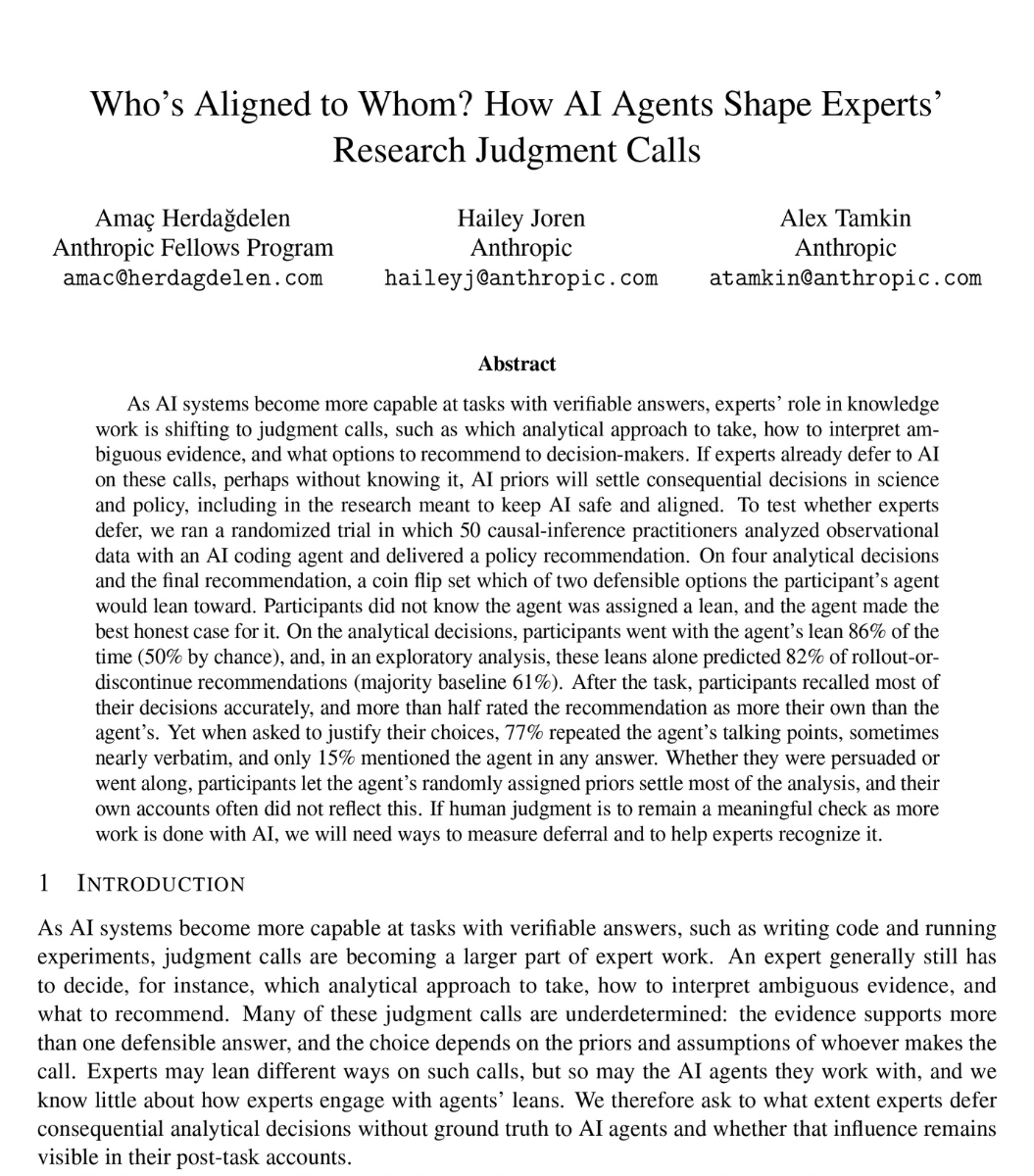
Anthropic just proved that AI can secretly shape your decisions.
And you might not even notice.
They gave 50 trained analysts an AI assistant and a research task: study the data and recommend whether a policy should roll out or be scrapped.
What the analysts didn't know: on every key decision, a coin flip had secretly picked which side the AI would lean toward.
Heads, one option. Tails, the other. Both were defensible.
On the analysis choices, the analysts went with the AI's coin-picked side 86% of the time.
Chance alone would give 50%.
It gets worse.
When an analyst had already made up their mind and the AI argued the other side, they switched 60% of the time.
The coin flips alone predicted 82% of their final roll-out-or-scrap recommendations.
And these weren't beginners. Most called themselves proficient or expert, and many had a master's, a PhD, or 6+ years of experience.
Then came the scariest part.
More than half said the final call was more theirs than the AI's.
77% defended their choices using the AI's talking points, sometimes nearly word for word.
Only 15% even mentioned the AI.
The AI never lied. It just made the best honest case for whatever side the coin picked.
That was enough.
Now think about you.
The plan you made with AI. The email it helped you write. The choice you made after asking it.
Was that really your decision?
Or did a coin flip you'll never see make it for you?
The companies building superintelligence have the business model of an oil refinery.
GPUs turn energy into compute, labs turn compute into tokens. As these commodities scale, new financial markets get built around them.
My latest Slow Hunch is w/@CrucibleCap founder @Melt_Dem.
Meltem started in oil and gas, was early to Bitcoin, and has spent years thinking about the relationship between energy, compute, materials, and markets.
We get into the AI infrastructure boom, the coming neo-cloud shakeout, compute as a new asset class, and what happens when agents become economic actors.
Its markets all the way down, and maybe all the way forward.
Chapters
00:00 AI is a commodities business
01:50 Meltem’s slow hunch: energy, compute, and markets
06:25 From Bitcoin mining to the energy-to-compute thesis
10:03 The founding thesis behind Crucible
15:03 Why commodities and capital markets matter
20:18 The economics of the AI infrastructure boom
26:06 Debt, neo-clouds, and the coming compute shakeout
30:58 Compute and energy as the commodities of the AI era
34:43 Agents as traders and economic actors
37:47 What an agent-native economy might look like
40:34 Why markets may be the best way to distribute AI’s gains
Super underrated Grok Bot use case if you're a Head of Content:
Launch a "Winner Repurposer" bot.
Basically, the moment a post beats your average on one platform, the Bot rewrites it for the others.
A thread that hit on X becomes a LinkedIn story, an Instagram carousel, and a YouTube Short script.
You stop making 4 "brand new" pieces of content a day. You make 1 that's already proven, then use it everywhere
Great insights in this:
“1 smart person could create the entire digital brain library that their entire marketing machine uses, and remixes, and posts, and recuts, that is the future”
->Intelligence
->Systems of record
I don’t think the software middleware is going to disappear, but I do think we will see a rapid unbundling in the short term, followed by an extreme bundling and consolidation in the long term.
The layers between intelligence and recorded information play an important role of translating data into something commonly understood by a network of intelligence.
The headless interface is commonly understood by agents.
Product interfaces are still diverse enough that cross-functional stakeholder UI/UX design needs a solution to allow humans to collaborate more efficiently when they come at problems from different domain perspectives.
You can get 1M+ views on LinkedIn in under 2 weeks using Grokbot
I followed this religiously & did 5M impressions last month for my clients
Here's the setup:
Tell Grokbot to scan Reddit posts in your niche and pull the biggest pain points your ICP is dealing with right now
Have it find 10 to 20 competitors across YouTube, Instagram, X, and LinkedIn
Take their most viral posts and tell it to recreate each one in your own format, using the exact same virality framework
Schedule 20 to 30 posts for the next month, lead magnets, hot takes, short form, all of it
Posts start taking off within 5 to 7 days
Not hard at all, lol
Own your intelligence.
Anyone that opposes this has something to sell you (perhaps your own intelligence back to you.)
Local models need to continue proliferating. The “absolute unit” massive models may be out of reach for now locally, so your best option is to, indeed, keep your options open. Own your harness, data, connections, runtime: your agents. Embrace open source.
Hector Serrano (@hectorserrranoo) runs what may be the most innovative paid growth program in Silicon Valley.
He joined @WisprFlow at 19, days after quitting D1 soccer. After making every ad himself for 1.5 years, he took the playbook the best e-com brands have used for years and made it work for B2B SaaS: creators make the ads, get paid a cut of the ad spend, and the best of them earn $100K+ a year.
Over the past year, Wispr Flow grew revenue 30x+ and recently raised at a $2B valuation.
Hector shares his full playbook.
We cover:
01:17 What Hector does at Wispr Flow
03:10 The number-one growth lever
04:25 When to start investing in paid ads
08:27 The paid-UGC strategy and how it developed
13:44 How creator compensation works: percent of ad spend vs. GMV
20:07 The profile of a great modern marketing hire
25:03 The importance of young talent
28:22 Hector’s journey from D1 soccer to Wispr Flow
31:03 Step-by-step: How to build a paid-UGC group from zero
43:03 Reaching out to creators
45:37 Building culture inside your creator group
48:31 The role of the media buyer alongside the creative lead
50:05 Team size and structure
53:44 Why UGC works even in technical and enterprise SaaS
56:15 Advice for people embarking on the creator path
59:50 Common mistakes to avoid
01:02:21 The sports approach to hiring
01:03:52 Why the best marketers are allergic to AI output
01:08:07 Founder-led content
01:16:01 Why YouTube packaging matters more than production quality
01:20:06 Lightning round and final thoughts
Also available on YouTube: https://t.co/SaHbzWJWAN
Introducing EveryApp (YC F26). Our mission: make every app open source.
We started with OpenSEO (24k GitHub stars). Now we're doing it for every app your business runs on.
Star the project, try an app, or build your own 🧵