@mil01425146@Walshie3131@LaughingH20Cap Do u realize that as of next Thursday there will be 25 mm more shares outstanding? That’s a 18 pct of shares outstanding. Do you understand what dilution is?
Nemotron is one of NVIDIA’s most underrated assets.
Open weights, tuned for their own silicon, now staffed with ex-Llama talent (@sudoraohacker).
Selling GPUs was step one.
Owning the open model layer is step two.
Congrats Arun welcome to the team!
in markets, to go long on something is to bet it grows more valuable over time. much of the conversation today is short on humans, wagering that ai makes people redundant. we believe the opposite is true for the industries @ThriveHoldings operates in.
we are long humans.
https://t.co/oqygDJKZGO
Ben Horowitz: “Do not expect life to be fair. It will only defeat you.”
The Andreessen Horowitz co-founder is asked for advice that he has found useful in his own life. Ben responds:
“The thing that I would say has had the biggest effect on me is something my father said to me years ago: ‘Life isn’t fair.’ That advice seems really simple, but the thing I’ve seen that defeats people more than any other thing in life is the expectation of some fairness.”
He continues:
“There are all kinds of things that are going to happen to you that don’t happen to other people and are completely unfair. But it doesn’t matter because that’s the way it is. And as soon as you can get that idea out of your mind [that life should be fair], you can just deal with it… ‘What should I do now?’ is the real question — not ‘How do I go back and get people to be fair?’… Life’s not fair. That’s the nature of it. If you think about it more than five seconds, you’ll realize that… As an individual, do not expect anything to be fair. It will only defeat you.”
Source: @lennysan (Sep 2025)
"Every dollar since the invention of fire" is going into this AI capex build out — and equity can’t fund it all.
Marc Rowan anticipates Wall Street & Silicon Valley teaming up much more frequently to fund this next tech supercycle.
Ray , we met years ago when John Ward was recruiting Gerry Bergeron and I from UBS in 2004. I have been at Stanwich for over 20 years and John and Lizzie were pivotal members at the club . Tokeneke club as well... So so sad. I wanted to get your opinion of the NNAVW. I have owned for 18 months and follow the story pretty close since M- Cor and Fortress got involved. Does it makes sense for the company to redeem these warrants asap? to get the 200mm as a hedge? Would welcome your thoughts. Best, Andy Walsh
Ken Griffin on the single factor he looks for when hiring at Citadel:
"show me an athlete who did well academically."
"an athlete because they know what it takes to win and they've had to experience loss."
talent is everywhere. what's rare is someone who knows how to lose, recover, and still perform at a high level.
same thing separates profitable traders from everyone else.
Oscar Q1 numbers are proof that it really is possible to build a profitable healthcare business ever more beloved by members: 3.2M members, $4.6B revenue, $704M earnings from operations in Q1 '26.
But could YOU have done it?
Now you can test yourself... 1/2
@WVinvest1@TheLongInvest 23mm in the. ACA, lets. say 12mm. dont pay,dont file claims. Oscar has 3mm. up from 2.1mm in 25. Its just math. they have 3mm. paid. Oscr raised premiums 28%. Hence revenue increase.
One of the best ways to judge a leader is by the number of people they've lifted up along the way.
In preparing for this interview, I spoke about a dozen incredibly successful folks on Wall Street that previously worked for Tony early on in their careers. Everyone was willing to jump on the phone within minutes and share incredible anecdotes about the belief that Tony had in them and the impact he had on their careers.
This included:
- Joe Baratta - Global Head of PE at Blackstone
- Michael Chae - CFO at Blackstone
- David Blitzer - fmr Global Head of TacOps at Blackstone
- Bennett Goodman - Founder of GSO (became the foundation of BX's credit business)
- Jas Khaira - New Head of Blackstone N1 (AI Fund)
And many, many others.
Something for all of us to aspire to!
Every year for AI Ascent, @gradypb, @Konstantine and I get to share some perspectives on AI and where things are headed.
This year's talk was about the arrival of agents and the race to deploy them across the application layer, and how founders can compete in this crazy intense market ("Get MAD!" Moats, Affordance, Diffusion).
00:00 Introduction
01:10 AI Wave Calibration
01:56 Three Differences of AI
04:28 Inflection Points to AGI
07:06 Building on Top Strategy
07:29 MAD Moats Framework
09:33 Affordance and Diffusion
12:07 Agents Are Here Now
13:46 Agent Stack and Trajectory
21:12 Future of Work and Meaning
Sundar Pichai just said data centers in space will be "the new normal" within a decade. @elonmusk has been saying this for years. When the CEO of Google starts agreeing with Elon, pay attention. The orbital compute era is closer than you think.
Much of Dwarkesh's argument hinges on this statment which *was* accurate but will be increasingly inaccurate on a go forward basis imo:
“American labs port across accelerators constantly. Anthropic's models are run on GPUs, they're run on Trainium, they're run on TPUs. There are so many things you can do, from distilling to a model that's well fit for your chips.”
As system level architectures diverge (torus vs. switched scale-up topologies, memory hierarchies, networking primitives), true portability is eroding. The Mi300 and Mi325 had roughly the same scale-up domain size as Hopper while Blackwell’s scale-up domain is 9x larger than the Mi355 scale-up domain, etc.
Many frontier models are now being explicitly co-designed for inference on specific hardware like GB300 racks. Codex on Cerebras is another example. Those models run less efficiently on other systems and the performance differentials will only widen. A model that runs well on Google’s torus topology will run less efficiently on Nvidia’s switched scale-up topology and vice versa - the data traffic is fundamentally different as a byproduct of the models being parallelized across the different topologies.
Google’s internal teams - and increasingly the Anthropic teams as they become the most important customer of almost every cloud - have the luxury of operating across the stack (models, chips, networking) - but that is not the case for the rest of the market and other prospective users. Anthropic is the exception, not the rule. To wit, Anthropic and Google allegedly have a mutual understanding where Anthropic can hire the TPU engineers they need every year to ensure that they can continue to get the most out of the TPU.
Given the overwhelming importance of cost per token to the economics of the labs, models will be run where they run best. Most extremely large MoE models will run best on GB300s given the importance of having a switched scale-up network like NVLink for MoE inference. When training was the dominant cost for labs and power was broadly available, labs were optimizing to minimize capex dollars. Model portability was a way to create leverage over suppliers. I think that drove a lot of the focus on portability.
Today, inference costs as measured by tokens per watt per dollar are everything. Inference is way more important than training costs (inference is effectively now part of training via RL). Labs are therefore now optimizing for inference. This means increasing co-design and higher go-forward switching costs for individual models between systems. I do think this explains why Anthropic and Nvidia came together: Anthropic needed Blackwells and Rubins to inference at least *some* of their models economically. And Mythos might just end up being released coincident with the availability of Rubins for inference.
TLDR: as labs shift their focus from training to inference, the costs of portability and the upside of co-design to maximize tokens per watt per dollar both rise. Portability is likely to begin decreasing as a result.
I think what I might have respectfully added to Jensen’s answer is that systems evolve under local selective pressures.
The evolutionary pressure in America is a shortage of watts so it makes sense for Nvidia to optimize, as an American company, for power efficiency and tokens per watt and stay on copper as long as possible. China has a surfeit of watts. Chinese AI systems are already taking advantage of this with the Huawei Cloudmatrix 384 and Atlas SuperPoD having an optical scale-up domain that is much larger than anything offered by Nvidia today at the cost of *much* higher power consumption and much lower tokens per watt. The networking primitives for this Huawei system are very different than those for Nvidia’s systems and a model that runs well on Nvidia will not run well on that system and vice versa. This means that if a Chinese ecosystem gets momentum, Chinese models might stop running well on American hardware. And when Chinese models run best on American hardware, America is in a better position as this gives America a degree of leverage and control over Chinese AI that it risks losing to an all-Chinese alternative ecosystem.
This architectural fork makes porting and distillation less effective and strengthens the pro-American national security case for selling China deprecated GPUs imo.
Also I will attest that I did not wake up a loser this morning.
Jane Street's moat isn't tech. It's flow.
George Coyle asks the right question and the answer is uncomfortable for finance Twitter.
Jane Street trades roughly $20 billion a day across ETFs, options, and fixed income. They're the largest market maker in US ETFs by a wide margin. They handle around a third of all retail ETF flow. They see order book activity nobody else sees.
That flow trains their pricing models. The pricing models capture the flow. The captured flow trains the next iteration of models.
Recursion all the way down.
This is the flywheel hedge funds talk about and almost nobody actually has.
Citadel Securities is the only real competitor. The two firms together handle north of 50 percent of US equity options volume. D.E. Shaw and Two Sigma can't catch up because they don't run market-making books at this scale. They trade on signals. Jane Street trades on flow.
What nobody's saying: barriers to entry in modern market making are now structural, not technological.
You can hire the same PhDs. You can buy the same hardware. You cannot manufacture a 15-year head start on order flow data, broker relationships, and exchange-level rebate structures.
Jane Street pays out 40 percent of revenue to its 2,500 employees. Bonus pools that hit $100M for individual senior partners. Citadel does the same.
That money isn't free. It's the rent collected on a flywheel nobody else can build anymore.
The story isn't why nobody's competing.
It's why nobody can.
Today we announce Thrive Eternal, a permanent capital holding company that will be concentrated in a small number of assets that we can own and steward over many decades.
Across Thrive Capital and Thrive Holdings, we are building and investing through a moment of exponential change; backing emerging technologies, the infrastructure that powers them, and the businesses they can transform.
Increasingly, we see a fourth category.
These are assets with qualities that cannot be replicated by technology. Iconic franchises and cultural institutions rooted in tradition, identity, and shared experience. In a world shaped by abundant intelligence where creation scales and distribution fragments, we believe they will matter even more.
Thrive Eternal is built on the belief that the most enduring of these assets share common characteristics: they benefit from long-term stewardship, they compound through cultural resonance, and they are enhanced by technology rather than displaced by it.
Our work at Thrive has always been informed and inspired by a deep appreciation for product, brand, and the ways in which consumers form lasting relationships with the things they love. We have been building towards this for a long time.
Our first partnership is expected to be with the San Francisco Giants - an institution built on more than a century of shared identity and community, and among the most iconic sports franchises in America. We have reached an agreement, subject to league approval, to acquire an ownership stake. We feel privileged by the opportunity to be long-term partners to the Giants.
Altimeter’s Apoorv Agrawal (@apoorv03) with @CrusoeAI Founder @ChaseLochmiller at Stanford:
“A gigawatt is basically what powers the whole city of Denver.”
This isn't abstract compute. A single AI campus now consumes city-level electricity. The bottleneck has shifted. It’s not just GPUs, it’s whether you can actually access and deploy power at this scale.
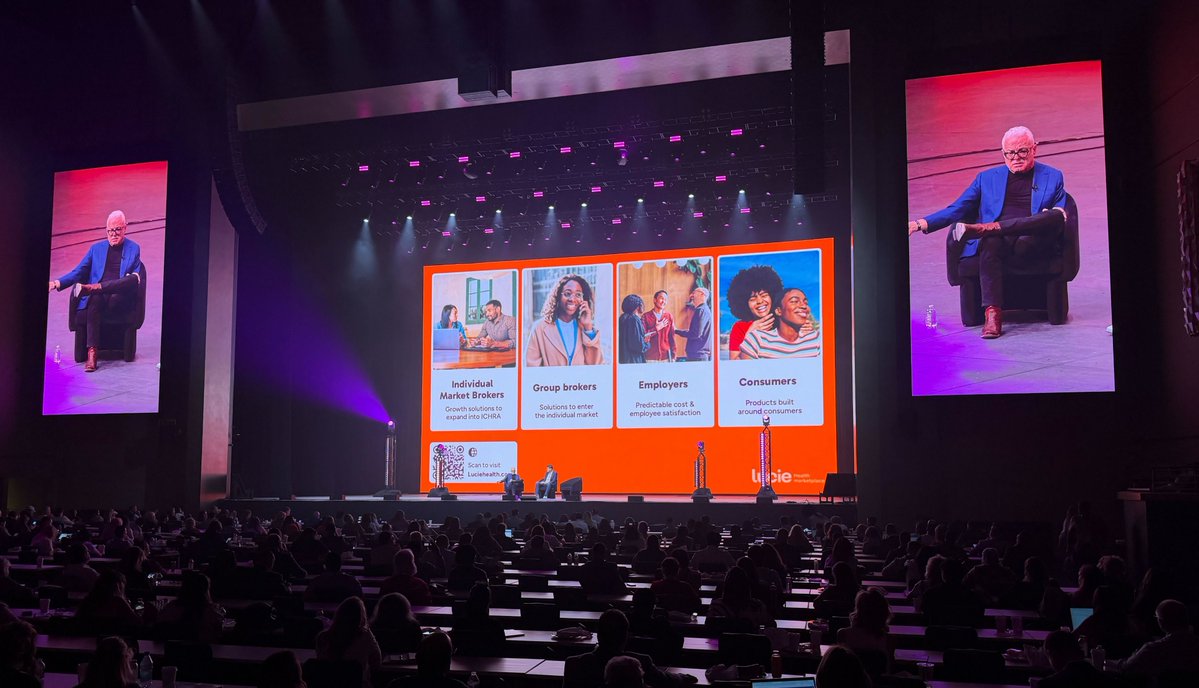
Oscar Health CEO Mark Bertolini just wrapped his keynote at Medicarians, outlining our vision to build the consumer marketplace of the future.
Mark’s message was clear: By moving away from rigid, legacy structures and toward a transparent, consumer-driven marketplace powered by Lucie, we can transform healthcare for 250 million Americans.
🟠 Consumerism drives down costs. Healthcare is now the largest household expense, and Mark believes individual choice is the only way to manage it . "Healthcare is now the largest line item in the household budget above cars, homes, education," Mark said. "People should be able to find what they can afford and find better deals so they can buy more. That’s where we take healthcare with Lucie.”
🟠 Transparency cures waste: Lucie is designed to give healthcare the same market efficiencies found in every other industry. “Consumers drive out all inefficiencies in the marketplace. They can do that in healthcare too. We just have to give them a transparent marketplace to do it," Mark said. "That’s where Lucie comes in.”
🟠 The individual market is bigger than the ACA: The goal is to move beyond the ACA exchanges to revolutionize how all 250 million Americans access care. “We can use the individual market model to transform the entire healthcare market across employer benefits, Medicaid, and even Medicare," Mark said. "We can turn every consumer into an individual buyer and convert this market into the largest healthcare market.”
#Medicarians2026 #luciehealth