Quality SFT data for text2image is key, but often closed. We used a pre-trained diffusion model to select optimal samples, creating Alchemist: an open, general-purpose SFT dataset, outperforming LAION-Aesthetics V2. Link to the method & 5 fine-tuned SD models below 👇(1/9)
📝 Parallel Scaling Law for Language Models
Traditionally, LLMs are scaled in two ways: by increasing parameters (parameter scaling), which is extremely memory-intensive, or by increasing inference-time compute with methods like chain-of-thought (inference-time scaling), which hurts latency.
This paper proposes a third, more inference-efficient path: Parallel Scaling (PS). The core idea is to increase parallel computations during both training and inference, while reusing the existing model parameters.
> Method TL;DR:
Inspired by Classifier-Free Guidance (CFG) in diffusion models, the authors formalize a new method called ParScale:
An input text x is transformed into P different versions using P unique, learnable prefixes (via prefix tuning).
All P versions are processed in parallel through a single, shared Transformer model.
The P resulting outputs (next-token probability distributions) are dynamically aggregated into one final output using a small, learnable MLP. Instead of making the model bigger, we make it "wider" at runtime by reusing its weights multiple times in parallel.
Experiments & Scaling Law:The paper's key contribution is a new scaling law that unifies the number of parameters N and the number of parallel streams P. They empirically derive the formula: Loss ≈ A / (N · (k log P + 1))^α + E
This implies that increasing parallel compute by a factor of P is equivalent to increasing the model's parameter count by a factor of O(log P). The training is done in two stages: standard pre-training (1T tokens), followed by a shorter ParScale fine-tuning stage (20B tokens) to manage training costs.
> Results:
The benefits are significant, especially for inference.
➡️ Inference Efficiency: A 1.6B parameter model with P=8 achieves performance comparable to a much larger model but requires 22x less memory growth and 6x less latency growth than simple parameter scaling.
➡️ Dynamic Scaling: The method can be applied to existing pre-trained models (like Qwen-2.5) by only fine-tuning the small prefix and aggregator modules. This allows for dynamically adjusting P at inference time to trade off performance and cost.
➡️ Reasoning Boost: The benefit from parallelization (coefficient k) was found to be greater for reasoning-heavy tasks (like coding) than for general knowledge tasks, supporting the idea that compute enhances "reasoning" while parameters enhance "knowledge."
> Main takeaway:
An elegant and highly pragmatic idea. Instead of chasing trillions of parameters, this work suggests a more intelligent way to utilize existing resources, offering a powerful "dynamic power" knob for models at inference time.
> Open questions:
Unlike CFG, where inputs are semantically distinct (e.g., conditional vs. unconditional), the prefixes in PS are abstract. What are they actually learning? Do they create genuinely different "perspectives" on a problem? Also, the O(log P) relationship suggests diminishing returns. The study tests up to P=8; it would be fascinating to see if the benefits saturate quickly at P=16 or P=32.
Paper: https://t.co/j9Ju5GgxdM
Post from the authors: https://t.co/4TpHz84zUJ
Parameter and inference-time scaling have already demonstrated that more compute brings more intelligence.
🤔 But is there a new way to scale compute? The answer might be yes!
We propose Parallel Scaling—increasing parallel computation during training and inference. As an exploratory study, we theoretically propose a new scaling law and validate it through pre-training, which shows that a model with P parallel streams is similar to scaling the parameters by O(log P), while showing superior inference efficiency.
📄 https://t.co/PpnUmSw6Jf
🤖 https://t.co/bMoXYpaPWX
🤗https://t.co/CVtc8cZqVM
📝 Enhancing Reward Models for High-quality Image Generation: Beyond Text-Image Alignment
Reward models for T2I evaluation, like CLIP, are popular but flawed. This paper tackles a major issue: these models often penalize highly detailed and complex images, giving lower scores even when the generation is superior.
The root cause? Standard contrastive loss. It trains encoders to find the minimum information needed to match an image to a text. This creates a bias where simple, generic images are easier to match with prompts and thus receive higher scores, while detailed images get punished for their complexity.
> Method TL;DR:
They replace the standard binary (match/no-match) system with a more nuanced one. The key is a new loss function that understands prompt specificity.
They create a dataset with prompts of varying detail (e.g., "a dog" vs. "a fluffy golden retriever sitting in a sunlit field").
They introduce new alignment categories: "matches detailed prompt," "matches general prompt," or "no match."
They use a new threshold-based loss that rewards the model more for matching a detailed prompt than a general one.
> Experiments:
The method is built around a custom-curated dataset where prompts are explicitly labeled by their level of detail. By training on this tiered data, the model learns to differentiate between low-effort and high-effort text-image alignment, directly addressing the core problem.
> Results:
By design, this approach should produce a reward model that aligns better with human preferences for quality and detail. It directly teaches the model that "high detail" is a positive signal, countering the simplifying bias of standard contrastive learning. The code and model are available for verification.
> Main takeaway:
A cool and practical idea for fixing a known flaw in CLIP-style reward models. It's a targeted solution that should work as described, pushing reward signals beyond simple semantic alignment.
> Open questions:
The solution is clever but feels a bit like a "workaround". While effective, is this the most elegant long-term solution, or is there a more fundamental way to fix the underlying issues in contrastive losses for aesthetic evaluation? Still, it’s a great step forward.
Paper: https://t.co/ZCyJLD7kPZ
Code/weights: https://t.co/J8t5FaxAB1
Thanks to authors: @WyvernBai (could not find other co-authors here)
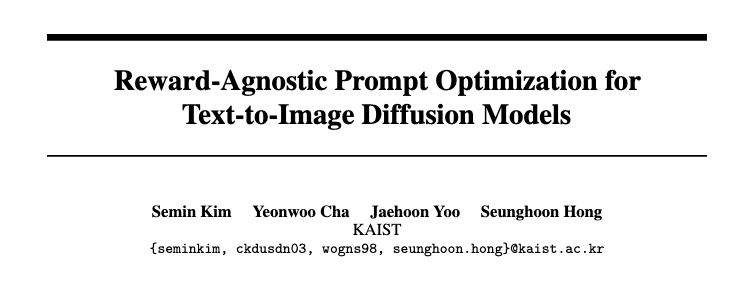
Tired of brute-forcing test-time compute for boosting text-to-image models?
A new paper on Reward-Agnostic Prompt Optimization offers a smarter, iterative approach.
Old way: Generate tons of images, then have a VLM pick the best (used in SANA 1.5). Very expensive.
New way:
1️⃣ An LLM suggests prompt improvements.
2️⃣ Images are generated from these new prompts.
3️⃣ A VLM scores the results.
4️⃣ The LLM learns from these scores to make even better suggestions.
This feedback loop achieves SOTA on LLMGrader for Lexica/DiffusionDB, though its success depends heavily on the quality of the LLM/VLM used.
Paper: https://t.co/2tEMTeTL6C
Code: https://t.co/v8Kill7TZM
So bad that none of the authors are on X.
📝 Vision-Language-Vision Auto-Encoder: Scalable Knowledge Distillation from Diffusion Models (https://t.co/Id4UHn2HCK)
There’s strong interest in speeding up multimodal model training. In T2I/T2V generation, REPA and its many variants are trending — they align diffusion features with those from a high-quality pretrained model like DINOv2 during training.
This new work applies similar ideas to VLMs. Instead of training I2T from scratch, first train the model to produce embeddings that enable good image generation. If those embeddings are informative enough for generating images, they should also work for generating text descriptions.
> Method TL;DR:
Train a vision-language-vision (VLV) autoencoder that encodes images to text embeddings, so a diffusion decoder can reconstruct the image. Then swap in an LM instead of the diffusion decoder, finetune a bit — and you’ve got a SOTA captioner.
> Experiments:
Stage 1: Pretrain VLV on 40M filtered LAION-AES images (self-supervised).
Stage 2: Use 6M synthetic image-text pairs from Gemini-2.0 Flash.
For init use Florence-2 as the image encoder, SDv2.1 as diffusion decoder (why that? not an obvious choice), and Qwen-2.5 of various sizes for the LM part on stage 2. Stage 1 takes ~1k GPU hours; total budget is modest.
> Results:
Image captioning matches GPT-4o quality (outperforms Qwen-2.5 VL). Other tasks (image generation, few-shot VQA) work but are less clear.
Main takeaway: great new SSL training framework + a new source of multimodal embeddings.
Open questions: Stage 2 relies on synthetic Gemini data, which might boost I2T training by itself — would love to see ablations. Suppl. shows stage 1 helps, but what if we did standard VLM pretrain, then only applied the stage 2 tuning?
Paper: https://t.co/Id4UHn2HCK
Page with code, model, data: https://t.co/YgVuVU6L0J
Thanks to the authors: @zhang_tiezheng, @jieneng_chen, @YuilleAlan, @_Chen_Wei_, @never1andd
📝 Why Is Spatial Reasoning Hard for VLMs? An Attention Mechanism Perspective on Focus Areas (https://t.co/zqKkV4IxST)
In Mechanistic Interpretability people find a problem in a DL system and try to explain it by looking for bugs within the model’s internal states (weights, activations, gradients).
The authors of this work decided to figure out why modern VLMs are unable to to adequately recognize spatial relationships between objects. When prompted to describe what’s happening in an image, these models often confuse which object is lying on another, which object is in the foreground, which one is in the background, etc.
For the experiment, they conducted the following analysis:
- Take a VLM and ask it to describe how one object is positioned relative to another in an image (left, behind, etc.);
- Use YOLO to detect the region that should be responsible for the correct answer;
- Check how much the model’s attention localization coincides with the YOLO-detected region in both correct and incorrect answers.
While doing that, the authors found that the model mostly makes mistakes when it mislocalizes its attention. They identified two error scenarios:
- The predictions are highly confident, but the attention spills out of the target region;
- The predictions have low confidence, but the attention is too tightly localized—the model is practically "staring at a point".
The proposed fix for both scenarios is to tweak the softmax temperature:
- In the case of high confidence, increase the temperature, helping the model localize its predictions better;
- In the case of low confidence, decrease the temperature, which helps it "look around" a bit more.
Experiments were conducted on LLaVA 1.5 using the WhatsUp and VSR datasets, which contain <image, text> pairs. GPT-4o was used to generate the questions for the images. During the experiments, temperature was swept on a grid to maximally improve prediction accuracy. The method significantly boosts performance, especially on synthetic data.
Paper: https://t.co/zqKkV4IxST
Code: https://t.co/oLKe4BITKg
So how is Alchemist built? We begin with raw internet data, then apply a multi-stage automated filtering pipeline. This targets NSFW content, resolution, image quality, & aesthetics, reducing billions of images to approx. 300M candidates. (3/9)
We release the dataset and models. Feel free to try it out and share your feedback!
Paper: https://t.co/sKZdOYa3Qo
Dataset: https://t.co/8zQW0oS62w
Models: https://t.co/S5VTILeQBe (8/9)
SFT (standard for top models since EMU '23) demands small, exceptional, unbiased data to avoid model collapse or domain specialization. While specific fine-tunes like anime exist, they sacrifice generalization. General SFT datasets? Often closed, how-to-create unknown. (2/9)
Quality SFT data for text2image is key, but often closed. We used a pre-trained diffusion model to select optimal samples, creating Alchemist: an open, general-purpose SFT dataset, outperforming LAION-Aesthetics V2. Link to the method & 5 fine-tuned SD models below 👇(1/9)
Look, Yet another Art rendering technology is here!✨
https://t.co/cxim6j44WE Find out the details behind data filtering, model scaling, RLHF and evaluation in the paper https://t.co/a6CnMqtQbL
You can also try the model in the app: https://t.co/vsWjBjSq7e