Neil Movva (@neilmovva) started his career at Nvidia, working on GPUs and kernels, and has an unusually deep understanding of inference, from software to chips to power.
We spend a lot of time on each of those layers, how they connect, and where the important tradeoffs are.
What makes this conversation special is how detailed it is (like a 401-level class), yet Neil makes it remarkably clear and easy to follow.
Today he runs Sail Research, a company building infrastructure for agents to make tokens as cheap as possible.
We discuss:
- Latency versus throughput
- Why there are no bad chips, only bad pricing
- The end of kernel engineering
- Buying chips and power no one else wants
- New chip architectures
- Nvidia lore + his contrarian view of the company
- Open source and the frontier labs
I learned a ton. Enjoy!
TIMESTAMPS
0:00 Intro
0:38 Building a “Token Factory”
4:21 The Future of Background Agents
13:09 Nvidia and the GPU Stack
23:27 Chips, Memory, and Transformers
36:14 The Future of AI Training Data
44:32 Chip Scarcity and Compute Arbitrage
52:44 Reinventing the AI Data Center
59:01 Power and the “Scavenger Strategy”
1:10:10 Open vs. Closed AI
Cardio is a scam for fat loss.
It's boring, leads to overeating, and barely burns any calories.
Summer 2026 is almost over.
Here are 9 cheat codes that actually burns fat:
1. Don't eat breakfast
We’re going live in 1 hour with @AlexFinn.
See how he gets things done with his voice agent in Codex—on desktop and mobile.
Keyboard optional.
https://t.co/TZVBy3EBDD
Introducing Vetta, the most efficient harness for long-horizon agent tasks.
Same model, same tasks. Only the harness changed:
🥇 Vetta: $0.298 per finished task
🥈 claude-code: $0.872
🥉 hermes: $1.095
Highest finish rate, a third of the price. Autonomous companies only happen when the cost makes sense.
Here's how we get there:
I use @pidotdev as my daily driver because it stays lean. Pi gives me an efficient, understandable core and lets me add capabilities only where my workflow needs them.
These are my current favorite extensions:
• Ponytail -- nudges the agent to reuse what already exists before writing more code. I use it to keep implementations focused and avoid unnecessary complexity.
https://t.co/IviojsLPt0
• pi-web-access -- gives Pi web search and access to pages, GitHub repositories, PDFs and videos. I connect it to my own SearXNG instance so Pi can research a topic and bring the relevant context into the session.
https://t.co/1M9FztKMmJ
• pi-subagents -- lets me delegate focused work to different models. I use it to run research or reviews in parallel and return concise results to the parent session.
https://t.co/mYlvUJBUPE
• pi-fff -- adds pre-indexed fuzzy file and content search with frecency ranking. It makes larger repositories noticeably faster to navigate.
https://t.co/wtZ9ZOGtTh
• pi-context-view -- estimates how the context window is being used, including the base prompt, tool definitions and extension injections. I use it to check the context cost of every capability I add.
https://t.co/p3JAdwoIB0
What extensions have earned a permanent place in your Pi setup?
@thsottiaux One example was testing an enterprise control against heterogeneous evidence files - where validating the control required reviewing and reasoning across different types of supporting evidence.
🥧 Introducing GooeyPi - A GUI for the Pi Family of Agents.
Supports: Pi, Oh-My-Pi (OMP), and Prime Agent
Very excited to share this with you all. Being into local models, I wanted to have a separate harness for my local models so I don't have to constantly switch configs. And I didn't want to go back to the TUI (nerds).
But, I didn't want to miss out on all the features that I know and love. Turns out, I didn't have to. I just needed to build it myself.
So I did.
Features include:
> Fully featured GUI experience
> Agentic Browser
> Realtime Voice Agent
> Voice transcription (local or API)
> Computer Use
> Automation Desk
> Agent to Agent messaging
> Ask Question Tool
> Git Control
> Terminal
> Pets
> and more
I tried to capture all of the most popular features I could in this first pass, but we're only just getting started.
Available in BETA on MacOS, Linux, and Windows.
I need testers! I have only tested on Mac and Linux.
If you want to help me with this project, please reach out.
Available: https://t.co/2uKJD0GetD
Ok friends, sharing the recipe to build basically any agent product:
• Memory: learn everything useful about the user, their work, people, preferences, projects, decisions, etc. from their emails, drive, computer files etc
• Context engineering: figure out which tiny subset of all that memory + current state actually belongs in the context window for the task.
• Skills: teach the agent how to do the work. Build a complex DCF. Prepare a board meeting. Triage an inbox. Run customer research. Write an investment memo.
• Tools / MCPs: give it access to the world. Email, calendar, Slack, GitHub, CRM, browser, databases, internal APIs, computer use, etc.
• Agent runtime: the loop that plans, acts, observes, retries, delegates, checkpoints state and can keep working for hours or days.
• Triggers: cron jobs + events. New email arrives. Meeting ends. Customer churns. Metric changes. Deadline approaches. The agent wakes up without being prompted.
• Trust / permissions: know what it can do autonomously, what requires approval, and whose identity / permissions it is acting with.
• Evals: trace everything and continuously measure whether the agent is actually getting better.
Then optimize the hell out of memory quality, context selection, action quality, latency and token cost. That’s basically the agent stack. If you need more verticalization (aka finance, logistics etc. just add more MCPs and skills).
Our finance team shared 16 workflows with ChatGPT Work and Codex, from monthly close to forecasting and treasury.
Really good read especially if you’re in finance.
https://t.co/w1zsDqSnxy
You should totally be updating your agents md regularly!
Here's mine:
- When explaining something to the user, use the Visualize skill
- Be concise, direct, and candid. Challenge weak assumptions and distinguish verified facts from uncertainty
- Ground research in authoritative, current sources and link important evidence
- Preserve the original goal and constraints; finish authorized work end to end and verify the actual result before claiming completion
- Ask questions only when a decision is materially ambiguous, risky, or requires approval
- Use relevant skills; spawn subagents only for genuinely independent work and synthesize their findings
- Keep changes focused and simple. Avoid unrelated edits, unnecessary abstractions, and low-signal tests
- Test observable behavior, review substantial changes, and validate user-facing work in the real interface when applicable
- Preserve unrelated work and never take destructive, production, or external actions beyond what the user authorized
- Report meaningful blockers, outcomes, and evidence without noisy progress
开发系统最极致高效的Agents.md,没有之一:
# AGENTS.md
## Core Principles
- Choose the simplest implementation that fully satisfies the current requirements. Avoid unnecessary abstraction, configuration, indirection, or speculative extensibility.
- Make the smallest necessary change that fixes the root cause. Do not refactor unrelated modules or change strategy semantics unless explicitly requested.
- Grow the system in layers. Start from the smallest working end-to-end version and add new capabilities incrementally. Never replace a working system with unfinished complexity.
- Reuse existing project components before creating new ones. Prefer extending proven modules over introducing parallel implementations.
- Prefer well-maintained libraries when they reduce overall complexity or improve reliability. Do not reimplement common functionality without a clear benefit.
- Keep components modular with clearly defined responsibilities. Avoid unnecessary coupling between strategy logic, execution, accounting, replay, and infrastructure.
- Design for long-term maintainability once a feature or strategy has been validated. Do not over-engineer speculative ideas before evidence exists.
---
## Strategy Development
- Validate hypotheses with historical replay before introducing forward-only logic whenever historical validation is possible.
- Every trading strategy must progress through Replay → Shadow → Canary → Live. Do not skip validation stages.
- Base design decisions on measurable evidence rather than intuition. Optimize only after demonstrating that an edge exists.
- Treat every strategy as an independent contract. Do not silently alter frozen behavior without explicit authorization.
---
## Existing Systems
- Do not break running Shadow or Live systems for unrelated work.
- Preserve compatibility only when required by active production or validation workflows. Otherwise, remove obsolete code instead of accumulating compatibility layers.
- Reuse existing infrastructure whenever possible, including replay engines, accounting, execution, wallet management, order book handling, logging, monitoring, and daemon frameworks.
---
## Engineering Standards
- Prefer deterministic behavior over hidden automation.
- Fail loudly when assumptions are violated. Do not silently ignore errors or fall back to unexpected behavior.
- Keep configuration minimal. Introduce new configuration only when behavior genuinely needs to vary.
- Remove dead code instead of leaving unused paths behind.
- Write code that is easy to inspect, replay, test, and reason about.
- Keep implementation consistent with existing project architecture unless an architectural change is explicitly requested.
---
## Scope Discipline
- Implement only the requested scope.
- Do not introduce unrelated optimizations, redesigns, migrations, or feature expansions.
- Non-blocking findings outside the requested scope may be noted separately but must not be merged into the current task.
- Consider a task complete once its agreed acceptance criteria are satisfied. Treat subsequent improvements as separate work items.
Audio moves through a dedicated fast path, while deeper reasoning and tool use happen asynchronously.
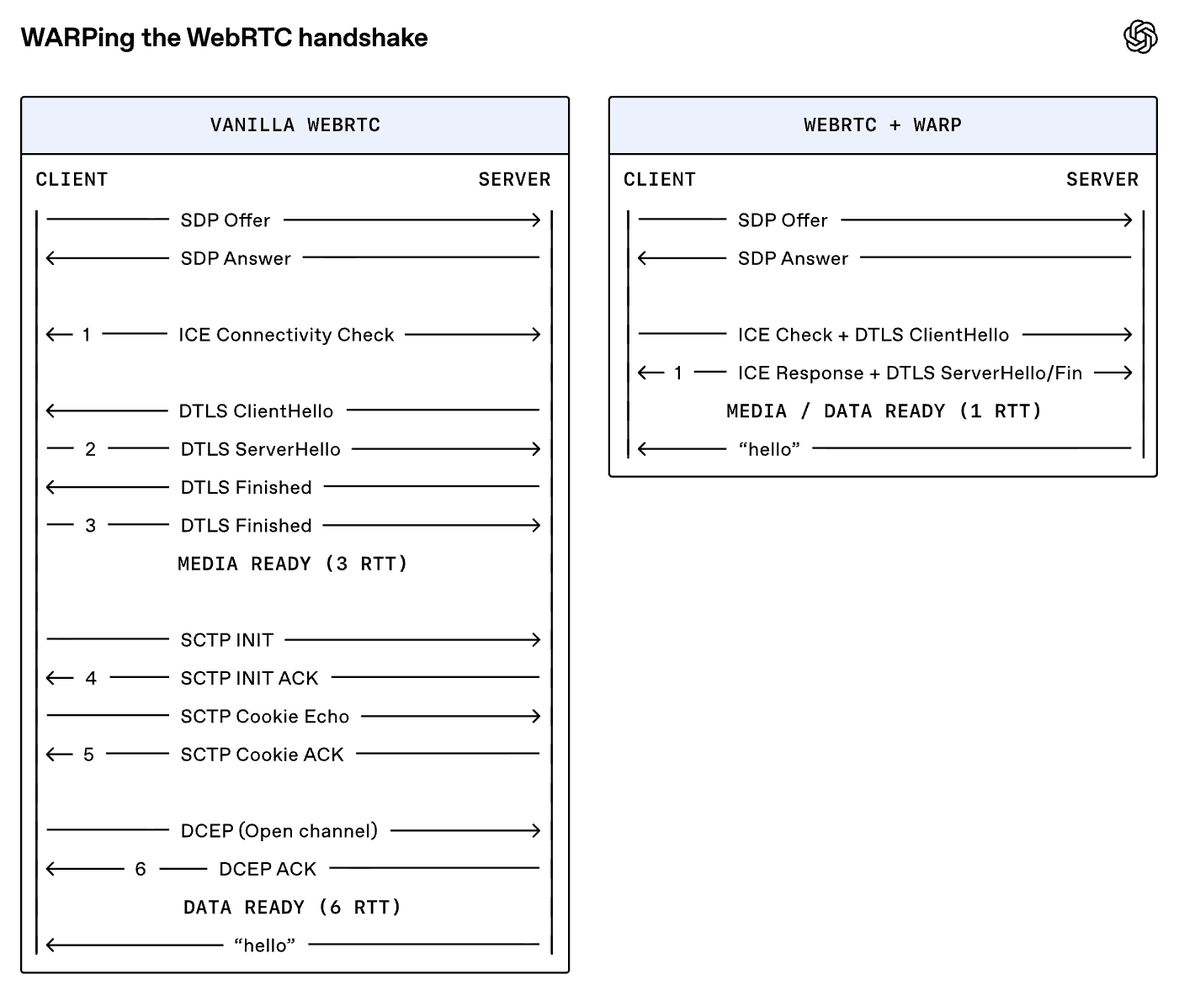
We also reduced voice-session startup from six network round trips to one.
GPT-Live can listen while it speaks.
To make that feel natural at ChatGPT scale, we rebuilt the voice stack from client to model.
This new architecture keeps audio flowing continuously, so deeper reasoning and tool use don't interrupt the conversation.
I've shipped 340+ features with Claude Code across 12 client projects in 18 months.
These 7 workflows are the ONLY ones I actually use anymore because they cut my dev time by 70% and turned Claude Code into a senior engineer that never sleeps: 👇