In our new review paper in Current Opinion in Neurobiology, we ask "What links self-reported 'surprise' in human experiments to the brain activity of monkeys seeing 'surprising' fractals?" 🤯😲
https://t.co/34DZLsKGfy
Do you "look at nothing" when making a decision?
Here we provide further evidence about the connection betwee gaze into nothing and decision confidence, revealing more on the sequential hidden dynamics of decisions
https://t.co/afXu90W6dd
AI vision is insanely good nowadays—but is it really like human vision or something else entirely? In our new pre-print, we pinpoint a fundamental visual mechanism that's trivial for humans yet causes most models to fail spectacularly. Let's dive in👇🧠
[https://t.co/rkJRN6HmDg]
Happy to announce that my PhD thesis deriving the mathematical theory of the free-energy principle has been awarded the Yael Naim Dowker Prize for Best Maths PhD Thesis from Imperial College London!! 🎉 https://t.co/okX2vCtcO9
How does our brain predict the future? Our review of predictive processing + research program is now on arXiv https://t.co/4GEXauuCeK
50+ neuroscientists distributed across the world worked together to create this unique community project.
What are serotonin neurons trying to tell the brain? Our work on the question has been so much fun (@JCBeique , @JermiahYCohen, @grossmancooper ). Check out @efharkin_ 's exciting paper
https://t.co/B4N4trwXvb
https://t.co/762ODzWcT0
Our latest research, led by @AntoineMadar, on what #SynapticPlasticity rules shape CA1 and CA3 representations in the hippocampus during familiarization has just been published in @NatureNeuro! Read here: https://t.co/eWT3j3wVSU
Want to hear more about hippocampus-to-cortex
feedback circuit? Our paper with the Basu lab is out in Nat Neuro! https://t.co/cu2lcjyOrJ . Well done Tanvi Butola!
🚨 Inviting all Curious Agents 🔍👀 to attend our workshop @RLDMDublin2025!!
With amazing speakers from across disciplines, we attempt to arrive at the core principles underlying intrinsic motivations in biological and artificial agents 🎮🧠🤖💪
Website: https://t.co/txeDPpHLfF
Long-overdue thread on our latest work using the IBL data to reveal the shared organizational principles of the neural code in the cortex.
A systematic analysis of categoricality 🧱 and dimensionality 📐 of the neural code across 40+ regions.
https://t.co/42Z2KwUkYS
👇 1/n
New results! Visual adaptation changes the geometry of V1 population activity: frequent stimuli elicit smaller responses but become more discriminable, consistent with our efficient coding model. You can find me on the "new neurotwitter" at mariodipoppa. https://t.co/Mf58zzYrgq
Happy to share my second paper with Peter Dayan on our decision-theoretic approach to perceptual multistability (see the tweeprint of the first paper here https://t.co/Qq3ABjSYoP): A decision-theoretic model of multistability https://t.co/QSeRJcmyLn
Feel free to check our preprint as well: https://t.co/0lFmp7Lm1Y
Thanks so much to the organizers @MonosovLab and Emmanuel Procyk for the inspiring conference! 💫
If you're at #foragingconference2024 , come check out our poster (#60) with @modirshanechi and @compneuro_epfl today!
Using a unified computational framework and two open-access datasets, we show how novelty and novelty-guided behaviors are influenced by stimulus similarities😊🤩
What are the brain’s “real” tuning curves?
Our new preprint "SIMPL: Scalable and hassle-free optimisation of neural representations from behaviour” argues that existing techniques for latent variable discovery are lacking.
We suggest a much simpl-er way to do things.
1/21🧵
I am excited to announce that I've been awarded an SNSF Starting Grant! 🥳 I will start a lab at the Institute of Neuroinformatics in Zürich next year and we will work on "Neural mechanisms of perception and learning in uncertainty."
@snsf_ch@UZH_en
🚨Preprint alert🚨
In an amazing collaboration with @GruazL53069, @sobeckerneuro, & J Brea, we explored a major puzzle in neuroscience & psychology:
*What are the merits of curiosity⁉️*
https://t.co/Au2HxPbZQL
1/7
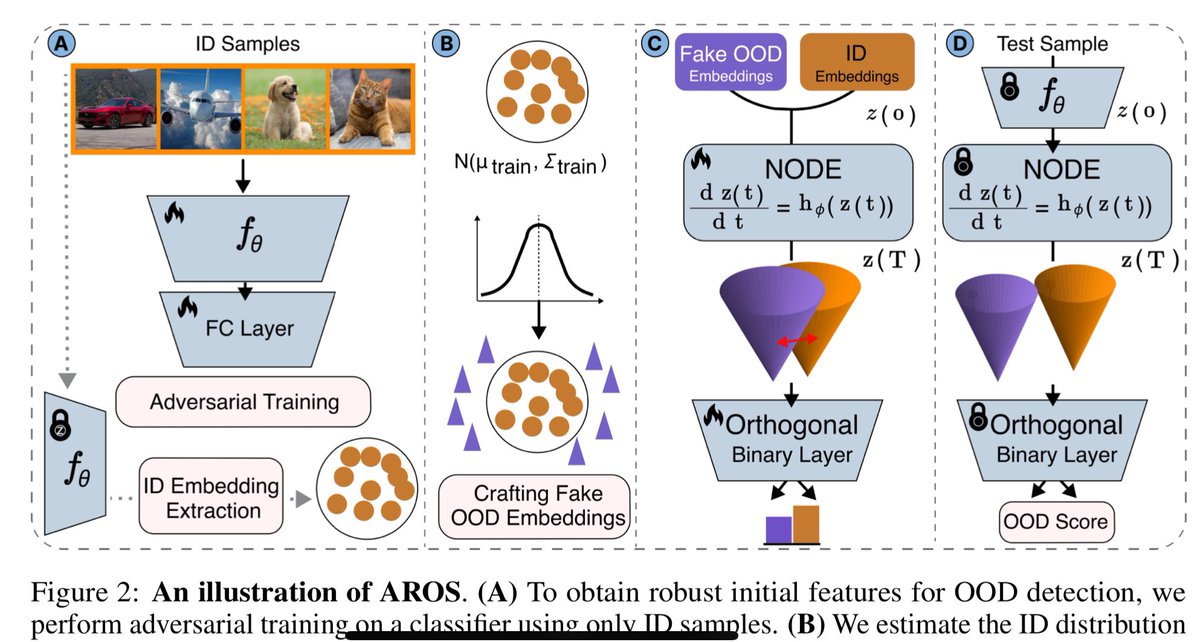
🚨adversarial robustness is becoming even more critical as AI systems are deployed in the real-world, but how can we detect outliers (adversarials) without having trained on them 👀?
In our new preprint, we introduce AROS💍: It leverages neural ODEs and Lyapunov stability theory to craft an embedding method to smartly detect OOD samples. Strikingly, we can improve performance on popular adversarial detection benchmarks such as CIFAR10 vs CIFAR100 by over 40%.
✨Led by the super talented @EPFL_en @mwmathislab PhD student @hsirm96 ~> check it out! https://t.co/pglbwzx6uj
Back in 2022, @roxana_zeraati & I organized a Cosyne workshop on neural timescales, and after working on it for the last 2 years together, it's now a review paper!
https://t.co/LgVdULAQ2U
w/ @SelfOrgAnna & @jakhmack
(2nd blogpost to turn into a real review paper this year lol)
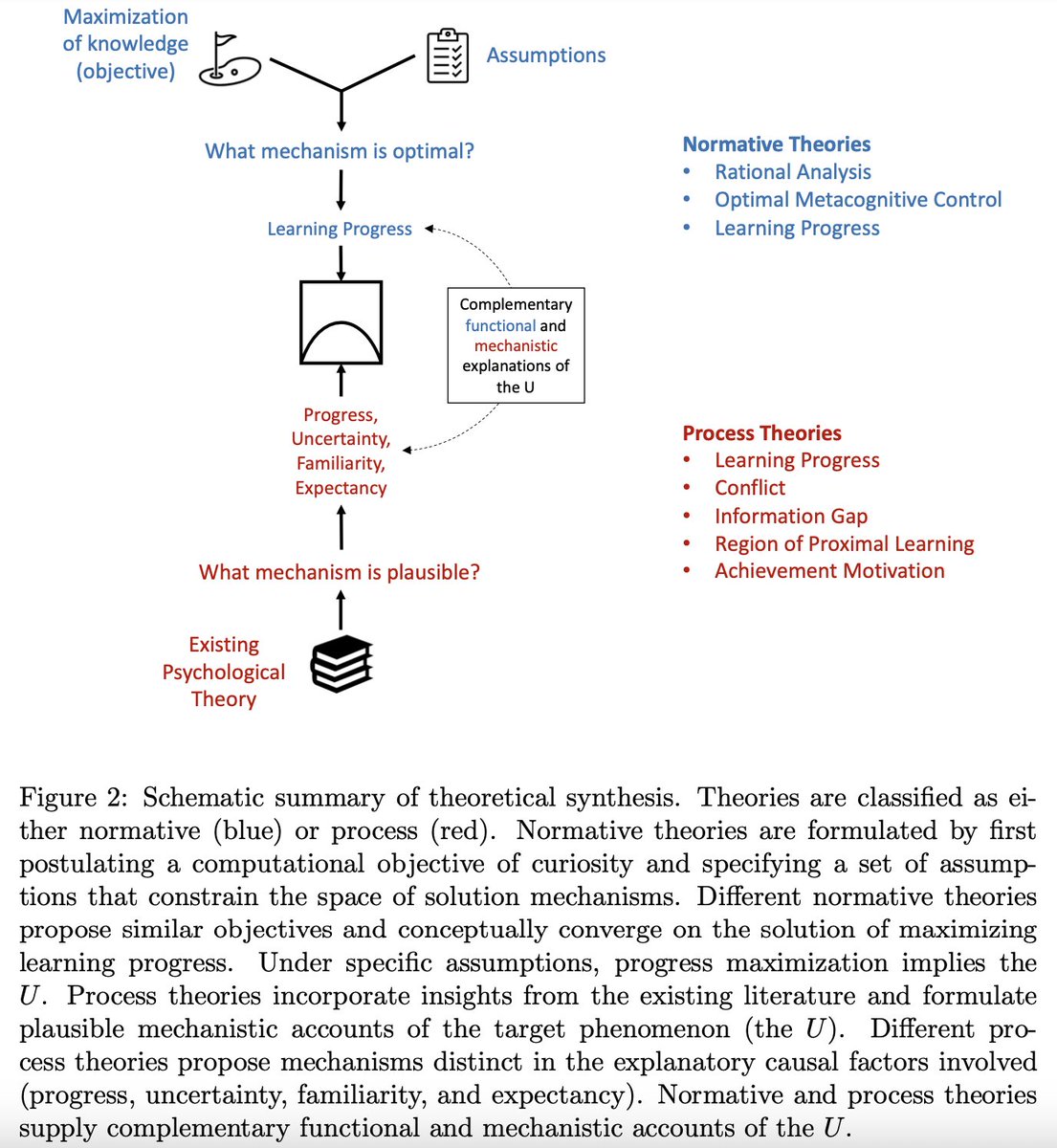
🚀The curious U: Integrating theories linking knowledge and information-seeking behavior
New preprint with Alexander Ten,@MichikoSakaki and @KouMurayama
Special thanks to Alex for leading this work! 🙌
📖 https://t.co/0YkyTaBoBw
In this paper, we study how 7 theories of human curiosity account for the inverted U relationship often observed between curiosity and knowledge 🧠🤔(We tend to be curious about things that are new, but not too new)
We consider both
+ 🧑🔬normative theories (rational analysis theory , optimal metacognitive control theory, learning progress theory)
+🧩process theories (conflict, information gap, learning progress, region of proximal learning, achievement motivation)
🤯So far, the links between these theories have been understood in very limited ways.
We leverage the fact that they all propose an account of the inverted U to identify several fundamental and formal links between these theories, and propose a framework explaining the U as the result processes that maximize learning progress 📈.
In turn, we discuss how these processes are efficient heuristics to approximate optimal knowledge maximization in complex worlds with limited time and energy resources.
💡We also explain why some of these theories predict that in some environments with particular kinds of learning opportunities (different from those studied in experiments about the curious U), one shall NOT observed an inverted U.




![lonnqvistben's tweet photo. AI vision is insanely good nowadays—but is it really like human vision or something else entirely? In our new pre-print, we pinpoint a fundamental visual mechanism that's trivial for humans yet causes most models to fail spectacularly. Let's dive in👇🧠
[https://t.co/rkJRN6HmDg] https://t.co/IkDhhrf3Og](https://pbs.twimg.com/media/GpI00iaWUAAe2YY.jpg)