There are two known sublime numbers:
First: 12
Second: 6,086,555,670,238,378,989,670,371,734,243,169,622,657,830,773,351,885,970,528,324,860,512,791,691,264.
@anishgiri The two posts really answer two different questions. Both perspectives are essential for different levels of play. Vidit’s post helps a person like me; Anish’s post helps the high-level player.
@MIT_CSAIL I routinely told my boss a project would take three times as long as decided in group meetings. This only earned me the nickname Cassandra from a coworker.
In his book “Helgoland,” the theoretical physicist Carlo Rovelli cites the Buddhist philosopher Nagarjuna as an influence on his work. “By renouncing ‘primary’ entities or any ‘ultimate absolute reality,’ we can better make sense of the world.” https://t.co/aZVDTeVbPM
Weekend Movie 🍿 🎥
Knight Moves (1992) is a thriller film starring Christopher Lambert as a chess grandmaster who becomes the prime suspect in a series of murders during a tournament, with the killer taunting him by staging the victims like a chess game.
https://t.co/C5KVnvdaUq
"Mathematical beauty is the aesthetic pleasure derived from the abstractness, purity, simplicity, depth or orderliness of mathematics."
The office of the mathematician who said that:
Today marks 20 years of sobriety for me. Extremely grateful for my recovery community today and every day and sending my love to anyone out there counting days ❤️🩹
@fsalav@pickover This problem gives a different set of assumptions by stating at least one is a boy. It’s not asking the probability of a random child being a boy.
@pickover Seems somewhat similar to the famous Goat problem in that the piece of knowledge you’re given narrows the domain of possibilities and so the answer is non intuitive (I agree that the answer to this one is 1/3)
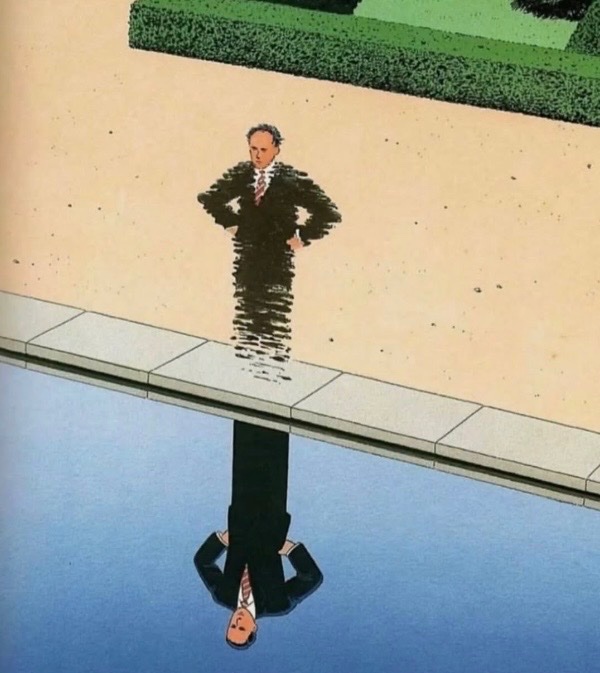
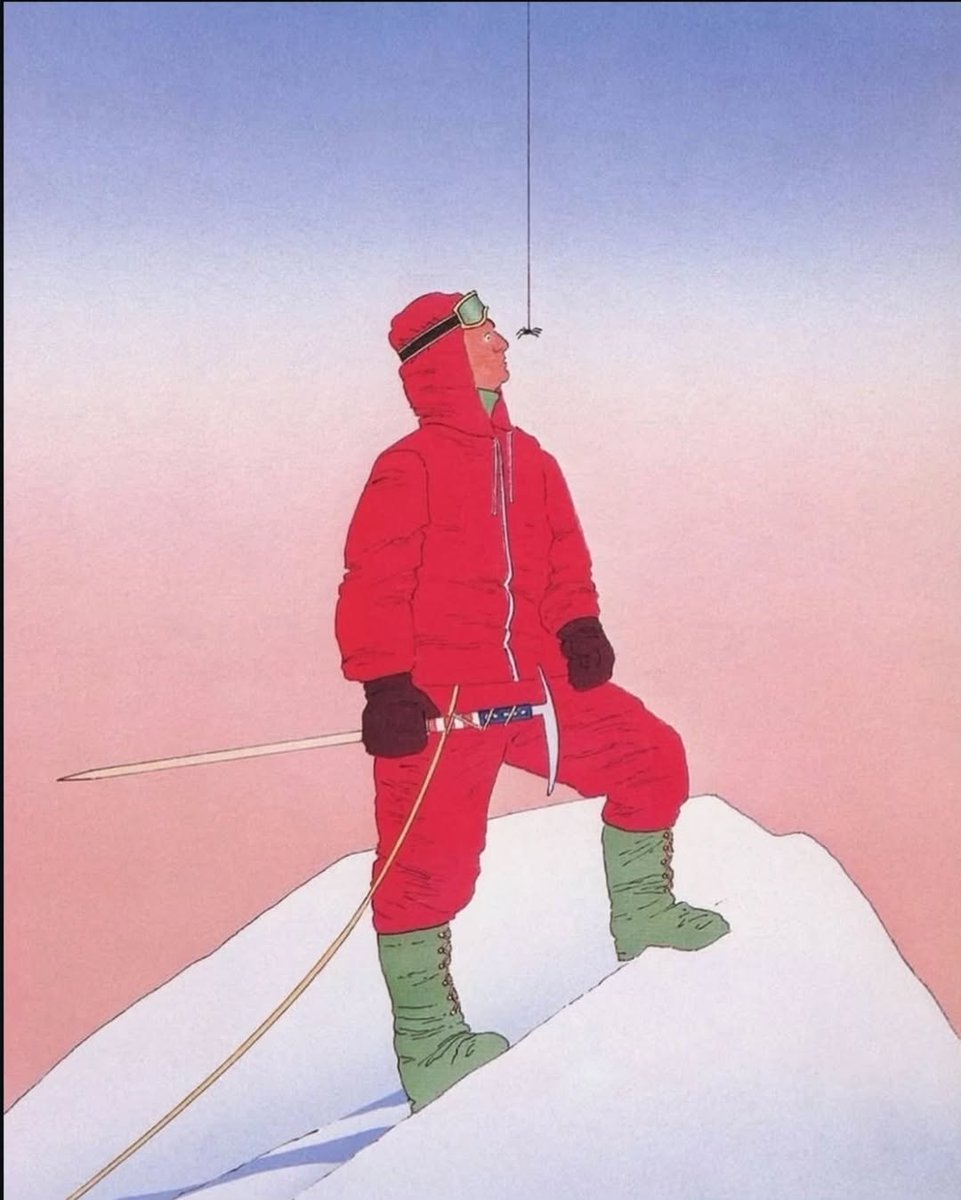
The most underrated illustrator you’ve probably never heard of: Guy Billout
Born in 1941 in France, Guy Billout is a master of visual irony who has spent decades subtly challenging our perception of reality. After beginning his career in advertising in Paris, he moved to New York in 1969, where he was discovered by legendary designer Milton Glaser. His career soon took off, and he became especially known for his 24-year run at The Atlantic, where he was given remarkable editorial freedom to create single-page illustrations that appeared ordinary at first glance—until a single impossible detail turned the entire scene on its head.
His work is heavily influenced by the ligne claire (“clear line”) style popularized by Hergé, featuring crisp outlines, subtle gradients, and minimalist compositions. Beneath their calm, architectural precision, Billout’s illustrations are deeply philosophical and quietly surreal. His work has earned him a place in the Society of Illustrators Hall of Fame and inclusion in the permanent collection of the Smithsonian Institution. By using visual “glitches” as a storytelling device, Billout reminds viewers that even the most orderly worlds can be undone by a single poetic disruption.