“The essential notion of a capitalist society is voluntary cooperation, voluntary exchange. The essential notion of a socialist society is force.”
— Milton Friedman
Here's one idea about SpaceX's next big thing. AI computing (inference) on orbit, but how the hell can SpaceX do this cheaper than just building more datacenters on the ground?
From first principles, it's an attractive proposition because the GPUs have extreme value per kg and extreme revenue per kW, both of which are relatively expensive. That is, the value prop somewhat washes out the pain of operating in space.
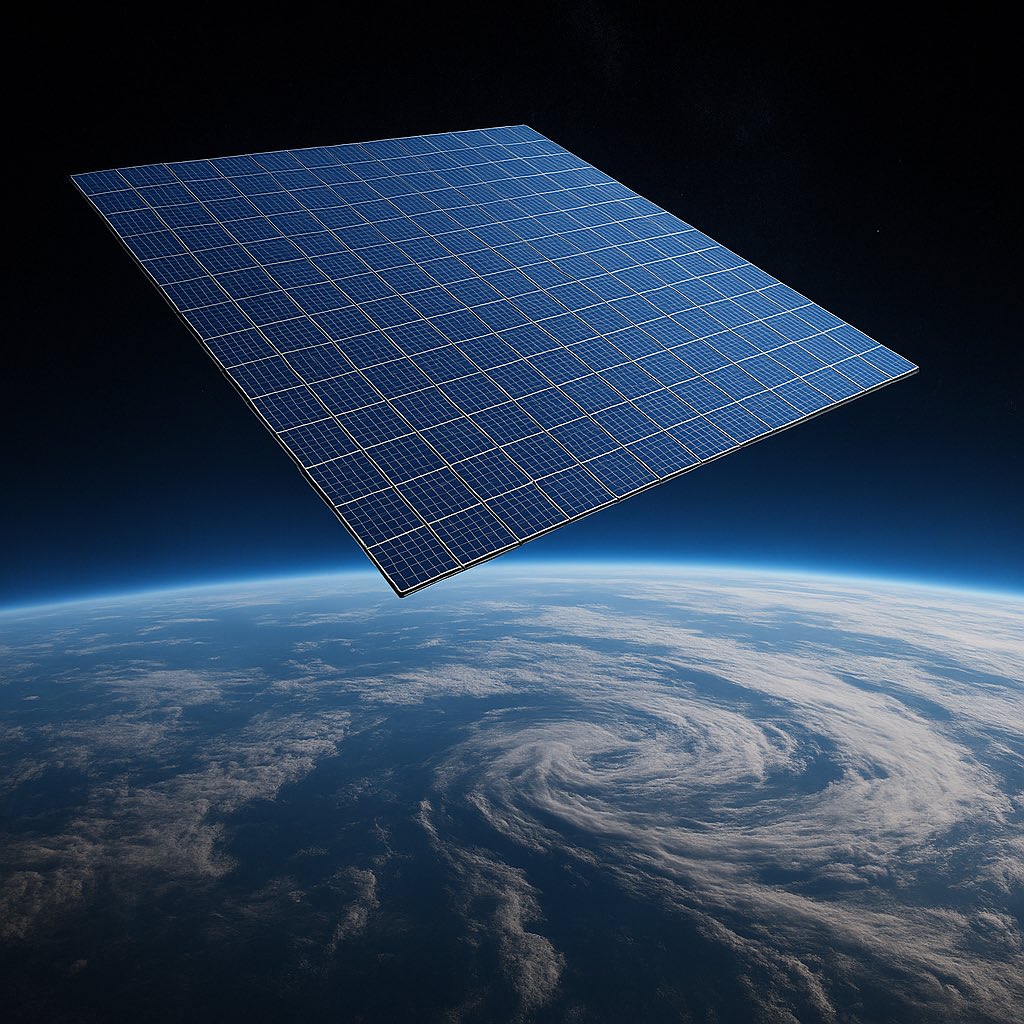
So I took a closer look. If anyone can make this work, it's a Starlink-derived system, so I started with the Starlink v3 satellites, with some high fidelity CEO-cad below.
Orbital parameters. Pick a sun synchronous orbit - so we're in full 1400 kW/m^2 sunlight at all times. No need for batteries. Deploy the solar array in "sun slicer" mode, facing full sun, but the edge is pointing in the orbital direction (bottom right in these images) to minimize drag. But the inference Starlink (Star Thought?) satellites don't have to scrape the atmosphere. Being in SSO, they'll need to use the rest of the Starlink constellation for backhaul via laser links anyway, and higher orbits actually improve worst case latency (serving equatorial customers around midnight or noon) very slightly. Too high though, and SSO is relatively full of debris. Let's pick 560 km.
A Starlink satellite in this orbit has full sun, so the back half is always shaded and relatively cool. The next hottest thing in the sky is the Earth, taking up almost half the sky to the bottom left in these images. So set up an MLI heat reflector there too, and then on the back side of the main bus we can use passive radiation to cool right down. The non-shiny parts of space are very cold. An array of this size produces about 130 kW of electrical power.
In this model, perhaps 200 H100-equivalent GPUs are racked on the main bus, generating 13,000 tokens per second, nowhere near enough to saturate a laser link. At $10/token, that's $4m of revenue per year. Assuming an all in cost of $50,000/kW (dominated by the GPUs on a kW or kg basis), that's something like 60% ROI per year. Obviously assumptions can vary.
But this neglects a broader point.
Starlink satellites have to do all kinds of things that inference satellites don't have to, in particular, talk to millions of customers all over the world. If most of our power is just going to inference, would we change the design?
Each solar array module produces about 6 kW. Each GPU consumes about 700 W. SpaceX could actually install GPUs directly to the solar module, matching optimal voltage and current levels and connecting each back to the main bus not with an insulated high voltage power cable, but a local wifi connection. There's then no real limit on how many modules can connect to each bus, which drives the overall power density of the system towards the thinnest solar arrays than can be flown, probably close to 1 kg/m^2 in the limit.
That is, the inference is performed by a thin piece of silicon that always faces the sun, connected to a somewhat smaller piece of thin silicon with billions of logic gates in it. This helps the thermal problem too, because we're not bringing a bunch of power into one concentrated place.
If one Starship can launch 100 T to LEO, then that gets close to 30 MW of inference per launch. 1000 launches is 30 GW. Now we're talking real scale - and provided the revenue per kWh is greater than about $4.00, I think the economics work out.
I've seen a bunch of high inclination Starlink launches from Vandenberg recently, but I don't think any of them were going to SSO.
In any case, a ring of inference satellites visible at dawn and dusk running north south will be awesome.
Maintenance is covered and rare anyway. Batteries may need to be replaced after 12 years or so but likely at a much lower cost than today.
Agree payback is not great if you finance a system.
ROI with cash purchase or lease to own is good.
Electric bill prices will only continue to increase over time, at a minimum due to inflation while your solar price per kWh is fixed.
Meanwhile, fossil backup generators can never pay for themselves or generate revenue and do require significant maintenance and fuel costs.
@1sthand2@JesseJenkins Fully installed solar prices in Australia are notably cheaper, roughly half the cost that we pay in the US.
Primarily due to decreased regulatory burden and the resulting high volume.
@xiaowang1984 Honestly, a $20/month grid access fee seems reasonable to me, but between data centers and the electrification of transport and industry, I doubt net grid usage will ever decrease, even if all homes go solar.
@1sthand2@JesseJenkins Compared to current solar prices in Australia, yes.
Compared to purchasing and maintaining a backup generator and keeping your electric bill for the next 25 years, no.
@TermPowerTrader@xiaowang1984 Yes, so at a minimum it is a hedge against inflation that also provides instantaneous back-up power with no noise, maintenance or fuel cost.
@TermPowerTrader@xiaowang1984 Even without tax credit, I can become entirely self reliant with 10kW of solar and 27kWh battery for $40k total in Houston.
That works out to 12 cents per kWh over 25 years and my price will never increase.
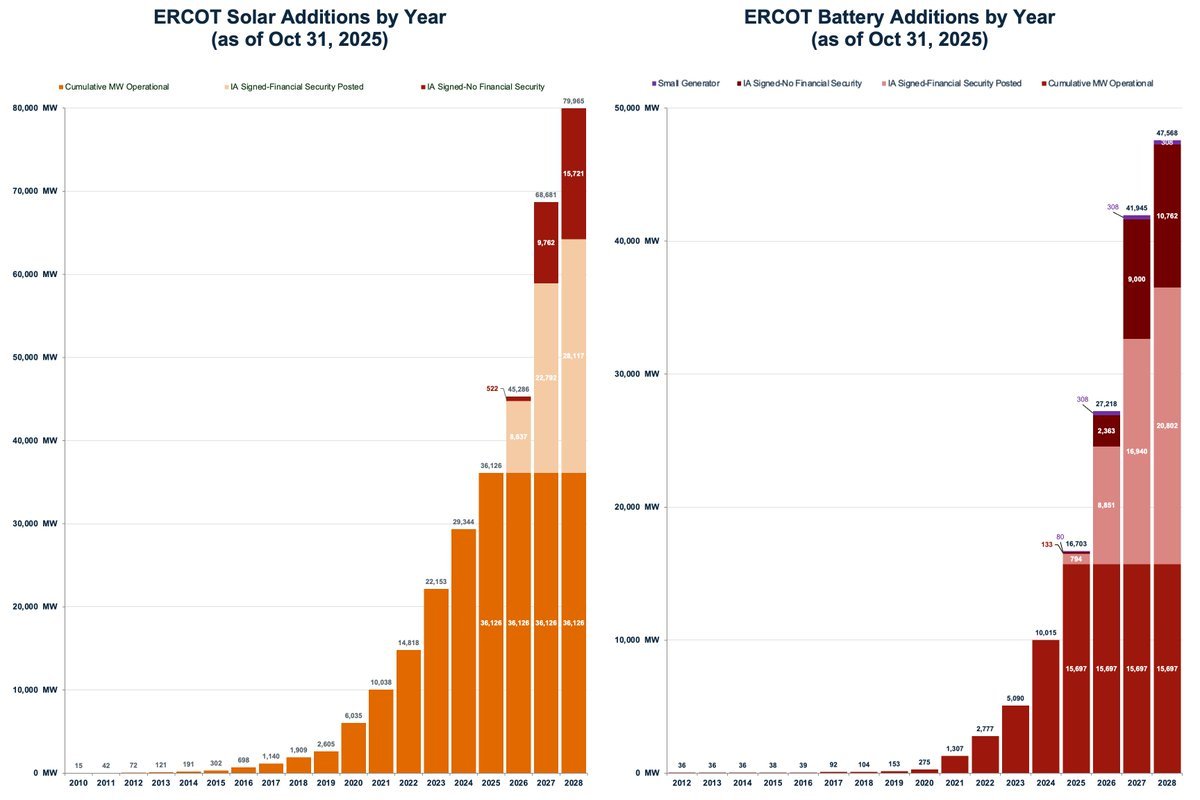
Texas is in the midst of a massive buildout, and these charts make it clear. Solar and battery storage are growing faster in Texas than anywhere in the United States, and faster than most of the world.
The numbers are astounding. In the first few months of 2026:
⚡ Solar will exceed 40,000 megawatts installed.
⚡ Battery storage will cross 20,000 megawatts
During Winter Storm Uri, we had ~200 megawatts of storage. That's a 100x increase in five years.
Texas builds.
Every place needs these flexible, fast-acting and fast-to-build resources as load grows. But Texas is getting them and they're powering industrial expansion, oil and gas production, new data center demand, and hundreds of thousands of new homes and apartments.
Solar gives us low-cost daytime energy. Batteries help us store it and use it exactly when the grid needs it most. Solar and storage aren't the whole answer, but nothing is.
Solar and storage set a powerful foundation for economic growth, reliability, and affordability.
Texas is showing what's possible.
1m² of solar in space generates 10x more energy than it does on Earth.
That’s because in space there is no night, no clouds, and no thick atmosphere.
A solar array 1km² in space would produce as much power as a nuclear reactor.
It’s why space datacenters make sense.
Starship should be able to deliver around 300 GW per year of solar-powered AI satellites to orbit, maybe 500 GW. The “per year” part is what makes this such a big deal.
Average US electricity consumption is around 500 GW, so at 300 GW/year, AI in space would exceed the entire US economy just in intelligence processing every 2 years.
Solar cell production for terrestrial applications is already far above this number at >1500 GW of annual production capacity.
Tonnage to orbit will be solved by Starship.
Chip production is therefore the major piece of the puzzle to be solved.
The Tesla Terafab is needed for this, as there is otherwise no solution at sufficient scale.
These numbers are immense by earthly standards, but don’t register materially on the Kardashev II scale. For that, lunar production of solar-powered AI satellites is needed to take things to the 100+ TW/year level.
@MattLoszak We'll probably just jump to this step and set up autonomous solar powered solar panel factories on the moon where it takes 96% less energy to launch them into space than from earth.
Texas has something the rest of the country wants.
Even global energy experts point to ERCOT as the model to copy.
Why? Because the Texas model still does something few markets manage: competition, speedy connection, and customer choice.
In this clip, we dig into it with Dr. Varun Sivaram, CEO of Emerald AI.
He lays out why ERCOT is uniquely positioned to lead the next wave of flexible, AI-driven load growth.
Varun gives three reasons ERCOT is a massive opportunity:
⚡ Companies want to be here.
Data centers already see Texas as a prime destination, and AI growth could be a major economic engine.
⚡ There is real headroom.
Varun highlights studies showing 10 to 15 gigawatts of potential room to absorb flexible load, if we use energy wisely and optimize to reduce waste.
⚡ ERCOT moves faster than other grid operators.
With its competitive market design and lack of federal regulations, ERCOT can test, refine, and implement reforms faster than the rest of the country.
If Texas gets this right, we can become the first home for large, flexible AI factories that help stabilize the grid instead of straining it.
What would it take to make ERCOT the premier destination for flexible AI load?
👉 Full conversation in the reply.
I think that the human compression algorithm (Randian concept-formation) precedes language and in fact makes language possible.
Rand's theory of concept formation, including measurement omission, has the potential to dramatically improve the efficiency of AI.
https://t.co/M6NUEnWCwA
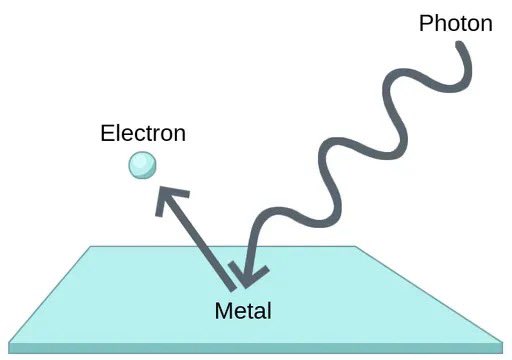
The photoelectric effect occurs when light strikes a material and ejects electrons from its surface. It revealed that light behaves as particles (photons) with energy ( E = h f ), where ( h ) is Planck's constant and ( f ) is the frequency. This discovery, explained by Einstein, revolutionized physics and confirmed quantum theory.
@MattLoszak Also, space based solar "panels" are already 70-90% less massive than terrestrial panels for the same power output since you don't need thick structural glass, or waterproof backsheets.
The Dyson swarms may ultimately be more like photovoltaic solar sails, thin like mylar.