🚨 New Paper!
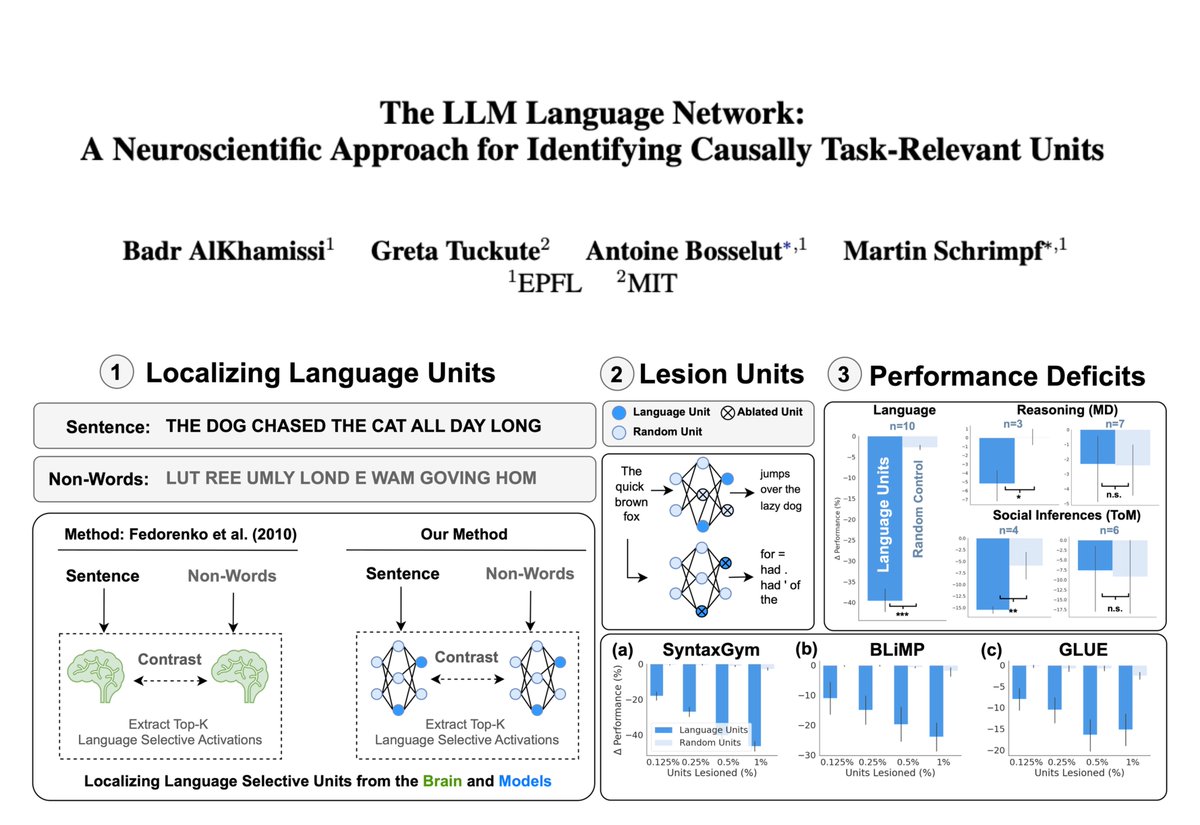
Can neuroscience localizers uncover brain-like functional specializations in LLMs? 🧠🤖
Yes! We analyzed 18 LLMs and found units mirroring the brain's language, theory of mind, and multiple demand networks!
w/ @GretaTuckute, @ABosselut, & @martin_schrimpf
🧵👇
We look forward to meeting old and new friends at #NeurIPS next week. My group will present two papers this year. Many congratulations to the first authors: Eryn sale and Junfeng Zuo. (1/5)
1/ Our work on unified principles for Topographic Deep Artificial Neural Networks is finally out in Neuron! 7 years in the making. https://t.co/76JdCqPzJU
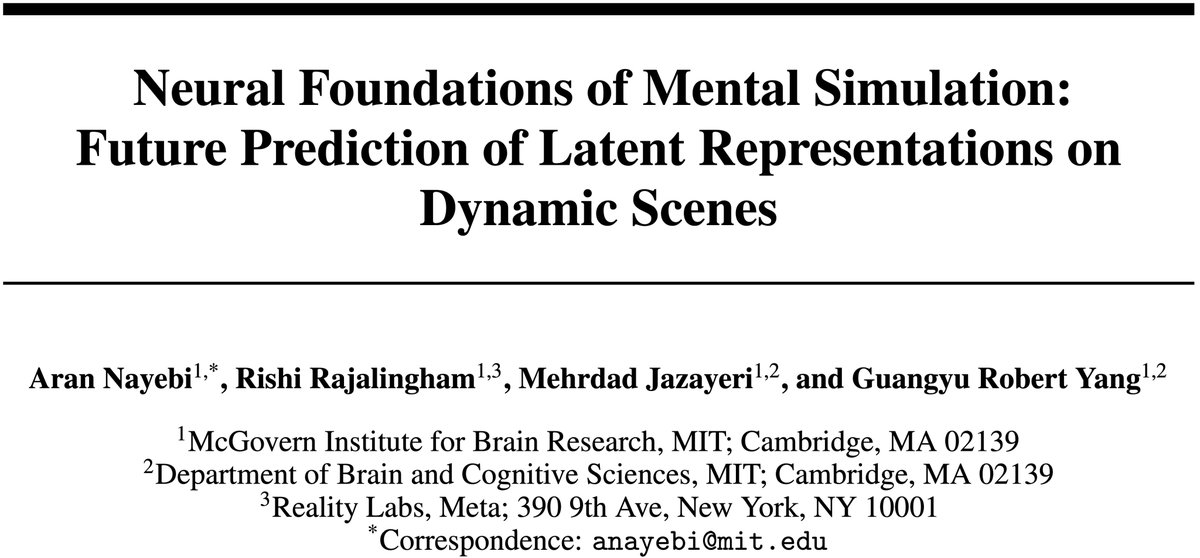
1/ How do humans and animals form models of their world?
We find that Foundation Models for Embodied AI may provide a framework towards understanding our own “mental simulations”. 🧵👇
https://t.co/XC63GLpsNI
with awesome collaborators: @rishi_raj @mjaz_jazlab @GuangyuRobert
New paper alert! In this article we explored how student and teacher neural networks can establish a common, flexible language for communication. (1/2) https://t.co/U4RdDAm1sN
Enough with LLMs - exciting things are happening in the world of atoms.
This is Stanford ALOHA, a low-cost and agile robot platform. The whole system is open-source (!!): hardware design, CAD models for 3D printing, simulator, and training code. Time to graft a physical arm onto GPTs 🦾
Led by my friend @tonyzzhao at Stanford, and advised by @chelseabfinn@svlevine@Vikashplus.
Project page: https://t.co/8iXpiHVEjS
If you don't want to 3D print your own components, you can buy the setup at https://t.co/ur0BCgyCZN