No matter how farfetched the idea might be of the Treasury Department repricing its gold to create cashflows out of thin air, even a remote possibility that desperate governments will do desperate things is a reminder to always have real assets in the portfolio. On that note, I continue to be impressed by Bitcoin’s resilience. I think it will be eating gold’s lunch for a while, although I remain bullish on both.
483 days ago, @5aitec and I raised $20M from @binnybansal to build ShopOS
Millions of brand images and videos later we learned: the model was never the hard part. Getting it right the 10,000th time is
Today, we’re launching @sloosh_ai to give every creator that secret sauce 👇
21Shares Polygon just bought nearly $2m of ethereum:0x455e53cbb86018ac2b8092fdcd39d8444affc3f6, bringing its total purchases to $3.6m in just one week.
No one knows why this institution is buying so aggressively!
Connecting TRON with @0xPolygon’s Open Money Stack gives businesses more ways to move USDT across different payment environments.
With more than $94B in USDT circulating on TRON, integrations like this can help connect onchain activity with everyday payments.
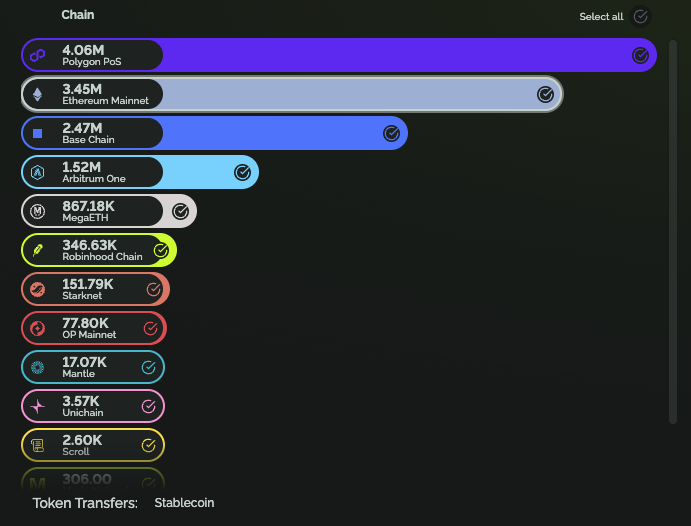
In the past 7 days, @0xPolygon has had more stablecoin transactions* than Ethereum L1, more than Base and Arbitrum combined. If you're doubting Polygon, you're not paying attention!
* Wallet-to-wallet transactions involving stablecoins, excluding contracts such as DeFi.
Source:
https://t.co/EnbvQBXEBI
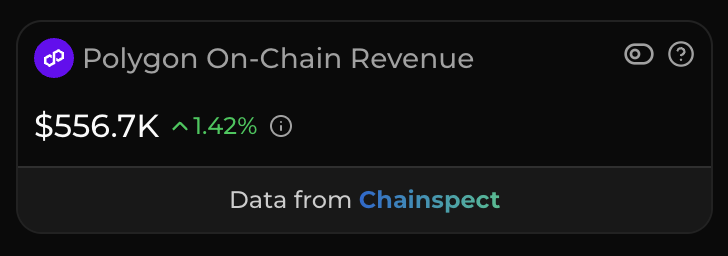
💰 @0xPolygon just crossed $550K in weekly revenue
$556,687 generated over the past 7 days 👀
Polygon is putting up some serious numbers 💸
📊 https://t.co/VADlQLVB5F
The internet's next billion users won't all be people.
AI agents, apps and onchain communities will each need a name they actually own.
Frontier by @D3inc and @domaprotocol opens .agent, .sol, .robot and more before public launch. You own the domain as a token, and you can trade it, use it and build on it.
The .com land rush is now onchain.
Frontier is now live on @Solana via @Loopscale 🤝
Deposit, stack Frontier points, and start building priority on the extensions you're backing.
https://t.co/cNY0LT94wR
Polygon’s economics are going through a fundamental change.
In March, the problem was obvious.
Polygon was generating real revenue, but the benefits were heavily concentrated.
In the February priority-fee distribution:
89.9% went to the top 20 validators.
Delegators were putting the capital behind Polygon’s security, yet none of that priority-fee revenue reached them directly.
The chain was succeeding.
The economics weren’t sharing that success to all contributors.
That is changing.
Under the new model, every 100 POL in priority fees is roughly split into:
26 POL → block producers
37 POL → validators
37 POL → stakers
And 27.3M POL already accumulated for stakers is now being pushed through the staking system.
This is an important shift.
Stakers are no longer meant to earn only from inflation.
They are starting to earn from real economic activity on the network.
Polygon seems to have figured out something fundamental:
A sustainable economy isn’t just about how much revenue you generate. It’s about how that revenue flows.
Block producers need an incentive to produce blocks.
Validators need an incentive to operate and secure the network.
Stakers need to be rewarded for putting billions of POL behind that security.
Maintainers need resources to keep improving the system.
And now it’s time to continue balancing the economy.
Because there is one final piece:
the reward itself has to keep its value.
Paying everyone more POL means little if the asset they are being paid in continuously loses purchasing power.
That is where the broader economic design matters.
Real usage generates fees.
Some of those fees reward the people securing the network.
Other fees remove POL from supply.
More valuable staking rewards can increase the incentive to own and stake POL.
More POL staked means less liquid supply.
And a stronger asset makes every POL earned by validators, stakers and maintainers worth more.
That creates a very different loop:
real usage → real revenue → rewards + burn → stronger POL economics → more valuable rewards → stronger ecosystem
Polygon already figured out how to generate activity.
Now it is figuring out how to distribute the value that activity creates — while protecting the value of the asset everyone is being paid in.
That is what real economic alignment looks like.
@0xPolygon@0xPolygonFdn@0xPolygonEco@sandeepnailwal
$5.1B in a day on Paradigm.
That’s 58% of Deribit volume that is moving onchain.
OTC options liquidity is already here. onchain is the unlock.
Slowly then suddenly.
Options onchain used to feel early. Feels less early now.
Big trades that used to only happen offchain are moving onchain.
Same big liquidity desks are showing up, risk is clearer, and usage on Paradex is climbing. That’s the combo that wins.
Clearer risk rules. No random forced closes wrecking your hedges. And actual people actually using it.
Nice to see volume picking up on Paradex.
Liquidity + fair rules + you can build on it
Bullish on onchain options growing, and paradex on taking a good market share here @fiddybps1
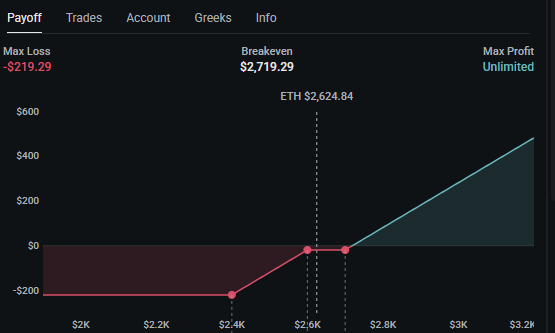
Paradex’s BIGGEST options trade yet!!!
$15.76M notional in a single block. 💥
📈 Bullish $ETH Seagull
🟢 Buy 2,000 ETH $2,400 Put · 9 Oct 26
🔴 Sell 2,000 ETH $2,600 Put · 9 Oct 26
🟢 Buy 2,000 ETH $2,700 Call · 9 Oct 26
Max Profit: Unlimited
Max Loss: $445.22K → ETH at/below $2,400
You Pay: $45.22K
Copy on Paradex 👇
https://t.co/QILKTnlwQf
Polygon's $POL leads USDT0 routes.
USDT0's holder base grew by 359.5%
to 13.5M across chains in three years.
The base is concentrated enough for
route choice to shape that flow.
8.2M gives #POL a routing moat.
I used POLTRACK to calculate how value has been distributed across the Polygon $POL since Jan 1, 2026.
TL;DR: Polygon is already funding every major participant in its economic system:
• POL holders (all ecosystem participants): $15.21M captured through burn
• POL stakers: $7.17M earned (emission rewards)
• Validators: $6.80M earned (priority fees)
• Block producers: $3.27M earned (priority fees)
• Community Treasury: $7.55M earned (emission rewards)
There are two different sources here: real value paid by network users through fees and new POL created through protocol emissions.
Overall, the system looks reasonably balanced. Passive POL holders are roughly at zero dilution in 2026 as burn offsets emissions. Stakers earn ~3% annualized, while validators, block producers and the Community Treasury are all funded.
And the economics should evolve further: part of priority fees is expected to be redistributed to POL stakers.
Polygon is still in its growth stage, so some of the value generated by the network should naturally fund future growth. On top of that, Polygon Labs becoming profitable and reducing its reliance on grants would make the broader ecosystem increasingly self-sustaining.
Track the full value flow live on POLTRACK:
https://t.co/QFUH2eiXfM
P.S. The entire POLTRACK design has been updated. Thanks for using POLTRACK - and if you find it useful, help spread the word 💜
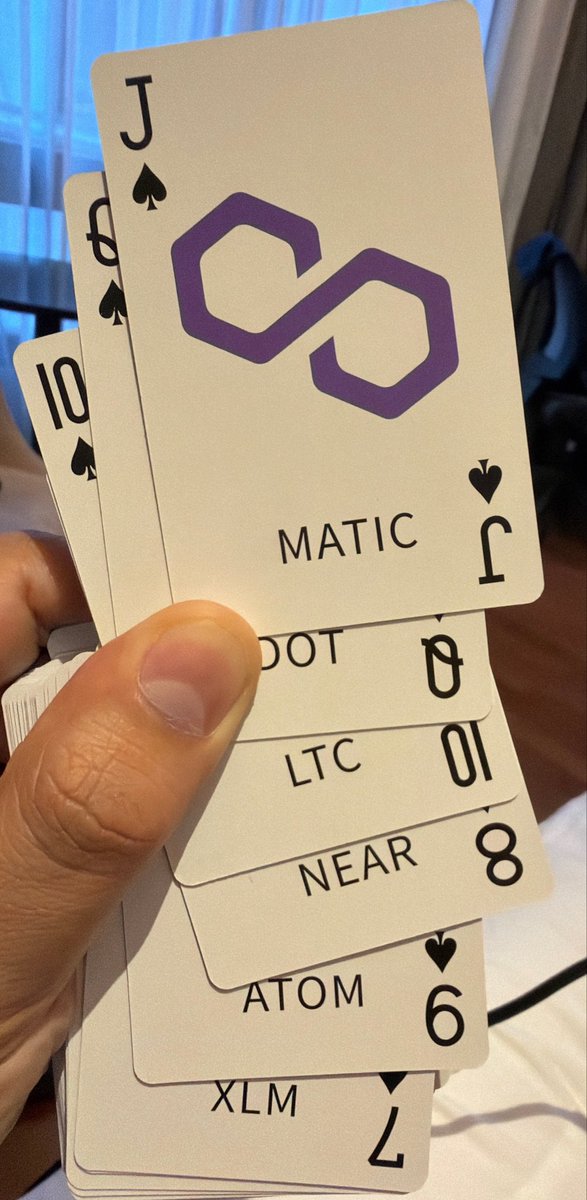
Came to @binance event in Bhutan. A startup named @BiteyeCN gave me a swag containing playing cards with project tickers on them
Surprisingly(not surprisingly) they still call @0xPolygon token as MATIC
MATIC has still one of the most powerful brand recognitions in the industry. Literally every crypto person I talk, they still call it MATIC
As a comparison
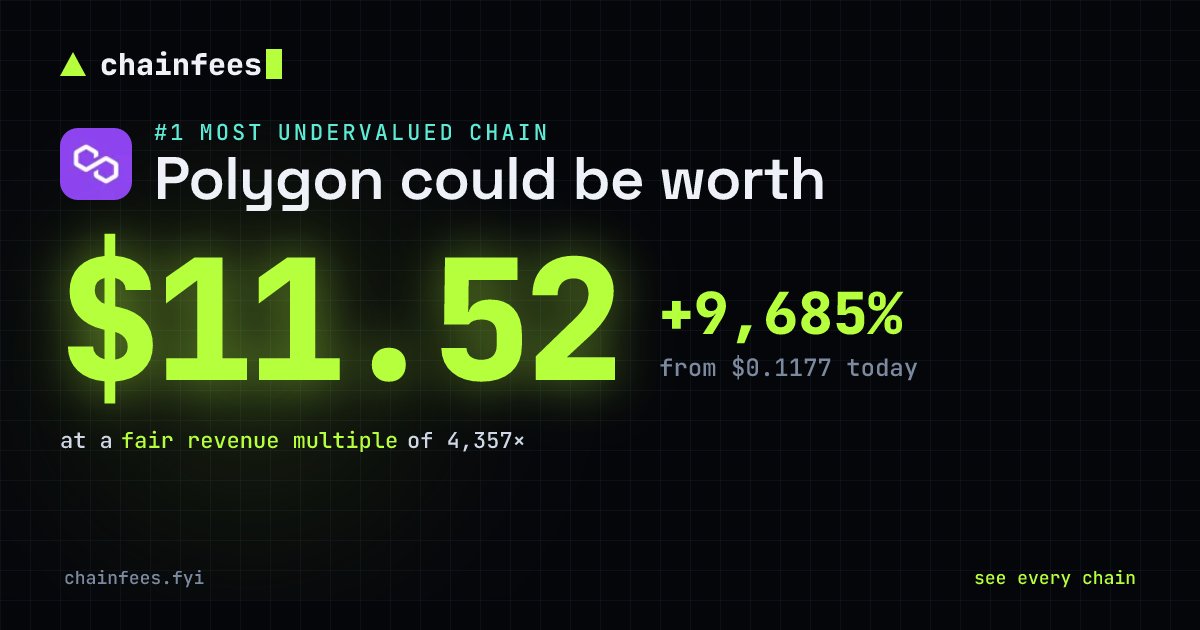
Polygon $POL burns $2.5M worth of tokens every month, and has been burning more than it issues for quite a while now.
Yet its FDV is only $0.7B.
No token unlocks. No vesting. No similar overhang. The token has already been circulating for 7 full years.
🤯
h/t @vadim_web3 , havent verified the exacr numbers myself but they seem about right
This is the best map of where crypto venture actually stands.
Peak adoption, trough sentiment. $11B onchain fees, GENIUS done, record $8.6B M&A + 11 IPOs, yet only 8 new funds formed last quarter, fewest since 2020.
Tokens stopped being the only exit. Stablecoins, prediction markets and perps found real PMF. The token-as-product playbook is finished, and folks with patient capital inherit the seed layer.
Crypto is maturing
New essay : Non consensus and right
Why we believe the next era of crypto venture will be defined by slow, patient capital.
Read here: https://t.co/9AKgRbMXDt