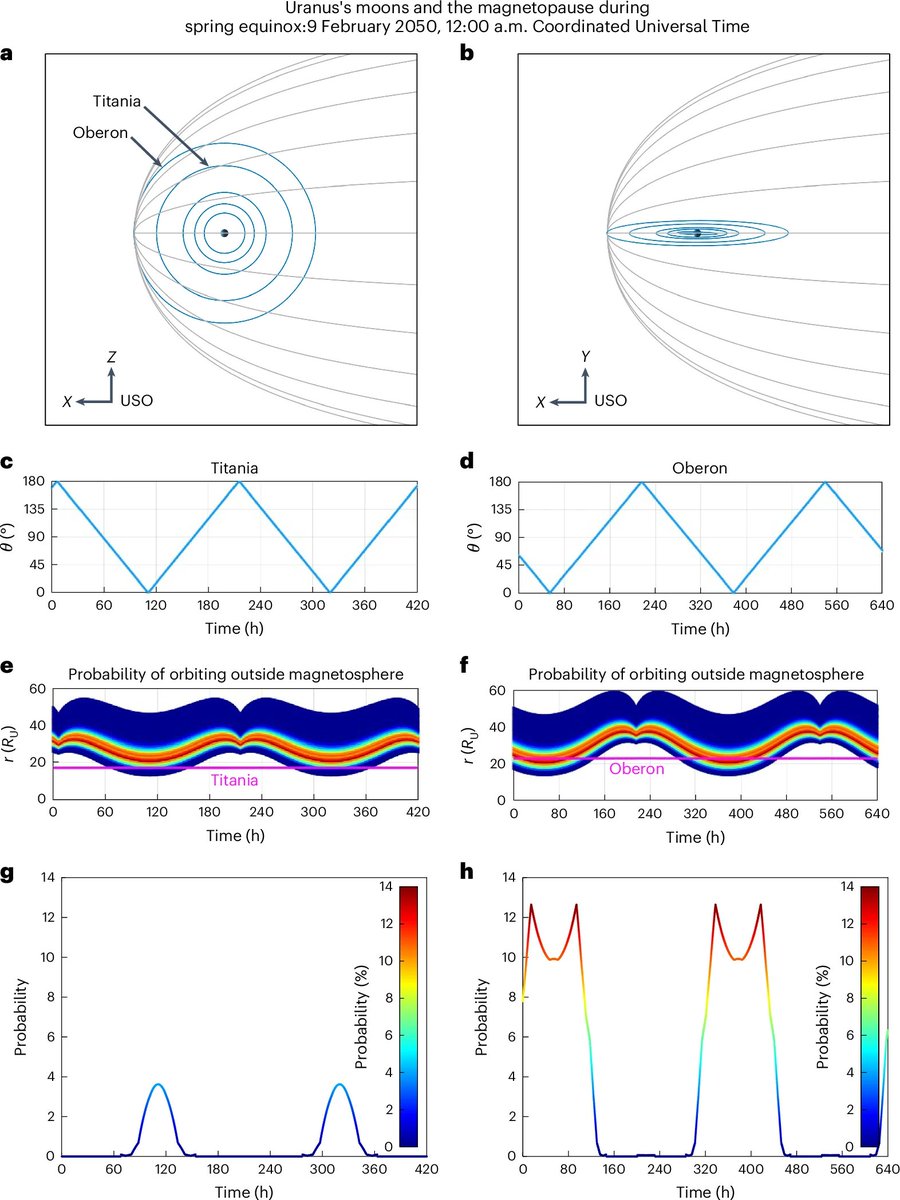
A study in @NatureAstronomy reveals that Voyager 2's 1986 flyby of Uranus — which formed much of the scientific understanding of the planet —might have occurred under rare conditions, leading to a potentially skewed understanding of the planet's magnetosphere.
@NaturePortfolio
Scientists are mining the mysteries of Uranus. (Yeah, we said it.)
Almost 40 years ago, @NASAVoyager got a close look at Uranus for the first time—but a new analysis is helping explain a few of the planet's unexplained oddities: https://t.co/h90is9buAi
When Voyager 2 flew past Uranus in 1986, the planet's magnetosphere seemed super weird. There was no plasma, and the radiation belts were mega intense.
Now we might know why, because of rare solar activity hitting the planet.
Story by me @nytimes
https://t.co/AtvJZtVGkC
My excellent friend @spaceJamieJ discovered that lots of Uranus's mysterious behaviour that we've talked about for decades, based on Voyager 2s flyby, happened during really extreme solar wind conditions. It's out today here: https://t.co/0taEEwX5ev . May be some news coverage.
A reanalysis of the 1986 Voyager 2 flyby of Uranus shows that it occurred during an extreme compression of the planet’s magnetosphere by the solar wind. This would have had significant effects on the measurements made during the flyby. @spaceJamieJ et al.: https://t.co/Bexf06nbR7
When @NASAVoyager 2 flew by Uranus in 1986, it provided our first — and, so far, only — close glimpse of this strange outer planet.
Scientists are still analyzing the data from that flyby, and one researcher recently found a surprise: https://t.co/fVgZN2kMI9
First look at the Solar System's innermost planet from today's #MercuryFlyby, including the recently named "Challenger Rupes" in anticipation of the scarp being well seen this flyby 🤩 https://t.co/eoI8jGOuXA #ExploreFarther
Check out my 3 talks at AGU this year:
SM53C-04: Photoionization at Mercury's Exosphere
SM43B-01: Reconnection at Saturn
P52B-09: Neptune's pole-on magnetosphere
Can I now call myself a collector of planets? 😂
How do meteoroids shape exospheres on airless bodies? Janches et al. review @MESSENGER2011 observations of #Mercury and @NASAMoon LADEE observations of the #Moon + dynamical models to explore this complex question! Read on: https://t.co/tY99AjF0yz
@lx_bdr @theAGU@AGUPlanetary Pay attention to your figures. They edited my figures, which ruined the y-axes tickmarks and labels. I had to ask for them to use the original figures I submitted.
@lx_bdr @theAGU@AGUPlanetary I agree....it changed a lot of things in my paper. So much time spent correcting things that were already properly formatted which they changed after acceptance. I asked to be able to see a second proof, which was ignored and they just published it....🙄
Ever wondered what processes produce Mercury's sodium exosphere? Check out the schematic from a paper I led that has now been published in GRL which discusses the exosphere and the role of photoionization. Paper link: https://t.co/7oeTnQ1jnu @ExploreMercury@NASAJPL@LASPatCU
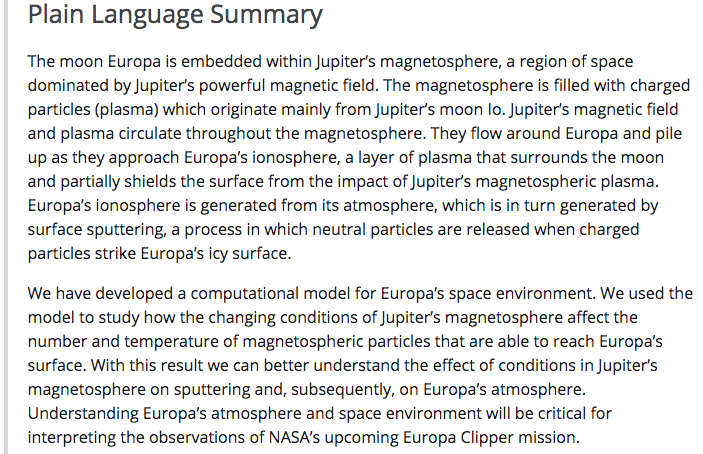
I need to permit myself a little self-promotion.... my first first-author paper has recently been accepted to JGR Space Physics! Typeset and formatted version coming soon :D https://t.co/6SSOwU0ZwY #Jupiter#EuropaMoon
Temperature isn't the only thing changing during the seasons...@spaceJamieJ et al. analyzed how the amount of sodium lost due to photoionization varies throughout a year on #Mercury using @INSU_CNRS #Themis telescope and @MESSENGER2011 data. Read on: https://t.co/BIkNshBeZ8