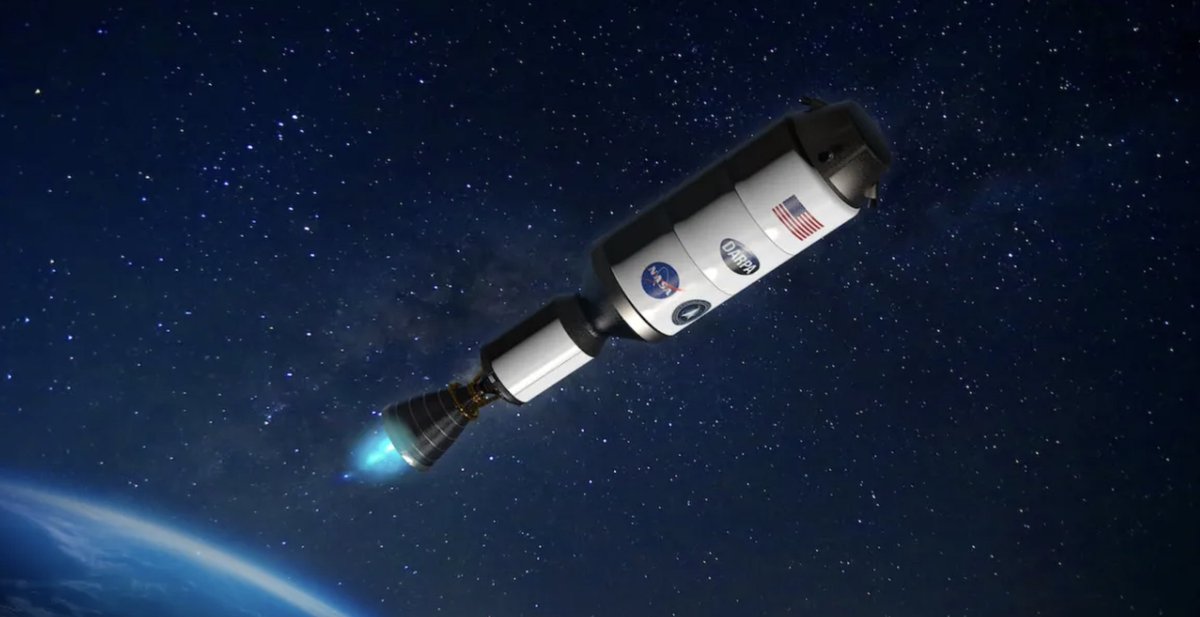
This is just the beginning of how good nuclear rockets could get.
One day we could do trips to Mars in 2 WEEKS, rather than 6-9 months.
Let’s explore the coolest crackpot nuclear rocket ideas in a thread🧵:
Some LC-36 updates. Now that we’ve had access to the pad and integration facility we can share a bit of good news. The propellant farm, oxygen, liquid hydrogen and LNG tanks are all in good shape. This is good luck because these are very long lead items. The water tower is also good. The big support tower is damaged, but it can be repaired in place rather than torn down and replaced. The booster “Never Tell Me The Odds” and the three GS-2s that were onsite in the integration facility also look good.
I’ve seen some speculation that we might move directly to the 9x4 configuration, but we won’t do that. Rate manufacturing of 7x2 is going well, and we’re going to continue that at pace as planned and store the stages for use. In addition, we had already been working for some time on eliminating our transporter-erector in favor of an alternative vertical conop, and we’ll now go directly to that; so we don’t need a new transporter-erector.
We will fly again before the end of this year. Gradatim Ferociter.
China might be less than 12 months from sending Long March 10 on a lunar flyby. This will be their Artemis 1 moment. Then how soon until they take crew?
Transition NASA’s CLD to the U.S. Space Force: a military-led program where stations are privately built and operated (such as Axiom and Vast) under Space Force contracts.
Space Force astronauts will lead secured experiments in:
• Advanced materials & in-orbit manufacturing (radiation-hardened components)
• Biotechnology & human performance (muscle/bone loss countermeasures, pharmaceuticals)
• Quantum sensing & precision clocks for resilient navigation
• Logistics & propellant transfer
• Space domain awareness & defensive technologies
US Space Force Should Prepare to Put Active-Duty Troops on the Moon, Report Argues https://t.co/jrW8urscjd
"The Mitchell Institute for Aerospace Studies recently published a paper pushing for a military human spaceflight program that could eventually place active-duty U.S. Space Force (USSF) personnel on the Moon and on board orbital space stations for defensive operations against China’s alleged military-focused space initiatives. The report signals a dark turn for the ongoing space race, suggesting that orbital warfare looms behind ongoing efforts to establish a permanent presence on the Moon. @NASAMoonbase #NASA #Artemis #Moon #Lunar"