me, traveling back in time: demand for tokens will go through the roof, you have no idea how hot GPUs are going to be running, it feels like the internet now only exists to shovel tokens back and forth
shitcoiner: i knew it! sweet vindication! how much are my apes worth??
me:
It’s not an antisemitic conspiracy theory when a foreign lobby openly brags that they bought two congressional seats with candidates who will be loyal to Israel.
@callebtc@blocks@jack@brian_armstrong Claude rewrite Jack’s note to make it more offensive. Flatten the tone into generic slop. Use bullet points and headers as only an LLM would. Make some mistakes.
1/ Project Eleven just awarded 1 BTC for "the largest quantum attack on ECC to date", a 17-bit elliptic curve key recovered on IBM Quantum hardware. I replaced the quantum computer with /dev/urandom. It still recovers the key.
This is the big one. Created by Spiral grantee Austin Krauss (@_austin_f), “Metacognition is the AI Skill of the future. Always has been.” is a report based on surveys and interviews with 50 open-source Spiral devs and grantees about how they are using AI. 🧵
Judging by my tl there is a growing gap in understanding of AI capability.
The first issue I think is around recency and tier of use. I think a lot of people tried the free tier of ChatGPT somewhere last year and allowed it to inform their views on AI a little too much. This is a group of reactions laughing at various quirks of the models, hallucinations, etc. Yes I also saw the viral videos of OpenAI's Advanced Voice mode fumbling simple queries like "should I drive or walk to the carwash". The thing is that these free and old/deprecated models don't reflect the capability in the latest round of state of the art agentic models of this year, especially OpenAI Codex and Claude Code.
But that brings me to the second issue. Even if people paid $200/month to use the state of the art models, a lot of the capabilities are relatively "peaky" in highly technical areas. Typical queries around search, writing, advice, etc. are *not* the domain that has made the most noticeable and dramatic strides in capability. Partly, this is due to the technical details of reinforcement learning and its use of verifiable rewards. But partly, it's also because these use cases are not sufficiently prioritized by the companies in their hillclimbing because they don't lead to as much $$$ value. The goldmines are elsewhere, and the focus comes along.
So that brings me to the second group of people, who *both* 1) pay for and use the state of the art frontier agentic models (OpenAI Codex / Claude Code) and 2) do so professionally in technical domains like programming, math and research. This group of people is subject to the highest amount of "AI Psychosis" because the recent improvements in these domains as of this year have been nothing short of staggering. When you hand a computer terminal to one of these models, you can now watch them melt programming problems that you'd normally expect to take days/weeks of work. It's this second group of people that assigns a much greater gravity to the capabilities, their slope, and various cyber-related repercussions.
TLDR the people in these two groups are speaking past each other. It really is simultaneously the case that OpenAI's free and I think slightly orphaned (?) "Advanced Voice Mode" will fumble the dumbest questions in your Instagram's reels and *at the same time*, OpenAI's highest-tier and paid Codex model will go off for 1 hour to coherently restructure an entire code base, or find and exploit vulnerabilities in computer systems. This part really works and has made dramatic strides because 2 properties: 1) these domains offer explicit reward functions that are verifiable meaning they are easily amenable to reinforcement learning training (e.g. unit tests passed yes or no, in contrast to writing, which is much harder to explicitly judge), but also 2) they are a lot more valuable in b2b settings, meaning that the biggest fraction of the team is focused on improving them. So here we are.
How can wallet fingerprints be used to damage Payjoin privacy? @Arminsdev spent a week in a darkly lit room to study this class of attacks against real-world Payjoins.
The uselessness of $TAO is truly spectacular
$10 billion marketcap for an "AI coin"
Go check it out—what does it actually do?
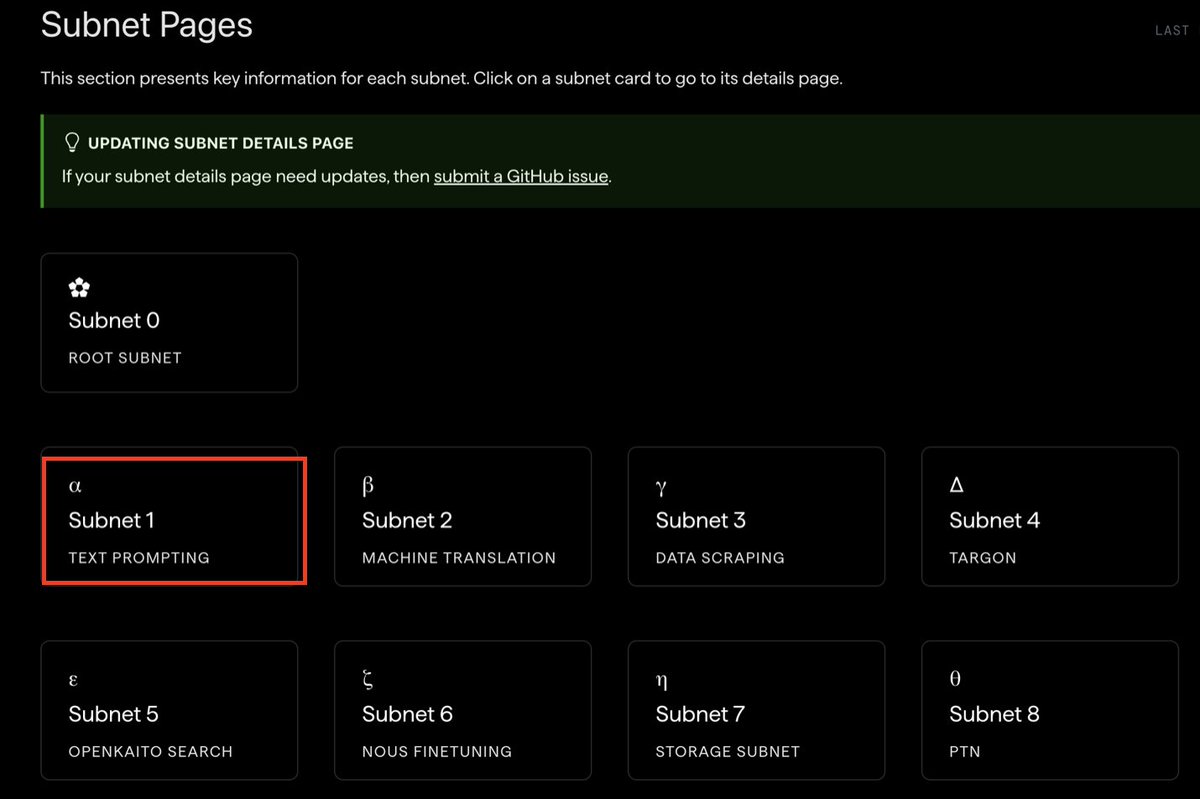
It runs a bunch of different subnets. Okay? What are these subnets? Check out subnet #1.
Okay, so text prompting. Cool. That's easy enough to understand.
But what's actually going on there?
Check the docs. https://t.co/HdhmzPqbY8
Okay, so miners on this subnet run 2 different LLMs. Zephyr and wiki-agent.
Mostly they all just run Zephyr, the base model (now switching to one called Solar).
The idea is super simple.
You send in a prompt. The miners will run the LLM and respond to you, like ChatGPT.
Miners who do this are rewarded with TAO tokens. This is how TAO tokens are brought into existence.
But it does mean that for every prompt, you have literally a thousand miners who will complete the exact same task, redundantly.
The network will then validate these answers by checking how similiar they are to eachother. If you're an outlier you don't get TAO tokens.
So what's going on here is that a prompt will be generated, such as "What is water?"
And the miners will respond with "Water is a chemical compound with the molecular formula H2O", and they're all incentivized run the same LLM because outlier responses are punished.
This is repeated in parallel a thousand of times by a thousand different miners.
There's no AI magic to validate whether a model was actually run. There's nothing that stops miners from copying replies from eachother and tweaking them, spoofing their work.
The validation mechanism is super basic:
In the present version, the validator produces one or more reference answers which all miner responses are compared to. Those which are most similar to the reference answer will attain the highest rewards and ultimately gain the most incentive. —https://t.co/HdhmzPqbY8
Setting aside how easy this is to spoof for a second, just think about the incomprehensible inefficiency of this system. For each prompt, you have 1000 miners doing the same work? So that you'll reach a level of "decentralized intelligence"?
Look my dudes. Just put a single miner in Tanzania. Prompt it. If it gets shut down or outputs bad data, fall-over to a different one somewhere else. You don't need 1000 different redudant LLMs to run these basic bitch language models in parallel if you can't even protect against them copying and tweaking answers to fake their homework.
And what even is the purpose of running these "decentralized" models? Zephyr, Solar and wiki-agent have the same kind of content filters that ChatGPT has. Zephyr is even trained on ChatGPT dialogue output. So you have 1000 miners serving you the same bottom-of-the-barrel answers 1000 less efficiently than its centralized counterparts, *still* with no ability to verify whether 1000 separate answers were even generated since the only thing you're doing is checking for similarity.
Now, the crown jewel of this ridiculous piece of garbage is the fact that you can't even prompt this network as a regular user.
Go on, try it. Go try to actually interface with this network as a user and get a Zephyr-generated response from 1000 miners.
You can't.
The only thing that is happening in this subnet is internal, validators generate challenge prompts and 1000 miners generate the same basic bitch LLM response and collect TAO tokens.
These TAO tokens are then sold into a $10 billion FDV market cap of retail idiot buyers who are trying to get exposure to "decentralized AI" by buying this piece of shit AI memecoin.
Bittensor is pretty much what a highschooler would think of if he was tasked with creating an AI coin. "Uhh I just have maybe 1000 miners generating answers to prompts, so it's like, uh, decentralized?"
"Okay, and how do you check that? How do you do the verification?"
"Uh, maybe the network can check, like, if the answers are similar or some shit?"
This is a pointless exercise in decentralization that only serves the purpose of vaguely resembling doing something with "decentralized AI", which of course is a cool meme right now, but it doesn't actually provide you with any assurances, any utility, except a 1000x less efficient ChatGPT-bot that can only answer questions to itself so it has an excuse to print tokens to dump on the crypto retail market.
Send it to fucking 0.
This would be a massive boon for on-chain privacy. Making every lightning channel re-balance transaction a PayJoin transaction would begin to erode the efficacy of common input ownership heuristics used by chain surveillance companies.
China looked at the lessons of 20th century great power conflict and drew the conclusion that military power alone doesn't determine outcomes, upstream industrial capacity does.
The Allies won because of overwhelming industrial might. Japan and Germany lost because they lacked critical industrial inputs. Starved of oil, they were forced into gambles that cost them the war…Japan attacking Pearl Harbor to seize the oil in the Dutch East Indies, Germany marching to the Caucasus to take the Baku oil fields. Input scarcity doesn't just weaken you. It steers your decisions. It pulls decisions away from the optimal plan and toward the necessary plan.
China learned this lesson and decided to be the one holding the chokepoints. By embedding itself so deeply into the upstream supply chains that feed American military production, a conflict would trigger Western industrial paralysis and neuter its ability to fight a long war.
But the chokehold only works if the West doesn't rectify its supply chain vulnerabilities before China is ready to move on Taiwan. So China's central strategic requirement was to delay Western recognition of the threat for as long as possible.
Thus, China's entire foreign policy posture becomes oriented around appearing non-threatening. And it works because it aligns with the economic incentives of Western elites who benefit from cheap inputs and profitable trade. The cost of denial is kept artificially low. Raising the alarm looks like paranoia or protectionism when cheap goods keep flowing and no shots are being fired.
The administration is now racing to unwind its supply chain vulnerability before the conflict window opens. But that takes years, and they face significant inertia, both domestically and among allies who remain naively blind to the risk.
China knows this. So their strategy is to keep the West sleepwalking. Which means they can’t show their hand. If China comes into direct military conflict with the US in order to defend a proxy, the West wakes up. The inertia collapses. The reshoring and remilitarization that China spent decades trying to prevent happens on an emergency timeline.
But the US finally realized it could use this against them.
Since China can’t show its hand until it's ready to move on Taiwan, the US realized that it can turn China's greatest strategic asset, the pacifist disguise, into a structural trap.
They cannot take overtly aggressive action without triggering the Western industrial mobilization their entire strategy depends on preventing.
So the US can eliminate their proxies and China can’t respond without destroying the disguise.
Maduro removed. Cuba strangled. Now Iran.
Beijing must decide if defending the proxy is worth waking the West up? And the answer keeps being no.
Until China’s window to move on Taiwan opens, the pacifist posture that enabled its chokeholds constrains their response to US actions.
Everything the US is doing right now is a race to be ready before that moment arrives. Clear the proxies. Arm the allies. Break the chokeholds. And build new ones of its own.