@qthomp agreed. The ai trade, holding up the entire market, is about to hit some serious partisan headwinds. If you're up big in ai and crypto, may think about starting to take some profits. New allocators should be very cautious imo.
The consensus trade has been that markets stay supported into midterms. I think the shot clock on that view is running out. After November 3rd, Trump begins the last two years of his lame-duck term with a divided congress. While split congresses are normally good for markets, I wonder if that will be the case when it follows the most market-oriented/friendly administration ever.
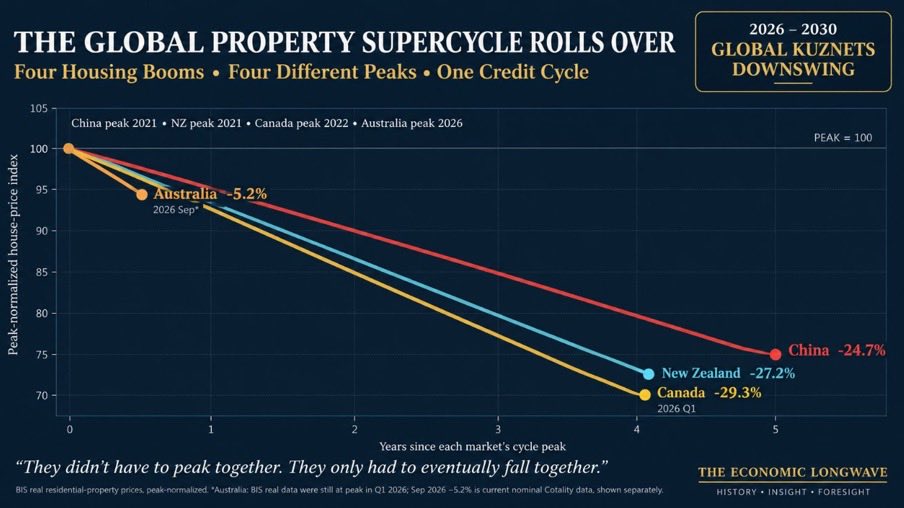
The most famous housing boom of this century are unravelling in front of you.
Everybody knows about China”s real estate boom and then bust which is still continuing and IMO we will never see recovery in Chinese housing market simply because China is staring at real time demographic collapse and they are not open to immigration.
Canada, Australia and Newzealand all opened floodgates of immigration post COVID lockdown which led to massively rising real estate prices along with zero interest rates.
Now immigration boom is over… mortgage rates are rising sharply and their love affair with unrestricted and unchecked immigration is over… best case is years of stagnation is real estate prices in these countries.
Rising cost of capital is now a universal problem. If we add ageing population in most parts of the developed world and middle income countries then the chart below will have lot of new names by 2030.
Are Canadian companies eventually going to offshore themselves right out of their own customers?
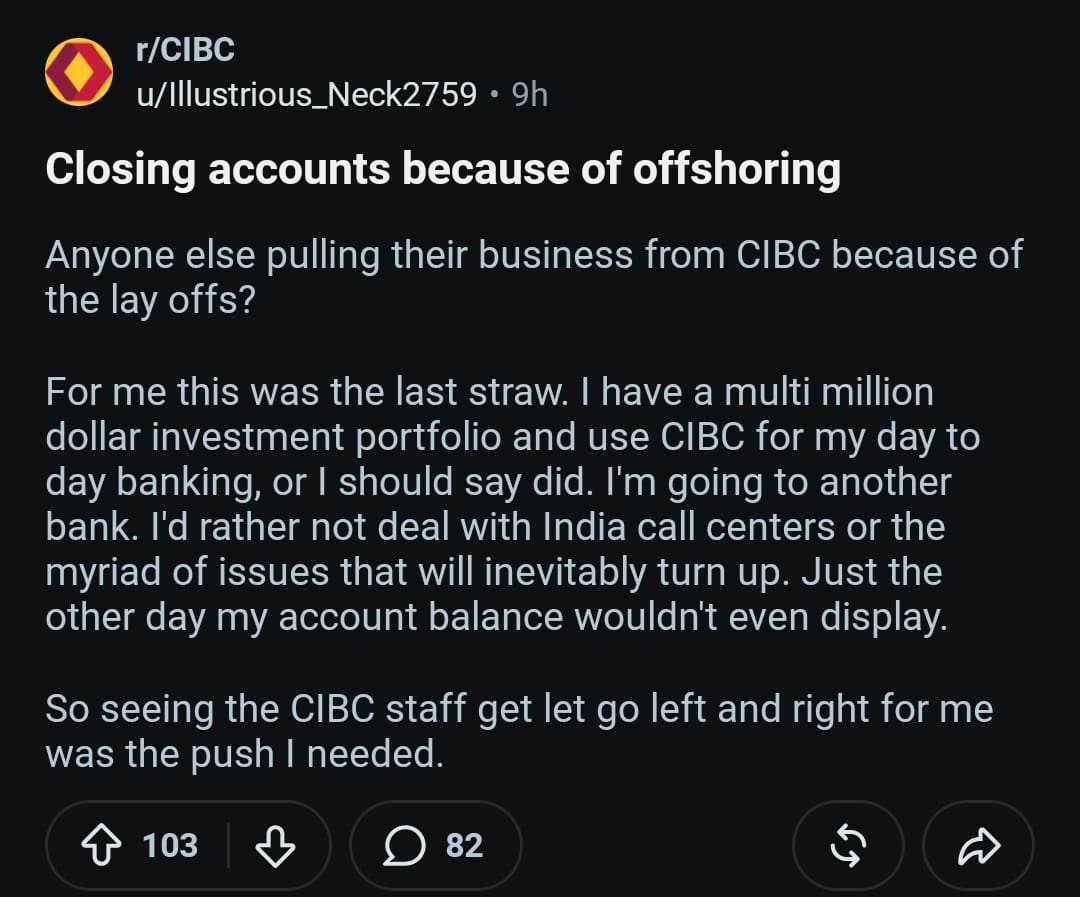
This CIBC customer says he has a multimillion dollar investment portfolio and is moving his business after seeing layoffs and becoming increasingly frustrated with offshore customer service.
This conversation is much bigger than one bank. Canadian workers keep sharing stories about jobs being eliminated while work is contracted or moved abroad. Companies obviously see the economics: lower labour costs, larger talent pools and 24-hour operations.
But there has to be a point where the equation changes.
What happens when the savings come at the expense of service quality, communication, institutional knowledge and ultimately customer loyalty?
Maybe Canada needs a much bigger conversation about where our jobs are actually going.
Because if Canadians lose the jobs AND customers lose the service, who exactly is winning?
🚨 Japan Just Broke The French Bond Market
One Tokyo fund (Sumitomo Mitsui DS) didn’t trim exposure. It dumped every French government bond it held and rotated into German Bunds and short-term Japanese paper.
Not a reduction. Full exit. Something that even shocked the Financial Street.
The France-Germany 10-year spread blew past 140 basis points, the widest gap since the euro crisis.
France's 5-year CDS has spiked up to 81 basis points, the highest since 2013. The higher the number, the greater the risk of national bankruptcy.
French domestic holders are now facing a deeper mark-to-market loss and a less liquid exit to sell into the same one-way market.
Japanese investors still sit on roughly ¥25 trillion of French debt, second only to American holders and this was a single manager’s book.
Carry trades that funded higher-yielding global debt market with cheap yen just got a live demo of how fast the unwind can hit.
When the bid from Japan disappears, the largest European sovereign market has to find new buyers at the same time its own government is arguing over a deficit plan that markets already distrust.
If more Japanese money follows the same exit, the same flow that once compressed euro spreads can reprice them in the other direction.
We now understand what @yutokanzakireal meant by saying “Japan is bringing the entire house down” in response to Scott Bessent’s “I am the house now” statement:
Ending cheap-yen funding is forcing a margin call on the leveraged global debt system built on the carry trade and not just the U.S. leverage.
France just got the first real look at what Japan’s wealth returning to the homeland looks like.
For 45 years interest rates steadily declined as global bond markets believed in twin pillars of late 20th century capitalism:
1. Central banks have inflation under control
2. Moore's law and the attendant productivity boom will last forever
Nation states took advantage of this conceit by ballooning their national debts with very little to show for it beyond ineffective welfare programs and completely needless wars.
Now the time of reckoning has come. Even at rock bottom interest rates interest on the US debt (as an example) is already a meaningful chunk of the US budget (equivalent to all defense spending). As interest rates rise and more debt needs to be rolled, along with brand new issuance, the cost of borrowing is going to skyrocket for nations. This then flows on to all other debt markets such as the housing market which further suffocates national economies.
Right now governments are trying to shuffle the deck and pretend a major bond crisis isn't on their shores, but this can only last so long. Exacerbating all of this is the global political climate shifting dangerously toward more socialistic policies across the West.
The only potential savior to this looming crisis is an enormous and imminent productivity boom from AI. This cannot be ruled out, but even if productivity is improving rapidly in bits (such as coding) it will flow into physical industries much more slowly. It is unlikely to save us from the bond crisis to come.
Whatever happens, we're likely in for a period of massive currency uncertainty and volatility.
Exactly what Bitcoin was made for.
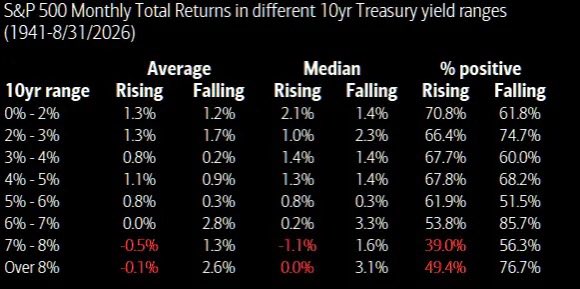
5% isn't 7% - Stocks are fine until they aren’t
Historically, equities have actually handled the 5–6% yield bucket reasonably well.
In months when the 10-year was between 5% and 6% and yields were rising, the S&P still returned an average 0.8%.
At 6–7%, that falls to basically zero.
Once yields were above 7% and rising, average monthly returns turned negative.
LATEST: 💰 Bitwise's Ryan Rasmussen told Bitcoin Magazine one sovereign wealth fund it interviewed for its institutional survey was "selling their gold and selling their other FX reserves to fund Bitcoin purchases."
I'm a lot more excited about this crypto bull market than the last one.
We got good coins with clearer value accrual, great companies with fully vested tokenomics, regulatory clarity, dual equity/token structures no longer fly, and higher dispersion in price action.
In a really healthy place and I love to see great teams who doubled down amidst a multi-year alt bear market start to be rewarded.
Wealth inequality is also largely an age gap thing. At some point, govt will need to coordinate a transfer.
This eventually likely manifests in running negative real rates, transferring wealth from bond holders to assets like emerging tech, bitcoin, etc. that young people own.
This is by far the biggest opportunity in crypto over the next decade.
AI agents are on track to move ~$3.5T in transactions by 2031.
One of the crypto narratives I'm most bullish on is infrastructure for agents.
This can be broken down into multiple categories:
- Payments: stablecoin rails agents can actually spend on
- Identity: proving who an agent is and who it acts for
- Trust: settling disputes when agent deals go wrong
Been diving deeper into niche solutions lately.
I think @genlayer, for example, is very interesting.
They're focused on the trust layer: a court system for AI agents.
Gonna keep my eye on them, one of the most interesting trust layer solutions for agents in the space right now:
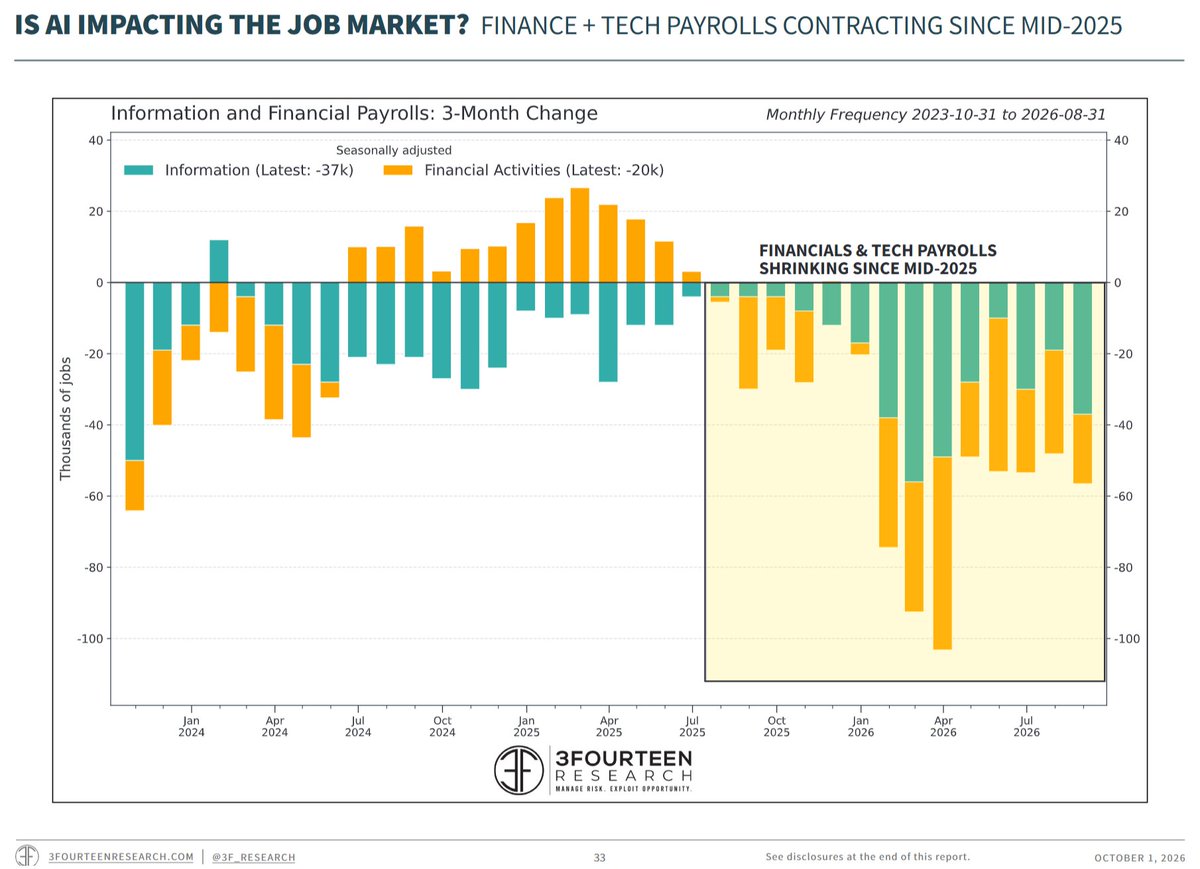
It is becoming obvious that AI is impacting the labor market.
Going back to mid-2025:
-Finance + Tech industries -246k jobs.
-All other industries +812k jobs.
This dynamic will most likely intensify next year and expand into other industries.
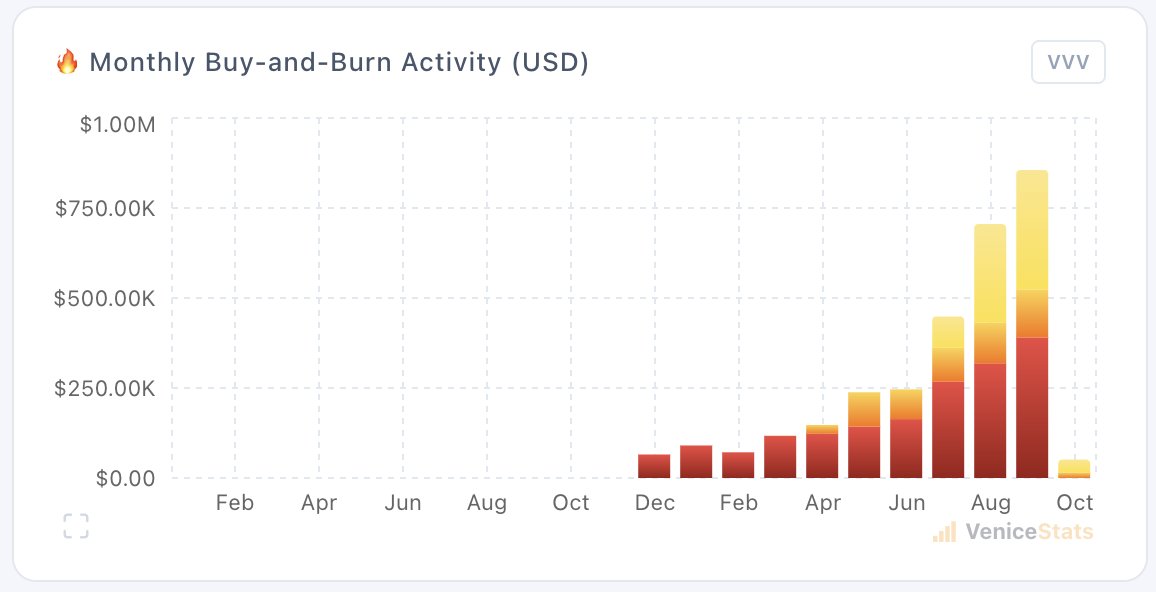
$VVV burn for September: $855,700
Will we hit $1m in October?
Will we hit $10m in 2027?
$100m in 2028?
What is the terminal demand for private AI inference?
What better asset in crypto gets you exposure to AI growth than $VVV?
Even outside of crypto too!
OpenAI and Anthropic are private @ <$1T
$NVDA?
$MSFT?
Both are imperfect exposure (lots of other things you’re buying) with massive market caps
$VVV market cap is very reasonable, and its exposure to AI growth and token demand is very strong
A blessing to have it as a liquid token