@Emilio2763 I looked at a unit in this building last year. The would-be landlord warned us that they were kicking off a three year project to replace the facade, all windows, and a ton of structural stuff.
Most of the people in the building were between 50 and 85 and bought a long time ago
$LINK is in a better position than $XRP to the benefit from the coming wave of institutional blockchain adoption and trillions in assets being tokenized onchain
A common response to this is "but Chainlink and XRPL don't compete 1:1 on product basis!!"
That's true but also completely misses the point
Chainlink offers institutions an all-in-platform spanning onchain data delivery, cross-chain interoperability, automated compliance, privacy-preserving compute, and legacy system connectivity
These are all core requirements for the tokenization of real-world assets (funds, equities, commodities, currencies, etc) across any blockchain network (public or private) as well as to enable the ability to transact across any blockchain using existing infrastructure and messaging standards (e.g., Swift)
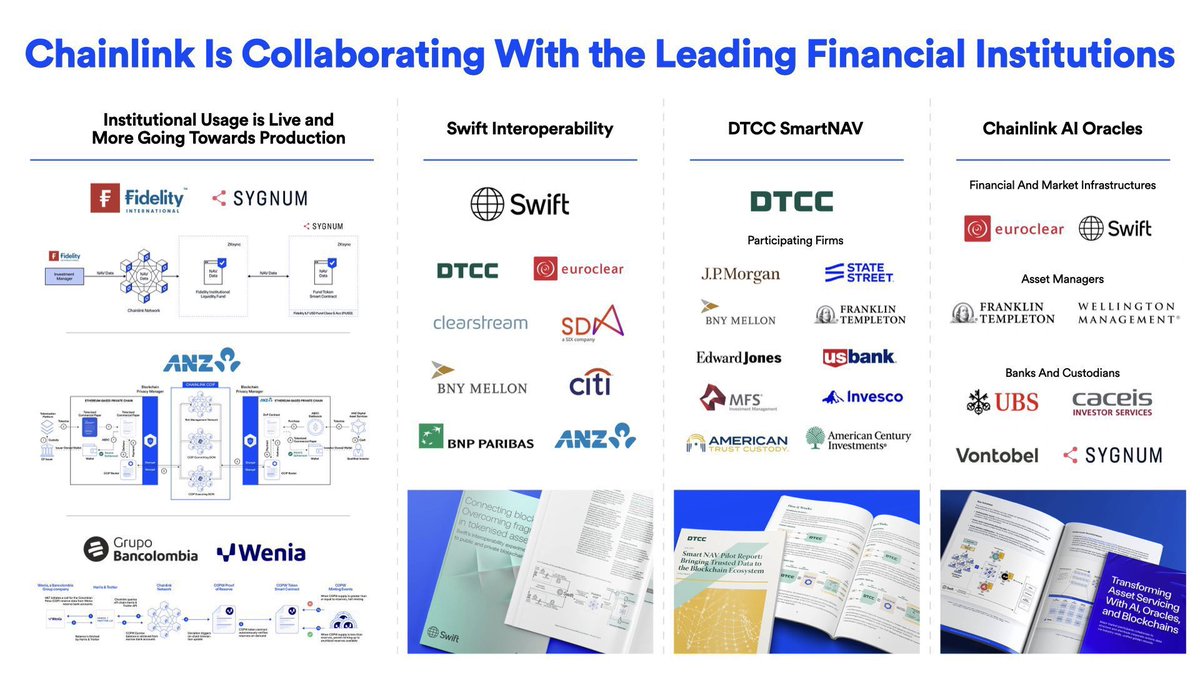
Chainlink is already working with the largest financial institutions and infrastructures in the world on adopting blockchains and tokenized assets (Swift, DTCC, Euroclear, J.P. Morgan, Mastercard, Central Bank of Brazil, UBS, SBI, Fidelity International, ANZ and many others)
No "NDAs", "breadcrumbs", 10 year old PDF slides, or grand conspiracy theories, just recent direct public confirmation from these institutions that they're working with Chainlink and using its technology
A bet on $XRP is a bet that institutions will adopt the XRPL as their ledger over other blockchains (including their own private chains) and/or adopt $XRP as a "bridge currency" digital asset
A bet on $LINK is that institutions will adopt blockchains as a technology, regardless of which specific ledger they decide to use (existing public chains or their own private chains), and/or adopt any digital assets in their transactional workflows (crypto-native, stablecoins, and/or tokenized RWAs)
Chainlink services already secure $92B+ (TVS) across 60+ blockchain networks via 2,000+ oracle networks used by 450+ applications, with more public and private blockchains regularly integrated all the time
XRPL has a DeFi TVL of just $100M from 9 applications that operate on one blockchain (~1000x less capital than Chainlink secures)
Simply put, Chainlink offers a more valuable set of products to institutions that is actually seeing real traction, with a chain-agnostic tech stack that means it benefits regardless of which blockchain is used
More in next tweet 🧵👇
Chainlink S tier protocol and investment thesis:
>Chainlink revealed to *already* having earned hundreds of millions in fees.
>Those past earned fees are now being deployed to token buy-backs, which go into a Chainlink Reserve. The reserve won’t be touched for years. (per blog: https://t.co/kMjkO9h7I6)
>Killed two biggest FUD uncertainties:
1) Chainlink is a money-making machine already.
2) Clear confirmation about no predatory, competing conflicts like Ripple Labs equity vs XRP token holders.
Chainlink generates revenue from useful services -> LINK token buy backs & yield to stakers
Ripple makes 99% of money from dumping XRP -> Ripple buys companies for itself and its own Ripple stock
>Future fees will be in the billions. Chainlink platform is needed by DeFi + TradFi more than any other protocol to deploy onchain finance use cases at scale because no other protocol offers what Chainlink does.
>LINK = upside in stablecoins
LINK = upside in tokenization
LINK = “TradFi + blockchain” thesis exposure
LINK= “Winner take all of entire infra stack” thesis
Simply way more products to sell for onchain finance than just access to blockspace. The revenue of those products become value accrual for token holders.
>Farthest ahead by order of magnitude on TradFi adoption of any protocol: SWIFT, DTCC, JP Morgan, UBS, Euroclear, Mastercard, ICE (NYSE), Clearstream, Franklin Templeton, Citi, Visa, BNP Paribas, SBI, Fidelity International, ANZ, Central Bank of Brazil, Hong Kong Monetary Authority, Bancolombia Group, Reserve Bank of Australia, Emirates NBD, Westpac, 21 shares, etc.
>Chainlink’s new architecture (CRE) changes entire process of how app development is anchored and sequenced from:
Old way: Choose chain first -> Build on-chain app next-> choose bridge/oracle at end
New way: Choose Chainlink platform first -> Build all of your workflows inside CRE -> Deploy your chain-agnostic workflows onto every chain and add onchain app code at end
“Build Once, Run Everywhere”
The entire dichotomy of guessing which chain will “win” is obsolete; trivial to deploy your workflows across all of them.
>Chainlink is constantly running hackathons, workshops, bootcamps, etc. to onboard new developers.
Their recent Block Magic event had 18,157 registrants from 219 countries, with 46% participants new to blockchain development and 60% joining their first Web3 hackathon. They’re all being taught to build with Chainlink as the default platform for developers.
>Most adopted and dominant protocol: 6+ years of market share dominance and gold-standard security track record (even higher than 2021). More dominant market-share than any blockchain. https://t.co/afFz6rS5Ir
Chainlink’s market share is HIGHER in 2025 than it was in 2019-202, despite being the market leader even then. Which other protocols became the market leader, whose lead only *increased* more since becoming market leader? Very, very, very few.
>No protocol offers as many products as Chainlink platform: Push feeds, Pull feeds, 1st party feeds, POR with SecureMint, NAV, SmartAUM, CCIP, Privacy (Blockchain Privacy Manager + CCIP private transactions + DECO(zkTLS), Compliance (Automated Compliance Engine + Cross-Chain Digital Identity (partnered with GLIEF, Tokeny, ERC6343), and Compute (Chainlink Runtime Environment), etc.
>Strongest moat in crypto: Centralized entities pose competitive risk to some protocols; not Chainlink.
Chainlink’s data competitors have no interop. Chainlink’s interop competitors have no data. No one else has even touched building a privacy suite, compliance, identity, etc. No one else is remotely close to having the complete package. No one else even has half.
>Chainlink being a complete platform of all infrastructure services makes disintermediating Chainlink’s incumbency that much harder. You can’t just show up with just one service being better (if you even could). Aave uses price feeds + CCIP + SVR.
What would a competitor need to do to steal Aave? Impossible.
>Institutions want a single integration/point of access that allows them to access all chains (both public and private) -> Chainlink is the dominant network effect ecosystem: "SWIFT doesn't always have the potential to try to connect to all of them (blockchains). Because if we bet on 10 this year and those 10 disappear, then we are losing investment in them. And, it's the same for the banks. So, this is where CCIP comes into play.
>Institutions don’t want fulfillment fragmentation. They use end to end, complete platforms. If I get interop from you, who is going to provide me data? If I get data from you, who will do my interop? If I get data from you and interop from that guy, who will do my compliance? Identity? Proof of reserves? Privacy? Are you a future-proofed platform? Do you work with my existing systems? Chainlink is yes to every question. That’s what they want. No one else has this.
>Chainlink created a set of formal standards across its verticals: Data, Interop, Privacy, Compliance. The institutions using Chainlink will proliferate those standards to all of their counterparties: If you want to do business with us, you have to be on the Chainlink standard, too.
>Chainlink is the biggest winner from the GENIUS bill; not any one chain. Why?
SEC greenlit institutions to use the ERC3643 token standard (EVM standard, on any EVM chain, including permissioned) as the token standard for tokenizing RWAs. Chainlink’s ACE (Automated Compliance Engine) and cross-chain identity come natively *embedded into* the ERC3643 standard, which means Chainlink services are by default being used within it.
So, everyone tokenizing via the standard the SEC endorsed is using Chainlink by default on every single EVM chain (including ones that don’t use ETH) and permissioned ones (like DTCC’s permissioned chain) https://t.co/rkBLnHRLOI
>No one has as many monetization formats as Chainlink: User fees at point of use (CCIP), Revenue sharing (GMX), Smart Value Recapture (OEV: Aave and Compound, first two examples), off-chain deals with protocols and enterprises, more flexible options for future.
All of these monetization formats roll into Payment Abstraction Layer and become token buy backs.
>Chainlink even generates revenue on permissioned/private chains (see upcoming launch on Digital Asset's Canton Network and JP Morgan Kinexys chain) and these off-chain deals become on-chain token buybacks. No other protocol even offers token value accrual from private chain activity.
Chainlink’s world-class dedicated BD team selling the Chainlink platform to TradFi now works for YOU. Their successful pitches of it -> Token buy backs for your LINK token.
This will bring back the old LINK marine roster back in full, vastly grow the tent of new LINK marines, and galvanize them into an energetic, loud fanbase evangelizing the protocol, the token, and the relationship between the adoption of it and token’s success.
>Building services years ahead of the competition. Name another protocol who has even typed “AI-powered Collateral Risk Assessment System”, let alone has been working on it. Chainlink is tailor-building what institutions are already telling them they want to use: https://t.co/oi0oQCSanh
>Value capture of chains is decreasing. Value capture of Chainlink, apps, and wallets is going up.
Example: MEV from oracle updates for loan liquidations used to go to chain validators -> now being split by Chainlink + Aave. Chainlink can expand this product to all lending apps on all chains.
Imagine Chainlink getting a cut of every single liquidation happening in all onchain finance and all that revenue going into token buybacks. Imagine those numbers as crypto treasury companies put their ETH to work on lending protocols. Imagine those numbers once banks and asset managers put stablecoins and tokenized RWAs into lending protocols.
>TVL of chains isn’t value accrual for a L1 token.
Example: Deposit $1 billion TVL into Aave, make $50M yield, $5 in gas fees paid.
TVS of Chainlink IS proportionate value accrual for LINK via Smart Value Recapture (OEV). Why?
TVL on lending protocols -> Large Loans -> Large liquidations -> Chainlink gets paid in proportion to the size of the loan being liquidated -> That revenue becomes token buy-back
>Chainlink has sweet spot of getting flows from two fronts:
“Fun Money Retail”
XRP - > LINK because Chainlink delivered what Ripple/XRP was supposed to with TradFi adoption.
Think crypto uncles, urban barbers, Midwestern dentists, and Uber drivers being won over simply by headlines, announcements, pages and pages of big names and logos.
“Smart Money Sharks”
ETH - > LINK because Chainlink has way more products to offer for onchain finance, which means more direct value accrual to LINK over ETH.
There are Wall Street “smart money” guys writing quotes such as:
“Ethereum isn’t trying to be a “better money.” It’s building a new digital foundation for how data, value, and identity move online.”
“Your bank?
Rebuilt as a smart contract.”
“ETH isn’t just a token.
It’s the underlying rails for a new digital economy.”
There are countless more calling Ethereum “the new financial system”, “Internet of Finance”, "TCP/IP of web3", “Backbone of blockchain (actual official Chainlink catchphrase now), or that buying ETH is the best way to get exposure to institutions, tokenization, and stablecoins, etc.
Once they discover that Chainlink is actually the foundational infrastructure/rails that connects all chains (public and private) together with non-chain networks (SWIFT, DTCC, FIX), serves as the “pipes” for all the major TradFi exchanges/indexes getting their data onchain, pulls in all the world’s data via APIs, and offers compliance, privacy, and identity, all inside a single platform that lets developers coordinate workflows across all these different systems, they will see that the mental model of what they thought they were describing is actually Chainlink.
Then, they will see that the token value accrual opportunity is much higher (because of many more products than just blockspace) and that the market cap is much, much lower. It will click in their heads.
>Closing Thoughts: If Amazon, Microsoft and Google cloud businesses were spun-out as their own entities, they’d be worth:
AWS = $740 billion to $1 trillion.
Azure = $510 billion to $690 billion.
GCP = $320 billion to $430 billion.
That's about $2T in market cap for back-end, B2B infrastructure that most people never even think about. They just quietly power our digital economies in the background.
Chainlink will be precisely that for onchain finance, except it will do so in a winner-take-all fashion rather than splitting that market share. You are early.
@nicucrypto I had always assumed that companies in direct partnerships with chainlink had to limit their purchase/holding of tokens to organically grow as evenly and dispersed as possible.
I also assumed that once staking is fully up and running that those agreements are over.
Our industry is used to seeing fake partnerships with TradFi, so I think there's almost a learned habit to ignore them because so many went nowhere in the past.
This is not like the rest. It's genuinely all real. You can just do 10 minutes of research to verify it.
Trillion dollar companies. Trillion dollar volumes will eventually flow through Chainlink.
11,000 banks (Swift) brought onchain via Chainlink.
Real live products, alongside all of their DeFi infra offerings.
None of this is priced in. Quants and analysts in the space have done zero maths.
No one even realizes how large Chainlink's annual revenue is currently.
Chainlink revenue is: SCALE deals + BUILD deals + fee sharing (GMX, SNX, JOJO, other data streams users) + point of use services like CCIP (this is the thing that will grow extraordinarily due to TradFi usage).
For reference, right now most L2s and L1s are paying Chainlink $10-30M annually to provide oracle services for their chain on behalf of their apps. That's likely somewhere in the range of $200-500M in revenue just from SCALE.
It will be extremely obvious in hindsight, and most on CT will miss it because they will be unable to pivot and away from old heuristics like "muh, dino coins pump less".
Chainlink isn't a dino coin. Dino coins are akin to memecoins where the token just exists and nothing about the project has changed in years.
Chainlink grows stronger year on year as one of the most innovative start ups in crypto, building new products that push adoption in the space forward. They literally bootstrapped all of DeFi when they launched price feeds. They probably have the most powerful network effects of any business, and possibly the biggest moat with their TradFi and capital markets partnerships.
Chainlink are the single biggest beneficiary of a new friendly US regime.
They have been held back immensely, and had to be extremely careful with the token's utility due to a corrupt SEC and regulation by enforcement.
This isn't hopium. The only thing that was unclear was the timeline for all of this to play out, which is much clearer now because of the US regulatory unlock.
The $LINK token has tested the patience and sanity of even the most ardent supporter, but the marines are going to be right, and I think it's their time.
No one talks about Chainlink and Swift going live next year. Seems huge and too big to ignore but still, no major coverage or analysis. Information asymmetry is huge with this one. @JSeyff would you help close the gap?
https://t.co/pZug53gPa2
🚨🚨 ELECTION RIGGING 🚨🚨
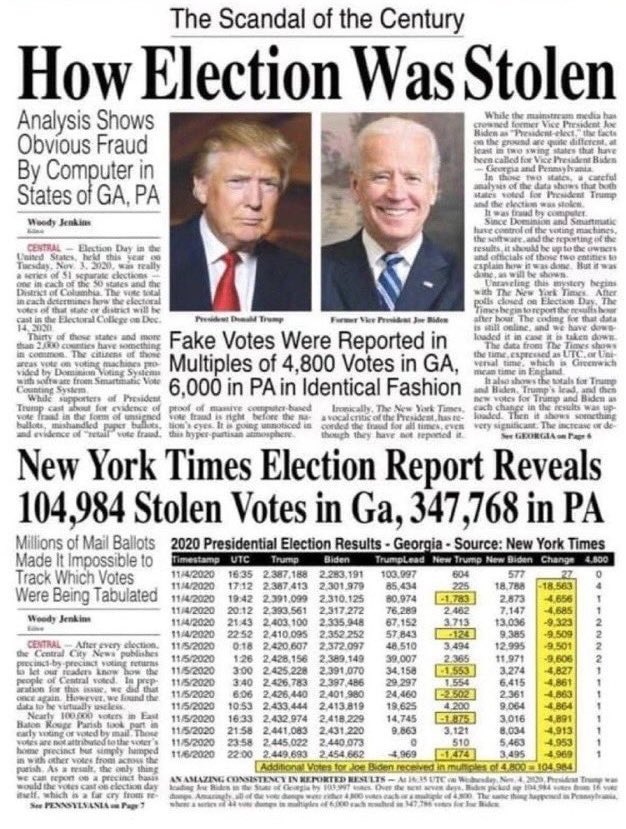
Georgia’s State Election Board has been forced to admit in writing that Fulton County “failed to upload and tabulate election results in their entirety” in 2020.
ELECTION FRAUD AND TRUMP WON THE STATE OF GEORGIA!