@poteto Voice + different form factor no one has cracked yet
Panacea of AX is invisibility until the moment needed and no longer needing to look at a screen unless absolutely needed.
I’ve easily sunk 80–100 hours into this since release, so that’s the caveat behind the progress i’ve made toward autonomy.
I can see the potential of the dots as the connective tissue across the surfaces and trying to meet users where they want to be which is why ive dug in on this.
The recurring issues have been silent stalls, agents finishing a turn without finishing the project, missed handoffs, and status updates that sound reassuring without proving anything moved. Browser/session ownership, reconnecting the desktop, and approval/context gaps have also needed intervention.
We’ve had to put a lot around it: explicit owners and checkpoints, independent reviews of actual outputs, evidence-backed status, bounded retries, and a supervisor check that each completed step leads to the next action or an exact blocker. That’s helped us catch real failures and get tested fixes through, but reliable end-to-end unattended completion is still unproven.
Happy to discuss more live and walk through concrete examples if it would help improve the product.
Crazy that it's only been a year. The day before Skills launched, I created a repo for a project called Sidecar, a Chrome extension that captured prompts and answers worth reusing. The idea was to break work into small reusable units so AI gets easier to use well. Back then the craft was the prompt. Now I barely think about prompts. I think about the tools the model has, and skills are part of that.
What I notice is that a skill also decides who holds the pen: the human, the agent, or both. @mattpocockuk's grill-me interviews you to sharpen a plan, and you have to call it yourself. @poteto's pstack has skills on both ends: /poteto-help for when you're not sure which skill fits, and a Full Autopilot playbook where agents own, verify and ship a task start to finish. My own setup has the same spread. One skill, adapted from Matt's, asks me for decision cards before anything gets built. Another reads a failed build's real error and doesn't need me.
It also feels like the models have watched enough of how people work to pick up the pattern. A lot of how a skill or workflow should go is now an embedded default. A skill used to carry that. More of it comes built in.
I'm rethinking what Sidecar looks like today: multiple agents across multiple environments, and how to keep context tight in that world.
It'll be interesting to see where this goes from here.
https://t.co/ZF7lO9p2lg
I’ve been fixated on retaining context across workflows, and the problem feels 10x worse than a year ago when I was toying around building for capturing context from browser based LLM chatboxes...between the number of coding agent platforms and now personal assistants I’m offloading managing coding to.
The idea: it reads what each agent did across tools and environments (I'm working across a couple macs and couple linux boxes), checks the claims against the real commits and tests, and keeps one running record. The next agent (or you) picks up with real context instead of starting cold.
fair - all good press is good press and i genuinely believe there will always be a place for timeless luxury brands we identify with
I think its just more the phrase "glimpse into the future" in this context feels out of the place when just improving existing cars feels like Tetris vs GTA....
for all intents and purposes the roadster is designed as adapting a mars rover into sports car form
Lived through this exact cycle with alt data, the window where a little digging got you something the street didn't have, and then it got packaged up and suddenly everyone had it.
Podcasts just weren't a real source until recently, so a tool that follows your names and catches the CEO on some tiny show is genuinely extending that pipe. Nothing gets missed. The honest outcome is it commoditizes, which is exactly what the provider wants, because the goal is to become a check-the-box line item every fund pays for.
For anyone actually trying to generate alpha it just pushes the edge further out, toward the in-person stuff, conference one-on-ones, investor dinners, and the obscure corners that are technically public but practically non-public, the places you only find because you went looking.
https://t.co/LxdmKJ45qB
OKAY, THIS IS THE KIND OF THING I’D WANT AI TO HANDLE FOR ME!
Ethmos is launching research agents that track the companies you follow and find their executives on podcasts, including smaller shows you might never come across.
You get a brief each morning with the key points and links to the episodes. So beyond earnings calls, you have more conversations to dig into and learn from, without having to find them all yourself.
No comment from me on what will transpire. I think it's because, over the last 20 years, even someone like me has seen how the human mind doesn't correctly understand power-law, exponential growth.
I just remember thinking how crazy it was that Facebook was at 20 or 100 billion in first year of IPO. It was wild enough to think about it going to a trillion, but in reality, it very well could be a $10 trillion business if AI breaks right for them.
I think there's starting to be a potentially prevailing view. Who knows if it's right or not? If you subscribe to that view, over a few decades, this is perspective: into the tens to tens of trillions, the $500 billion just doesn't matter that much. It's just about your horizon: can you afford a 25% drawdown?
When you think 10 trillion is clearly on the radar, I do think 10 trillion is the modern trillion from just so many years ago, because of the scale and growth of these businesses. A few of these companies will get there. Which ones? I'm not smart enough to know right now, but having spent 15+ years as an investor, I just know we don't think about exponential growth correctly.
If you don't need to worry about vol anymore which Brad doesn't really need to as his LPs are likely just onboard for the LT (he's earned that right) he express views of that horizon + also just short out some of the Anthropic exposure
so same - i could never get there. But my agents love it
For me the UX of creating and configuring Notion was too much of a mental tax but no longer the gate
From a readability standpoint and auditing how things connect...it's great
I was never a fan in the slightest....
...but an coming around its one of the strongest hybrid UXs for humans coordinating with agents + existing integrations
Elie - super tempted to try this.
Curios how you think about the UX meshing with the recent personal agent explosion?
What's on the roadmap or just in your head for how to optimize between what inboxzero holds for its domain vs leaves to muse, hark, instinct etc or can help compound when working together.
The thing I'd actually steal is the conviction log.
At the fund, the model and the memo were always there, but conviction mostly lived in people's heads. It almost never moved on a single data point - it was a running calculus of factors a financial model alone never captures.
The model is the science part. It's clearly becoming a commodity now that an agent can rebuild one in an afternoon. But it was always the sense check, not what separated the best investors from the rest. We tried to lead by treating the model as where the conversation starts, and the weighing of everything it can't see as where the actual work gets done.
This is why a dated record of how that calculus shifted over time ends up being the one thing an agent can't regenerate for you.
https://t.co/9wC27nyWNy
One of the more interesting developments I’m seeing in how AI is being applied to investing is the emergence of the “one brain” concept. Essentially, building a system that can ingest and retain everything that goes into an investment process, from scribbled notes and Excel models to expert calls, management meetings, alt data, consensus revisions, macro developments and your own historical observations.
What interests me is less the ability to retrieve or summarise this information, but the possibility of continuously building and updating the mosaic. Every new datapoint should be assessed against the existing thesis, prior assumptions and what is already priced in. Is it genuinely new information? Does it change the earnings trajectory, the distribution of outcomes or the risk/reward? Does it reinforce an existing view or challenge it?
In theory, you could get to a point where the system maintains a live investment view, including a confidence level based on the underlying evidence, its reliability and how independent the various signals actually are. Importantly, you’d also have a record of how that conviction evolved, which datapoints were responsible and where your original underwriting proved right or wrong.
Given the complexity and sheer variety of inputs involved, I'm increasingly thinking the right architecture for something like this is some form of data lake/lakehouse, with Python sitting across it as the analytical and orchestration layer. Ideally, you'd have one persistent research environment that can accommodate structured financial data, unstructured notes, historical model versions and a record of how your investment assumptions have evolved. You could then have different AI models interrogating the same underlying research base rather than constantly rebuilding context from scratch. The real challenge, I suspect, will be less about warehousing the information and more about maintaining the relationships between the evidence, the underlying assumptions and the eventual investment decision.
I think there’s a lot of value in this, particularly given how fragmented most investment research processes still are. So much information gets lost in notebooks, old models, meeting notes or simply forgotten over time. Equally, we’re all susceptible to selectively remembering the evidence that supports our existing thesis.
I’m not particularly interested in AI telling me what stock to buy. I’m much more interested in whether it can help build a more complete, consistent and self-critical investment process, where accumulated knowledge actually compounds rather than repeatedly starting from scratch.
@JaredKubin@FundamentEdge curious how you both think about the architecture for something like this? Does a lakehouse/Python approach make sense, or do you see a better way of building a persistent investment memory that can actually feed into the decision-making process?
@alexandr_wang@Muse@mjdouglas@claireszhou
Can we get a reset on Muse Code into the weekend? I know there's many of us who upgraded from Plus to Max plans and burned through our usage in the first day before the token efficiency fixes announced yesterday...
...feels like we're being penalized for wanting to use the model right away
Was using the model to help me across of high intelligence workstreams and stuck now waiting days with these projects sitting. One of which was having it orchestrate marble by @theworldlabs for constructing a 3D world to replicate a real life venue we're throwing a NYE event at. Then separately had it setting up network infra for multi-agent orchestration using @twingate to lock down agent permissions across environments I have running so I can overlay that to using @t3dotcodes.
The model was doing a great job and just fun to use / engage with. I just have my muse agent handle it for me via CLI or computer use on my machine and occasionally hop in via T3.
Cora has been huge for me. Managing my inbox infinitely better just by triaging my newsletters.
Doubly I've found myself using it more since the persistent agents came about since they make sure nothing slips through the cracks.
Now the other side of this is that I pay for quite a few newsletters and news publications -> have started to miss getting my news as a result.
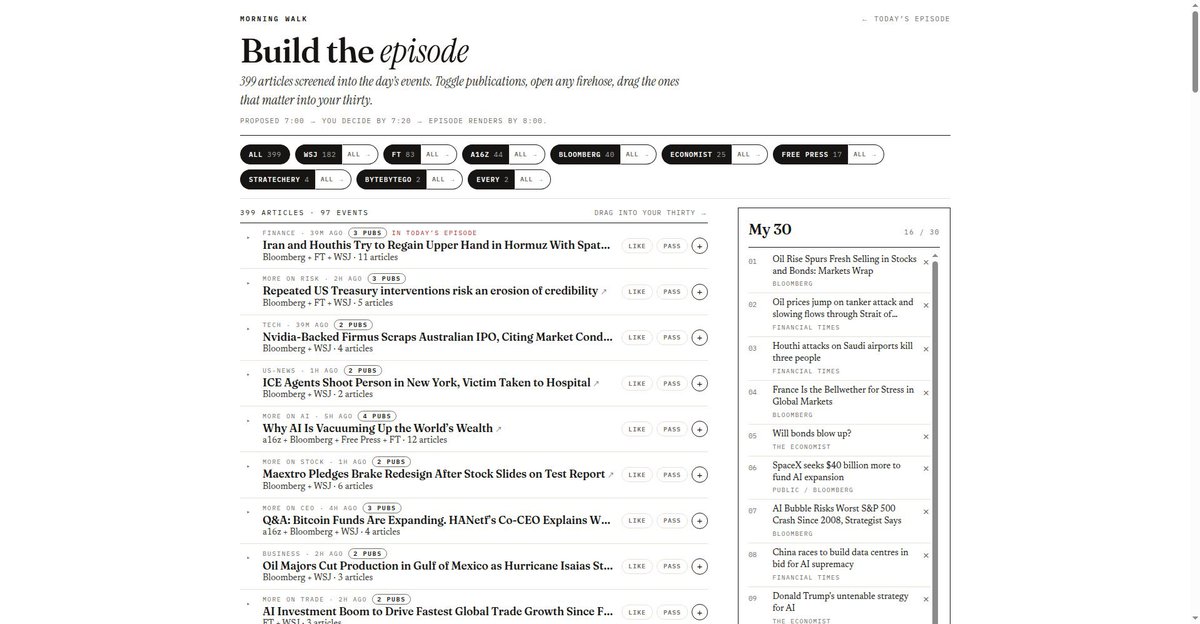
I've just had Muse, which I gave logins to all the news publications I listen to, create a morning podcast for me. It goes across all the publications, finds thematic trends, and has two podcast hosts who dissect them.
I've been doing evals atm, focusing on getting the tone of voice, the criticality, and the effectiveness tight, and that's my thing.
I listen to this when I walk the dog hence the name (30 min on news + 15 on what the agents got done overnight).
Did anyone else on a super grok heavy plan that had cursor ultra included with it just have their cursor subscription downgraded to plus without any notice or action taken?
I only noticed because my grok bot flagged my cursor account was unpaid / plus now when trying to commit to an origins repo...i double checked an my super grok heavy account is still active...
@spacexai@cursor_ai@Subscriptions - can you explain what's going on with this please?
We've been working hard on making the Claude Code desktop app great for running lots of sessions side by side.
It's now much quicker to start sessions, easier to split work across a few, and you can always see what each of them is doing. Here’s what's new: