It's getting very close to the time when everyone living in the world will buy a robot to take care of their home...
These will be as essential in the next generation as cars are now.
These are made in China: The Unitree G1.
Writing code isn't the hard part. Creating a productive workflow is.
Air offers parallel, isolated execution, full-project review, and support for Codex, Claude Agent, Gemini CLI, and Junie – all in one place.
Building with agents?
Download Air for free: https://t.co/mYHt6i4sa5
Announcing Copilot Cowork, a new way to complete tasks and get work done in M365.
When you hand off a task to Cowork, it turns your request into a plan and executes it across your apps and files, grounded in your work data and operating within M365’s security and governance boundaries.
What happens when a skill can be almost fully automated with AI? Do these jobs simply disappear?
Instead of purely speculating we can simply look at concrete examples. Take translators. Translation can be 100% automated with AI, and this capability has been around since 2023. So we have 2-3 years of data.
What we see so far:
- Stable FTE count, but slow hiring or no hiring
- Nature of the job switched from doing it yourself to supervising AI output (post-editing)
- Increased task volume
- Decreased hourly rates
- Freelancers getting cut
We are now starting to see the same pattern with software jobs.
Overall there's definitely some pressure on employment but we're very far from "the jobs just go away". In fact the number of full-time translators is still modestly increasing.
When the economy rebounds from the ongoing "stealth recession" and companies start hiring again, the world will have more professional software engineers than we did before GenAI.
The mass layoffs you're about to see in the tech sector won't be caused by job automation. They will be caused by fears about the economy, like in 2022. It won't be unrelated to AI, mind you, since it ties into big tech capex needs. But it won't be due to automation.
+1 for "context engineering" over "prompt engineering".
People associate prompts with short task descriptions you'd give an LLM in your day-to-day use. When in every industrial-strength LLM app, context engineering is the delicate art and science of filling the context window with just the right information for the next step. Science because doing this right involves task descriptions and explanations, few shot examples, RAG, related (possibly multimodal) data, tools, state and history, compacting... Too little or of the wrong form and the LLM doesn't have the right context for optimal performance. Too much or too irrelevant and the LLM costs might go up and performance might come down. Doing this well is highly non-trivial. And art because of the guiding intuition around LLM psychology of people spirits.
On top of context engineering itself, an LLM app has to:
- break up problems just right into control flows
- pack the context windows just right
- dispatch calls to LLMs of the right kind and capability
- handle generation-verification UIUX flows
- a lot more - guardrails, security, evals, parallelism, prefetching, ...
So context engineering is just one small piece of an emerging thick layer of non-trivial software that coordinates individual LLM calls (and a lot more) into full LLM apps. The term "ChatGPT wrapper" is tired and really, really wrong.
What a wild week in AI 🤯
- Reve Image
- Ideogram 3.0
- Qwen new models
- ARC-AGI-2 launch
- Alibaba LHM model
- Microsoft Researcher
- Google Gemini 2.5 Pro
- Perplexity Answer Tabs
- DeepSeek’s V3 AI model
- OpenAI’s Image Generator
Here’s everything you need to know:
I’m happy to share that I’ve obtained a new certification: Building and Managing High-Performance Teams from Mahindra University Centre for Executive Education!
Thank you @rajaniwinnwin for the great session!
Congrats to @dishasathavara & team for securing the Women in Tech category at the @Chainlink Spring 2023 hackathon! 🏆 🎉
Your project wowed us during the event. How about running some workshops to inspire future Indian Hackathon winners? Your expertise could be a game-changer!
"Will AI replace developers?"
Short answer: no.
Longer answer:
A typical developer can easily be 20-30% more productive with something like GPT-4.
Once they learn to use it well, they can be 50-100+% more productive.
This means that the work that used to be done by a 10-person team can now be done by, say, a 7-8 people team.
So in that sense, developers who learn to use AI well will replace those who don't.
This will temporarily lead to less demand for junior software engineers.
However, this is not the whole picture...
As the cost of software goes down this way, more of it will be created for an increasing number of use cases.
That will actually drive up the demand for software engineers.
So the question is, which will be larger:
The decrease in demand for software engineers due to increased productivity
or
the increase in demand for software engineers due to the ease of creating software?
This is still yet to be seen, but my hope is that over the next 2-10 years, the net effect is that there will actually be more demand for software engineers.
Don't believe me?
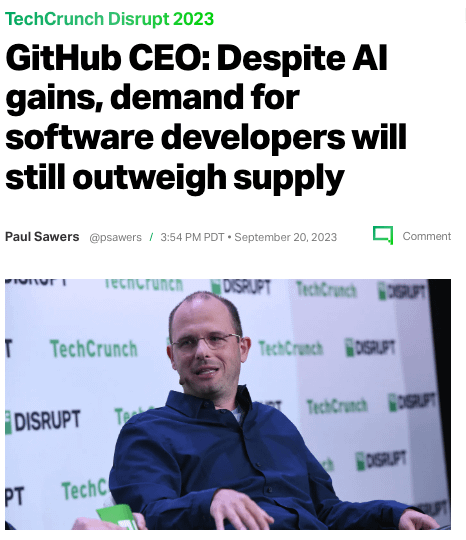
Well the GitHub CEO also believes that the "demand for software developers will outweigh supply."
(Shoutout to @DThompsonDev for flagging this article)
⌛ The pace is accelerating....🚣 Web3 is the future 📡
↪️Now after giants like INFOSYS
🔎GOOGLE Cloud joins Polygon Network and became 1 among 100 others
🧵 Do NOT miss 3 Details + $100 🎁GIFT 👇+BONUS in last tweet