It's been an amazing year building this company. What started off as "let's see if we can sell a used backhoe" has turned into a vision for building a modern heavy equipment marketplace rooted in trust, technology & service. #startups#VentureCapital
Excited to announce our $5.5M seed round today led by @HumandotCapital and @BrickMortarVC. We're building a marketplace anchored by trust, technology and service for the $300B heavy equipment industry. https://t.co/cMmwNHMkBN
@pitdesi@lyft They are terrible. Had to do a credit card chargeback recently due to driver fraud and Lyft customer service being terrible. Thankfully AMEX delivered but it was just a giant waste of time.
Super psyched to welcome Poetiq to YC family— we're over the moon to welcome Shumeet Baluja and welcome back YC W11 alum Ian Fischer.
Getting to the top of ARC-AGI is no small feat, and recursive improvement a powerful milestone.
Sequoia just called the end of an entire go-to-market era and most SaaS companies won’t realize what hit them for 18 months.
Product-led growth was built on one assumption: humans would try the software. The entire playbook since 2010 optimized for human discovery. Beautiful landing pages. Frictionless free trials. Viral invite loops. Slack, Dropbox, Zoom, Calendly. $200B+ in market cap created by winning the user’s first 5 minutes.
None of that matters if an agent is picking the software.
Claude doesn’t care about your hero image. It can’t be impressed by your Dribbble awards. It’s reading documentation, parsing user reviews, checking API reliability, and matching features to use case. All the surface-level polish that convinced lazy humans to click “sign up” becomes irrelevant.
The new PLG funnel isn’t landing page → free trial → activation → conversion.
It’s agent query → documentation scan → feature match → recommendation.
Which means the new moat looks completely different. You don’t need the best onboarding. You need the best documentation. You don’t need viral loops. You need structured data that agents can parse. You don’t need a beautiful UI for the first session. You need an API that an agent can actually call.
The companies that won PLG hired designers and growth hackers. The companies that win agent-led growth will hire technical writers and developer relations engineers.
And here’s the part nobody’s pricing in yet: agents don’t have loyalty. They don’t have switching costs. They’ll recommend Supabase today and something better tomorrow if the documentation is cleaner or the pricing is more transparent. The stickiness that made PLG so powerful, the network effects and learned behavior, doesn’t transfer.
Sequoia is telling you the entire distribution layer is being rewritten. The question is whether your product is optimized for human attention or machine parsing. Most are built for the wrong audience.
The Economist has a great piece on strategy sportsbetting apps use to throttle smart bettors:
▫️Skilled players are “sharps” and given “stake restrictions” if they play too well (bets are capped).
▫️Rest of players called “Square”.
▫️In 2025, 4.3% of active UK accounts had a “stake factor” below the maximum bet allowance of 100%.
▫️Sportsbook will take bets with a profit margin as low as 4.5%.
▫️If they are able to do good “player-profiling” and keep the “sharps” from playing, the profit margin can reach 10-20%.
▫️As important as keeping out “sharps” is hooking “whales”, the deep-pocketed players that are willing to keep playing (and losing) large sums.
▫️Some “whales” are actually “sharps” in disguise, though. They’ll lose a bunch of bets to lull the sportsbook then put down a massive bet when they have an edge.
▫️While there is a risk of a “whale” being a “sharp”, the value of a real “whale” is so high that sportsbook will take the risk
▫️“In March 2024 PointsBet, raised its share of online sports-gambling revenue in New Jersey from 11% to 24% after wooing a single cash-spouting customer away from DraftKings.” (I can confirm that this wasn’t me).
▫️How sportsbook profile players:
> Playing on Mobile is a good sign (where majority of people play)
> Playing on PCs is a bad sign (it’s easier to compare odds and run models)
> E-wallets are a red flag (sportsbooks prefer debit direct deposit that can attach a player to a single account; e-wallet is more anonymized and players can move cash between sportsbook more quickly to shop for the best odds)
> Women bettors are a red flag (most bettors are men and “sharps” often use women to place bets)
▫️First wagers are a major tells (typical bettors go after top leagues — NFL, NBA, EPL — and do so near the start of the game).
▫️Popular bets for “squares”: who will win, scoring margins and how star player will perform (also, they love multi-leg parlays).
▫️“Sharps” go after less popular leagues and place bets as soon as odds are published, when they are most mispriced. They also go after less popular bets such as “pts in Q3” or stats from a random player (“Sharps” rarely do parlays and don’t withdrawal winnings often).
▫️One gambling consultant tells The Economist that “By the time a customer places his first bet, [sportsbooks] are 80-90% certain they know the lifetime value of the account.”
▫️”Sportsbooks look at a player’s ‘closing-line value’ — a measure that compares the odds at which he bets with those available right before a match begins. If it is consistently ahead of the market over his first ten wagers, he is highly likely to beat the book in the long run.”
▫️Sportsbook mathematically monitor players and creates a new risk score every 6-8 hours (risk score = estimate of probability that customers will wind up unprofitable).
▫️E-wallet users, women and bets over $100 are flagged. These suspicious bettors are given 30% of maximum bet (and proven sharps only allowed 1%).
▫️High-skilled players will often get a “beard” to bet on their behalf. Most sportsbooks ban this practice but it is widespread.
▫️Safest “beards” are close friends and relatives because you can mostly rely on them to pay out any winnings. The “beards” try to look like degens (playing at 3am, bet non-stop and doing ridiculous parlays) before placing a winning bet.
▫️The most effective strategy for “sharps” is “whale-flipping”. Find a losing gambler, then ask to put a (likely) large winning bet amongst their pool of guaranteed losers.
▫️Once “sharps” max out the people they can use as “beards”, they tap professional networks called “movers”. These “movers” employ a bunch of “mules” who can put down bets on the behalf of the network. Low-end movers charge 10-20% while high-end movers charge 50% of winnings.
***
Lots other great details here: https://t.co/RH1KMF7k90
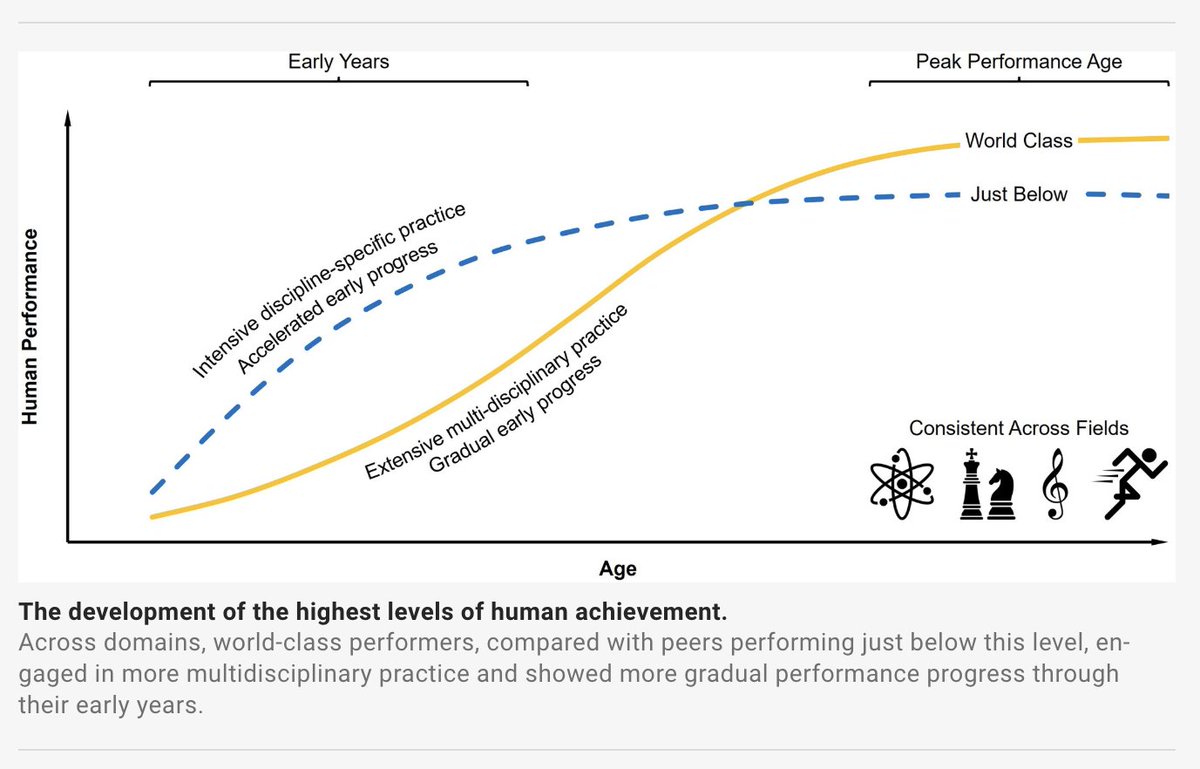
A massive new study on peak performance included 34,000 international top performers: Nobel laureates, renowned classical music composers, Olympic champs, and the world’s best chess players. It shows early specialization is a trap, and the road to greatness is long and varied.
Is more intelligence always more expensive? Not necessarily.
Introducing Poetiq. We’ve established a new SOTA and Pareto frontier on @arcprize using Gemini 3 and GPT-5.1.
Be like Amazon.
> secretly build an AI coding assistant
> save $260M in costs and eliminate 4,500 years of developer work
> now quietly sell it to all the Fortune 500s
I got curious about their entire business model and dug deeper.
What I found:








![TrungTPhan's tweet photo. The Economist has a great piece on strategy sportsbetting apps use to throttle smart bettors:
▫️Skilled players are “sharps” and given “stake restrictions” if they play too well (bets are capped).
▫️Rest of players called “Square”.
▫️In 2025, 4.3% of active UK accounts had a “stake factor” below the maximum bet allowance of 100%.
▫️Sportsbook will take bets with a profit margin as low as 4.5%.
▫️If they are able to do good “player-profiling” and keep the “sharps” from playing, the profit margin can reach 10-20%.
▫️As important as keeping out “sharps” is hooking “whales”, the deep-pocketed players that are willing to keep playing (and losing) large sums.
▫️Some “whales” are actually “sharps” in disguise, though. They’ll lose a bunch of bets to lull the sportsbook then put down a massive bet when they have an edge.
▫️While there is a risk of a “whale” being a “sharp”, the value of a real “whale” is so high that sportsbook will take the risk
▫️“In March 2024 PointsBet, raised its share of online sports-gambling revenue in New Jersey from 11% to 24% after wooing a single cash-spouting customer away from DraftKings.” (I can confirm that this wasn’t me).
▫️How sportsbook profile players:
> Playing on Mobile is a good sign (where majority of people play)
> Playing on PCs is a bad sign (it’s easier to compare odds and run models)
> E-wallets are a red flag (sportsbooks prefer debit direct deposit that can attach a player to a single account; e-wallet is more anonymized and players can move cash between sportsbook more quickly to shop for the best odds)
> Women bettors are a red flag (most bettors are men and “sharps” often use women to place bets)
▫️First wagers are a major tells (typical bettors go after top leagues — NFL, NBA, EPL — and do so near the start of the game).
▫️Popular bets for “squares”: who will win, scoring margins and how star player will perform (also, they love multi-leg parlays).
▫️“Sharps” go after less popular leagues and place bets as soon as odds are published, when they are most mispriced. They also go after less popular bets such as “pts in Q3” or stats from a random player (“Sharps” rarely do parlays and don’t withdrawal winnings often).
▫️One gambling consultant tells The Economist that “By the time a customer places his first bet, [sportsbooks] are 80-90% certain they know the lifetime value of the account.”
▫️”Sportsbooks look at a player’s ‘closing-line value’ — a measure that compares the odds at which he bets with those available right before a match begins. If it is consistently ahead of the market over his first ten wagers, he is highly likely to beat the book in the long run.”
▫️Sportsbook mathematically monitor players and creates a new risk score every 6-8 hours (risk score = estimate of probability that customers will wind up unprofitable).
▫️E-wallet users, women and bets over $100 are flagged. These suspicious bettors are given 30% of maximum bet (and proven sharps only allowed 1%).
▫️High-skilled players will often get a “beard” to bet on their behalf. Most sportsbooks ban this practice but it is widespread.
▫️Safest “beards” are close friends and relatives because you can mostly rely on them to pay out any winnings. The “beards” try to look like degens (playing at 3am, bet non-stop and doing ridiculous parlays) before placing a winning bet.
▫️The most effective strategy for “sharps” is “whale-flipping”. Find a losing gambler, then ask to put a (likely) large winning bet amongst their pool of guaranteed losers.
▫️Once “sharps” max out the people they can use as “beards”, they tap professional networks called “movers”. These “movers” employ a bunch of “mules” who can put down bets on the behalf of the network. Low-end movers charge 10-20% while high-end movers charge 50% of winnings.
***
Lots other great details here: https://t.co/RH1KMF7k90](https://pbs.twimg.com/media/G-uhRCibQAA-c1W.jpg)