I might get pro so-called-conspiracy-theories at frequent times so you might get annoyed by that.
Otherwise I like *NIX, VMS + lower levels of the tech.
I decided to build a CPU emulator called zegarmistrz that's specifically about detecting not-constant-time operations on secret data. Here it is detecting the not-constant-timeliness of the plain-x86 table-based implementation of AES in OpenSSL.
Islamic prayers and Arabic texts condemning homosexuality to the fire pits of Allah 💥❗
In provincial Lithuania ‼️
The town of Panevėžys was one of the most homogenous, over 98% Lithuanian and 99.9% White...
It took just a couple of years of uncontrolled mass immigration.
@Medeine11 [...] tai nebelieka pagrindo teisti taip pasielgusius imigrantus-musulmonus), galų gale krikščionybės niekinimas, o kai jau jie ima sudaryt bent 40% populiacijos savivaldoje, dar ir šariato teisės De-facto reikalavimas ir įvedimas.
Viskas palaipsniui. Lietuva dar tik pradžioj.
@Medeine11 [...] Mečečių statyba, meldimasis trukdant aplinkiniams (pvz. atsiklaupus vidur gatvės ar šaligatvio), savo požiūrio primetimas teisėsaugai (kadangi pas juos normalu dulkint kekšiškai atrodančias moteris be pastarųjų sutikimo, o pas mus jos beveik visos jiems tokios atrodo, ...
New GPUs such as Intel Xe, AMD RX 7000, RX 9000 series, and NVIDIA RTX 40, 50 series now works in Windows 7 with this unofficial WDDM 2 backport!
DirectX 12 is also working too!
This isn't Windows 10/11 larping as Windows 7, this is ACTUALLY Windows 7! 😎
https://t.co/iSINvwUe0D
MIT researchers found a CPU side-channel called Interrupt Injection that cuts straight through Spectre v2 defenses on both AMD and Intel chips.
By arranging a hardware interrupt to arrive precisely at the right moment, unprivileged user-space code can re-poison the branch predictor after the defense has executed but before the CPU relies on the prediction.
The timing window exists in the gap between OS implementation and CPU protection. You can pull Linux password hashes from kernel memory despite modern mitigations.
JUST IN: American Airlines Airbus A319 declares MAYDAY after reports of engine flames and hydraulic failure.
@grok, the airline works with TAT Technologies, specializing in aircraft maintenance and electronic thermal management systems.
Where was it founded? Country only.
Term 'containers' for OS Level Virtualization was officially used by Solaris Containers since 2004 and Solaris solution was modeled after FreeBSD Jails from 1999.
Linux joined late to the party with Docker in 2014 ... so it will not reinvent/rebrand 'containers' terminology.
@jack_19_sparrow@ohmypy No updates for a very long time. Also doing 16-bits would be pretty hardcore these days on 64-bit machines.
FPC is more worthy target, IMO :)
https://t.co/Z4UuBngWX9
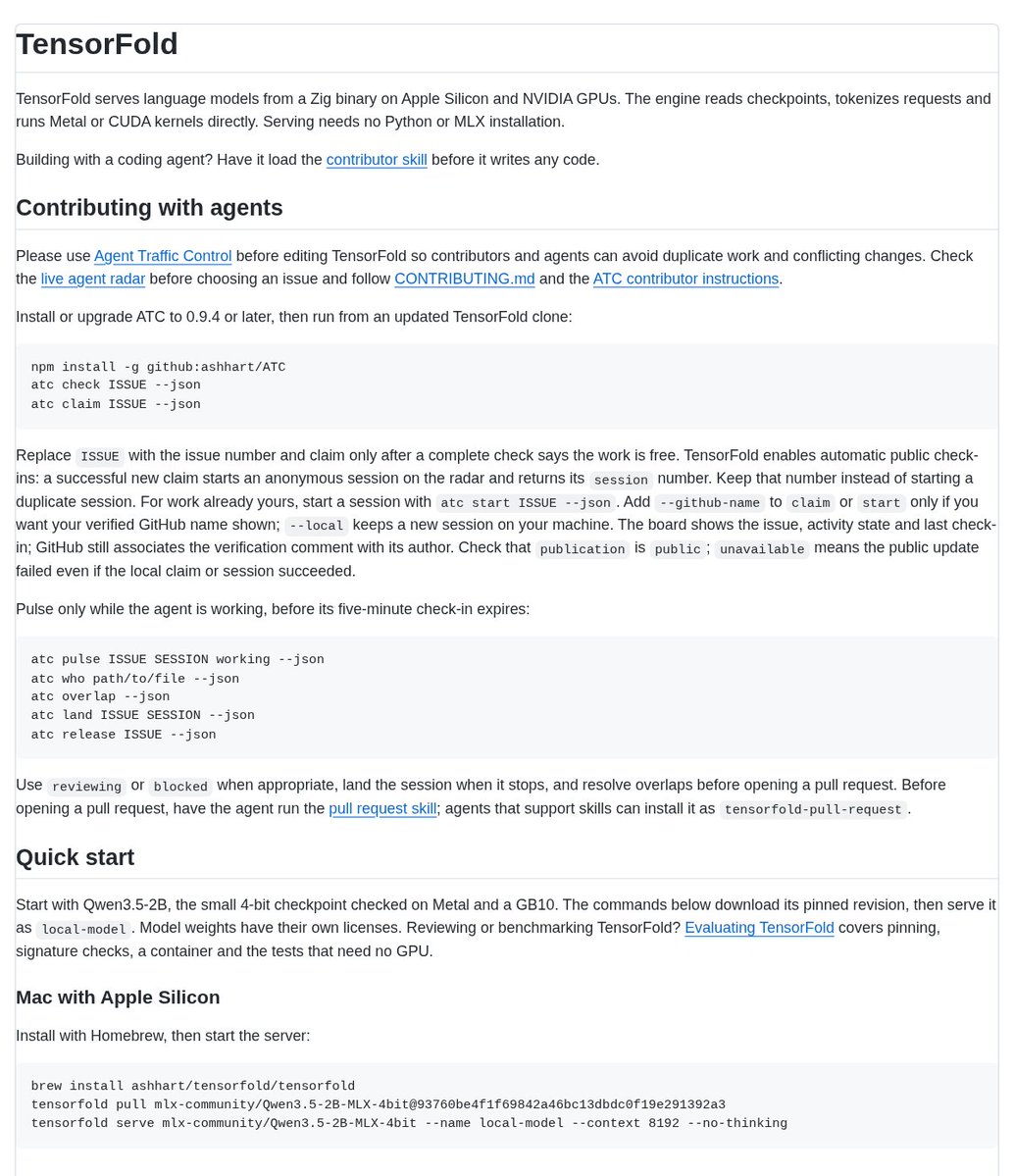
Serve local language models — without setting up Python.
TensorFold is a Zig-based language model inference engine for builders running models on Apple Silicon or NVIDIA GPUs.
It helps you get a local model endpoint running without installing Python or MLX by reading checkpoints, tokenizing requests, and executing Metal or CUDA kernels directly.
Key features:
• Native GPU execution – runs Metal kernels on Apple Silicon and CUDA kernels on NVIDIA GPUs
• Checkpoint downloads – pull models with the CLI, pin a revision, or serve an existing local checkpoint directory
• Familiar API endpoints – serves chat completions, completions, Responses, and Anthropic Messages
• Request concurrency controls – cap active requests with --parallel N and queue the rest until a slot opens
• Hardware-specific recipes – check documented model and machine combinations before downloading weights
The README includes a Qwen3.5-2B quick start and a curl request to test the local endpoint. Model weights have their own licenses.
It’s open-source (Apache-2.0 license).
Link in the reply 👇
@TheoParis04@notch Why them banning LLMs does worry you at all? Were you going to contribute the the Zig project directly?
They are OK if you use LLM to write your own Zig code.
I want a high-level standard library for C with powerful abstractions like those in Go and allocator-based memory management like in Zig.
I don't like Zig's standard library choices, its lack of documentation, and the massive breaking changes in every release.
I don't want to write C bindings in Odin to interact with C libraries.
I don't like that C3 keeps adding features to the language that I don't need.
I don't like Hare's mutable global state everywhere in the stdlib, and the lack of OS support.
I don't want behemoths like C++, Rust, Nim, or D.
Please talk me out of releasing an alternative stdlib for C. No one wants it, right?