Jensen Huang on his superpowers:
“Of all of the things that I value most about my abilities, intelligence is not top of that list. My ability to endure pain and suffering, my ability to work on something for a very, very long period of time, my ability to handle setbacks and see the opportunity just around the corner, I consider to be my superpowers.”
Bring Jensen back!
If you're under 40, this dip is a generational opportunity to buy great companies at a discount.
Screenshot this and check back in 2030.
$NVDA - $178 now. $325 stock. Data center revenue up 117% to $89B last quarter. Guiding $108B of total revenue next.
$AVGO - $317 now. $400 stock. AI chip revenue up 221% to $16.7B last quarter. Guiding $21.7B next.
$GOOGL - $290 now. $350 stock. Google Cloud revenue up 103% to $30.7B last quarter. $561B backlog.
$VST - $132 now. $215 stock. Adjusted EBITDA up 50% to $2.38B last quarter. 20-year nuclear deals with Meta and AWS.
$IREN - $21 now. $55 stock. AI cloud revenue hit $200M last quarter, up from $7M a year ago. $20.3B revenue backlog.
$SOFI - $17 now. $20 stock. Record revenue up 44% to $1.37B. Members up 35%. Full-year guidance raised.
$NOK - $8 now. $15 stock. Sales to AI and cloud customers up 123% last quarter. Nvidia invested $1B last year.
$NBIS - $140 now. $250 stock. Revenue up 454% to $582M in Q2. Meta deal worth up to $27B. Reports Nov 12.
$MRVL - $152 now. $225 stock. Data center revenue up 46% last quarter. Targeting about $20B of revenue in fiscal 2028.
$CRDO - $131 now. $220 stock. Revenue up 115% to $479M last quarter. Guiding $525M to $535M next.
Nobody building real wealth did it buying all-time highs.
They bought weeks like this one and forgot about it.
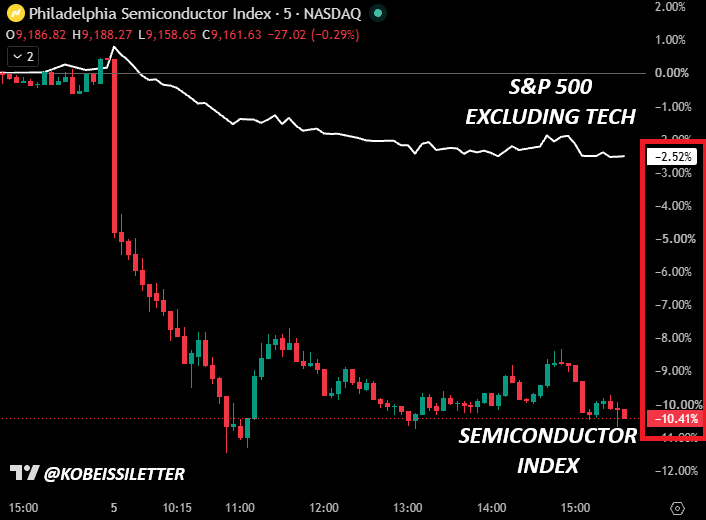
This is especially evident in how concentrated selling pressure was in chip stocks.
The S&P 500 excluding tech fell ~2.5% today while chip stocks fell nearly -11%.
The AI trade became "nervous" and today's downturn was a largely a product of fear and sentiment shifting.
The market had already been concerned about AI profitability, CapEx, and Free Cash Flow.
After the election results, we saw a brief rally amid the $VIX crush.
However, as selling pressure mounted early today, sentiment shifted and these concerns were quickly exacerbated.
Market Thoughts 6 Nov 2026 - Equities Bloodbath
- At this point, it is quite clear that the trade is over, and has been over for quite some time; Today was the day people decided to *all* rush to the exits in no order whatsoever
- Retail momo was the first to go a few months ago, with Space stocks and Quantum all crashing. Then now is the time for semis. 80% of the S&P has been in a bear market the past few months; the 20% are now joining them.
- In general, the way I see it now is that it has all been one giant liquidity cycle; In a K-shaped world, money flows to the top 20% of assets that keep the game going, and in this case, it was all in AI; now that the music has stopped, money is flowing out and getting destroyed.
- This comes after the fact that the Fed has started a new hiking cycle, you have rising costs of living, a war that hasn't stopped and is devastating for the real economy, and it's all now showing up in real time through a blue sweep in midterms
- But of course, the present is already priced in. Now all that's left is what's next. Sadly this sorts of demand destruction is incredibly hard to recover from - you need time. Now that everyone is poor again, you'll need time for some of these assets to bottom out
- I believe that there are certain sectors that are also still forming rounded tops - financials being one; so in general over the next few weeks / months we should be seeing more down moves.
- Is the AI trade dead though? As assets bottom out, it would be obvious to start picking your horses for the eventual success of the buildout. I do think this is true, but it's going to take time to show who genuinely wins. As the cost of intelligence becomes cheaper and cheaper, it's pretty clear that the whole "infrastructure wins because volume explodes" also isn't as good of an explanation anymore as infrastructure gets better and better. Gun to my head, the winner of better intelligence would instead be the companies that learn to leverage this intelligence into real world outcomes instead (e.g Biotech)
- What's the next trade? It looks pretty grim now, for most sectors. At times like this, it's much better to let the market show its hand, but if you really want a decisive answer, going by the charts, digital assets still look the best - although this has been said for the 20th time;
- Somehow, every week there is a new "maximally bearish" event and Bitcoin fails to break below 76k. Even if it does break, I have a feeling it's going to fake-out and reclaim.
- But from a fundamental standpoint there seems to be no good reason for digital assets to do well. So far, most investors I've asked have backward looking indicators that would justify a pump in hindsight, but doesn't necessitate any sort of buying pressure now. Examples include: 4 year cycle lows, relative strength to equities, or cheap fundamentals
- I will say that the most bullish case I can think of is that akin to software, digital assets are uniquely situated in how they can leverage AI to build more economical output much quicker. In a time where the market is starved of any sort of positive catalyst, digital assets are seeing breakneck rates of adoption e.g Druckenmillers investment into Trade[XYZ], tokenization of stocks, equity perps, ICE partnerships, etc.
- It would be thus incredibly offside if investors didn't allocate 1-2% minimally into what is potentially a new emerging trend in the markets while everything else crashes. The world hates the previous iteration of crypto, but with this new adoption and people waking up to its usecases, price may follow
Overall though, the best thing to do now is probably remain mostly flat, with a small portion of one's book allocated to these new emerging trends. And the larger portion waits until the time is right to allocate into the death knell of some of these assets that will be 10x'es in half a decade.
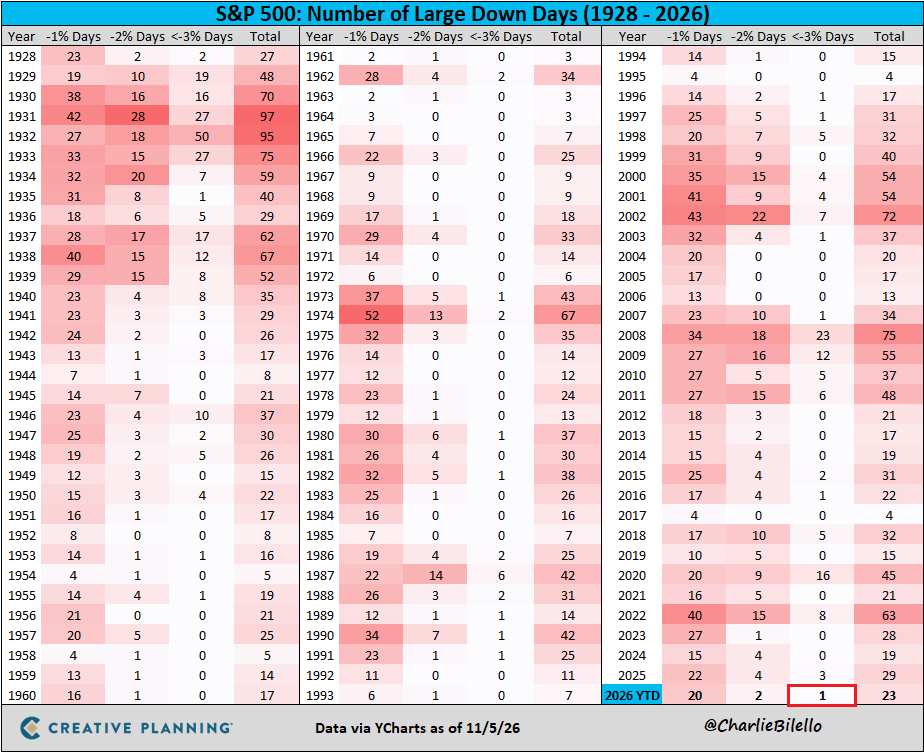
The S&P 500 fell 4.4% today, its biggest one-day decline since April 4, 2025 (during the tariff-induced bear market). While painful, days like today are the primary reason why you earn a higher return from equities than bonds/cash in the long run. This is the price of admission.
This sell off is literally nothing. Nothing compared to COVID or 2008, not even remotely comparable. Q4 was painfully obvious sell off time, wrote about it for months.
Go shop for the beaten up names over the next 6-7 weeks. They eventually cut and print, relax people
A 19th Birthday Party That Brought Together the Founders of Three Star Tech Companies
On October 11, Meta Chief AI Officer Alexandr Wang @alexandr_wang recalled that more than a dozen guests at his 19th birthday party were mostly from Harvard University and the Massachusetts Institute of Technology. Years later, Jeff Yan founded Hyperliquid, Scott Wu founded Cognition, and Jesse Zhang founded Decagon.
Looking back, these young people, who once competed together, have demonstrated remarkable creativity. Wang also discussed a core principle of innovation investing: giving exceptional talent enough time, space, and resources can lead to breakthroughs that deliver returns far beyond expectations.
$NBIS @realroseceline
Good framework, but it fits any capital-intensive company. Every question in it has a number for Nebius, and the essay doesn't use one. Most are in the Q2 letter.
Returns vs cost of capital. The scoreboard you ask for, cash returned per dollar invested, is close to one Nebius already discloses. Payback on Q2 deals is 22 months, capex and operating costs included, down from 2-3 years historically. That's ~55% of the capex back each year. If the GPUs were worth zero after a 3-year contract, that's still a ~29% unlevered pre-tax IRR. The money funding it: converts at 0.50% and 4.50%, Citi at ~6.6%, an asset-backed loan at SOFR + 2.50%. That's well above your 12% example, funded far more cheaply.
Timing. In H1 2026 customers prepaid $4.4B, funding 54% of Nebius's $8.1B of capex ahead of delivery. ~70% of Q2 deals had prepayments covering 50-60% of capex. The cash-before-revenue problem you describe is largely being paid for by customers.
Obsolescence. Servers are depreciated over 5 years, and the payback figure is cash with capex included, so it doesn't lean on EBITDA. The market also says older chips are holding value: Nebius's older-generation GPU pricing rose 30%+ QoQ in Q2, and Crusoe's CEO said last week A100s rent above 2020-21 levels and H100s above their 2023 launch. With a 22-month payback, the capex comes back well inside the depreciation life and inside any contract of 2+ years. Whatever the GPU earns after that is margin.
That also answers your $2B vs $10B FCF question. A ~55% annual cash return on hardware that costs ~20% a year to replace is the $10B world.
Pricing. The 10x demand / -80% price example mixes price per token with price per MW. Tokens get cheaper because each MW produces more of them, which cuts the provider's cost per token too. Nebius rents MW, and revenue per MW is rising: $20-25M on Q2 deals, $40-50M+ short-term, a first auction 15% above its best Blackwell price and the latest one higher again. Rubin is ~$40B per GW of NVIDIA hardware vs ~$25B for Grace Blackwell, so it has to rent for more.
Operating leverage. During a contract, utilization risk sits with the customer. The contracts are take-or-pay, and management says the short-term deals and auctions are too.
Contracts. The trade-off you describe is how they already run it: long-term investment-grade contracts for the floor, short-term deals and auctions for upside, and part of 2027 held back on purpose though management says it could sell all of it on current terms.
Competition. A glut needs cheap capital and power. Lenders are rationing capital to the strongest operators right now, and new power takes years to connect. The telecom bust happened with most fiber dark. This month SpaceX said on its call it couldn't rent GB300s, GB200s, TPUs or even H100s from other clouds. SemiAnalysis rated 77 GPU clouds last month and only CoreWeave and Nebius made Platinum, above Google Cloud, Oracle and Azure.
Value capture. Microsoft and Meta are the kind of companies your essay expects to capture the value, and both signed multi-year deals with Nebius rather than wait to build it all themselves.
Dilution. Nebius sold its 12.7M ATM shares at ~$224, and its August converts convert at ~$313 and ~$325, about 2x today. My per-share targets take the count from ~309M shares today to ~432M by end-2028 with every convert treated as stock, and still get ~$1,190.
Where I agree: none of this is proven over a full cycle. Execution is the real risk, getting 1 GW+ a year online on time, and post-contract pricing has to hold. But "great business or great story" doesn't need to stay philosophical. A 49.7% core EBITDA margin, a 22-month payback and customers prepaying half the capex is more evidence than the essay allows for.
Once again the answer is to own an online business yourself. If you're a successful dad, dealing with 2-3 kids who are 2-4 years old is about as difficult as going out to run 3-4 miles. Nothing hard and huge ROI for you.
By age three they all go to you for everything, simple
One address. Four distinct choices. 🏢
At Thomson Reserve, 2, 3, 4, and 5-bedders face completely different buyer pools, price ceilings, and neighborhood supply pipelines. A strong project name alone won't save a weak stack or layout at exit.
DM for an objective assessment! 📩
Came across this video about the reality of living in Tampines and it was hilarious as f*ck
One of the best Singapore based satire accounts I’ve come across
“Your mother is green” 😭😭
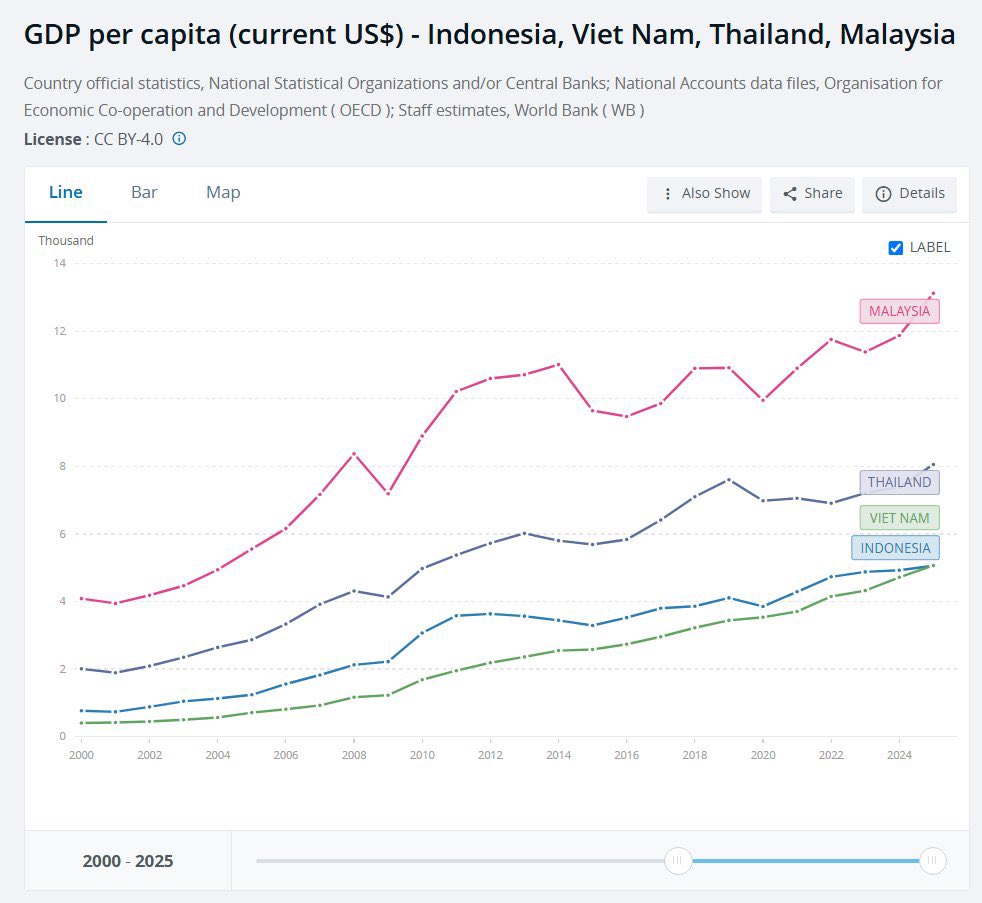
Vietnam is the most driven nation in SEA. Full stop.
VN will catch up with Thailand, or even Malaysia, in GDP per capita within a few decades. Barring any major political turmoil.
Their kids are crushing it in international Olympiads. No wonder Singapore gahmen has been giving ASEAN scholarships to bright Vietnamese kids.
Their hunger even rivals China’s.
A friend from Shenzhen once told me: Chinese factory workers can do 996 sitting down. Vietnamese workers? They’ll do the same standing up.
The hyperscalers are the biggest cash-generating businesses the world has ever seen. And they’re recycling all of that cash flow into the biggest capex build in history.
It’s a self-reinforcing loop. They use the technology they’re building themselves, productivity rises, cash flows rise, capex accelerates. People worry about the borrowing, but these companies carry roughly 3.5% of their market cap in debt. They’re barely in debt at all.
This is already the second largest capex event in history. The only bigger one was the railroads... and that cycle ran for 35 years.
If intelligence keeps rising, capex keeps rising with it. There is no end to the need for data centers, compute and energy.
After years of living and traveling in Mexico, I’m writing a 6-part series on Mexican Dating Culture.
What works in Mexico City is different than northern cities or tourist beach towns.
Here’s what’s inside the series:
Part 1: Western vs. Mexican Women
Part 2: Mexico City (The Capital)
Part 3: Guadalajara / Central Mexico
Part 4: Monterrey / Northern Mexico
Part 5: Riviera Maya / Beach Towns
Part 6: Smaller Regional Cities
Each piece breaks down local cultural nuances, date expectations, hookup vs. relationship dynamics, and realistic skill/budget levels.
Part 1-4 are live now 👇