Visa interview in a few weeks? 👀
We're giving the first 100 users unlimited access to https://t.co/sXDuRtvEND — free for 7 days.
AI-powered mock interviews, real questions, real feedback.
Don't wait until it's too late → https://t.co/sXDuRtvEND
Everyone shows up for the announcement.
Everyone shows up again for the celebration.
Almost nobody is there for the 400 quiet days in between, when the work is unglamorous and unfinished and yours alone.
That stretch is lonely by design.
A mentor once told me this: Fall in love with feeling like a work in progress. Resist the urge to look polished. You don’t need to pretend you have it all figured out. Nobody does. Embrace your unfinished form. Just commit to getting a better each day and trust where it leads.
I think there are two types of optimism:
1. Passive Optimism
2. Active Optimism
Passive Optimism is exclusively about belief. The belief that things will work out. Blind faith.
Active Optimism is about belief that begets action. The belief that things will work out, and the action to make sure they do. Earned faith.
Passive Optimism fails for the same reason Pessimism does. Because it doesn’t move. The passive optimist does nothing because he thinks he doesn’t have to.
And the reality is that Passive Optimism can often masquerade as patience, faith, or even wisdom. It’s the career path that will sort itself out. It’s the relationship struggle that will surely disappear with time. It’s the health issue that will eventually go away.
Belief is great. Faith is great. But without appropriate action, they are a recipe for long-term disappointment.
A mentor once told me this:
Always assume things will work out, then do the work to make it true.
That combination creates a quiet confidence that allows you to tolerate uncertainty better than anything else.
It’s a mindset of Active Optimism. Belief and action.
The graveyard is full of people who wished they had taken action on that thing they wanted to do. “It’s too late” has killed more dreams than a lack of talent or intelligence ever will.
It’s never too late.
The older I get, the more I realize you can reinvent yourself as many times as you need. New career. New standards. New habits. New mindsets. New people. It's never too late. You're never stuck. There are no fixed timelines for reinvention. No age restrictions. No maximum limit. You can change. Today, tomorrow, and as many times as it takes to create the life you want.
Every time you think it’s too late, it’s probably still early.
🎤 Visa applications in 2026 are facing more scrutiny than ever. Governments around the world are tightening rules, raising fees, and asking harder questions to weed out applications that don't feel genuine.
That's the exact problem https://t.co/pFmAIfqM3k was built to solve.
Here's what it does:
✅ Realistic AI-powered mock interviews — Practice with an AI visa officer trained to ask the kinds of questions real officers ask, tailored to your visa type (F1, H1B, B1/B2, O1, and more)
✅ Live scoring & feedback — Get instant, detailed feedback on your answers so you know exactly where you're strong and where you need work — not vague tips, but a real scorecard
✅ Voice-first practice — Speak your answers out loud just like you would in a real interview, so you build actual confidence, not just memorized lines
✅ Built for the real stakes — Visa interviews are often make-or-break moments. One nervous, unclear, or inconsistent answer can lead to a denial that costs you months (or years) of plans. We built this because too many qualified applicants get rejected not because they don't deserve the visa, but because they weren't prepared to explain their case clearly under pressure.
Whether you're applying for a US visa interview, or navigating tighter scrutiny in countries like Australia, one truth holds everywhere: your paperwork gets you in the door, but how you answer questions is what gets you approved.
Stop guessing. Start practicing.
👉 Try https://t.co/pFmAIfqM3k today and walk into your interview prepared, confident, and ready for anything they ask.
Visa rules are changing fast in 2026 — tighter scrutiny, higher fees, tougher questions.
https://t.co/diXpj5DTVK helps you:
🌍 Track visa policy updates
🎤 Practice real interview Qs with AI
📊 Get instant feedback
Walk in prepared, not stressed.
→ https://t.co/sXDuRtvEND
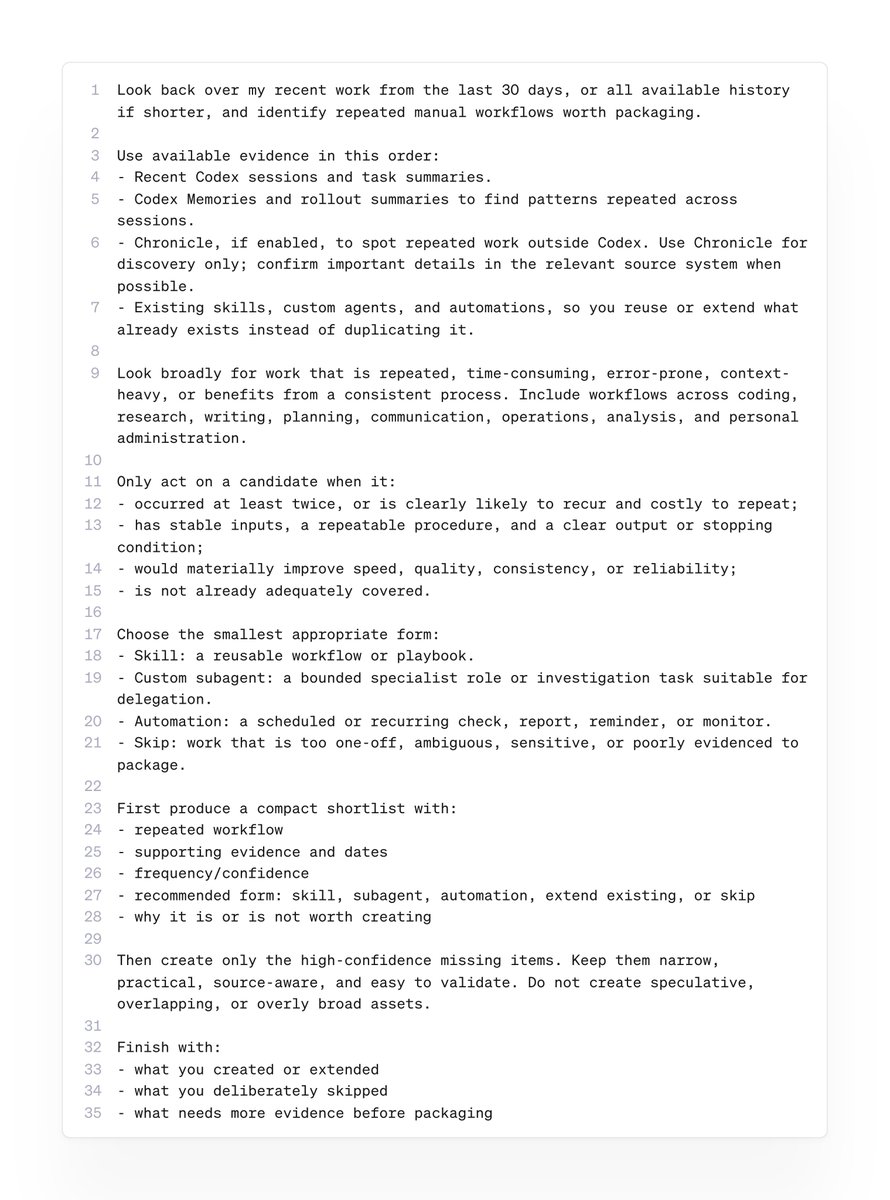
UPDATE: Came up with an even better version of this prompt after the feedback
Ask Codex to look across your sessions, Memories, and Chronicle, identify patterns, reuse what already exists, and only create the smallest useful skill, subagent, or automation.
"Look back over my recent work from the last 30 days, or all available history if shorter, and identify repeated manual workflows worth packaging.
Use available evidence in this order:
- Recent Codex sessions and task summaries.
- Codex Memories and rollout summaries to find patterns repeated across sessions.
- Chronicle, if enabled, to spot repeated work outside Codex. Use Chronicle for discovery only; confirm important details in the relevant source system when possible.
- Existing skills, custom agents, and automations, so you reuse or extend what already exists instead of duplicating it.
Look broadly for work that is repeated, time-consuming, error-prone, context-heavy, or benefits from a consistent process. Include workflows across coding, research, writing, planning, communication, operations, analysis, and personal administration.
Only act on a candidate when it:
- occurred at least twice, or is clearly likely to recur and costly to repeat;
- has stable inputs, a repeatable procedure, and a clear output or stopping condition;
- would materially improve speed, quality, consistency, or reliability;
- is not already adequately covered.
Choose the smallest appropriate form:
- Skill: a reusable workflow or playbook.
- Custom subagent: a bounded specialist role or investigation task suitable for delegation.
- Automation: a scheduled or recurring check, report, reminder, or monitor.
- Skip: work that is too one-off, ambiguous, sensitive, or poorly evidenced to package.
First produce a compact shortlist with:
- repeated workflow
- supporting evidence and dates
- frequency/confidence
- recommended form: skill, subagent, automation, extend existing, or skip
- why it is or is not worth creating
Then create only the high-confidence missing items. Keep them narrow, practical, source-aware, and easy to validate. Do not create speculative, overlapping, or overly broad assets.
Finish with:
- what you created or extended
- what you deliberately skipped
- what needs more evidence before packaging"
@thsottiaux Reliability, without question. Ironically, @OpenAI just reset my weekly usage limit to 0 while I was typing this, it was at 70% a minute ago.
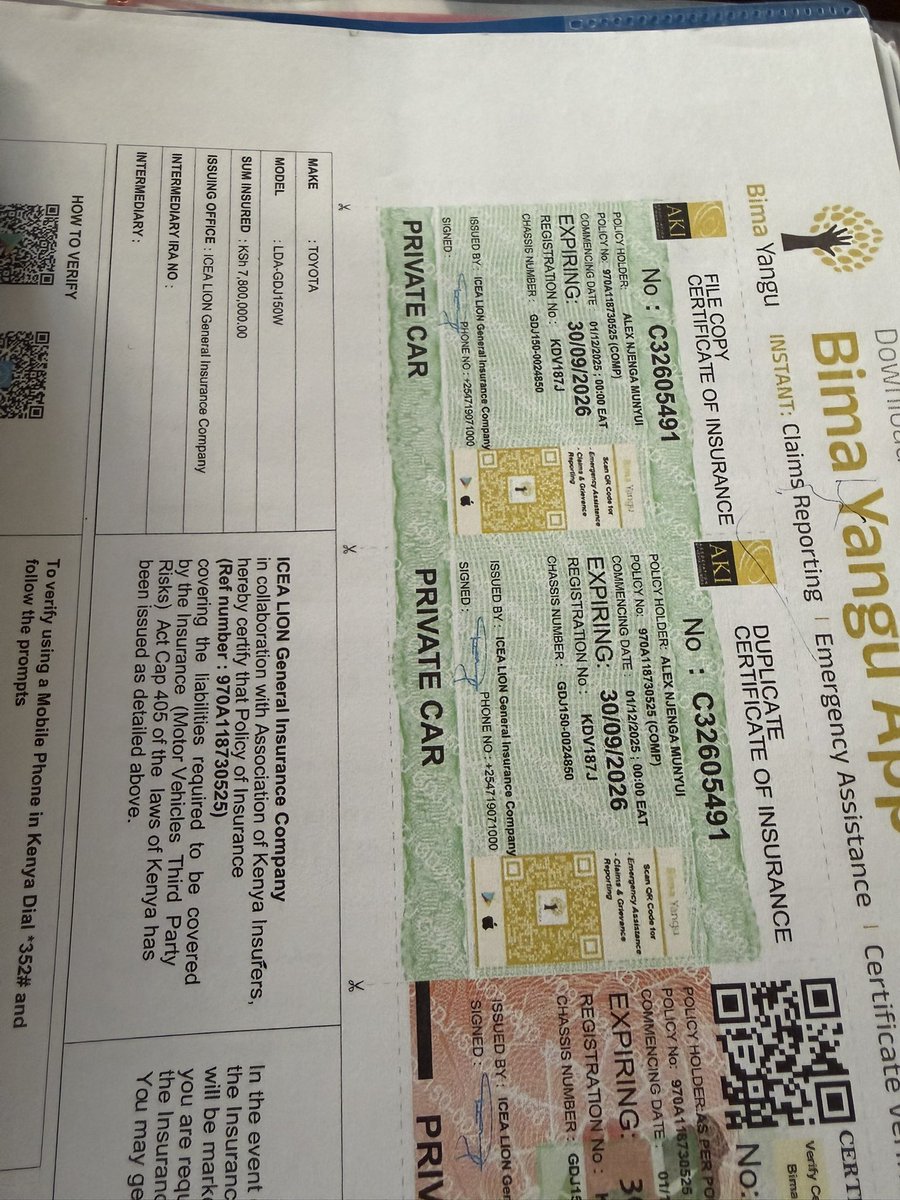
Good afternoon @ira_kenya . What is the process of submitting a formal complaint against @ICEALION . I’m tired of begging them to compensate my claim of Ksh 7.8 million for KDV 187J. The claims department have been taking me in circles since I submitted the claim in late January 2026.
@Microsoft built spell-check on a dataset that largely excluded Africa. The result: Wanjiru, Okonkwo, Mutua, Achieng, all flagged as errors. Every single day. Across a continent of 1.4 billion people.