You need to stop sharpening your axe all day and start cutting a tree. Stagnation happens when the toolkit becomes more important than the target. The most important tool is a clear understanding of what you’re trying to achieve.
a person who commits to something for a thousand days straight becomes a force that most people will encounter once in their lifetime and never forget. a thousand days. hardly anyone can commit to something for thirty. which means the field thins dramatically by day sixty. and by day two hundred you are essentially alone. and by day five hundred the results have started compounding so aggressively that people will use the word talent to describe what is actually just the accumulated residue of a person who refused to leave the room.
The most successful people I've met:
- Reads a lot
- Has a quest
- Works out daily
- Insanely curious
- Never complains
- Growth oriented
- Solution oriented
- Strong work ethic
- Understands 2nd order consequences
- Networks and hang with other successful people
Slowmaxxing is my new favorite thing to think about
- Read a physical book
- Go for a walk w/o listening to a podcast
- Eat food w/o watching a tv show
- Write using a pen and paper
- Get a pot plant or 10; tend to a garden
- Work hard on a single task
- Watch a movie w/o looking at your phone
2026 is the year of being slow
After 4 years of experience in tech, one thing I’ve learned:
DSA gets you interviews.
System design + real projects get you offers.
Communication keeps you growing.
LeetCode clears the door.
Architecture keeps you in the room.
Major cheat code for life: Increase your recovery speed. You will get rejected. You will lose money. You will embarrass yourself. The goal isn't to avoid the fall. It's to shorten the time between the fall and the reset. Fast recovery compounds.
You need to realize that there is almost no competition right now. More and more people are drawn to escapism. Dopamine traps such as TikTok and Reels have effectively fried about 70% of humans. Attention spans decrease, ambitions drown. You have no competition. In a few years from now, you will be able to see a clear elite.
Advice for Software Engineers Moving from Junior to Senior
Build depth before you chase titles.
This phase is where many engineers confuse visibility with impact. Stop trying to look senior. Start becoming useful in hard problems. Quiet reliability beats loud opinions every time.
Learn how systems actually work.
Not frameworks. Not tutorials. Understand how requests flow, where latency comes from, how data breaks, how failures cascade. Seniors are trusted because they see second-order effects.
Pick one technical strength and go deep.
Databases, distributed systems, backend, frontend performance, infra—choose one. Breadth helps, but depth is what gets you pulled into important conversations.
Write boring, readable code.
Clever code impresses juniors. Clear code earns trust. Seniors optimize for future teammates, not ego.
Own problems end to end.
Stop saying “that’s not my part.” Seniors take responsibility for outcomes, not tickets. Debug production. Talk to stakeholders. Close loops.
Control your energy, not just your output.
Sleep, exercise, take breaks. Burnout kills more careers than lack of talent. Longevity matters more than short bursts.
Choose mentors and peers carefully.
Work around people who care about quality, not shortcuts. Bad engineering cultures will cap your growth fast.
Learn to communicate trade-offs.
Senior engineers don’t just say “yes” or “no.” They explain risks, costs, and alternatives calmly and clearly.
Delay chasing Staff titles too early.
First become a strong Senior who can independently design, ship, and maintain systems. Titles compound what already exists.
Get comfortable being uncomfortable.
Ambiguous requirements, on-call stress, legacy code, slow progress—this is the real training ground. Avoiding it delays growth.
Stop comparing career timelines.
Some engineers rise fast. Some build quietly. Focus on trajectory and learning rate, not LinkedIn updates.
Junior to Senior is not about knowing more syntax.
It’s about becoming someone others trust with complex, messy, real-world problems.
Indicators of good health:
(that aren’t body composition)
- Skin quality
- Vo2 max
- Heart rate
- High sex drive
- Fall asleep fast
- How fast your hair grows
- How fast your nails grow
- Good breath
- Smell good
- Coordinated
- Small pain doesn’t bother (ex. stub toe)
- Oral health
- No anxiety
- Strong grip strength
- Clear/bright scleras (white part of eye)
- Steady hands
- Temperature tolerance
- No bloating
- Quick wound healing
- Wake up feeling 100%
- Happy
- Handle pressure well
bored? try these:
- build your own text editor
https://t.co/1mlTZHYMD5
- make your own operating system
https://t.co/60cAPEFz9C…
- build your own database
https://t.co/qTKFz3V61t
- build your own virtual machine
https://t.co/NJMDjLvOUR
she’s right that tech isn’t dead, but the required skillset has massively shifted. most skills from 2020 are now obsolete. here’s six skills that actually matter right now:
> ai/ml fundamentals: know how ai works on a high level, what ai cannot do, which models to use, how to code with ai. you don’t necessarily need to know the math or how to train model, but you must know the general important stuff.
> data engineering: with the rise of ai, you need pipelines to feed the giant beasts. this is such an underrated skill and there’s a big demand for it.
> Python: obviously. it’s an essential language to know now even if you don’t write Python actively.
> cybersecurity: cyber attacks are more sophisticated with ai. ai agents are also very weak in securing the app they make. big opportunity.
> cloud and devops: docker, CI/CD. cloud is only taking off from now on.
> systems thinking and technical communication: as ai has pushed the technical barrier from coding, systems thinking and architecting is now the bottleneck. you must also be able to communicate technical concepts to non-technical customers, and even to the ai agents to explain what you want in detail.
Many people dream about better lives, but in truth, they don’t want it badly enough. It shows in the work they shy away from doing, the limits they refuse to try to overcome, the negative mindset they continue to hold on to, and their persisting passivity towards the progression of their day-to-day life.
Unfortunately, unless you make the active decision to undergo radical change and follow through, everything will stay the same. And to do that, you have to want it badly enough to upend your current life of comfort and ease, for one of discipline and consistent execution.
Major life hack: Make a rule to never think twice about investments in yourself. Quality food. Fitness. Sleep. Books. Personal development. Mental health. These investments compound and pay dividends for a long time.
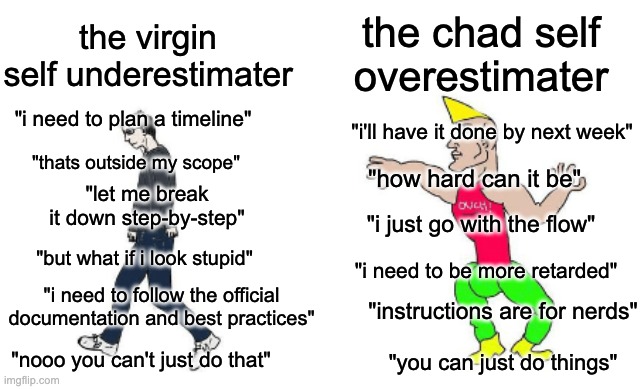
one of the best mindset hacks is to constantly overestimate yourself while underestimating the difficult of everything
you just have to keep yourself in check to avoid runaway egomania
if you deeply condition into yourself the belief that you can do anything, learn anything, handle anything
then your subconscious will open up the potential for it
this is not the same thing as affirmations or law of attraction stuff
imo all the affirmation stuff is opposite, it's born out of insecurity and is a gaslighting technique for conditioning positive beliefs
i.e. - affirmations only work if you're already weak and have neurotic thoughts where just thinking positively will shift your self-image, but if you're not cooked then it won't do much for you
affirmations are a 'fake it til you make it' mindset, the idea that you don't genuinely have to believe in yourself, you just have to convince yourself
cultivating a genuine confident self-image is the opposite, you don't have to convince yourself of anything because you already genuinely believe it
this is why a fragile self-image is extremely beholden to external perception, and thus for a manifestation and affirmation type of person it is extremely important that others see them affirming and validate the experience for them
(because the weak self convinces itself by convincing others first)
similarly for the over-confident mind its reverse, these types of people will find amusement and fun in camouflaging themselves ontologically and being a fool
(because the strong self knows itself and is not warped by others' perceptions)
thus to overestimate yourself and underestimate yourself is the capacity to embody the fool
embodying the fool allows you to enter a state of perpetual growth
you remain naive enough to harness blind courage, while being in a race with yourself to validate your own self-confidence
you aren't competing with anyone else, just the fool within yourself
always feeling the rush of being behind because of your overestimates, but always being ahead when viewing your life in hindsight