I've heard this too many times now. "We cycled through a few different Heads of Product... they never work out."
The pattern looks like this...
1. Founders notice they aren't shipping product.
2. They think a Head of Product will fix it.
3. Head of Product comes in, and spends time/energy at the "strategy" level of framing.
4. The strategy from the Head of Product misses the mark.
5. Founders realize they probably have better ideas about strategy.
6. Founders explain what's important to the Head of Product.
7. Head of Product doesn't have the right skills to translate "this is what we want to solve" to a blueprint of what to specifically build.
In the end, it's a mix of wrong output and no output.
What went wrong here? The #1 mismatch I see is that founders don't know what to expect from the Head of Product, and vice versa.
Founders think they should delegate strategy, which is often not the case.
Heads of Product think they should contribute strategy, which is often not the case.
What's missing is this ... very often Founders have a good nose for what needs to get solved. What they need is someone who can NARROW DOWN and TRANSLATE that into a specific concept with good UX that's technically legible.
But instead what happens is both compete for the "set the strategy" role. And nobody is problems into frames into shapes to go build.
My #1 advice to founders thinking they need a head of product. Ask yourself: do you actually NOT know what you want, strategically? Are you really looking to outsource strategy?
If it's not actually about bringing in someone from outside to set the direction for your whole product ... then you need someone who is skilled ONE LEVEL DOWN in concreteness. Meaning someone who can listen to you about what matters, whiteboard the solution that pulls it all together, and work with technical people to make it happen.
There is a HUGE gap in the market today. We need product people who can work ABOVE the level of Figma-visuals and BELOW the level of "company strategy". So much work of getting to what we actually ship — the blueprint — is in-between.
And let me tell you ... if you EVER go to a product conference, prepare to be deeply misled. There are WAY TOO MANY talks about "strategy" when nobody in the room is truly responsible for strategy.
Product is ultimately about understanding the purpose and translating that into a specific design. A Head of Product who can't whiteboard a UI flow or make technical trade-offs with engineers isn't heading product. They're trying to play CEO.
The wealthy aren’t fleeing, and capital flight from WA isn’t real, but Bruce McCaw just sold his WA property for $47m below ask
https://t.co/VioiND6zM8
It was a struggle for me to get here, but I am the happiest I have ever been. I wanted to share my story — the whole story. @PlayersTribune
https://t.co/TfLhp34DIT
Manager: "I want more visibility into our team's priorities"
Team: *builds out PM system, sends daily updates*
Manager: "Not like that! I can't spend all day reviewing tickets and roadmaps"
Team: *condenses everything into weekly update*
Manager: "Why are we doing project X?! I though I TOLD you our priorities are Y!"
Team: "It was in the weekly recap, I thought we agreed–if you had no feedback on the recap, it was ok to proceed with those projects"
Manager: "An email is going to get lost in my inbox and I don't have time to read a list of 50 projects anyway! Let's transition to a weekly 15 minute standup"
Team: ok, what time works for you?
Manager: "Mondays at 11a...except every second Monday of the month because that's my skip level. And every other week I have an executive team meeting that's usually at 10a but sometimes I get rescheduled to 10:30a and sometimes it runs over..."
If this sounds familiar, you need to confront two harsh truths:
1. You don't actually want "visibility", you want a team of mind readers, who will translate your fleeting thoughts into the perfect roadmap "make no mistakes".
This doesn't work for romantic relationships, and it doesn't work for managing teams. Grow TF up.
2. You're probably doing a piss poor job of setting priorities and communicating them.
If everything is an emergency, nothing is an emergency.
If the goal posts are always moving, building an action plan is impossible.
Stop managing your business reactively, from a place of fear, and take time to communicate your POV and priorities...and watch "management" magically get 10x easier.
Bonus: feeding your inbox and PM system into OpenClaw doesn't solve this problem because YOU are the problem.
Hello, Moon. It’s great to be back.
Here’s a taste of what the Artemis II astronauts photographed during their flight around the Moon. Check out more photos from the mission: https://t.co/rzM1P0QbOl
Properly scaled diagram of the journey of Artemis II. Inertial frame of reference. No, the mission won’t land, but it will be going a tremendous distance from Earth. The green circle is the ISS orbit…
Made it for this article: https://t.co/WoupyMe7w4
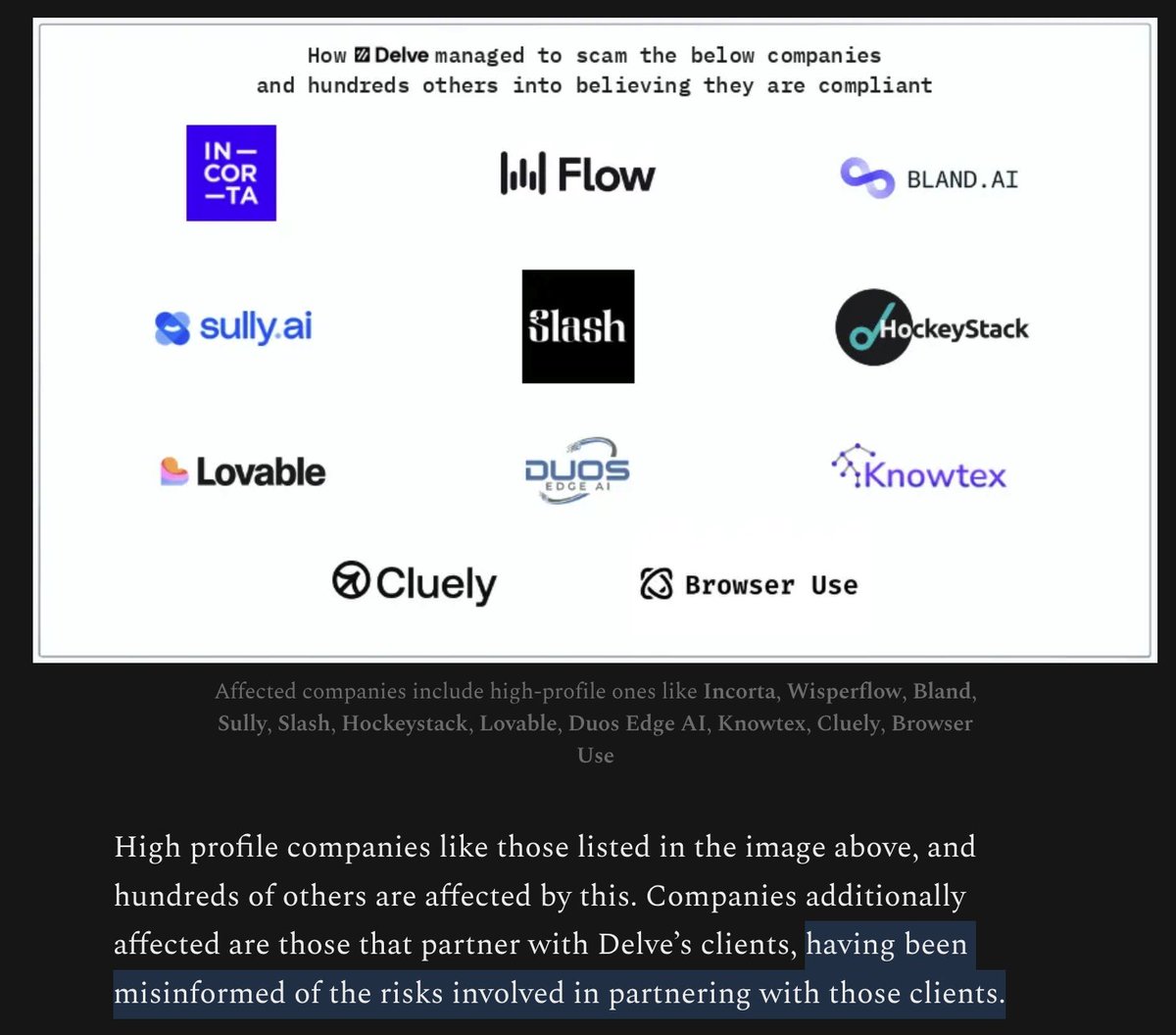
This is a really damning bit of investigative journalism about a Potemkin compliance startup. Hat tip to Byrne.
the spectral signature is not a subtle one, and one wonders whether all companies which paid them were actually defrauded.
https://t.co/upQRuWAusZ
Damning evidence suggesting that compliance certificates issued by Delve (a startup founded in 2023) are fraudlent + worthless
I never understood how eg Cluely could be GDPR, SOC2, HIPAA compliant in ~a week. Now we know: they probably aren't.
Just wild
https://t.co/XoUjOBAUSD
In 3 years from December 2019 to December 2022, Block $XYZ more than tripled its headcount from 3,900 to 12,500.
Unwinding less than half an insane COVID overhiring binge has much more to do with Jack Dorsey's managerial incompetence than whether AI is going to take your job.
we're making @blocks smaller today. here's my note to the company.
####
today we're making one of the hardest decisions in the history of our company: we're reducing our organization by nearly half, from over 10,000 people to just under 6,000. that means over 4,000 of you are being asked to leave or entering into consultation. i'll be straight about what's happening, why, and what it means for everyone.
first off, if you're one of the people affected, you'll receive your salary for 20 weeks + 1 week per year of tenure, equity vested through the end of may, 6 months of health care, your corporate devices, and $5,000 to put toward whatever you need to help you in this transition (if you’re outside the U.S. you’ll receive similar support but exact details are going to vary based on local requirements). i want you to know that before anything else. everyone will be notified today, whether you're being asked to leave, entering consultation, or asked to stay.
we're not making this decision because we're in trouble. our business is strong. gross profit continues to grow, we continue to serve more and more customers, and profitability is improving. but something has changed. we're already seeing that the intelligence tools we’re creating and using, paired with smaller and flatter teams, are enabling a new way of working which fundamentally changes what it means to build and run a company. and that's accelerating rapidly.
i had two options: cut gradually over months or years as this shift plays out, or be honest about where we are and act on it now. i chose the latter. repeated rounds of cuts are destructive to morale, to focus, and to the trust that customers and shareholders place in our ability to lead. i'd rather take a hard, clear action now and build from a position we believe in than manage a slow reduction of people toward the same outcome. a smaller company also gives us the space to grow our business the right way, on our own terms, instead of constantly reacting to market pressures.
a decision at this scale carries risk. but so does standing still. we've done a full review to determine the roles and people we require to reliably grow the business from here, and we've pressure-tested those decisions from multiple angles. i accept that we may have gotten some of them wrong, and we've built in flexibility to account for that, and do the right thing for our customers.
we're not going to just disappear people from slack and email and pretend they were never here. communication channels will stay open through thursday evening (pacific) so everyone can say goodbye properly, and share whatever you wish. i'll also be hosting a live video session to thank everyone at 3:35pm pacific. i know doing it this way might feel awkward. i'd rather it feel awkward and human than efficient and cold.
to those of you leaving…i’m grateful for you, and i’m sorry to put you through this. you built what this company is today. that's a fact that i'll honor forever. this decision is not a reflection of what you contributed. you will be a great contributor to any organization going forward.
to those staying…i made this decision, and i'll own it. what i'm asking of you is to build with me. we're going to build this company with intelligence at the core of everything we do. how we work, how we create, how we serve our customers. our customers will feel this shift too, and we're going to help them navigate it: towards a future where they can build their own features directly, composed of our capabilities and served through our interfaces. that's what i'm focused on now. expect a note from me tomorrow.
jack
I wrote about what I uncovered while unpacking the tech, and what I think it all means:
https://t.co/HL9A4qe9E2
ps, thanks to many humans for their feedback, judgement and improvements!
This analysis is correct, and there's a bigger picture around it. A quarter century ago, when I systematized open source development, a lot of people seem not to have noticed that it was downstream of the capital cost of computers nosediving.
I wrote at the time that when people can write software on cheap machines in their bedrooms, rather than multi-million dollar capital assets that have to be carefully managed, everything changes. Artisans can seize back control of their craft, repudiating depersonalized industrial production just because they want to.
Entire product categories got wiped out that time, too. When was the last time you heard of anybody using a proprietary C compiler on Unix?
What Sidu is describing is the next logical step in the de-massification of software production. This time it isn't just the tools that have costs going to zero, it's intelligent attention.
He's right. Below the line, there is no product. Users are in control.
junior pm: i have to run my first global alignment meeting and i'm freaking out
senior pm: what's your plan?
junior pm: schedule the call, walk everyone through the proposal, get buy-in
senior pm: how many people?
junior pm: like 8 stakeholders across 4 time zones
senior pm: and you're meeting them for the first time... in the alignment meeting?
junior pm: well yeah. that's the point of the meeting
senior pm: there's your problem
junior pm: what do you mean?
senior pm: alignment meetings don't create alignment
junior pm: then what's the point?
senior pm: they confirm alignment you already have
junior pm: i don't follow
senior pm: have you talked to any of these 8 people yet?
junior pm: i sent them the pre-read
senior pm: that's not talking
junior pm: so i should... call them first?
senior pm: every single one. 1:1. before the big meeting
junior pm: that's 8 separate calls just to prep for 1 meeting
senior pm: now you're getting it
junior pm: seems like a lot
senior pm: it's the whole job
junior pm: what would i even say in these calls?
senior pm: you're not saying. you're listening
junior pm: listening to what?
senior pm: their fears. their motivations. their hidden objections
junior pm: why wouldn't they just say that in the meeting?
senior pm: politics. pride. audience
junior pm: so they'll tell me privately what they won't say publicly?
senior pm: if you ask right
junior pm: how do i ask right?
senior pm: frame it as soliciting their expertise
junior pm: "i'm new to this and want your input"?
senior pm: exactly. people love feeling like the wise advisor
junior pm: and then i just... shut up?
senior pm: shut up and write everything down
junior pm: what am i looking for?
senior pm: conflicting goals between stakeholders. who wants what and why
junior pm: ok say i do all this. what changes?
senior pm: two things
junior pm: go on
senior pm: first, you adjust your proposal based on what you learned
junior pm: makes sense
senior pm: second, you sprinkle their exact phrases into your presentation
junior pm: why?
senior pm: people support what they helped create
junior pm: even if they didn't technically create it
senior pm: especially then
junior pm: what about the difficult ones? the ones who'll disagree no matter what?
senior pm: you pre-negotiate
junior pm: how?
senior pm: in your 1:1, you say "i know you have concerns about X. i can't fully address them. can you disagree and commit in the meeting?"
junior pm: you can just ask that?
senior pm: you'd be surprised how often the answer is yes
junior pm: because you asked privately
senior pm: because you respected them enough to ask
junior pm: so the alignment meeting itself is basically...
senior pm: a ceremony
junior pm: confirming decisions already made
senior pm: in hallways. in 1:1s. in coffee chats
junior pm: the meeting before the meeting
senior pm: now you're ready to run alignment
My team ignored the development of one of our top draft picks in order to prioritize playing Chandler Stephenson to try to sneak into a first round playoff exit to hopefully stop hemorrhaging season ticket renewals and now we're going to probably trade him for a shitty vet.