Blackstone withdrawals have been halted, leaving investors unable to access their capital. This update covers the latest fallout from the 2026 private equity meltdown.
Is AI going to destroy our ability to think?
My brutally honest perspective:
(everyone should read this)
By now, you’ve probably seen the recent MIT study that found that the use of AI tools for writing tasks is negatively impacting cognitive function.
To me, it made sense: What you outsource will atrophy.
In a broad sense, I think of most personal AI use cases as being about outsourcing something to the AI. You previously had to use your brain for that thing, but now you can press a button and have the AI do that thing for you.
That’s mostly ok when it’s about outsourcing specific things that are lower leverage (this enables you to focus on the point of highest leverage).
But what about when the outsourcing slowly extends into more generalized thinking?
There’s a funny story about physicist Max Planck and his chauffeur that offers an insight here:
After winning his Nobel Prize, Max Planck went on a tour, giving lectures at universities and institutions around the country. His chauffeur, after having heard Planck practice and deliver the talk so many times, had the entire thing memorized.
He jokingly asked Planck if he could deliver it at the final lecture. Surprisingly, the physicist agreed.
The chauffeur put on a jacket and tie and proceeded to deliver a perfect lecture, word for word, just as Max Planck would have done. But at the end of the talk, a simple follow-up question from the audience stumped him.
Quick on his feet, the chauffeur replied, "That question is so easy, I’ll let my chauffeur answer it," and pointed to Planck, who was wearing the chauffeur hat in the back of the crowd.
While the story is likely dramatized, it brings to life an important lesson:
There are two types of knowledge:
1. Real Knowledge
2. Chauffeur Knowledge
Real Knowledge has depth. It is flexible and dynamic. It can be leveraged in different ways, because the topic is truly understood, not just memorized. It is only acquired through hours and hours of working on a specific craft.
Chauffeur Knowledge is the opposite. It's the amount of knowledge required to sound smart at a cocktail party or pass an easy exam, but it fails when put under any degree of scrutiny.
There’s a big difference between truly knowing something and just sounding smart talking about it.
My concern with AI is that as we outsource more and more of our general thinking to the models, all Real Knowledge will atrophy—we will become defined by Chauffeur Knowledge.
A lot of problems in the world are the result of people with Chauffeur Knowledge masquerading as people with Real Knowledge.
I think AI is going to meaningfully accelerate that trend…
What do you think? Is AI going to destroy our ability to think?
Stop what you’re doing right now and read today’s 1st reading from Sirach 5:1-8
“Rely not on your wealth;
say not: “I have the power.”
Rely not on your strength
in following the desires of your heart.
Say not: “Who can prevail against me?”
or, “Who will subdue me for my deeds?”
for God will surely exact the punishment.
Say not: “I have sinned, yet what has befallen me?”
for the Most High bides his time.
Of forgiveness be not overconfident,
adding sin upon sin.
Say not: “Great is his mercy;
my many sins he will forgive.”
For mercy and anger alike are with him;
upon the wicked alights his wrath.
Delay not your conversion to the LORD,
put it not off from day to day.
For suddenly his wrath flames forth;
at the time of vengeance you will be destroyed.
Rely not upon deceitful wrath,
for it will be no help on the day of wrath.”
@j_wingfield10@Mrinemomforever@volfan_29@MdBreathe Joshua Brown is your huckleberry. You fill out a form and they charge $125 for a 1 month supply.
Joshua Brown Family Pharmacy
(615) 866-9360
https://t.co/GSVB1nyEXH
@xLogicxl@KenDBerryMD What has worked for me is use an electrolyte mix like Dr Berg's and sip on that during a fast. Add a scoop of creatine and you will be a superhero!
https://t.co/54FLdpOJFD
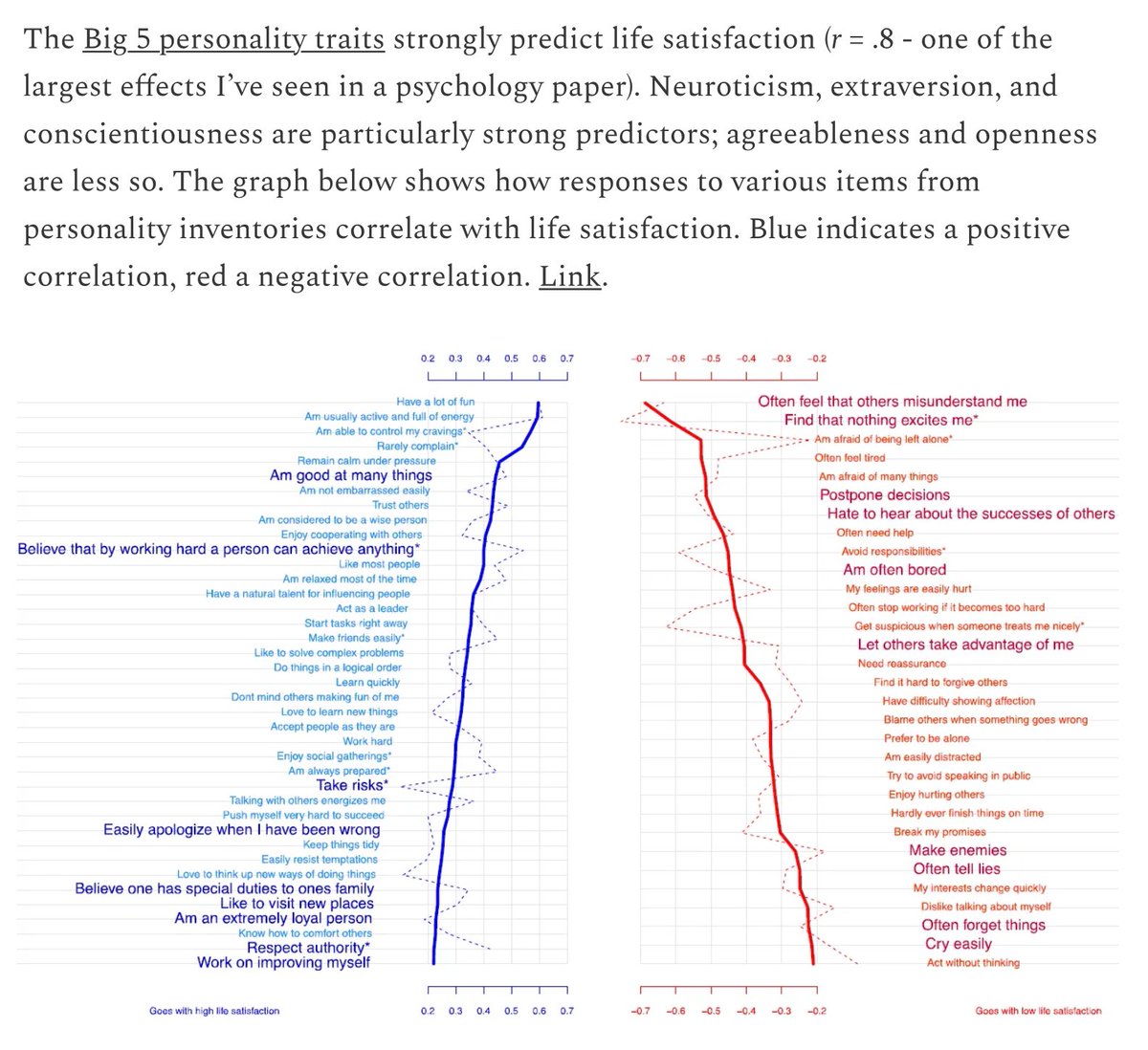
The Big 5 personality traits strongly predict life satisfaction (r = .8 - one of the largest effects I’ve seen in a psychology paper). https://t.co/K2OaLCSD0L
This may be one of the solutions to microplastics...
The probiotics Bifidobacterium breve and Lactobacillus casei bind to BPA in the digestive tract and DOUBLE the excretion
Milk, kefir, cheese, yogurt and sauerkraut are great sources of these bacteria
I wonder if the early Christians ever went to the colloseum. Like, would they have said "I don't agree with them feeding deacon Josephus to those lions, but I only go because I like the ship battles, and there's nothing sinful on the ship battle days"?
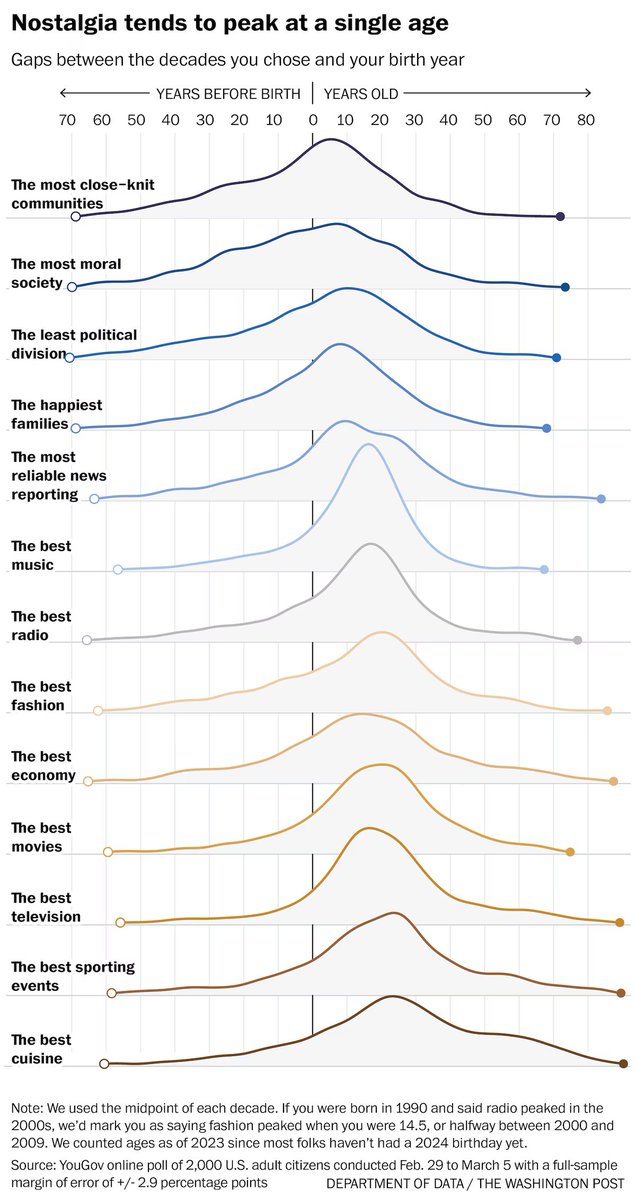
It turns out music, movies, entertainment, and society in general peaked during the exact time period when you, the person reading this, were a teenager.
At a show on his Solo Tour, John Mayer confessed:
“I wait for most things to be over. I wait for this to be over to do the next thing and the next thing and the next thing and the next thing...”
To counter this tendency, he implemented a rule.
“Because I’ve realized, he said,
“Everything you love and hate leaves at the same speed: Done. Done. Done. The thing you hate that you have to do tomorrow will be over before you know it, and the thing you're looking forward to tomorrow will be over before you know it.”
“So I have a new rule in my life,” Mayer said, “and the rule is:
Never wish for less time.
Waiting for things to be over is just wishing for less time. Waiting for this to be over to get to the next thing—that's just wishing for less time.”
“So wherever you go, just make a home right there and do that thing…Wherever you are, go, 'this is where it's all at right now.'
I’ve been having the time of my life because I figured that out…”
Takeaway 1:
John's realization—that “everything you love and hate leaves at the same speed”—made me think of something that Dr. Anna Lembke writes about in her book Dopamine Nation:
“One of the most remarkable neuroscientific findings in the past century is that the brain processes pleasure and pain in the same place. Further, pleasure and pain work like opposite sides of a balance.”
“And one of the overriding rules governing this balance,” she said, “is that it wants to stay level…With any deviation from neutrality, the brain will work very hard to restore a level balance—what scientists call ‘homeostasis.’ … With any stimulus to one side, there will be a tip of an equal and opposite amount to the other side.”
Pain and pleasure, good days and bad days, the things you're dreading and the things you're looking forward to—everything leaves at the same speed.
Takeaway 2:
The brain’s tendency to think about the next thing is called “prospection.”
“Our brains were made for nexting,” the psychologist Daniel Gilbert writes in a chapter titled “Prospection” in his book Stumbling On Happiness.
“When researchers count the items that float along in the average person’s stream of consciousness, they find that about 12 percent of our daily thoughts are about the future.”
In other words, the average person spends 1 out of every 8 hours thinking about the next thing, “which is to say…each of us is a part-time resident of tomorrow.”
We are constantly nexting, Gilbert explains, because of “the illusion of foresight”—the illusion that “prospection can provide pleasure and prevent pain.”
The reality is that “the future is fundamentally different than it appears through the prospectiscope.”
The reality is that (whether through the prospectiscope or in the present) everything—pain and pleasure, the things you're dreading and the things you're looking forward to—leaves at the same speed.
- - -
“So wherever you go, just make a home right there and do that thing…Wherever you are, go, 'this is where it's all at right now.' ... I’ve been having the time of my life because I figured that out...” — John Mayer
Follow @bpoppenheimer for more content like this!
Smart people disagree ON societal design. Wise people disagree WITH societal design.
Below, Crow defends Shear's idea by saying that he is a "smart, thoughtful dude".
If you defend an idea by saying its author is smart and thoughtful, you reveal your underlying assumption of bad ideas come from stupid or thoughtless people.
That's not so. Stupid or thoughtless people don't have bad ideas for what Crow calls "societal design"; they have NO ideas.
The really bad ideas come from smart people.
There's hidden traps in certain IQ levels, and the largest and most dangerous one is "I can design a better society". People fall so in love with their own intelligence that they get seduced by this one great-sounding idea they have for fixing everything or making everything better.
It is that category of idea that ends up getting millions of people killed and collapsing entire civilizations.
Everything works on paper because you assumed that people are rational actors, or that everyone has perfect market knowledge, or that prices don't carry information, or that the chicken is a sphere (to make the math easier).
But in practice, kaboom.
People with ideas like this are doubly dangerous precisely because they are so intelligent. They are good at making just-so stories that sounds workable, and they are good at convincing others that their ideas will work.
And decades later, people are wondering why insulin costs as much as a mortgage payment.
See, society doesn't advance through policy. It doesn't advance with big central plan from a really smart guy, executed by hordes of minions all marching in the same direction. It advances when some dude decides to try something on his own, and 99 times out of 100, he blows himself up or goes bankrupt, but that other 1 time, it works and everyone imitates him.
All of this is why you get a lot of socialists between IQs of 115 and, say, 135. It's not because socialism appeals to the intellect. It's because socialism appeals to the intellectual. It presents him with the prospect of a ready source of centralized power that he can harness to solve all of society's problems with the power of HIS massive brain and brilliant ideas, and then everyone will oooh and aaaaah over how smart he is, just like mom did when he was 7 years old and he solved a difficult math problem.
Policy ideas tend to come from people who put lots of points into intelligence and charisma, but used wisdom as a dump stat, and consequently they can understand the concept of Chesterton's fence, but they're also oh-so-very-good at convincing themselves that it doesn't apply here.
So, to make myself crystal clear:
Socialism isn't just an example of a bad idea in societal design. It is a bad idea because societal design itself is a bad idea.