Unitree Introducing: H2-X Kung Fu Legend Guardian🤖
Powerful performance to serve and guard you, with a maximum endurance of approximately 8 hours.
Please use the robot safely and in a friendly manner.
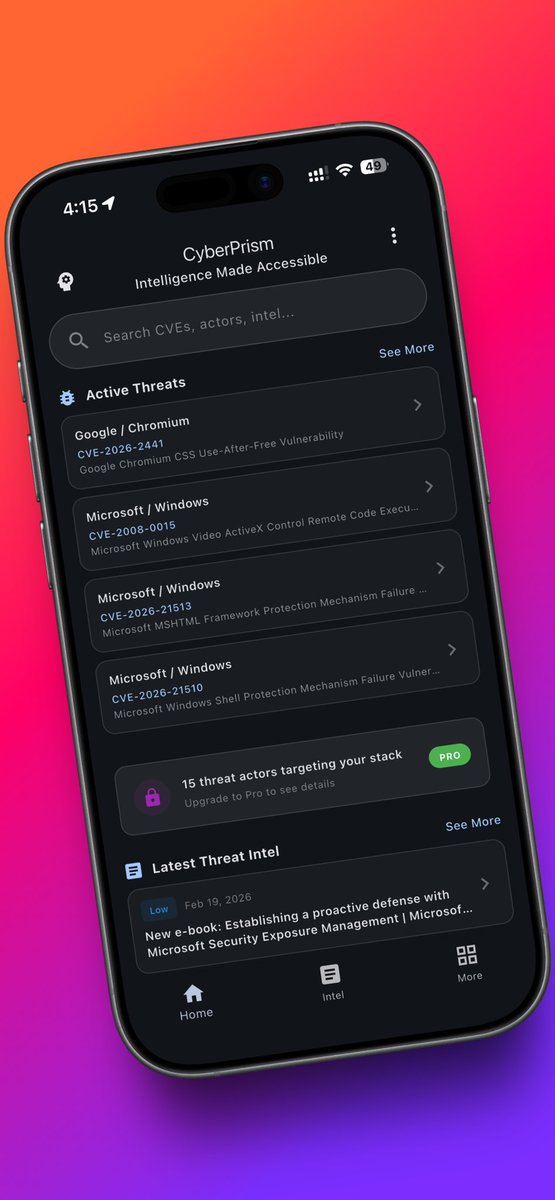
next version of @CyberPrismApp will be a personalized hub for CISOs
Track your company’s tech stack for actively exploited vulnerabilities and AI-simplified threat intel
Know which threat actors are targeting the products
Send PDFs to your Attack Surface and SOC teams
NEW: Amazon is rolling out Health AI for One Medical members where an AI assistant, built on Amazon Bedrock, uses your medical records, labs & meds.
It can answer health questions, manage prescriptions & book appointments pushing Amazon deeper into this space now too.
The reality of adult gaming is that you still love it, but it's harder to keep up.
You buy a new game, play a few hours, get busy, come back days later and realize you've forgotten everything. You can either grind from the start or just quit. Most quit.
We built @EarlyGodAI to solve this—a voice-based AI gaming companion with:
- Computer vision to see your screen and provide real-time guidance
- Persistent memory that tracks your progress across sessions
- Low-latency web search to pull game guides and strategies instantly
It's the first AI gaming assistant that can watch you play, remember your journey, and help you optimize your limited gaming time. It's like having a friend on Discord guiding you through the game.
Demo 👇
(Spoilers)
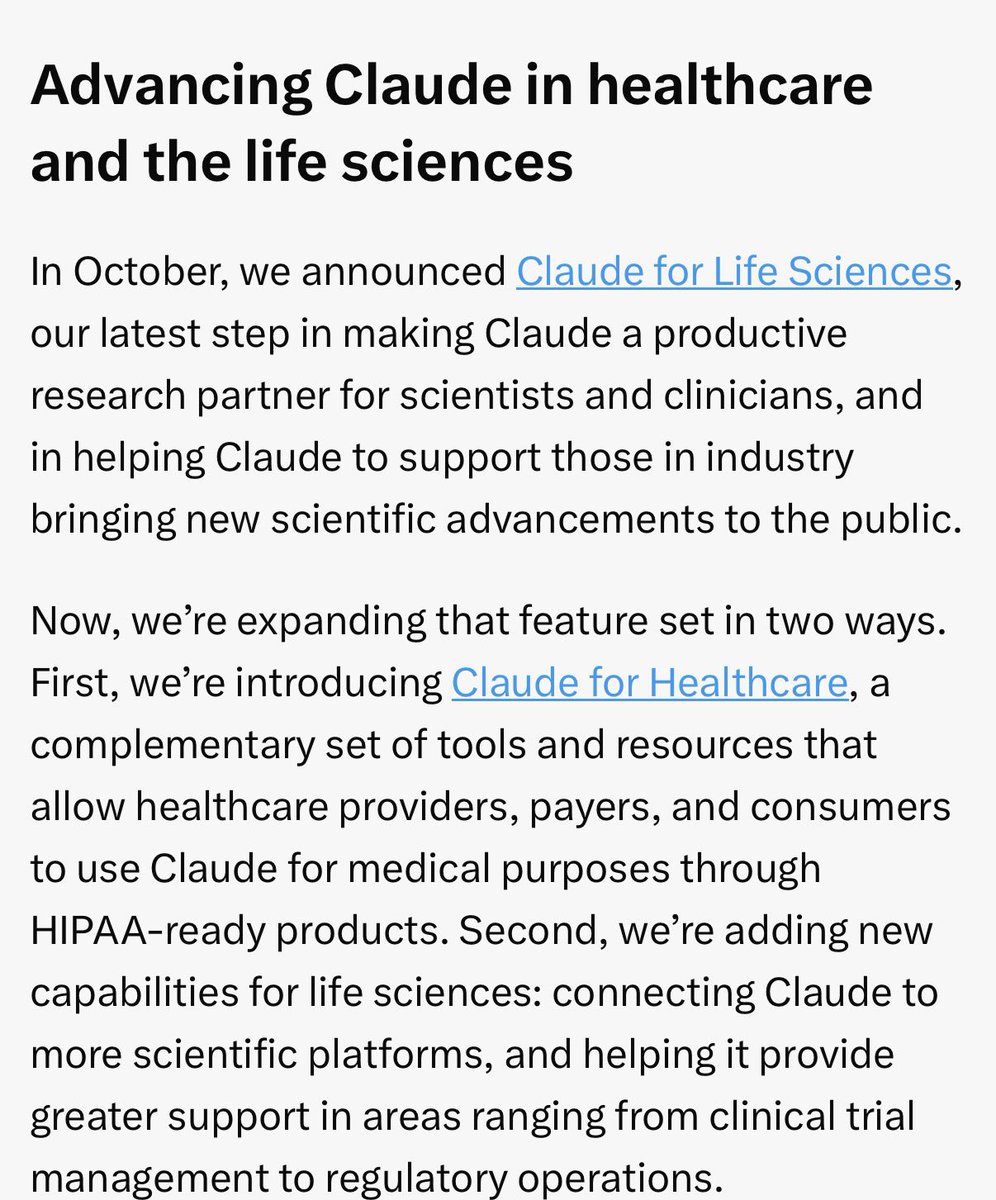
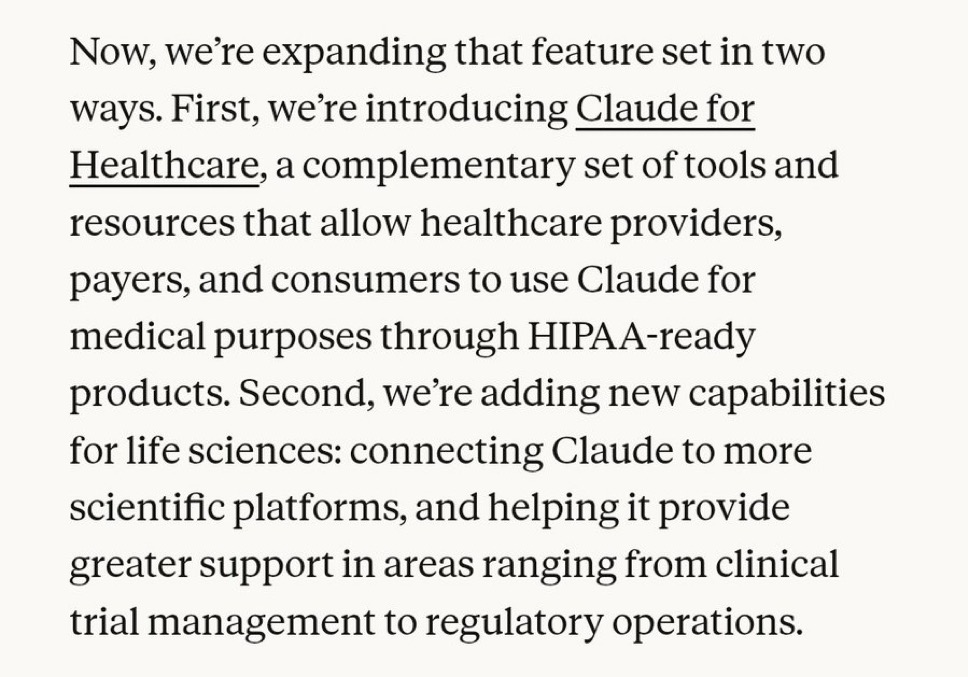
NEW: Anthropic launched Claude for Healthcare.
Claude now connects to CMS coverage data, the NPI registry, and more with HIPAA-ready tools for providers and payers. Anthropic is also expanding Claude’s role in life sciences, from trials to regulatory workflows.
Claude goes healthcare!
After OpenAI recently shifted its focus to Health, Anthropic is following suit - with Claude in healthcare!
The future lies in AI + Health / Longevity. I'm curious to see who will win this race!
The launch of ChatGPT Health is really personal for me. I know how hard it can be to navigate the healthcare system (even with great care). AI can help patients and doctors with some of the biggest issues. More here: https://t.co/3mbS6a3OMc
Playing video games has always been my happy place. But as I've gotten older, it's become harder to play them. A key challenge is that most modern games are deep, and complex, and require sustained engagement. For years I’ve I've bought new games, played for a few hours, got busy with work, came back and I’ve forgotten how to play it. Not willing to invest a few hours re-learning everything, I usually just give up.
So over the past few weeks I’ve been building a solution on the side - an in-game voice-based AI assistant. It can access game guides from YouTube, see your screen, has a low-latency web-search tool to find information instantly, and most importantly it has memory. So I can just log back in to a game after a few days or weeks, simply ask the AI assistant to tell me where I was, what milestones have I completed, and which quest I was in - and I can just pick up where I left off. It also helps me optimize my limited playtime by searching the best builds, skipping optional quests, and giving me tips on how to cheese a particularly hard boss.
Here's a rough demo of the application I recorded while playing Clair Obscur Expedition 33.
(Oh and the video may have some spoilers)
Glad to end the year with this accolade of being among top 10% in the world. Pro tip - about 99% of that was just telling Claude “nothing is working, think extra hard this time, no placeholders, please I’m begging you I have kids”.
I've never felt this much behind as a programmer. The profession is being dramatically refactored as the bits contributed by the programmer are increasingly sparse and between. I have a sense that I could be 10X more powerful if I just properly string together what has become available over the last ~year and a failure to claim the boost feels decidedly like skill issue. There's a new programmable layer of abstraction to master (in addition to the usual layers below) involving agents, subagents, their prompts, contexts, memory, modes, permissions, tools, plugins, skills, hooks, MCP, LSP, slash commands, workflows, IDE integrations, and a need to build an all-encompassing mental model for strengths and pitfalls of fundamentally stochastic, fallible, unintelligible and changing entities suddenly intermingled with what used to be good old fashioned engineering. Clearly some powerful alien tool was handed around except it comes with no manual and everyone has to figure out how to hold it and operate it, while the resulting magnitude 9 earthquake is rocking the profession. Roll up your sleeves to not fall behind.
Yep. Providers using this for free is just the eval layer that is making their model smarter. Next comes DTC and soon after, when (not if) permitted by the FDA, comes SAMD.
OpenEvidence has revenue of $50 million - but a valuation of $6.1 BILLION.
Question for all the “AI can’t replace doctors!” naysayers:
What do *you* think OE’s long-term monetization pathway looks like?
What are investors expecting will happen to justify this valuation?
🧵
Excited to partner with AMD to use their chips to serve our users!
This is all incremental to our work with NVIDIA (and we plan to increase our NVIDIA purchasing over time).
The world needs much more compute...
Over the past few years, DoorDash Labs has been building one of the most sophisticated autonomy stacks designed for the real-world challenges of local delivery.
Today, we're introducing Dot, the first commercial autonomous delivery robot to travel on bike lanes, roads, and sidewalks. At one-tenth the size of a car reaching speeds of up to 20 mph, Dot is purpose-built for local commerce.
Together with our new Autonomous Delivery Platform, Dot is the next step toward a more efficient, sustainable, and accessible delivery ecosystem for everyone.