What's up for June?
The solstice brings summer to the Northern Hemisphere. Jupiter and Venus will appear close together in the night sky, and Mercury will join them soon after. The Moon will also pass in front of Venus on June 17. Learn more: https://t.co/Ujal0GZVJU
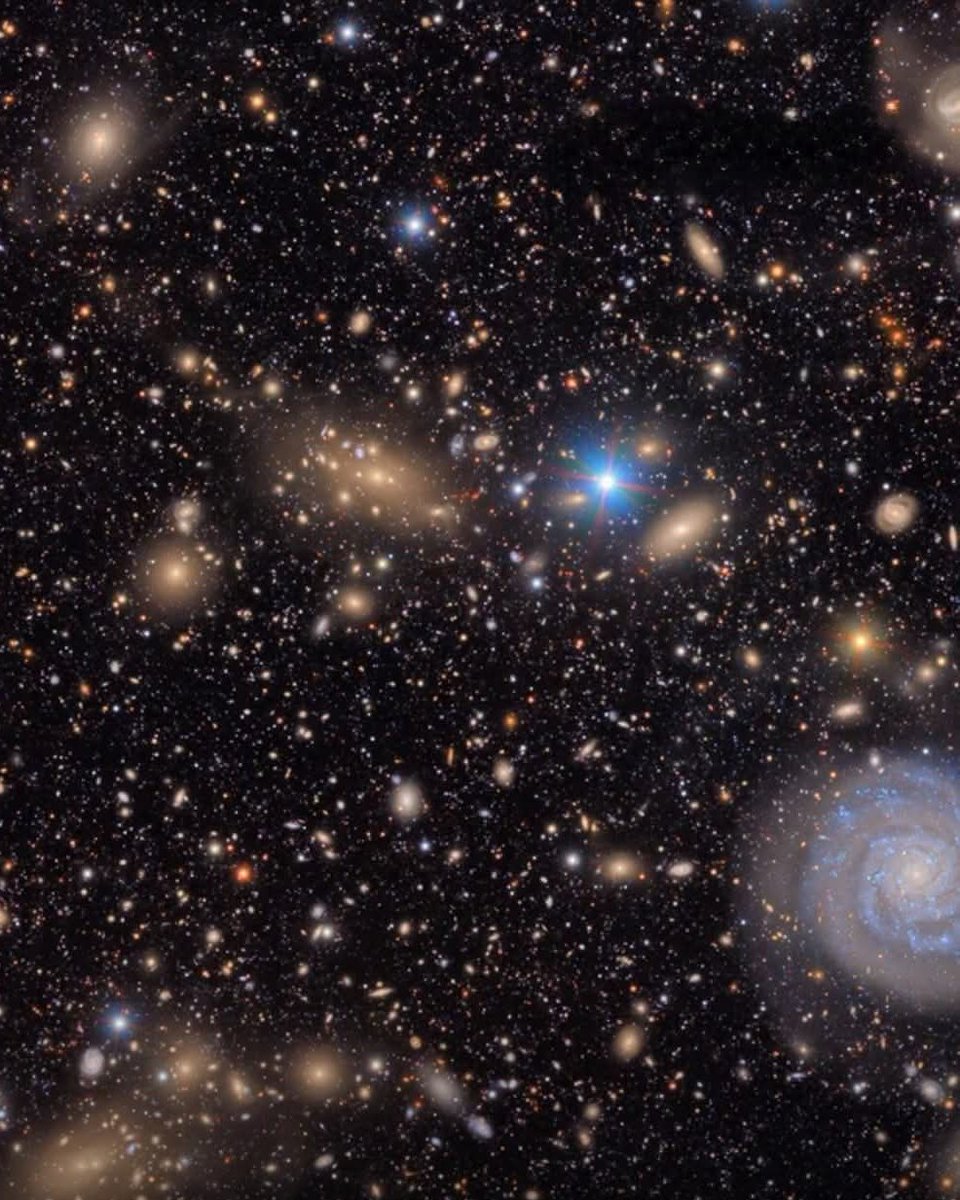
The Cosmic Treasure Chest: 10 Million Galaxies in a Single FrameThis is the first major image released by the largest digital camera ever built for astronomy — the 3.2-gigapixel LSST Camera on the Vera C. Rubin Observatory.And it is absolutely staggering.Every single speck of light you see in this vast field is not a star.
It is an entire galaxy — each one home to hundreds of billions of stars, planets, and possibly entire https://t.co/yQw975m5mo this one breathtaking snapshot, astronomers have captured roughly 10 million galaxies. That’s only about 0.05% of the total number this revolutionary observatory is expected to image over its 10-year survey.Captured in the direction of the Virgo Cluster, this image transforms what looks like empty space into a glittering tapestry of distant universes stretching back billions of years. The few brighter foreground stars belong to our own Milky Way — everything else is far beyond our galaxy.This is more than just a pretty picture.
It is a preview of a new era in astronomy — where we will map the changing universe in unprecedented detail, hunt for mysterious dark matter and dark energy, discover thousands of new asteroids, and witness cosmic events as they unfold in real time.Welcome to the future of discovery.
Image Credit: NSF–DOE Vera C. Rubin Observatory
🚨 It’s finally happening.
In November 2026, NASA’s Voyager 1 will cross the "one light-day" threshold, making communication with Earth a 48-hour round trip.
Launched in 1977, the Voyager 1 spacecraft continues to redefine the limits of human achievement as it traverses the silent void of interstellar space. By November 2026, the probe will officially be one light-day away from Earth, a distance of approximately 16 billion miles. At this staggering range, radio signals traveling at the speed of light will require a full 24 hours to reach the spacecraft, turning every command and response into a two-day marathon. This symbolic milestone underscores the sheer scale of our solar system and the incredible longevity of a machine designed nearly half a century ago.
Despite its age and the extreme conditions of deep space, Voyager 1 remains a functional scientific outpost beyond the reach of the sun's influence. It continues to beam back invaluable data about the mysterious environment between stars, carrying with it the "Golden Record"—a time capsule of Earth’s sounds and images for any intelligence it might encounter. As it drifts further into the cosmic dark, the probe serves as a testament to human curiosity, proving that our technological reach now spans distances measured not in miles, but in the time it takes light itself to travel.
Source: National Aeronautics and Space Administration. (2025) Voyager 1: The Farthest Human-Made Object. NASA Science Mission Directorate.
The Cosmic Treasure Chest: 10 Million Galaxies in a Single FrameThis is the first major image released by the largest digital camera ever built for astronomy — the 3.2-gigapixel LSST Camera on the Vera C. Rubin Observatory.And it is absolutely staggering.Every single speck of light you see in this vast field is not a star.
It is an entire galaxy — each one home to hundreds of billions of stars, planets, and possibly entire https://t.co/yQw975m5mo this one breathtaking snapshot, astronomers have captured roughly 10 million galaxies. That’s only about 0.05% of the total number this revolutionary observatory is expected to image over its 10-year survey.Captured in the direction of the Virgo Cluster, this image transforms what looks like empty space into a glittering tapestry of distant universes stretching back billions of years. The few brighter foreground stars belong to our own Milky Way — everything else is far beyond our galaxy.This is more than just a pretty picture.
It is a preview of a new era in astronomy — where we will map the changing universe in unprecedented detail, hunt for mysterious dark matter and dark energy, discover thousands of new asteroids, and witness cosmic events as they unfold in real time.Welcome to the future of discovery.
Image Credit: NSF–DOE Vera C. Rubin Observatory
The definitive 3D map of our universe On April 15, 2026, the Dark Energy Spectroscopic Instrument (DESI) officially completed its five-year survey of the sky. Perched atop the Nicholas U. Mayall Telescope at Kitt Peak, this instrument uses 5,000 robotic eyes.
Voyager hit a 90,000°F wall at the solar system’s edge
NASA’s Voyager 1 spacecraft crossed a boundary called the heliopause — the outer edge of the Sun’s influence, where the solar wind meets interstellar space. But what it found there surprised scientists: a region of intensely heated plasma reaching temperatures of 30,000–90,000°F (17,000–50,000°C).
This wasn’t a solid wall. It was a turbulent boundary zone where particles from the Sun slow down and pile up against the pressure of interstellar space. As they compress, their energy increases, heating the plasma to extraordinary temperatures.
But here’s the strange part: despite those extreme temperatures, this region wouldn’t feel hot to a human. The plasma is incredibly sparse — far emptier than any vacuum we can create on Earth — so there are too few particles to transfer heat effectively. In other words, it’s a “hot” region that wouldn’t actually burn you.
Voyager’s instruments detected a sharp drop in solar particles and a rise in cosmic rays, confirming it had crossed into interstellar space. At the same time, it picked up subtle vibrations in the plasma — like ripples traveling through an invisible ocean — allowing scientists to measure its density and temperature for the first time.
This boundary acts as a protective shield. The heliosphere deflects a large fraction of harmful cosmic radiation, helping make life on Earth possible. Beyond it lies the raw environment of the galaxy.
Now more than 15 billion miles (24 billion kilometers) from Earth, Voyager 1 continues to send back data from this frontier. It’s the most distant human-made object ever built — still exploring a region no spacecraft had ever reached.
At the very edge of our solar system, space isn’t empty or calm.
It’s a violent, invisible boundary — and we’ve only just begun to understand it.
Learn more:
“Voyager 1 Observes Low-Energy Galactic Cosmic Rays in a Region Depleted of Heliospheric Ions.” Science, 2013.
📸Credit: NASA/JPL
Latest footage from NASA’s Curiosity rover just dropped — and it’s breathtaking. For the first time in stunning clarity, we’re walking across the rugged, ancient surface of Mars. Sharp rocks, rolling dunes, and distant hills stretch out under a butterscotch sky. But what makes this clip truly special is the real audio captured directly on the Red Planet.Close your eyes and https://t.co/cmct05HegL can hear the faint, haunting whistle of Martian wind brushing past the microphone — thin, ghostly, and completely alien. No birds. No leaves rustling. Just the lonely sound of an atmosphere 100 times thinner than Earth’s.This isn’t a simulation. This is Curiosity’s microphone picking up the actual voice of Mars in real time — a world 225 million kilometers away, yet suddenly feeling so https://t.co/Fk5K0vrYQY eerie, dusty, beautiful wilderness that humanity is only beginning to explore. Absolutely mesmerizing.
The sun is fascinating to watch. This timelapse was recorded using a modified telescope designed to safely observe the solar chromosphere, captured over a period of several hours from my backyard in Arizona.
The entire Earth would be a small dot at this distance of ~93M miles.
Newborn stars are forming in the Eagle Nebula.
They are gravitationally contracting in pillars of dense gas and dust. The intense radiation of these newly-formed bright stars is causing surrounding material to boil away.
This image, taken with the Hubble Space Telescope in near infrared light, allows the viewer to see through much of the thick dust that makes the pillars opaque in visible light.
The giant structures are light years in length and dubbed informally the Pillars of Creation. Associated with the open star cluster M16, the Eagle Nebula lies about 6,500 light years away.
The Eagle Nebula is a satisfying target for small telescopes in a nebula-rich part of the sky toward the split constellation Serpens Cauda (the tail of the snake).
Credit: NASA, ESA, Hubble, HLA; Processing: Luis Romero Ventura
Every single dot you see here is a galaxy.Not a star. A full-blown galaxy — home to hundreds of billions of stars, planets, and who knows what else. And this single frame contains ten million of them.This is one of the very first images from the Vera C. Rubin Observatory, perched high on a mountain in Chile. Its secret weapon? The largest digital camera ever built — a staggering 3.2 billion pixels spread across 189 sensors. To explore every galaxy in this image at full resolution, you’d need to wallpaper it across roughly 400 television screens.
https://t.co/v5qTByh8dT
The image was stitched together from more than 1,100 individual exposures taken in just over 10 hours of test observations. In that same brief window, the observatory also spotted more than 2,000 previously unknown asteroids zipping through our Solar System.
https://t.co/v5qTByh8dT
And this? This is just the warm-up.The real mission — the Legacy Survey of Space and Time (LSST) — hasn’t even officially started. Over the next decade, Rubin will scan the entire southern sky again and again, cataloging roughly 20 billion galaxies, mapping how the universe changes over time, and creating a dataset hundreds of petabytes in size. Its prime targets include the invisible forces shaping everything: dark matter and dark energy, which make up about 95% of the cosmos.
https://t.co/v5qTByh8dT
This $810 million observatory, two decades in the making, is about to transform astronomy. It will track millions of changing objects, hunt for killer asteroids, and give us an unprecedented time-lapse movie of the evolving universe.Ten million galaxies… in test mode.Just imagine what it will reveal once it’s fully awake. The night sky will never look the same again.