Even Chinese companies are signing LTAs now lol
RTRS:
- China’s CXMT has signed a $3 billion LTA with Tencent.
- CXMT is also in talks with other Chinese internet companies, including Alibaba Cloud, ByteDance, and Xiaomi.
- As of Q1, CXMT’s DDR5 yields still lagged behind Western peers.
- CXMT currently operates two 12-inch DRAM fabs in Hefei and one fab in Beijing, with total wafer capacity of around 300k wafers per month.
🇰🇷 Samsung and SK Hynix selling off again in Korea. KOSPI starting the week red and the trigger is a $13B, 10-year capex plan.
The whole memory bull case, the one Micron just validated at 85% margins rests on supply discipline holding.
Margins are at records because the makers refused to flood the market and rationed supply toward HBM. So a massive capex headline hits the nerve directly.
The fear is legitimate and big spend erodes cash flow now, and all that new capacity eventually floods the market which is how every prior memory cycle has died. Build at the top, glut at the bottom, repeat. That reflex has been right for 30+ years.
But what the panic/bears are missing is the timing and the market environment that we’re currently in.
The new lines already announced by Samsung, Hynix, and Micron don’t release meaningful capacity until 2H 2027, real volume not until 2028 and this new plan lands even later than 28.
So for the entire window that matters now, through at least the first half of next year, HBM, DDR5, and high end NAND stay tight while demand keeps surging.
The thing that eventually kills this cycle is supply discipline breaking.
A capex plan that doesn’t produce a single extra bit until 2028 isn’t that. It’s the market pricing a 2028 risk into a 2026 mkt.
Watch the capacity, not the capex headline. The day new bits hit the market is the day to worry and that day isn’t this year, and it isn’t next…bullish
@SouthernValue95 It literally doesn't matter? CXMT cannot satisfy China demand this decade. So there's 0nreason besides the small price arbitrage. It's like bannin Iranian oil. India and China buy it anyways, but price diff is less
Physical AI memory demand will be much larger than people expect
$MU has said humanoid robots carry 10x the memory content of an average L2+ vehicle
The average car today has around 16GB of DRAM, while L4 autonomous vehicles can require over 300GB
Humanoid robots are expected to use compute platforms comparable to high-end autonomous vehicles
Given that, if physical AI scaled to 100M humanoid robots, or compute-equivalent robots, the total DRAM need would be:
- 100M x 300GB = 30EB
That is equivalent to around 75% of 2026 global DRAM capacity
We can already see proof of this with NVIDIA’s Jetson Thor. Directed toward physical AI use cases, it comes with 128GB of LPDDR5X and 273GB/s of memory bandwidth, double the memory capacity of Jetson AGX Orin
______________________
The reason for these memory requirements is that robots are not running a single small model
They need to process multiple cameras, sensors, depth data, audio, tactile inputs, and proprioception while running perception, reasoning, and real-time control loops
Vision-language-action models such as NVIDIA’s GR00T N1 also add memory pressure, as they combine visual understanding, language reasoning, and motor-policy generation
______________________
The opportunity could be even bigger
Physical AI requires world models, simulation, synthetic data generation, policy training, fleet learning, and continuous retraining
NVIDIA’s Cosmos platform is an example of this, using massive video datasets and world foundation models to train and evaluate physical AI systems
This does not just increase demand for DRAM, it also explodes demand for NAND
$MU
I can’t begin to explain how important it is to follow the right people on X and discern who is an expert from who is just making stuff up.
Gavin Baker is an actual industry insider.
Gavin Baker @GavinSBaker: HBM DRAM will be 30-40% of all hyperscaler capex in 2027.
Baker manages Atreides - his 2025 Micron call is now 14x. This is his next call.
HBM requires stacking 12-16 DRAM dies in a single package. Only three companies can do it: Micron, SK Hynix, Samsung. No fourth supplier arrives in 2027. Hundreds of billions annually to three firms.
Micron's new supply chain agreements lock in floor pricing above prior cycle gross margin peaks.
If you still hold $MU at a commodity discount to $ASML and $LRCX, Baker says that discount is no longer earned.
Baker's full case at @theallinpod:
https://t.co/sH8c5iozAo
Source: All-In Podcast - https://t.co/31lFFUPJgJ
$AAPL IPHONE 18 PRO COST BREAKDOWN
Apple’s bill of materials reportedly rises from $582 to $726 while retail price moves from $1,099 to an estimated $1,299 which means ~$144 increase in memory and storage costs is driving most of the $200 price hike once Apple protects its margin.
Whats wild to see is that the processor, camera array, display and battery are mostly flat (areas where Apple has decades of supplier leverage) but line item exploding is memory and storage which is the exact bottleneck benefiting $MU, Samsung and SK Hynix.
AI data center demand bids up HBM, pulls capacity away from commodity DRAM + NAND and eventually that scarcity shows up in a device most consumers view as a necessity.
Jefferies expects memory prices to rise 40–50% QoQ in Q3 2026, followed by another 30–40% QoQ increase in Q4 2026
$MU is guiding for $31 EPS in calendar Q3 2026
If prices rise another 35% and then remain stable through 2027, Micron would be trading at less than 7x 2027 EPS
However, Jefferies is even more optimistic than that
For 2027, Jefferies expects memory pricing to remain 40–45% higher YoY. Relief is not expected until 2028, when new capacity could add 15–20% supply, although the article says this may not fully offset AI and compute demand
Realistically, Micron may be trading at less than 5x 2027 EPS, with Hynix and Samsung even below that, depending on how SCAs have been negotiated
The article also says around 50% of total memory capacity is already under long-term contracts, potentially rising to 70%, which would reduce available supply for PCs, smartphones, consoles, and other consumer markets
On China, the article argues that CXMT and YMTC are unlikely to pressure global memory prices in 2026–2027, because Chinese supply is mostly domestic and not meaningfully cheaper. It says China may become more relevant in 2028 as new fabs and production lines ramp up
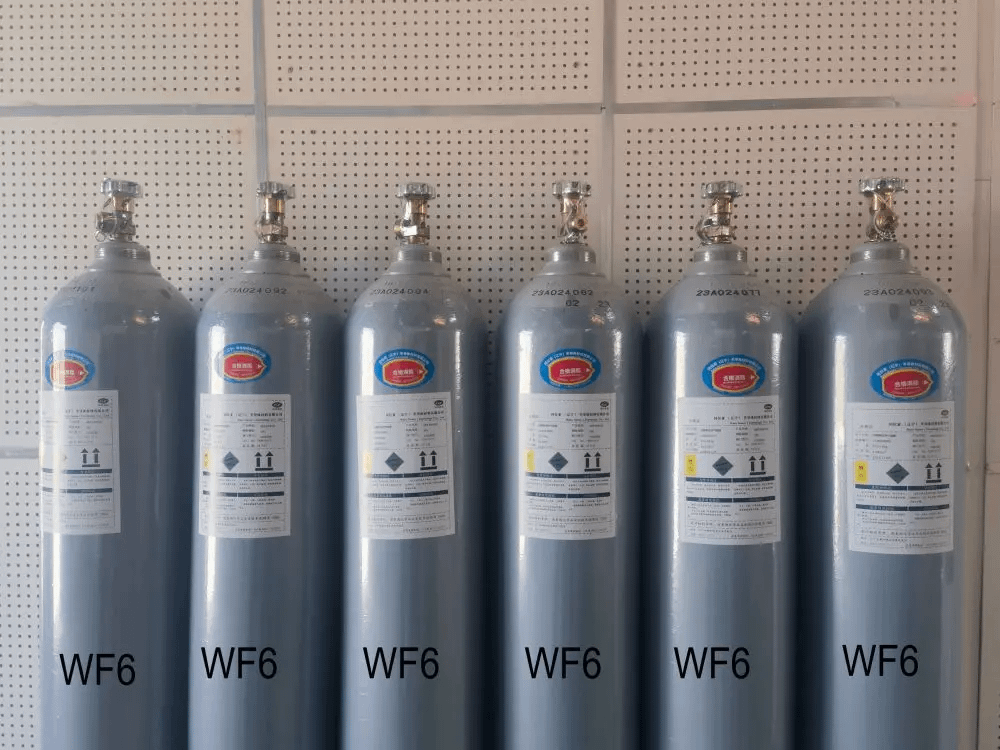
Samsung, SK Hynix, and TSMC source 80% of their WF6 from Japan. Two Japanese companies produce 25% of the world's tungsten hexafluoride. Both Kanto Denka and Central Glass are stopping all WF6 production on July 1. We manufacture chemicals. WF6 is a chemical. The semiconductor industry never asked what it's made from. WF6 deposits the tungsten contact plugs inside every advanced chip on Earth. There is no substitute for running production lines. Qualifying a new supplier takes 12 to 18 months. Building new capacity takes two to three years. China controls 80% of the tungsten powder WF6 is made from. Japan's tungsten imports from China have been zero since February. The two producers survived on stockpiles for five months. The stockpiles are gone. WF6 prices are up 232.7% year over year. Upstream tungsten powder is up 557%. Only six companies produce 90% of the world's supply. Two just quit. Every AI accelerator, smartphone chip, and SSD depends on a gas about to lose a quarter of its supply.
$MU $DRAM $SNDK Bank of America just put out their 2030 semi TAM.
$1.96T total.
$900B is memory. Nearly half.
And this is almost certainly outdated. It's not pricing in the Agentic AI boom yet.
This is extremely bullish for Korean ecosystem suppliers
Especially small-cap semicaps
Samsung is reportedly going to announce a 1,000 trillion won, $650B, 10-year investment plan
SK Hynix is also developing its own long-term capex plan
The spending is expected to target semiconductors, HBM/DRAM capacity, AI data centers, advanced packaging, batteries, displays, and physical AI/robotics
This is a national strategy around AI memory, AI infrastructure, and robotics, with government backing, not just company capex
Enterprise AI is becoming a national security issue, and countries are starting to take it seriously
Korea will become a hub for semiconductor manufacturing, but other countries will be forced to either develop their own AI capabilities or build strong alliances with trusted allies
BLOOMBERG: AI SALES START TO JUSTIFY DATA CENTER SPENDING BOOM
“The hundreds of billions of dollars tech companies are spending on AI may be economically sustainable”
Global AI sales, excluding China, reached $25 billion in Q1 2026 exceeding estimates of $21 billion in quarterly depreciation costs for data centers and chips
JP Morgan: AI Power Semiconductors
> JPMorgan’s latest research indicates that the market for AI power semiconductors is on the verge of massive expansion. The firm projects that the sector will scale from approximately $2.7 billion in 2025 to around $16 billion by 2028. This rapid trajectory represents a remarkable three-year compound annual growth rate (CAGR) of roughly 82%.
This growth is primarily propelled by two main factors:
1. Systemic transition of data centers toward 800V high-voltage direct current (HVDC) architectures. This architectural redesign will notably increase the total value and density of semiconductor components required for every kilowatt of power managed.
2. Wholesale replacement of traditional electromechanical components with solid-state, semiconductor-based solutions throughout the entire power distribution chain, stretching from the primary utility grid down to the individual server rack. Over the long term, this modernization is expected to double silicon carbide (SiC) component value per kilowatt, climbing from $30 to $60. Concurrently, gallium nitride (GaN) component value is projected to experience a massive surge, skyrocketing from a baseline of $3 to $46 per kilowatt, representing an especially profound growth vector for wide-bandgap materials.
> JPMorgan forecasts that total new AI data center capacity additions will reach approximately 80 gigawatts (GW) by 2028, consisting of roughly 63 GW from new construction and about 18 GW from legacy replacements. Factoring in a baseline compute capacity expansion of 65 GW and an average semiconductor content value of $250 per kilowatt, the firm projects the AI power semiconductor market will scale to about $16 billion by 2028.
> Data disclosed by Infineon indicates that the current semiconductor content per kilowatt stands at approximately $175. However, the company provides a guidance range of $100 to $250, fluctuating based on specific architectural implementations. As the industry widely adopts vertical power delivery modules, integrates large-scale solid-state transformers (SSTs) and solid-state circuit breakers (SSCBs), and aggressively implements high-value GaN devices, semiconductor value is projected to shift toward the maximum end of this spectrum—and potentially surpass it.
> By material breakdown, traditional silicon (Si) will maintain its position as the largest revenue generator, with a projected market size of roughly $11.2 billion by 2028. Silicon carbide (SiC) is estimated to follow at around $3.1 billion, while gallium nitride (GaN) is expected to reach approximately $1.7 billion. Even though silicon commands the largest footprint in absolute dollar terms, wide-bandgap alternatives like SiC and GaN are expanding at a much faster velocity and will continue to capture market share.
> Legacy data center power architectures suffer from severe efficiency bottlenecks. On the journey from the primary utility grid to the actual GPU silicon, electricity passes through four to five distinct conversion phases—including transformers, uninterruptible power supplies (UPS), power distribution units (PDU), server power supplies (PSU), and voltage regulator modules (VRM). This multi-stage process drags end-to-end efficiency down to a modest 85% to 88%, which means a substantial 12 to 15 kilowatts out of every 100-kilowatt server rack are lost purely as waste heat.
> The 800V High-Voltage Direct Current (HVDC) architecture fundamentally resolves these physical limits by raising the system voltage and lowering the current, drastically minimizing line-resistance (copper) losses and Joule heating. This streamlined design strips out double-conversion UPS clusters, rack-level step-down transformers, conventional PDUs, and the independent AC-to-DC power bricks found on legacy servers. In their place, the 800V HVDC layout implements centralized, high-efficiency AC-DC rectifiers, specialized rack-level 800V-to-low-voltage DC-DC converters, and native DC battery backup units (BBUs).
JPMorgan divides this transition into three phases:
Current phase (2026–2027): Traditional 215V–400V AC architectures remain dominant; native 800V racks have not yet become widespread, and retrofitting efforts are underway.
Short to medium term (second half of 2027 to 2028): NVIDIA’s Kyber racks are scheduled for mass production in 2027, marking the beginning of large-scale deployment of native 800V racks. Schneider and Legrand anticipate that significant 800V traction will not emerge before 2028.
Medium to long term (post-2028): Solid-state transformers (SSTs) will directly convert medium-voltage AC to 800V DC, integrating transformer and rectifier functions. Large-scale deployment of SSTs is not expected before late 2027 to early 2028.
> Silicon carbide (SiC) serves as the cornerstone for power infrastructure stretching from the primary high-voltage utility grid down to the individual server rack. In demanding, high-voltage environments—including solid-state transformers (SSTs), solid-state circuit breakers (SSCBs), and energy storage systems (ESS)—SiC is considered irreplaceable. This material dependency is driven by its exceptional physical properties: a breakdown electric field roughly 10 times greater than traditional silicon, combined with a thermal conductivity that is three times superior. Highlighting this shift, Infineon projects that by 2030, the global market for SSTs will top $1 billion, while the SSCB market will expand past $800 million. Furthermore, centralized AC-DC rectifiers are increasingly engineered around these high-voltage SiC MOSFETs to maximize efficiency.
> Gallium nitride (GaN) displays distinct advantages during "Stage 1" power management, which involves stepping down 800V inputs to lower, usable voltages. Utilizing 650V GaN High Electron Mobility Transistors (HEMTs), these devices leverage exceptional electron mobility to operate efficiently at megahertz (MHz) frequencies. This high-frequency switching capability allows engineers to use far smaller passive components, dramatically optimizing overall system power density. Demonstrating this capability, Navitas developed a 10-kilowatt, all-GaN DC-DC platform that achieves 98.5% peak efficiency during 800V-to-50V down-conversion. Taking this a step further, their aggressive single-stage 800V-to-6V architecture eliminates intermediate conversion steps entirely, hitting a peak efficiency of 96.5% and cramming a power density of 2,100 W/in³ into a profile thinner than a mobile phone. Driven by these high-performance properties, JPMorgan forecasts that the long-term dollar value of GaN components packed into every kilowatt will scale from today's $3 to $46—marking an explosive, 15-fold market increase.
> Legacy silicon-based components will maintain their dominance in "Stage 2" power delivery, which covers the voltage regulator module (VRM) and point-of-load (PoL) stages. VRMs are tasked with delivering hundreds to thousands of amperes of current directly to GPU chips at ultra-low voltages, all while adapting within nanoseconds to sudden load spikes triggered by intense GPU computing cycles. At this precise point in the power chain, low-voltage silicon MOSFETs remain incredibly difficult to displace due to their ideal balance of mature cost and reliable performance. However, the industry-wide transition toward complex vertical power delivery modules (VPDMs) is dramatically altering the economics, driving up individual component unit prices by three to four times.
> The explosive rise of AI computing is simultaneously triggering massive investments in global power grid expansion. Global data center electricity demand is projected to more than double from roughly 115 gigawatts (GW) in 2025 to between 240 and 280 GW by 2030. According to BloombergNEF (BNEF), global grid capital expenditures will exceed $470 billion in 2025 alone, with the United States representing about $115 billion of that total. This aligns with a broader macroeconomic shift, where total global spending on the wider energy transition—including renewables, grid infrastructure, EVs, and stationary storage—is expected to hit $2.3 trillion.
> Within this framework, Energy Storage Systems (ESS) are transitioning into critical infrastructure for AI data centers. Because AI processing workloads cause server racks to spike from a 30% idle state to 100% full capacity within milliseconds, entire data center facilities face massive, multi-megawatt power swings in mere seconds. Rather than acting as simple passive emergency backups, ESS must function as active buffers that shield the electrical grid from chaotic GPU power fluctuations. Consequently, data centers are forecast to represent 83% of all behind-the-meter commercial and industrial ESS deployments by 2030.
> On the hardware level, each storage installation relies on bidirectional inverters built around advanced IGBT or SiC power modules. Infineon estimates that this semiconductor content translates to over €2,000 per megawatt. With global ESS shipments projected to hit roughly 1,500 GWh (equivalent to 375 GW of capacity), the addressable market for these power semiconductors represents an estimated €750 million opportunity.
Recommended reads for the week
SemiAnalysis — China’s CXMT Is Set to Challenge DRAM Incumbents
Goldman Sachs — Americas Technology: Hardware — Expert Network Series: CPU Server Demand Driven by Refresh, Agentic AI
Morgan Stanley — Old Memory: Better to Buy More
J.P. Morgan — First Principles — AI Power Infrastructure: Following the Power
From Goldman's Delta-1 Desk:
Hyperscalers: This is poised to become one of the defining debates of the next few months. Markets have rarely rewarded companies allocating exceptionally large proportions of free cash flow toward capex during the build phase. This does not necessarily mean management is making poor long-term decisions; it simply means equity investors generally prefer immediate, tangible returns to distant, uncertain cash flows. Multiple expansion typically occurs during the harvesting phase, not the construction phase. The theory of reflexivity remains highly relevant in this environment. If hyperscalers continue to underperform while suppliers rally, boardrooms may increasingly question whether incremental AI investment is maximizing shareholder value. At some point, capital expenditure may slow and if one peer blinks, the market will immediately question whether others should follow.
>> Lenovo: Rising memory prices are the “new normal”; elevated DRAM and NAND pricing to persist beyond 2030
• The era of cheap digital devices is coming to an end. Lenovo warned that DRAM and NAND flash prices have already entered a structural upcycle, and that even if major suppliers continue to expand capacity, prices are unlikely to return to early-2025 levels.
Higher costs are being passed through across the entire industry. Going forward, all types of electronic devices, including PCs and smartphones, are expected to face sustained price-increase pressure, with higher prices becoming the “new normal” beyond 2030.
Probably the most bullish thing I’ve seen recently on the AI buildout.
Assuming 8% cost of capital, 30% operating margin and 5 years of depreciation, hyperscaler capex turns positive roughly at 1.7-1.8x revenue/D&A.
We are still far from there, but the progress is promising.