Our latest manuscript is finally out in @NatureSMB!
Here, we show that the GAP activity of SEAC (GATOR) acts as a molecular switch, regulating both inhibition and reactivation of TORC1 upon changes in amino acid levels.
https://t.co/EgW0fh2c0a
Exciting new work from @RobertoZoncu, led by all star first authors @clairegoul and @aakritijain24 reveals the mechanism mediating the sensing of lysosomal damage and recruitment of ESCRT for membrane repair. Beautiful work!🤩
https://t.co/fpazvFMciI
Just when you think this nonsense can't get any worse, you find this hilarious attempt to lie about the lie:
- we made a mistake and did not include the pre-registered primary endpoint when we full-well knew and then attempted to obscure the data and did not include it any of our social media tsunami in early April, nor was it even discussed in the paper, but in this video we admit we had it but just did not like it
- but then people went crazy so
- we are crafting a story that we were naive and really never should have made this the primary endpoint and actually we really have another way to do this that was the primary methodology (WTF) and should have been the primary endpoint
- and now we will spin on and on about how the Cleerly results are just implausibly bad and so must be wrong even though we never even discussed this for one second in our social or in the actual paper
- and also it was probably covid or "some covid-related activity" that led to these Cleerly results being so messed up
- also here are new data with another method (keep re-analysing it till it looks right) and these data look less bad so it's all good...
Seriously, i thought this was a clown show but now I am searching for something that more accurately describes it. I am not sure I can solve that
Online now!✨Iiams, Skinner et al explore the effect of early-onset, lifelong time-restricted feeding in >500 male and female mice, and report extended healthspan in male and female mice, and extended lifespan in male mice @SamIiamsClever@CircadianClocks https://t.co/Bno0Mf5tAO
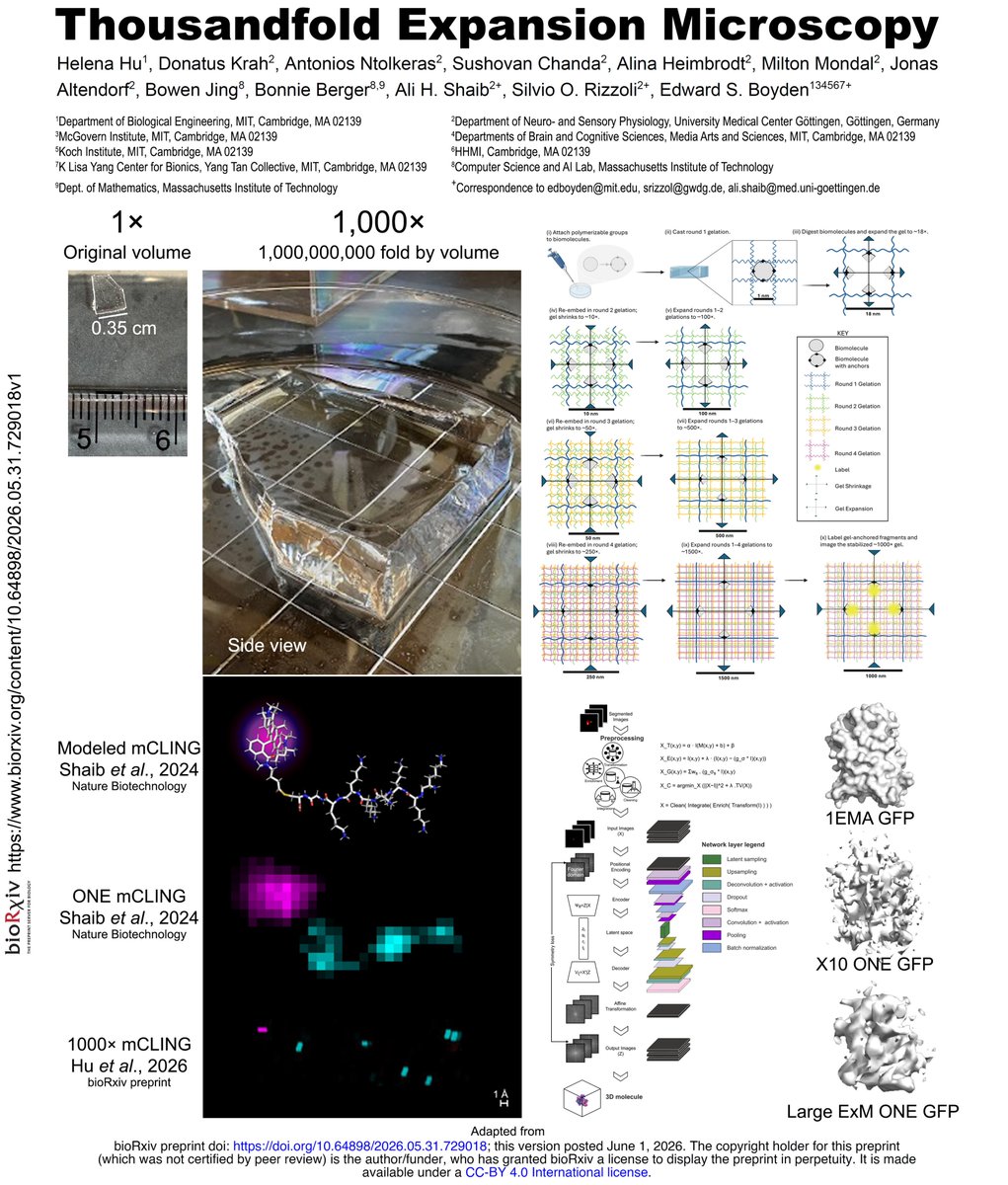
Hello world, meet 1,000× Expansion Microscopy.
1,000,000,000× expansion by volume! A gel that starts at a few centimeters will then expand to the volume of an Olympic swimming pool. https://t.co/E43kxx4O5M
In our new bioRxiv preprint, work carried out between MIT and UMG, led by Helena Hu in collaboration with scientists from the labs of @eboyden3 Ed Boyden, Silvio Rizzoli, and myself, we present Thousandfold Expansion Microscopy.
By enlarging biological specimens across multiple rounds of expansion, molecular-scale features, as small as the distances between adjacent amino acids, can be visualized with conventional optical microscopes.
Democratizing super-resolution microscopy.
New publication from our group: what happens inside human endometrial tumors during a ketogenic diet?
We analyzed paired tumor biopsies before and after a very low-carbohydrate intervention in women with endometrial cancer 🧵
@caloriesproper2 Exactly why there are a million runners and saturated marathons but comparably not a lot of weightlifters/powerlifters. Because the former is harder. 🤣
@Alexleaf@caloriesproper2 To truly test the PFT you’d have to show at least a correlation between ectopic fat and T2DM burden, negatively but also positively within weight regain contexts.
@Alexleaf@caloriesproper2 What one can conclude from the ReTUNE trial is that when people lose fat, some resolve T2DM. Nothing more. The PFT is unfalsifiable because any null result can always be explained by “needs to lose more fat”.
@Alexleaf@caloriesproper2 Not really. If someone loses fat but fails to resolve T2DM, then she/he’s still within his PFT. If she/he does resolve it, then he’s below his PFT. Unfalsifiable. It’s always posthoc because, contrary to energy balance, you cannot model/predict it.