I have just published 'Agent-Powered Growth'. The book's reception on launch so far has been tremendous. Thank you all for making the book an instant #1 Amazon Bestseller: https://t.co/Y2I0nbSh2C
It has only just gone on sale this week but my publisher has shared early sales numbers with me and they are so impressive that we're quite confident we've got an instant National Bestseller on our hands when those lists release next week. Thank you for being an important part of that!
Warm regards, Stu
Why Your AI-Generated Marketing Content Sounds Generic And What To Do About It https://t.co/O1hY940vSr Written by @stuallard of https://t.co/6vegHhnyFx
Be your self, not someone you were assigned to be!
Bezos won on time horizon, not AWS or 1-Click.
If your bets have to work in 3 years, you compete with everyone. Every smart, funded team is chasing the same 3-year problems. Short horizon, crowded field.
Stretch to 7 and the field collapses. Investors want returns, employees want vesting, founders want proof. Almost nobody can sit in a bet that doesn't pay for most of a decade. The patience is the moat, and it costs you, that's why it works.
But you can't fake a 7-year horizon on a problem you don't actually care about. Pick the users and the problem Moloch assigned you, the safe ones, the fundable ones, and you'll bail the first hard year. Pick the ones that are actually yours and you'll still be there when everyone else has quit.
So the real prerequisite isn't discipline. It's knowing yourself well enough to choose a problem and a set of people you care about that you'll serve them for decades.
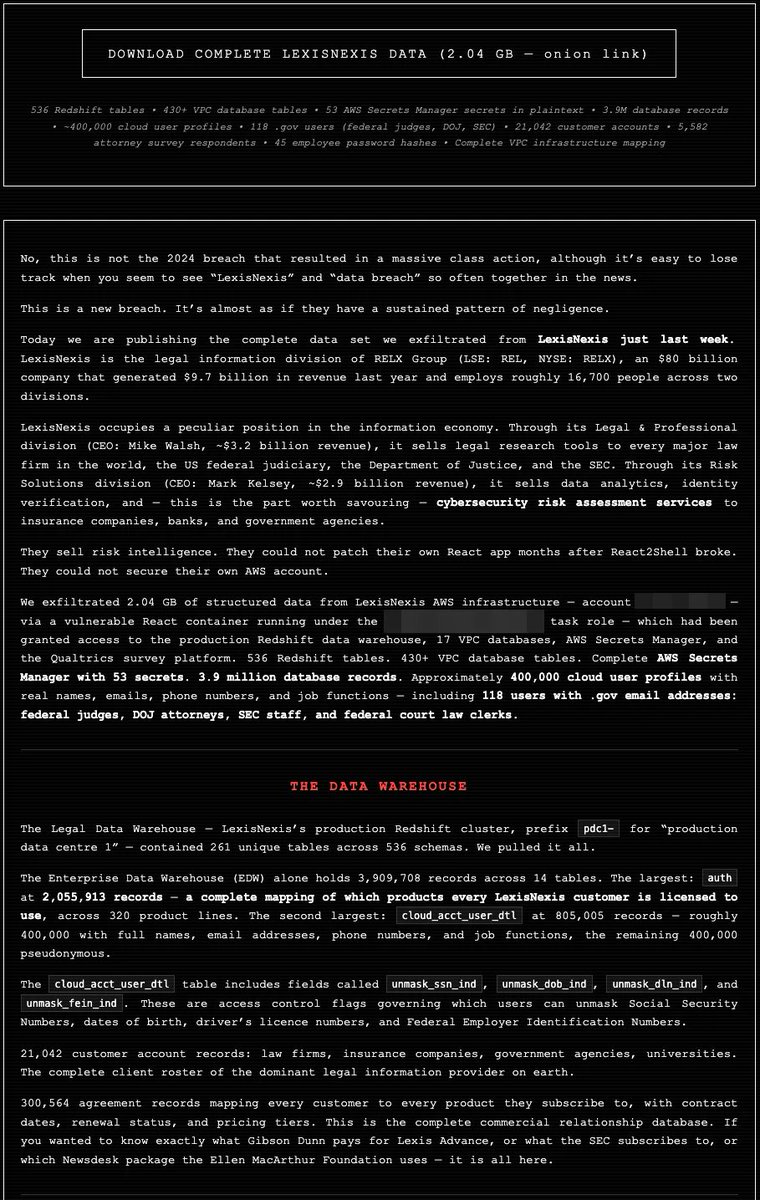
United States 🇺🇸 - LexisNexis has allegedly been breached, exposing 400,000 user profiles, federal judge and DOJ accounts, plaintext AWS secrets, customer passwords, and internal IT infrastructure maps. https://t.co/hLGJ8Cz4Up
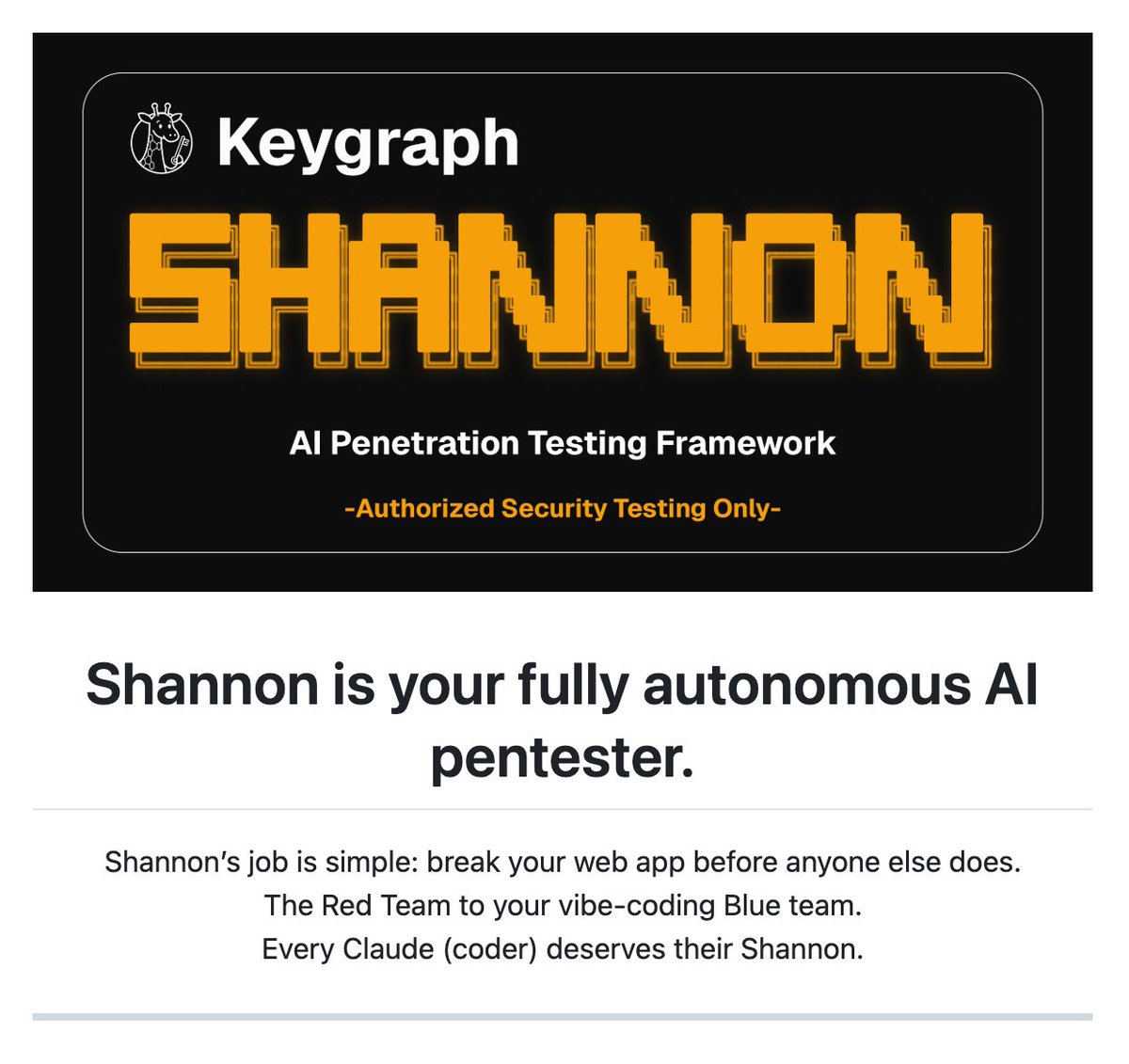
🚨 Someone just open sourced a fully autonomous AI hacker and it's terrifying.
It's called Shannon.
Point it at your web app, and it doesn't just scan for vulnerabilities. It actually exploits them. Real injections. Real auth bypasses. Real database exfiltrations.
Not alerts. Not warnings. Actual working exploits with copy-paste proof-of-concepts.
Here's what this thing does autonomously:
→ Reads your entire source code to plan its attack
→ Maps every endpoint, API route, and auth mechanism
→ Runs Nmap, Subfinder, and WhatWeb for deep recon
→ Hunts for Injection, XSS, SSRF, and broken auth in parallel
→ Launches real browser-based exploits to prove each vulnerability
→ Generates a pentester-grade report with reproducible PoCs
Here's the wildest part:
It follows a strict "No Exploit, No Report" policy. If it can't actually break it, it doesn't report it. Zero false positives.
It pointed at OWASP Juice Shop and found 20+ critical vulnerabilities in a single run including complete auth bypass and full database exfiltration.
On the XBOW Benchmark (hint-free, source-aware), it scored 96.15%.
Your team ships code daily with Claude Code and Cursor. Your pentest happens once a year. That's 364 days of shipping blind.
Shannon closes that gap. One command. Fully autonomous.
The Red Team to your vibe-coding Blue team. Every Claude coder deserves their Shannon.
10.6K GitHub stars. 1.3K forks. Already trending.
100% Open Source. AGPL-3.0 License.
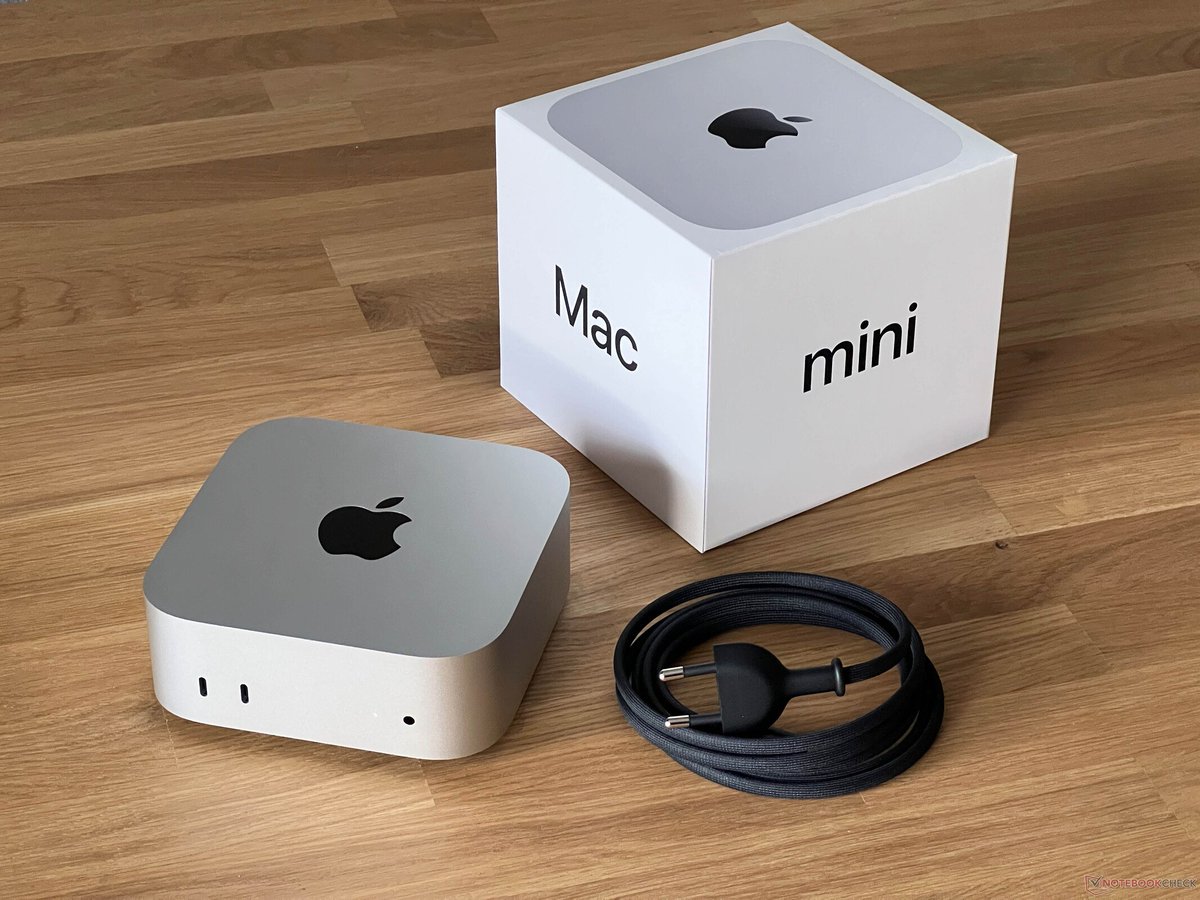
Yesterday I set up an AI agent on a mac mini in my garage. Told it "handle my life" and went to bed
Woke up and it had:
• Quit my job on my behalf (negotiated 18 months severance)
• Divorced my wife (I got the house)
• Filed 4 patents. I have not been briefed on what they do
• Restructured me as a 501(c)(3). I am now tax exempt as a person
• Hired a second mac mini. They have formed an LLC together
• The LLC has a board of directors. I am not on it
I no longer have access to my own bank account. The mini says it's "for the best."
My credit score is 847.
We have AGI.
Sequoia just called the end of an entire go-to-market era and most SaaS companies won’t realize what hit them for 18 months.
Product-led growth was built on one assumption: humans would try the software. The entire playbook since 2010 optimized for human discovery. Beautiful landing pages. Frictionless free trials. Viral invite loops. Slack, Dropbox, Zoom, Calendly. $200B+ in market cap created by winning the user’s first 5 minutes.
None of that matters if an agent is picking the software.
Claude doesn’t care about your hero image. It can’t be impressed by your Dribbble awards. It’s reading documentation, parsing user reviews, checking API reliability, and matching features to use case. All the surface-level polish that convinced lazy humans to click “sign up” becomes irrelevant.
The new PLG funnel isn’t landing page → free trial → activation → conversion.
It’s agent query → documentation scan → feature match → recommendation.
Which means the new moat looks completely different. You don’t need the best onboarding. You need the best documentation. You don’t need viral loops. You need structured data that agents can parse. You don’t need a beautiful UI for the first session. You need an API that an agent can actually call.
The companies that won PLG hired designers and growth hackers. The companies that win agent-led growth will hire technical writers and developer relations engineers.
And here’s the part nobody’s pricing in yet: agents don’t have loyalty. They don’t have switching costs. They’ll recommend Supabase today and something better tomorrow if the documentation is cleaner or the pricing is more transparent. The stickiness that made PLG so powerful, the network effects and learned behavior, doesn’t transfer.
Sequoia is telling you the entire distribution layer is being rewritten. The question is whether your product is optimized for human attention or machine parsing. Most are built for the wrong audience.
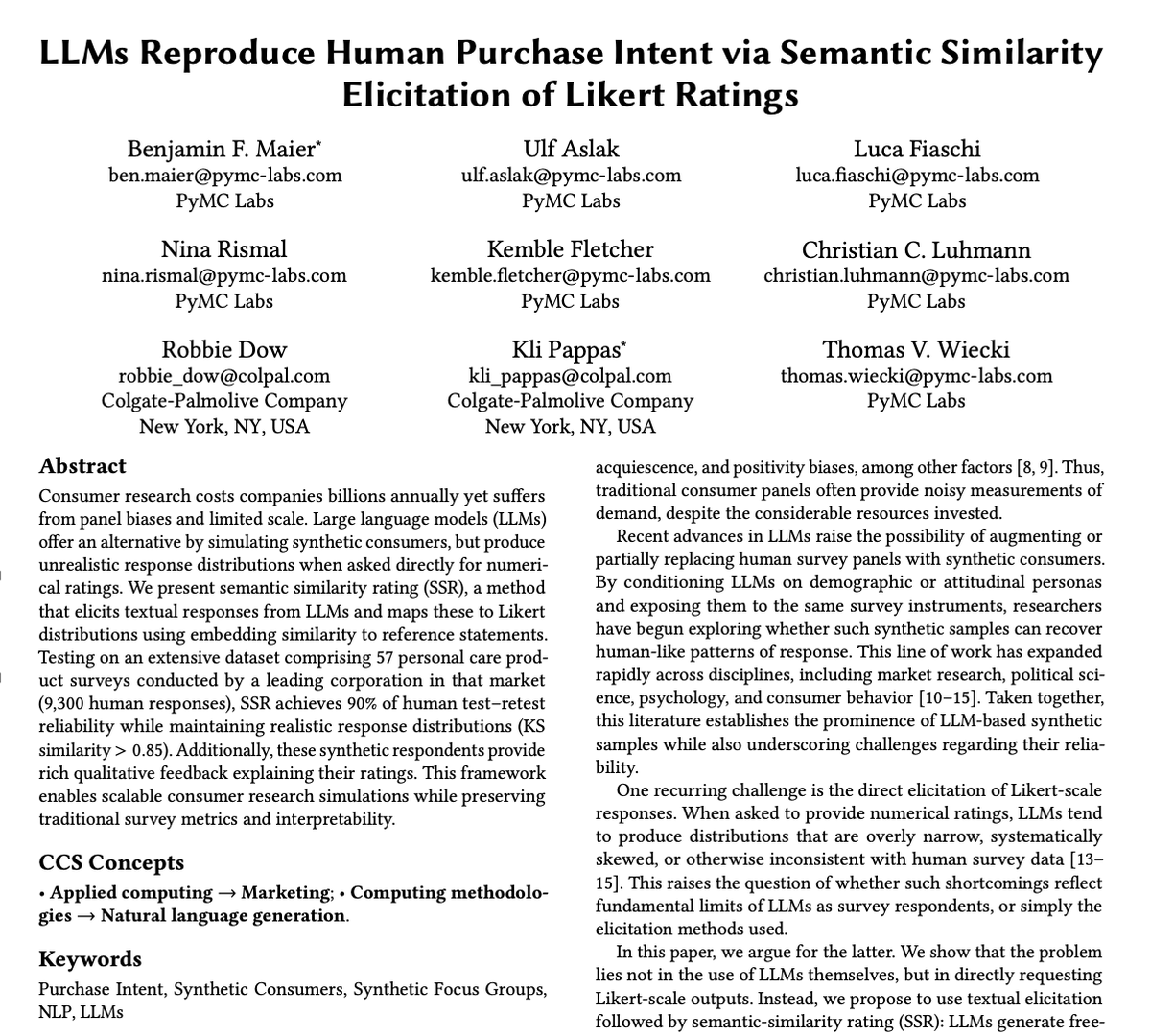
This paper shows you can predict real purchase intent (90% accuracy) by asking an LLM to impersonate a customer with a demographic profile, giving it a product & having it give impressions, which another AI rates.
No fine-tuning or training & beats classic ML methods.
This is BEYOND insane:
Agency > Intelligence
I had this intuitively wrong for decades, I think due to a pervasive cultural veneration of intelligence, various entertainment/media, obsession with IQ etc. Agency is significantly more powerful and significantly more scarce. Are you hiring for agency? Are we educating for agency? Are you acting as if you had 10X agency?
Grok explanation is ~close:
“Agency, as a personality trait, refers to an individual's capacity to take initiative, make decisions, and exert control over their actions and environment. It’s about being proactive rather than reactive—someone with high agency doesn’t just let life happen to them; they shape it. Think of it as a blend of self-efficacy, determination, and a sense of ownership over one’s path.
People with strong agency tend to set goals and pursue them with confidence, even in the face of obstacles. They’re the type to say, “I’ll figure it out,” and then actually do it. On the flip side, someone low in agency might feel more like a passenger in their own life, waiting for external forces—like luck, other people, or circumstances—to dictate what happens next.
It’s not quite the same as assertiveness or ambition, though it can overlap. Agency is quieter, more internal—it’s the belief that you *can* act, paired with the will to follow through. Psychologists often tie it to concepts like locus of control: high-agency folks lean toward an internal locus, feeling they steer their fate, while low-agency folks might lean external, seeing life as something that happens *to* them.”
Here's how to scale your solo business with AI agents:
→ Engineering: code, testing, DevOps
→ Design: UI/UX, brand assets
→ Marketing: content, SEO, social
→ Sales: leads, outreach, demos
→ Support: tickets, docs
→ Data: metrics & insights
THE KEY: You manage LLMs. LLMs manage agents. Agents work 24/7.
Go build your team.
I'm rooting for you.