AI is showing up in layoffs before it shows up in earnings.
More than 100,000 announced job cuts in the first half of 2026 cited AI. Yet Goldman Sachs found that in Q2 earnings, 46% of S&P 500 companies talked about AI in the context of productivity or efficiency, 11% quantified the impact in a specific use case, and only 2% quantified an impact on earnings.
The problem is that the decisions are moving faster than the evidence. Companies are already making workforce decisions based on the value they expect AI to create, while very few can yet show that value in the P&L.
The spending data adds another dimension. Goldman cites the Ramp AI Index, where median AI spending per employee has gone from $5 a month at the start of the year to about $12 in July. At the top decile, it is already $650.
So why is the earnings impact still at 2%?
Our research at @Accenture points to part of the answer. 86% of organizations plan to increase AI investment this year, but only 21% have redesigned end-to-end processes with AI at the core. National Bureau of Economic Research's survey of nearly 6,000 executives found that 89% reported no impact from AI on labor productivity over the last three years.
For a long time we called this a pilot problem. It is a value-realization problem, and solving it requires reinvention. Organizations that bolt AI onto existing ways of working will struggle to move the P&L. The ones bold enough to reinvent the work, the workforce, and the workbench (the technology) around AI, then deploy at scale, are the ones who will turn productivity into earnings. The ones that hire and partner with AI engineering talent, industry and process expertise with solutions that focus on adding replicable value will be the future winners.
The real test will be how long it takes for more than just 2% of the S&P 500 companies to start showing that AI impacted their earnings.
Comment "data" below if you want the links to the sources.
As a fun Saturday vibe code project and following up on this tweet earlier, I hacked up an **llm-council** web app. It looks exactly like ChatGPT except each user query is 1) dispatched to multiple models on your council using OpenRouter, e.g. currently:
"openai/gpt-5.1",
"google/gemini-3-pro-preview",
"anthropic/claude-sonnet-4.5",
"x-ai/grok-4",
Then 2) all models get to see each other's (anonymized) responses and they review and rank them, and then 3) a "Chairman LLM" gets all of that as context and produces the final response.
It's interesting to see the results from multiple models side by side on the same query, and even more amusingly, to read through their evaluation and ranking of each other's responses.
Quite often, the models are surprisingly willing to select another LLM's response as superior to their own, making this an interesting model evaluation strategy more generally. For example, reading book chapters together with my LLM Council today, the models consistently praise GPT 5.1 as the best and most insightful model, and consistently select Claude as the worst model, with the other models floating in between. But I'm not 100% convinced this aligns with my own qualitative assessment. For example, qualitatively I find GPT 5.1 a little too wordy and sprawled and Gemini 3 a bit more condensed and processed. Claude is too terse in this domain.
That said, there's probably a whole design space of the data flow of your LLM council. The construction of LLM ensembles seems under-explored.
I pushed the vibe coded app to
https://t.co/EZyOqwXd2k
if others would like to play. ty nano banana pro for fun header image for the repo
If America is drifting toward two distinct demand curves, how do national brands and investors redesign pricing, supply chains, and talent strategies to keep scale advantages intact?
Interesting observation from The Economist that is consistent with detailed analyses of both hard and soft data, though some more than others.
“America is splitting into two different economies and markets: one conservative, the other liberal. People on each side think about the economy differently; they buy different things and work in increasingly different industries.”
#economy #markets @TheEconomist
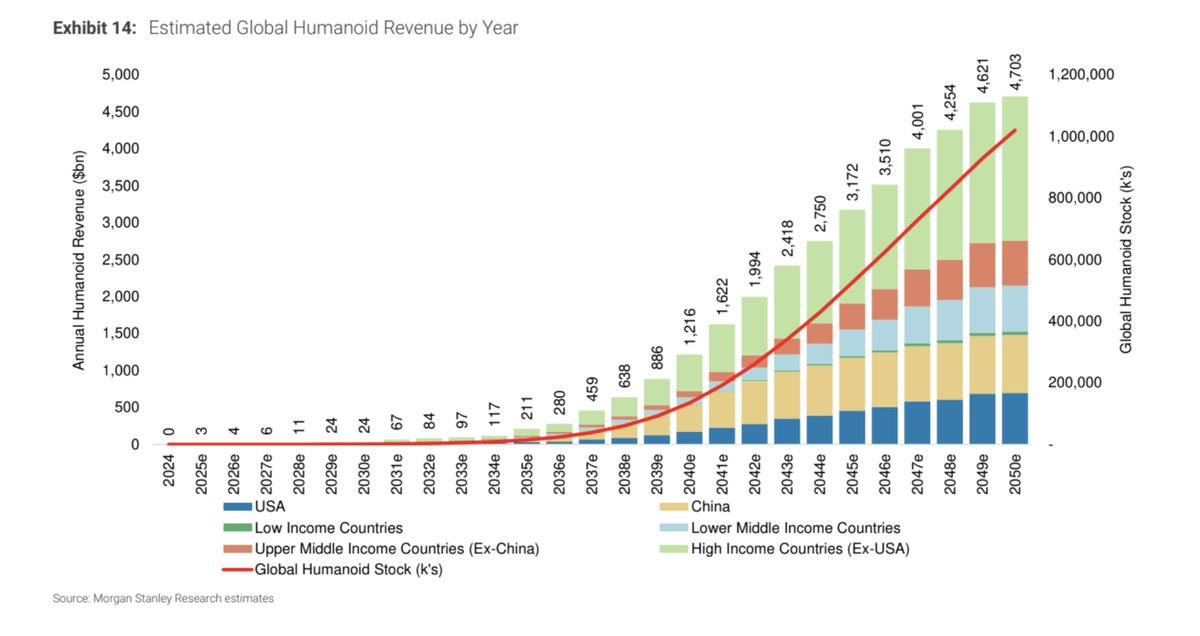
Morgan Stanley projects humanoid revenues will explode from effectively zero today to $4.7 trillion by 2050—roughly equivalent to Japan’s current GDP.
Low-income countries barely register on this chart, suggesting a new dimension of global inequality forming around physical automation.
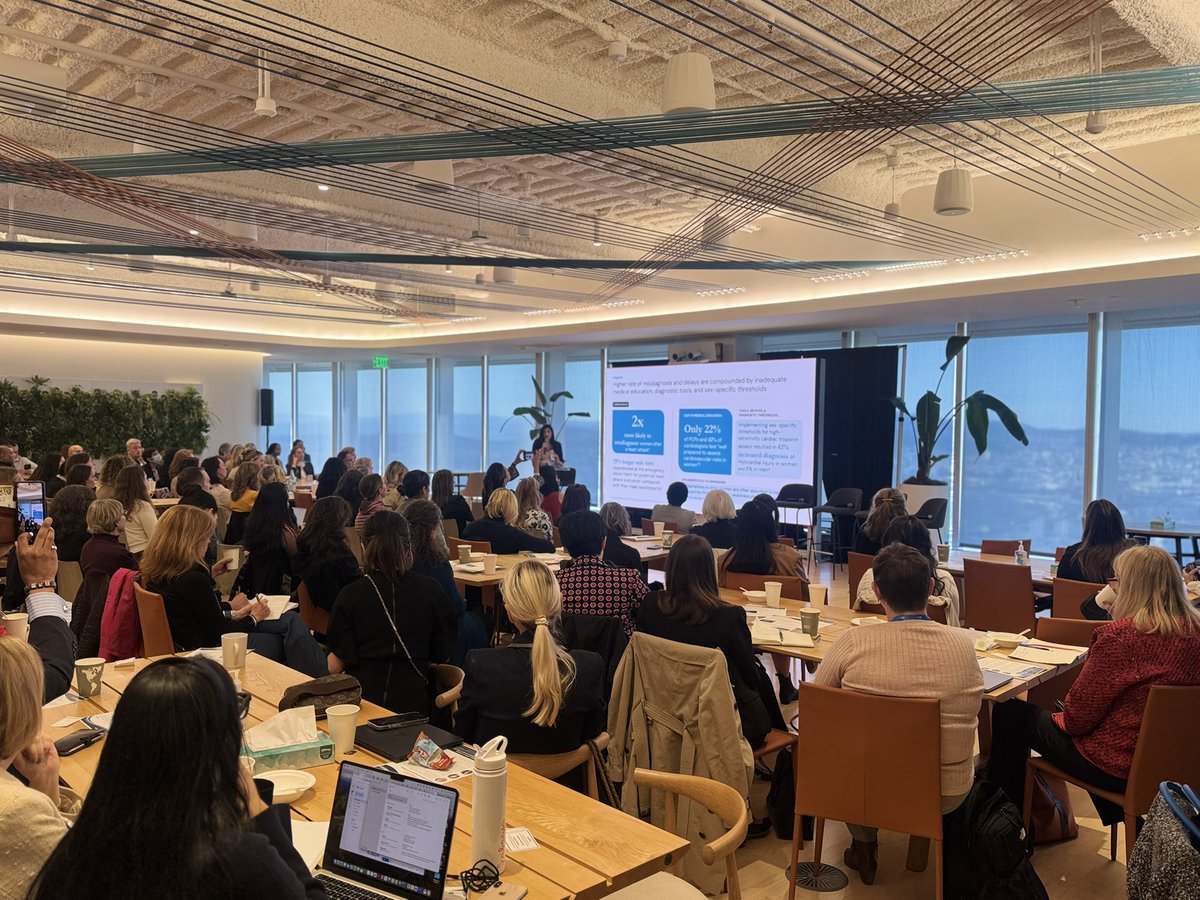
JPM kickoff day 1 - started with @Bloomberg noting that women will control 50% of global wealth market. Then terrific AMevent hosted by @Accenture@SpringboardEnt@salesforce on the future growth on women’s health
CES report #30.
Walking around with a guy who partially built DOS (Jim Harding) and now is building a new kind of operating system that orchestrates robots and humans working together.
The Holodeck needs a hyper smart network. I wrote an important book on contextual software years ago.
A new operating system is coming. It doesn’t run one computer at a time.
It runs us and all computers at the same time. It will show us how to connect with autonomous vehicles, get served by robots, and much more.
And can communicate with competitive ones that Elon Musk and others are building.
The future: https://t.co/3y08x9LrKG
This is the biggest idea I have ever heard.
🎄🎅starting tomorrow at 10 am pacific, we are doing 12 days of openai.
each weekday, we will have a livestream with a launch or demo, some big ones and some stocking stuffers.
we’ve got some great stuff to share, hope you enjoy! merry christmas.
It’s the festive season… so get ready for 12 Days of OpenAI. Sam Altman just shared that OpenAI will be showcasing an incredible demo everyday for the next 12 days that highlights the progress they are making towards AGI. Starting tomorrow…. #NYTimes#Dealbook#OpenAI
Big paper I have been waiting for: what are the real impacts of AI on programmer productivity?
It is a randomized controlled trial using the older, less-powerful GPT-3.5 powered Github Copilot for 4,867 coders in Fortune 100 firms.
It finds a 26.08% increase in completed tasks.
We are at the most interesting point in history. We are transitioning from a period of fairly slow to moderate change to a time of extreme change.
We are still at the beginning of the inflection curve and it’s already quite crazy!
- A viral Drake song turned out to be AI-generated
- Waymos are all over SF and no one gives a second look
- Very beautiful AI generated fashion went viral on Rihanna and Katy Perry
- People are doing interviews with avatars
- Companies are claiming to have let large teams go and entirely replaced them with LLM apps
- The latest FSD release is pretty magical
- Vision Pro, even if it’s not very useful is a technological marvel
All of this happened in 2024!! Things are going to accelerate from here. We are already living in the future 🤯
Robots + AI are the next great frontier
We demo’d some of the latest AI on our robot during 60 Minutes last week
Figure-01 is connected to a pertained model via OpenAI to output common sense reasoning
So when Bill says “hand me something healthy” the robot, by visual reasoning via robot cameras, knows this is the orange in the scene and not the chips
The behavior of this robot grabbing the orange was an in-house trained neural network. The model is mapping camera pixels at 10hz to robot actions
Why did I deepfake myself? To see if conversing with an AI-generated version of myself can lead to self-reflection, new insights into my thought patterns, and deep truths.
The First AI-Generated Video That Looks Super Real
Microsoft Research announced VASA-1.
It takes a single portrait photo and speech audio and produces a hyper-realistic talking face video with precise lip-audio sync, lifelike facial behavior, and naturalistic head movements generated in real-time.
This is amazing, given that the AI-generated video looks very real!
Of course, these examples will likely be cherry-picked, but this is still amazing.
My favorite use-case for this tech is to revive old actors like Cary Grant in new movies with this tech :)
The Path To AGI
OpenAI has claimed before that Sora is the path to AGI. Many, including me, have been skeptical.
I now see a path to how that can happen - Let's assume that the definition of AGI is an AI capable of most tasks humans can do. For AI to match human abilities, you need a foundation model for robotics.
Ideally, this model will ingest
- a NLP prompt
- state of the current environment in the form of the last X min of video from its "eyes"
The output would be a set of detailed instructions for the humanoid to perform the task specified in the prompt. For example, the prompt "make coffee" would be broken down into smaller tasks that would, in turn, be broken down into instructions for the robot to perform.
A robust multi-modal LLM would need to be trained to perform these tasks. The biggest challenge in teaching these models is training data. We don't have enough robot training data, so the only way to do this is to gather it with teleoperated robots.
Tesla, Figure, and a ton of robot companies are busy trying to collect this data. The problem is that it may take years to collect enough data to train a robust multi-modal LLM
Enter Sora - Imagine if I had 100K training data points for training this robot LLM and needed 100M to 1B training points? Sora can easily bridge that gap by simulating and generating scenarios based on the input data.
All you need to do is give it the 100K data points and ask it to amplify the dataset by 100-1000x. Now, imagine applying some post-processing steps to validate the generated data! Magically, you would have enough data to simulate the world.
After that, the problem becomes trivial. 1000x your training data with Sora, and then proceed to train this foundation model, which will mimic humans at most tasks, including walking, making coffee, and solving problems in quantum mechanics!
Sure, it may not be self-aware or conscious, but it can do everything a human can. Some may call that AGI!! 🤯🤯
Open AI may have a line of sight to this powerful foundation model - a.k.a AGI!
AI video generation is getting shockingly good.
In a couple of years, anyone will be able to create a movie from a smartphone- we're entering a whole new era of film.
Here are some of the best examples I've seen:
Proud to share @Accenture is committing $4.5M in support of the important work the Aspen Institute’s Global Opportunity Youth Network is leading.
@AspenInstitute@GlobalOYNetwork