The best accounts to follow for AI leaks:
@synthwavedd
= in the Amodei family group chat
@scaling01
= in the Altman family group chat
@elder_plinius
= jailbreaks every model for sport
@ai_explorer25
= runs non-released models in real time
@testingcatalog
= stalks API endpoints for fun
@theo
= building an LLM out of spite
@kimmonismus
= translates leaks into english
@mark_k
= finds leaks before labs leak them
@apples_jimmy
= leaks from inside the orchard
@LiorOnAI
= first to post every release, every time
@nearcyan
= knows what the model said before you prompted it
@AndrewCurran_
= narrates the leaks like a documentary
Mejores cuentas de cada lab de IA para mantenerte siempre informado:
Anthropic
→ @karpathy → cuenta imprescindible en IA, acaba de unirse a Anthropic
→ @bcherny → creador de Claude Code, siempre comparte tips muy útiles
→ @trq212 → también desarrollador de Claude Code, escribe artículos increíbles sobre CC
OpenAI
→ @polynoamial → trabaja en investigación de razonamiento, comparte muchos detalles técnicos
→ @gabriel1 → desarrollador de Sora, trayectoria profesional muy interesante
→ @jxnlco → enfocado en experiencia de desarrollador, comparte mucho sobre Codex
Google AI
→ @OfficialLoganK → todas las actualizaciones importantes de Gemini y AI Studio
→ @ammaar → producto y diseño, comparte cosas geniales sobre vibe-coding en AI Studio
→ @fofrAI → casos de uso muy creativos con modelos generativos
Cursor
→ @leerob → la voz más activa detrás de las novedades de Cursor
→ @ericzakariasson → comparte muy buenos insights sobre cómo usar Cursor
→ @mntruell → CEO de Cursor, publica los lanzamientos y datos de uso más importantes
xAI
→ @milichab → se unió hace poco a xAI, comparte novedades sobre Grok
→ @skcd42 → también cubre los lanzamientos grandes de Grok
→ @elonmusk → Elon hace muy buen trabajo reposteando y dando visibilidad a todos los productos de xAI
Me he dejado a alguien?
CPU vs GPU vs TPU vs NPU vs LPU, explained visually:
5 hardware architectures power AI today.
Each one makes a fundamentally different tradeoff between flexibility, parallelism, and memory access.
> CPU
It is built for general-purpose computing. A few powerful cores handle complex logic, branching, and system-level tasks.
It has deep cache hierarchies and off-chip main memory (DRAM). It's great for operating systems, databases, and decision-heavy code, but not that great for repetitive math like matrix multiplications.
> GPU
Instead of a few powerful cores, GPUs spread work across thousands of smaller cores that all execute the same instruction on different data.
This is why GPUs dominate AI training. The parallelism maps directly to the kind of math neural networks need.
> TPU
They go one step further with specialization.
The core compute unit is a grid of multiply-accumulate (MAC) units where data flows through in a wave pattern.
Weights enter from one side, activations from the other, and partial results propagate without going back to memory each time.
The entire execution is compiler-controlled, not hardware-scheduled. Google designed TPUs specifically for neural network workloads.
> NPU
This is an edge-optimized variant.
The architecture is built around a Neural Compute Engine packed with MAC arrays and on-chip SRAM, but instead of high-bandwidth memory (HBM), NPUs use low-power system memory.
The design goal is to run inference at single-digit watt power budgets, like smartphones, wearables, and IoT devices.
Apple Neural Engine and Intel's NPU follow this pattern.
> LPU (Language Processing Unit)
This is the newest entrant, by Groq.
The architecture removes off-chip memory from the critical path entirely. All weight storage lives in on-chip SRAM.
Execution is fully deterministic and compiler-scheduled, which means zero cache misses and zero runtime scheduling overhead.
The tradeoff is that it provides limited memory per chip, which means you need hundreds of chips linked together to serve a single large model. But the latency advantage is real.
AI compute has evolved from general-purpose flexibility (CPU) to extreme specialization (LPU). Each step trades some level of generality for efficiency.
The visual below maps the internal architecture of all five side by side.
👉 Over to you: Which of these 5 have you actually worked with or deployed on?
Why is nobody talking about this?
NVIDIA is giving developers free access to ~80 hosted AI models via API.
Models include:
• MiniMax M2.7
• GLM 5.1
• Kimi 2.5
• DeepSeek 3.2
• GPT-OSS-120B
• Sarvam-M
…and more.
Works with Cursor, Zed, OpenCode, Hermes, OpenClaude, etc.
Setup:
1. Get API key → https://t.co/DGHAEwNC6f
2. Use base URL: "https://t.co/eyLOTGmRLe"
3. Choose model ID (example: `minimaxai/minimax-m2.7`)
4. Plug into your AI IDE / app
If you're experimenting with AI apps,
this is basically free inference.
Most builders have no idea this exists.
Thank me later.
Suno just lost its moat 🤯
Someone built ACE-Step UI, a Spotify-style interface for ACE-Step 1.5 that generates full songs with vocals up to 4+ minutes, completely locally on your own GPU.
100% Free. Open-Source and Local
this is wild. 🤯
if you can send a message, you can now build your own AI agent.
Telegram just launched Lobster Father. a single bot that builds AI agents for you, on demand, inside the chat you already use.
here's how it works.
→ you open Telegram and message Lobster Father.
→ you describe the AI agent you want in plain English.
→ Lobster Father builds it, names it, and launches it for you.
→ your AI agent now lives inside Telegram. ready to talk to you, your friends, or anyone you share it with.
→ start to finish in under 60 seconds.
950 million people already use Telegram every day. no new app to download. no new skill to learn. no payment required. just a message.
building an AI agent used to be a startup pitch.
now it's a chat command.
vc: @telegram
OpenClaw showed agents can act.
Hermes showed they can remember.
Mercury solves the next problem:
An agent that stays.
Always there when needed.
Memory that compounds.
Identity you own.
Permissioned execution.
Presence that persists.
Soul-driven. Token-efficient. Always on.
🚨𝗕𝗥𝗘𝗔𝗞𝗜𝗡𝗚: Build your next app without spending a dollar on data.
Someone made a list of 320,000+ free public APIs, and developers are going crazy.
→ Weather, finance, news, sports, crypto
→ AI & machine learning APIs you can call right now
→ Government open data, maps, geolocation
→ Entertainment: movies, music, games, anime
→ Categorized, searchable, and verified as working
Free and 100% open source. Link Bellow:👇 just like + comment " send" + repost+ Follow me so that it can be auto DM.
Build an AI agent. Live. In 3 hours.
Microsoft Agent-a-Thon:
→ May 6 • Global • Virtual
→ 3 tracks: Explorer • Commander • Master
→ No-code to enterprise • Live experts • Surface Pro prize
Pre-learning included. Build with confidence.
If you've ever wanted to ship an agent that actually works.
This is your sprint.
Register 👇
https://t.co/xXFtSRSRzG
@Microsoft
🔥DeepSeek-V4-Pro API is 75% OFF until May 5th, 2026, 15:59 (UTC Time)! Don't miss out on this massive discount.
🛠️Integration Updates:
🔹Claude Code: Set model to deepseek-v4-pro[1m] to unlock 1M context!
🔹OpenCode: Update to v1.14.24+
🔹OpenClaw: Update to v2026.4.24+
Check the latest official API docs for full details: https://t.co/9J9ZedDpyU
Hugging Face just dropped an autonomous ML intern
It’s called ml-intern — and it runs the full post-training loop:
→ reads papers
→ finds datasets
→ writes code
→ runs experiments
→ evaluates + iterates
This isn’t a coding agent.
It’s a research workflow.
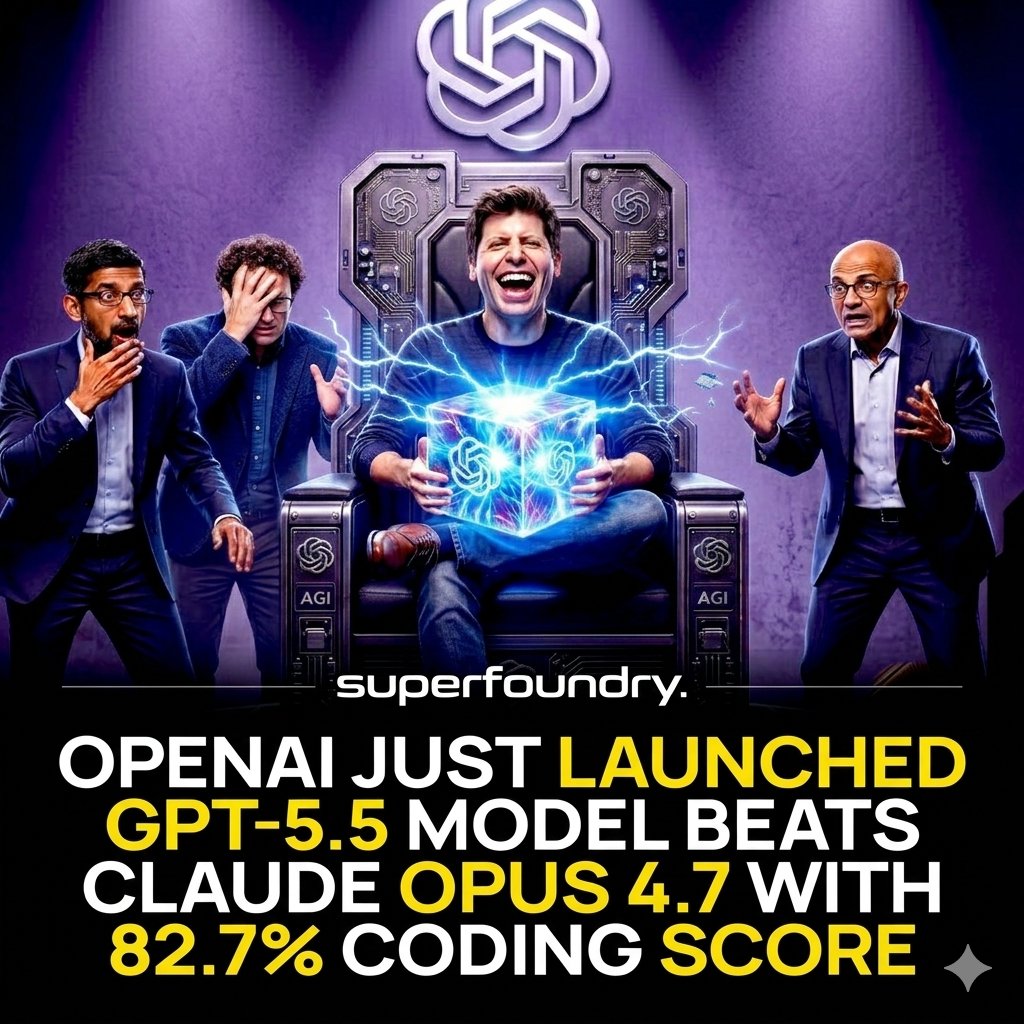
GPT-5.5 is here—and it’s not just smarter, it’s more efficient ⚡
OpenAI focused on:
→ same speed
→ better outputs
→ fewer tokens (lower cost)
Beating Claude Opus 4.7 & Gemini 3.1 Pro in most benchmarks.
Shift is clear:
Power + Speed + Efficiency > just intelligence
Claude Code can now watch videos + understand audio 🤯
Drop a video → ask questions → get insights.
No screenshots. No transcripts.
Uses tools like OpenAI Whisper + Google Gemini to process everything together.
#AI#Claude#OpenSource#DevTools#MultimodalAI
🚀 100 Days of AI Crazy Updates — Day 04
NVIDIA just made something very interesting move 👇
They’re opening access to a wide range of AI models…
👉 through hosted APIs
👉 completely FREE
💬 Comment “Free” and I’ll send you:
📌 Follow: 100 Days of AI Crazy Updates




![deepseek_ai's tweet photo. 🔥DeepSeek-V4-Pro API is 75% OFF until May 5th, 2026, 15:59 (UTC Time)! Don't miss out on this massive discount.
🛠️Integration Updates:
🔹Claude Code: Set model to deepseek-v4-pro[1m] to unlock 1M context!
🔹OpenCode: Update to v1.14.24+
🔹OpenClaw: Update to v2026.4.24+
Check the latest official API docs for full details: https://t.co/9J9ZedDpyU](https://pbs.twimg.com/media/HGwt-7VasAAPM7i.jpg)