Big news: Kimi-K3 by @Kimi_Moonshot is now #1 in the Frontend Code Arena with 1679 pts, surpassing Claude Fable 5.
This is a 17-place jump from Kimi-k2.6 (#18 -> #1).
In Frontend, Kimi-K3 ranked #1 in 6 of 7 domains: Brand & Marketing, Reference-Based Design, Data & Analytics, Consumer Product, Simulations, and Content Creation Tools, landing #2 only in Gaming behind Fable 5.
The full model weights will be released by July 27.
Congrats to the @Kimi_Moonshot team on this major milestone!
Seedance 2.0 on OpenArt AI
Prompt:
Main subject: young Korean woman, early 20s, natural everyday appearance, faded charcoal-grey sleeveless crop top, loose high-waisted light-wash jeans, black canvas sneakers, black cord necklace, black wavy hair in a messy side ponytail with wispy bangs. Realistic skin texture, minimal makeup, warm and approachable personality. Maintain consistent identity, clothing, hairstyle, and appearance throughout the entire video.
Location: Authentic Korean residential neighborhood during a calm late morning. Narrow concrete alleys, low-rise homes, small terraces, potted plants, laundry lines, bicycles, utility poles, overhead wires, mature trees casting moving shadows, quiet residential atmosphere. No stores, advertisements, cafés, crowds, or commercial activity.
Visual Style: Ultra-realistic documentary realism. Genuine candid behavior. Natural body language. Unscripted slice-of-life feeling. Strong environmental authenticity. Rich real-world details and believable human motion.
Camera Style: Early-2000s consumer DV camcorder aesthetic. Friend casually recording everyday moments. Heavy handheld shake, imperfect framing, frequent autofocus hunting, lens breathing, exposure pumping when moving between sun and shade, occasional motion blur, subtle rolling shutter, mild digital compression artifacts, faded colors, soft contrast, slight sensor noise. No stabilization. No cinematic camera moves. No modern color grading.
00:00–00:02
Outside a small house entrance. She sits on a low concrete wall adjusting her ponytail with both hands raised. A light breeze moves loose strands of hair. She smiles naturally while the camera struggles to hold focus.
00:02–00:04
The camera follows her into a narrow alley lined with potted plants and concrete walls. She notices a stray cat approaching and crouches down. Framing drifts off-center as the operator tries to keep up.
00:04–00:06
She gently pets and feeds the cat. Autofocus repeatedly shifts between her face and the animal. Morning sunlight flickers through leaves overhead.
00:06–00:08
Small front yard beside her house. She hangs laundry on a clothesline while fabrics sway in the breeze. Exposure changes as clouds briefly pass overhead.
00:08–00:10
On a quiet terrace with a ceramic coffee cup. She sits comfortably watching the neighborhood, occasionally brushing hair behind her ear. Loose handheld side angle with natural camera drift.
00:10–00:12
Close side profile. Someone off-camera greets her. She turns, raises her hand, smiles warmly, and casually says, “Annyeong.” The camera catches the moment slightly late.
00:12–00:15
Walking slowly down a tree-lined residential lane holding her coffee cup. She notices the camera, gives a small genuine smile, then looks away and continues walking. Recording cuts abruptly to black mid-motion as if the camcorder was switched off.
Audio: Natural ambient sound only — morning birds, distant motorcycles, light wind, leaves rustling, faint neighborhood chatter, cat sounds, footsteps on concrete, fabric moving on clotheslines, subtle residential ambience. No music. No sound design. No narration.
Goal: Authentic Korean neighborhood life captured like a forgotten home video from the early 2000s — candid, imperfect, realistic, warm, and deeply believable.
SpaceXAI and @cursor_ai are now working closely together to create the world’s best coding and knowledge work AI.
The combination of Cursor’s leading product and distribution to expert software engineers with SpaceX’s million H100 equivalent Colossus training supercomputer will allow us to build the world’s most useful models.
Cursor has also given SpaceX the right to acquire Cursor later this year for $60 billion or pay $10 billion for our work together.
My long mean reversion strategy based on implied volatility just made a new equity high.
Yesterday’s IRDM trade was a good reminder why I like IV for swing mean reversion.
Price alone does not always reflect fundamentals.
But implied volatility contains information from the options market - especially from traders selling volatility and pricing risk.
That is why I use IV not only for entries, but also for exits.
This model has been live in my portfolio since 2024.
Current stats:
CAGR around 22%
Max drawdown around -6%
Sharpe 2.12
Average capital exposure only 4.62%
And that is the part I like most.
It beats the S&P 500 by a wide margin while using very little capital.
This is exactly the type of edge I want inside a systematic portfolio:
Low exposure.
Different logic.
Strong risk-adjusted return.
Easy to automate.
The process is simple:
* download IV data from IBKR for free
* calculate levels (using IV) for swing mean reversion
* enter when stocks reach IV-based reversal zones
* exit using the same IV framework
* repeat mechanically
Most traders look only at price.
But for mean reversion, implied volatility can be one of the best timing tools available to retail systematic traders.
I also provide a Python script to download IV data from IBKR on my blog - look for the Deep Dip in Live Trading Models.
holy fuck, a hair dryer at a Paris airport broke Polymarket weather markets & made someone $34,000 richer
- polymarket was settling Paris temperature bets on a single Météo France sensor sitting near the Charles de Gaulle runway perimeter - basically unguarded
- the guy bought the long-shot outcome (like "22°C" when everyone expected 18°C) for pennies, since nobody thought it'd hit
- then he walked up to the probe and briefly heated the air around it with a portable heat source, spiking the reading just long enough to register as the daily max
- temperature snapped back to normal in minutes, the market resolved in his favor, and he cashed out - twice, on April 6 and April 15, before Météo France caught on and filed charges
hyperstitions.
A systematic portfolio does not have to be complicated.
If I were starting from scratch, I would not begin with 25 exotic strategies and endless optimization.
I would start with a few simple, different return drivers:
- stock momentum
- slow long mean reversion on stocks
- faster long mean reversion on stocks
- simple intraday system on indices
The goal is not to find one perfect system.
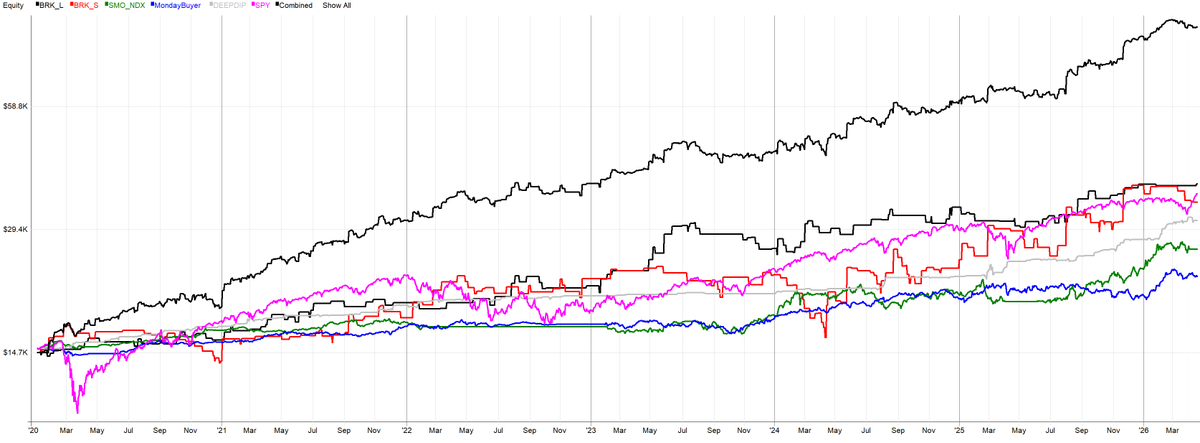
The goal is to combine simple systems that behave differently, make money in different market conditions, and reduce dependence on any single edge.
This chart shows the main strategies in my own portfolio applied to a smaller account, with slippage and commissions included.
Simple ideas.
Different behavior.
One systematic portfolio.
Deep dive with detailed statistics, updated daily:
https://t.co/QqtucCENtB
Os presento la v2 del BQuant MCP server.
En esta versión he ampliado la convergencia de señales: calidad + momentum + insiders + congreso + noticias en una sola query:
▶️"Busca empresas con Piotroski ≥7, Altman ≥3, ROCE ≥25%, golden cross confirmado, y con algún superinvestor de los 13F dentro."
▶️ "Fondos UCITS que en los últimos 5 años hayan subido al menos un 85% de lo que sube el mercado pero caído menos de un 75% de lo que cae, con comisión inferior al 1%."
▶️ "Dame tickers con noticias esta semana, al menos un insider comprando, algún congresista también dentro, y que la empresa tenga balance saneado."
▶️ "Hazme un briefing completo de NVDA: fundamentales, calidad, momentum, analistas, insiders, congreso, superinvestors y noticias."
Seguimos iterando para mejorar cada producto. Leo todos vuestros comentarios.
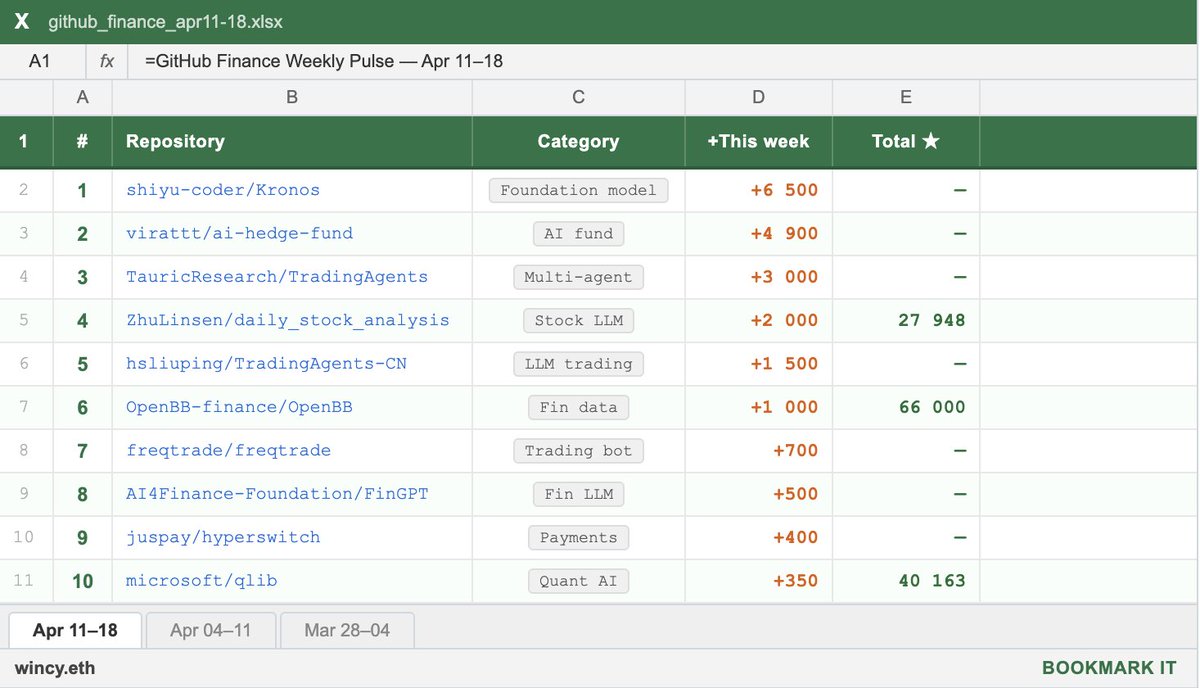
the fastest growing GitHub repos in finance this week:
1. shiyu-coder/Kronos (+6.5K ★)
first open-source foundation model for financial candlesticks. trained on 45+ global exchanges. predicts OHLCV candles as tokens — literally GPT for price charts. accepted at AAAI 2026.
2. virattt/ai-hedge-fund (+4.9K ★)
a team of AI agents simulating Buffett, Munger, Ackman, Cathie Wood and others. each agent runs its own strategy, a Portfolio Manager makes the final call. one of the most viral finance repos right now.
3. TauricResearch/TradingAgents (+~3K ★)
multi-agent LLM trading framework. fundamental analyst, sentiment analyst, technicals, risk manager — all working together. supports GPT-5.x, Gemini 3.x, Claude 4.x, Grok. built by UCLA/MIT researchers.
4. ZhuLinsen/daily_stock_analysis (+~2K ★)
LLM stock analyzer for US, A-share and H-share markets. auto-builds a daily decision dashboard with exact entry/exit levels. pushes to WeChat/Telegram/Discord/Email via GitHub Actions. zero cost, zero server.
5. hsliuping/TradingAgents-CN (+~1.5K ★)
Chinese fork of TradingAgents. fully localized for A-share markets (Shanghai/Shenzhen), Chinese data sources, and domestic LLMs. 5.1K forks — very active community.
6. OpenBB-finance/OpenBB (+~1K ★)
open-source Bloomberg alternative. stocks, crypto, options, derivatives, fixed income — one platform. integrates with AI agents via MCP. 66K total stars and still climbing.
7. freqtrade/freqtrade (+~700 ★)
free, open-source crypto trading bot in Python. supports all major exchanges, full backtesting, strategy optimization, Telegram control. release 2026.3 just dropped.
8. AI4Finance-Foundation/FinGPT (+~500 ★)
open-source financial LLMs trained on real market data — news, filings, earnings. built for sentiment analysis and robo-advisors. models on HuggingFace, ready to deploy.
9. juspay/hyperswitch (+~400 ★)
open-source payments router in Rust. one API to connect Stripe, Adyen, PayPal and 50+ providers. smart routing, high performance, built for fintech scale.
10. microsoft/qlib (+~350 ★)
Microsoft's AI quant investment platform. covers the full pipeline: alpha seeking, backtesting, model training, live trading. supports ML/DL, RL, and auto-quant.
bookmark this and start today.
Live like a Queen.
The Foot Tribute Bundle is now live. Cast in perfect detail, bare and unapologetically regal. A decadent indulgence for the truly refined. Judgment fades, elegance lingers.
The Shop awaits your most cultured decision.
I BUILT A BOT THAT PREDICTS FOOTBALL MORE ACCURATELY THAN BOOKMAKERS
3 probability sources. ML model + Bet365 odds + Polymarket. When all three diverge - that's edge
5 seasons of EPL, La Liga, Bundesliga. 7,600+ matches. Each with goals, shots, possession, corners, cards, odds
ELO rating using the FIFA formula - accounts for opponent strength, goal difference, home advantage. Not just W/D/L but the context behind every win
xG proxy from basic stats - shots on target * 30% conversion + shots off target * 3%. Teams scoring more than they should - regression is coming
Rolling averages over 5 matches, fatigue factor, head-to-head history, day of the week
Claude API analyzes context the model can't see - motivation, pressure, derbies
XGBoost + Random Forest + Logistic Regression in an ensemble. Walk-forward backtest, not random split
Bookmaker says 55% home. Polymarket says 48%. Model says 52%. KL-divergence between sources = signal. The bigger the gap + the fatter the edge
All three agree - I skip, zero edge. Two against one - I enter on the majority side
Kelly sizes the position, Claude explains why
LLM Knowledge Bases
Something I'm finding very useful recently: using LLMs to build personal knowledge bases for various topics of research interest. In this way, a large fraction of my recent token throughput is going less into manipulating code, and more into manipulating knowledge (stored as markdown and images). The latest LLMs are quite good at it. So:
Data ingest:
I index source documents (articles, papers, repos, datasets, images, etc.) into a raw/ directory, then I use an LLM to incrementally "compile" a wiki, which is just a collection of .md files in a directory structure. The wiki includes summaries of all the data in raw/, backlinks, and then it categorizes data into concepts, writes articles for them, and links them all. To convert web articles into .md files I like to use the Obsidian Web Clipper extension, and then I also use a hotkey to download all the related images to local so that my LLM can easily reference them.
IDE:
I use Obsidian as the IDE "frontend" where I can view the raw data, the the compiled wiki, and the derived visualizations. Important to note that the LLM writes and maintains all of the data of the wiki, I rarely touch it directly. I've played with a few Obsidian plugins to render and view data in other ways (e.g. Marp for slides).
Q&A:
Where things get interesting is that once your wiki is big enough (e.g. mine on some recent research is ~100 articles and ~400K words), you can ask your LLM agent all kinds of complex questions against the wiki, and it will go off, research the answers, etc. I thought I had to reach for fancy RAG, but the LLM has been pretty good about auto-maintaining index files and brief summaries of all the documents and it reads all the important related data fairly easily at this ~small scale.
Output:
Instead of getting answers in text/terminal, I like to have it render markdown files for me, or slide shows (Marp format), or matplotlib images, all of which I then view again in Obsidian. You can imagine many other visual output formats depending on the query. Often, I end up "filing" the outputs back into the wiki to enhance it for further queries. So my own explorations and queries always "add up" in the knowledge base.
Linting:
I've run some LLM "health checks" over the wiki to e.g. find inconsistent data, impute missing data (with web searchers), find interesting connections for new article candidates, etc., to incrementally clean up the wiki and enhance its overall data integrity. The LLMs are quite good at suggesting further questions to ask and look into.
Extra tools:
I find myself developing additional tools to process the data, e.g. I vibe coded a small and naive search engine over the wiki, which I both use directly (in a web ui), but more often I want to hand it off to an LLM via CLI as a tool for larger queries.
Further explorations:
As the repo grows, the natural desire is to also think about synthetic data generation + finetuning to have your LLM "know" the data in its weights instead of just context windows.
TLDR: raw data from a given number of sources is collected, then compiled by an LLM into a .md wiki, then operated on by various CLIs by the LLM to do Q&A and to incrementally enhance the wiki, and all of it viewable in Obsidian. You rarely ever write or edit the wiki manually, it's the domain of the LLM. I think there is room here for an incredible new product instead of a hacky collection of scripts.
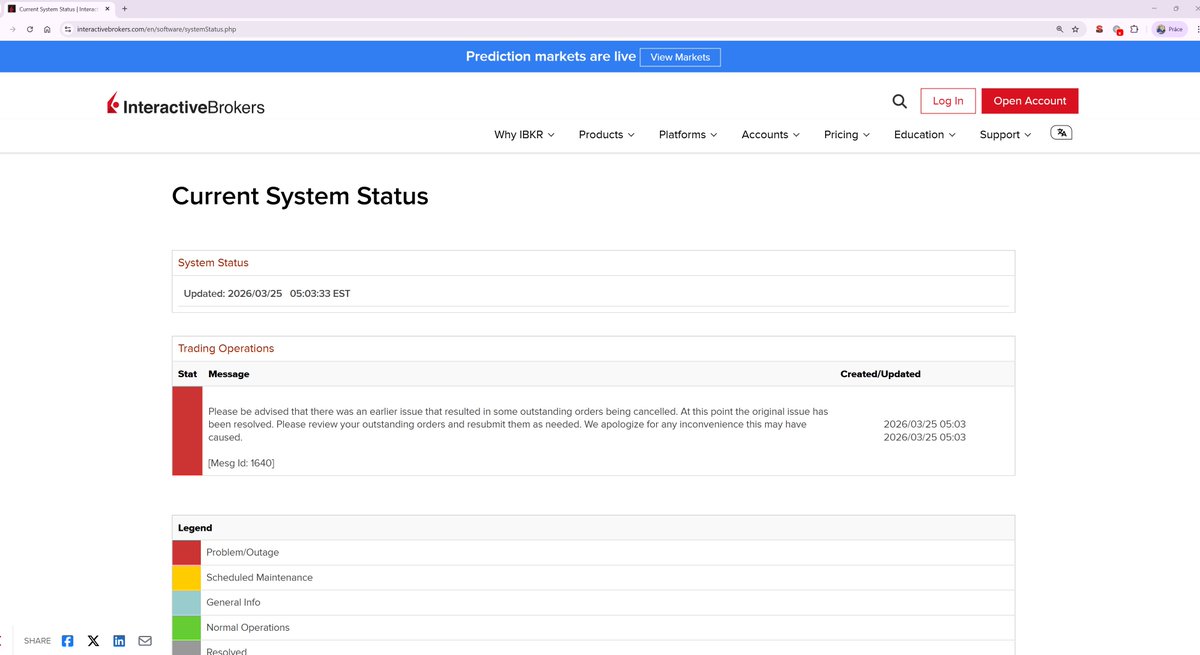
Interactive Brokers users should check their accounts today.
IBKR reported an issue that caused many outstanding orders to be canceled. It canceled my waiting limit and stop orders too.
This is a good reminder that in trading, execution risk is not only about entries, exits, or slippage. Broker and infrastructure problems can leave you exposed without noticing.
Verify your open orders.
Especially your protective stops.
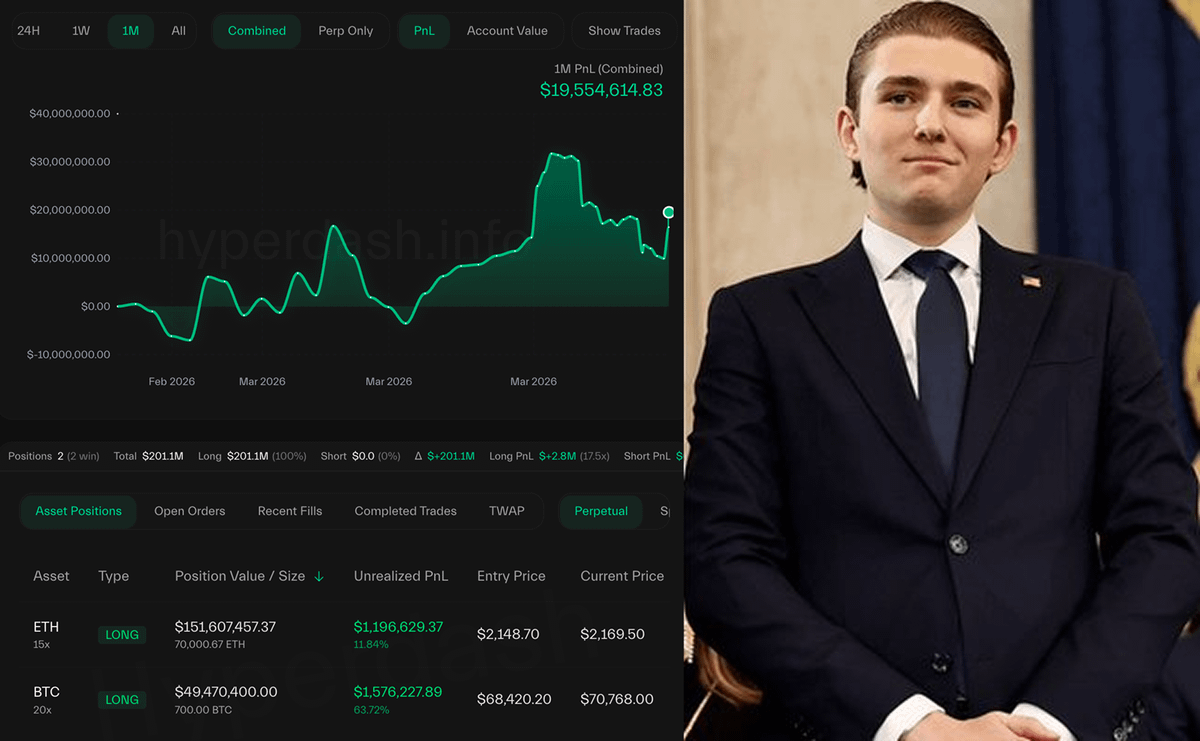
🚨 BREAKING:
TRUMP'S INSIDER WITH A 100% WIN RATE JUST OPENED A $201M LONG AHEAD OF THE U.S. MARKET OPEN TODAY
THIS GUY WENT ALL-IN FOR THE FIRST TIME SINCE THE OCTOBER CRASH, WHEN HE MADE $65 MILLION IN JUST 3 HOURS
ALL EYES ON THE INSIDER!! 👀