I put together a one-page overview of our lab’s research (SNU Visual Computing Lab) and the areas we’re currently focused on.
I’d been meaning to make one for years, and in the end it took AI and a single click.
https://t.co/zDWzDOnzER
Robots act through bodies—not vectors. So why should a video world model see actions only as numbers?
We present 🤖🌏 𝐑𝐨𝐛𝐨𝐭-𝐅𝐚𝐜𝐭𝐨𝐫𝐞𝐝 𝐖𝐨𝐫𝐥𝐝 𝐌𝐨𝐝𝐞𝐥𝐬 (𝐑𝐨𝐅𝐚𝐜𝐭𝐨), 𝘢𝘯 𝘢𝘤𝘵𝘪𝘰𝘯-𝘤𝘰𝘯𝘥𝘪𝘵𝘪𝘰𝘯𝘦𝘥 𝘷𝘪𝘥𝘦𝘰 𝘸𝘰𝘳𝘭𝘥 𝘮𝘰𝘥𝘦𝘭 ��𝘩𝘢𝘵 𝘴𝘦𝘦𝘴 𝘢𝘤𝘵𝘪𝘰𝘯𝘴 𝘢𝘴 𝘳𝘦𝘯𝘥𝘦𝘳𝘦𝘥 𝘳𝘰𝘣𝘰𝘵 𝘨𝘦𝘰𝘮𝘦𝘵𝘳𝘺.
Robot actions shape the future in two stages. A controller first turns commands into robot motion, and then the scene responds through contact. Conditioning on raw commands asks one model to learn both, while conditioning on logged future states leaks part of the interaction being predicted.
Rofacto moves two robot-specific factors outside the learned model:
𝟭. 𝗔𝗰𝘁𝗶𝗼𝗻 𝗥𝗲𝗮𝗹𝗶𝘇𝗮𝘁𝗶𝗼𝗻
We roll each command through the robot’s own controller and kinematics into a deployment-available nominal trajectory. This signal is available at inference time and does not use future interaction outcomes.
𝟮. 𝗥𝗼𝗯𝗼𝘁 𝗥𝗲𝗻𝗱𝗲𝗿𝗶𝗻𝗴
We render the nominal trajectory through the robot URDF into camera-aligned mesh RGB. This makes the robot’s geometry, appearance, and image-space motion explicit instead of asking the model to infer them from numeric states. Depth conditioning adds geometric cues for contact beyond 2D overlap.
Together, they form a 𝗦𝗵𝗮𝗿𝗲𝗱 𝗩𝗶𝘀𝘂𝗮𝗹 𝗪𝗼𝗿𝗹𝗱-𝗠𝗼𝗱𝗲𝗹 𝗜𝗻𝘁𝗲𝗿𝗳𝗮𝗰𝗲:
action → nominal motion → visible robot geometry → scene response
With the same model-facing interface, Rofacto:
• outperforms vector-conditioned baselines on DROID and RoboCasa-GR1
• works across fixed and moving viewpoints and different robot action spaces
• supports zero-shot inference with unseen embodiment configurations, including an unseen arm-hand pairing and a dual-arm setup
• turns retargeted human demonstrations into robot-interaction videos
The division of labor is simple: each robot handles how its actions become motion, while the world model learns how the scene responds.
📄 Paper: https://t.co/u6B3TpjU76
🌐 Project Page: https://t.co/w0K3oopG3e
Joint work with Taeksoo Kim(@taeksu98), Hyunsoo Cha(@hyunssu_cha), and Hanbyul Joo(@jhugestar).
Huge thanks to all my collaborators!
Introducing ZeroDex: Zero-Shot Long-Horizon Dexterous Manipulation via Multi-View 3D-Grounded VLM Reasoning
VLMs know what to do. ZeroDex grounds that reasoning in multi-view 3D, enabling robots to perform dexterous actions.
No task-specific demos. No policy fine-tuning.
We introduce 🖐️🌏 𝐃𝐞𝐱𝐭𝐞𝐫𝐨𝐮𝐬 𝐖𝐨𝐫𝐥𝐝 𝐌𝐨𝐝𝐞𝐥𝐬 (𝐃𝐖𝐌) — a scene-action-conditioned video diffusion model that simulates human manipulation in static 3D scenes from egocentric hand motions.
📄 Paper: https://t.co/u2IldpfYTD
🌐 Project Page: https://t.co/YSE3rOmV1s
Excited to present our work, "GTU," at #CVPR2024!
GTU reconstructs 3D human avatars from monocular video with limited observations using a Diffusion Model.
📌 Main Conference: Wednesday, 10:30-12:00, #87
📌 Neural Volumetric Video Workshop: Tuesday, 15:30-16:30, #188
(1/5)
We will present our PERSE at #CVPR2025
Creating 3D personalized generative avatars from a single image is a tough challenge, and I’m incredibly proud of my students, @hyunssu_cha and @sulwon0516, for their amazing efforts.
Code will be released soon:
https://t.co/jqlUx3TYh9
Personalized 3D Generative Avatars from a Single Portrait
Contributions:
1. Generate a personalized 3D avatar from a reference portrait image with controllable facial attributes.
2. Create high-quality synthetic 2D video datasets with diverse attribute editing from a reference portrait image.
3. Use latent space regularization with face morphing supervision for a continuous and smooth latent space, enhancing the generative ability for unseen or interpolated attribute appearances.
4. Employ an efficient fine-tuning technique via Low-Rank Adaptation (LoRA) [26] to integrate any new facial attribute into the avatar model.
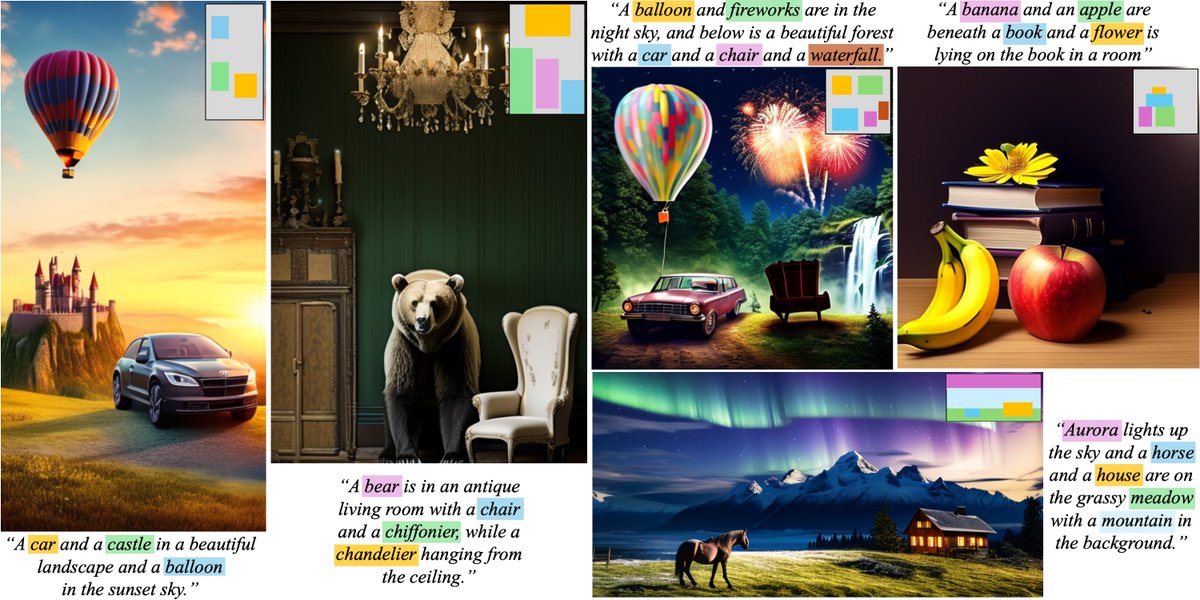
🌟 Excited to present our paper "ReGround: Improving Textual and Spatial Grounding at No Cost" at #ECCV2024!
🗓️ Oct 3, Thu. 10:30 AM - 12:30 PM
⛳ Poster #104
✔️ Website: https://t.co/bMIwU25o1P
✔️ Slides: https://t.co/g1kUqsnLjo (from U&ME Workshop)
Details in thread 🧵(1/N)
The full version of the ParaHome dataset is now available! 🎉
Check out our webpage: https://t.co/qI2HWGQd2q
- 486 min, 207 sequences, 38 subjects
- 3D parameterized 22 objects
- Text annot. for every action
- Full 3D mocap for body and hand movements
- Sequential HOI scenarios
Thrilled to present our work “ComA” at #ECCV2024 as oral presentation!
ComA (Comprehensive Affordance) is a first approach to model both contact and non-contact affordance for a given 3D object.
(1/4)
What would be the best optimization method for editing NeRFs, 3D Gaussian Splats and SVGs using 2D diffusion models? 🤔
We present Posterior Distillation Sampling (PDS) at
#CVPR2024, a novel optimization method designed for diverse visual content editing.
1/N
Please come to our poster session for more discussions!
The work has been done in collaboration with my wonderful co-authors,
Byungjun Kim(@byungjun__kim ),
Hanbyul Joo(@jhugestar ).
🔗Project Page:https://t.co/SMAKhdfFZh
💻Code: https://t.co/oNmW0581iD
(5/5)