@robertorobotics From which base model are you post training? How many eps? Are the eps identical or is there some variation in eg initial position of the components?
@baraqlipshitz For the inference speed, how many denoising steps are you doing for video and action?
How many actions do you predict per chunk and what is control frequency?
@baraqlipshitz@xdofai For mid train, how many epochs on the ABC dataset did you do? How many nodes and for how many days did you run for the mid train?
I built something that finally gives agents the option to see and measure the physical world, reason within it, and accelerate your business with better and faster decisions.
Pulling out insights from 3D data and cross-referencing across data silos, completely automating all the steps.
From point cloud to the sent pick-up price, date, and picking the best buyer.
If you have other companies our agent should integrate with, tell me!
One of the reasons I like using rerun among many others is that their UI actually looks good and this new website redesign just confirms that they have great taste
@songyoupeng Hey, thx for an interesting finding! I just wonder - have you tried post training any other image-gen backbone, ideally open source and obtain similar results?
Would be great to have access to @GeneralistAI’s Gen1 backbone…
@mikasenghaas - maybe is time for @PrimeIntellect to look into video-action models to get some great open source alternatives:)
@arnie_hacker@odysseyml@olivercameron Just wondering why built VAE from scratch, when there are already really good open source ones such as WAN VAE? is it not much more interesting to focus on the actual model?
I’m so tired of writing rebuttals to this kind of “lack of novelty” review: “This paper trivially combines A, B, and C, so the algorithmic novelty is limited.”
Technically, most (if not all) robotics papers are convex combinations of existing ideas.
I still deeply appreciate A+B+C papers—especially when they deliver:
- New capabilities: the “trivial combination” unlocks behaviors we simply couldn’t achieve before
- Sensible & organic design: A+B+C is clearly the right composition—not some arbitrary A′+B+C′
- Nontrivial interactions: careful analysis of the dynamics, coupling, or failure modes between A, B, C
- Rehabilitating old ideas: A was dismissed for years, but paired with modern B/C, it suddenly works—and teaches us why
- System-level & "interface" insight: the contribution is not any single piece, but how the pieces talk to each other
- Scaling laws or regimes: identifying when/why A+B+C works (and when it doesn’t)
- Engineering clarity: making something actually work robustly in the real world is not “trivial”
- New problem formulations: sometimes the real novelty is in the reformulation—only under this view does A+B+C make sense.
Maybe worth keeping these in mind when reviewing the next A+B+C paper : )
Kudos to @dimensionalos for their amazing repo which helped us to make 90 % of our demo 🙏
And also Me during and after 😂
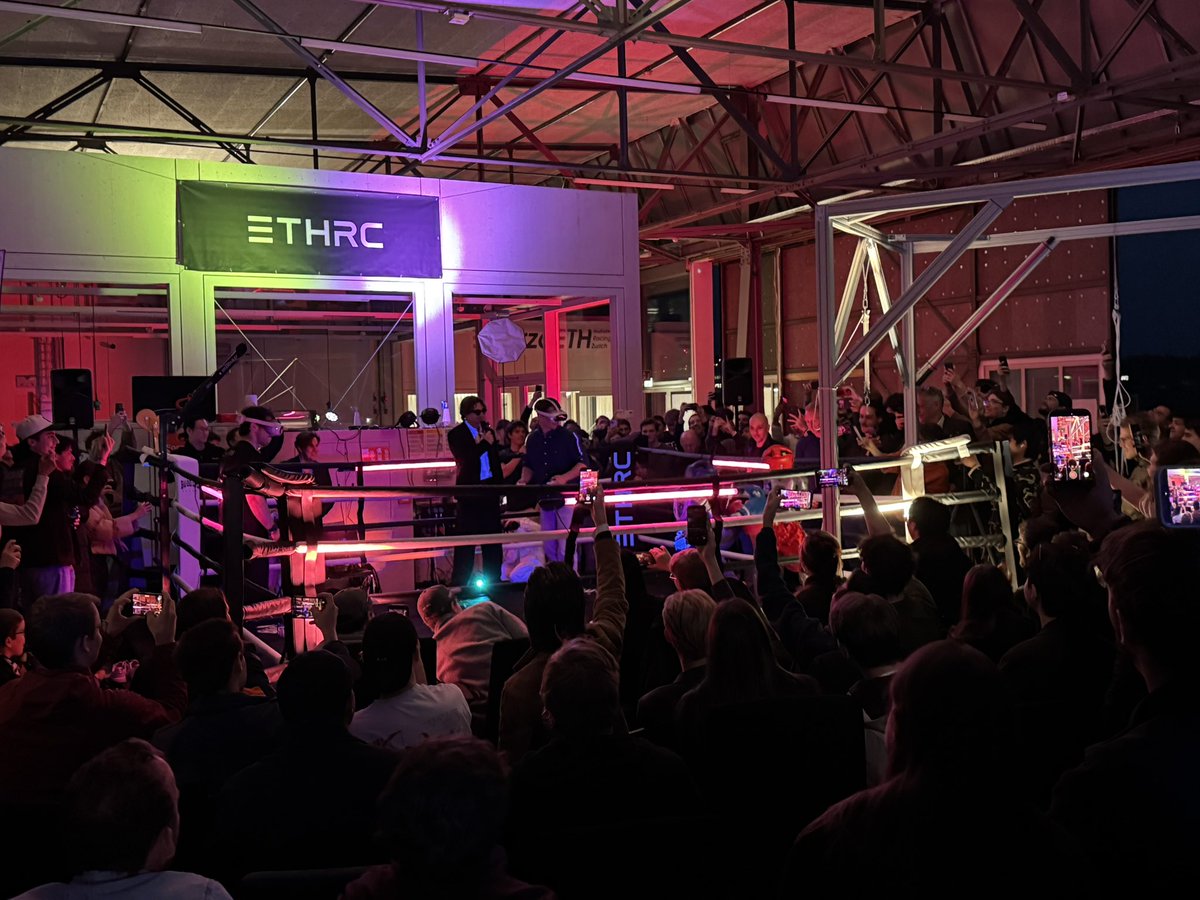
Also thx to @ethroboticsclub for organising, wknd to remember for sure