@Polymarket That’s a stupid mistake. May work for large corporations who can handle missed payments, but individual landlords would not be able to afford even a single missed payment and this might force them to sell the house all together
Anthropic is playing is risky game. Involving so many government and ex government stakeholders might be good for them to get government projects, but tech ecosystem and startups hate this kind of org structure
Former Federal Reserve Chairman Ben Bernanke has joined Anthropic’s long-term benefit trust, an oversight body that helps keep the AI company accountable to its public mission https://t.co/KCX6zNzSFr
@ShaziGoalie Partially agree. Data center demand isn’t going away anywhere soon, hence, the long term economic benefit will continue for at least 10-12 years if not more, allowing Canada a respite again the federal deficit
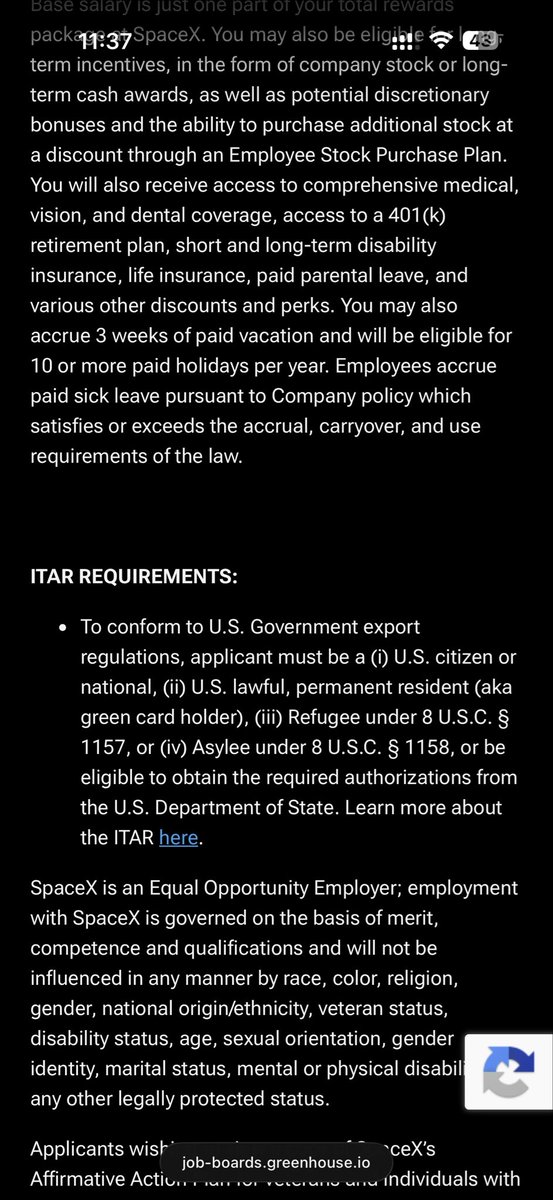
The future can always be fixed, but about the existing illegal immigrants, we need to have a hard stop. Personally I find it a joke, the I am not in consideration of companies like SpaceX because they only accept green card, Us citizens or people on asylum. I came to US legally but a person granted asylum has more options compared to me.
Source is excerpt from SpaceX careers
The Intent of government is right, however, better solution is 1. helping reduce non wage costs for businesses. Such as insurance, regulation costs, to increase profit share for these businesses 2. Focus on making total comp more attractive, such as adding 401k, health benefits tax free for employers so that employees don’t have to pay for them and get more value for the same amount, 3. Push for profit sharing concept like esop, if small businesses instead of making them increase wages share a % of profit that would be win win for both parties as incentives would motivate employees to increase business growth
AI is not a model problem. It’s a distribution problem.
Every Organisation has the best users already working at their company, aka the power users.
Any organisation or group which wants to succeed must turn those workflows of the power users into everyone's default.
The moat is in the model. It's the judgement those power users have that can be distributed across the organisation to make it run a hundred times faster.
The AI race is moving from model quality to workflow ownership.
Claude is excellent.
But excellence can still get compressed if it becomes a premium model inside someone else’s operating layer.
OpenAI’s advantage is distribution.
ChatGPT became a consumer habit first. That habit now creates enterprise pressure, budget, integration, and switching costs.
This is the real risk for Anthropic. Not failure.
Compression!
The company that owns the workflow captures more value than the company that only supplies intelligence.
The question is not:
Who has the best model?
It is:
Who owns the canvas where intelligence gets used?
The most important person in enterprise AI may not be the model researcher.
It may be the person sitting inside the customer’s workflow, watching where the model breaks.
That is why the FDE model is having a moment.
Palantir made it visible. Frontier model companies are leaning into it. Hyperscalers will not stay far behind.
On the surface, this looks like implementation support.
Customer buys AI.
Customer struggles to make it work.
Vendor sends technical operators into the field.
Outcomes improve.
Simple.
But that is not the interesting part.
The interesting part is what the FDE learns while solving the customer’s problem.
They see the messy workflow.
They see the undocumented decision logic.
They see where the data is weak.
They see which edge cases actually matter.
They see what the product could not do out of the box.
And then the strategic question becomes:
Where does that learning become durable capability?
Because there are two very different versions of this model.
In one version, the FDE discovers patterns in the field, brings those learnings back to the product, and helps the provider build reusable capability.
That accelerates the vendor’s product roadmap.
In another version, the FDE helps the enterprise build durable internal capability: context, workflows, evaluation systems, data products, decision logic, and operating muscle.
That accelerates the customer’s transformation.
The best engagements may do both.
But leaders need to be clear on the architecture of value capture.
Where is the intelligence being retained?
In the model layer?
In the context layer?
In the application layer?
In the operating model?
This is where the FDE model becomes strategically interesting.
It can reduce implementation risk for the customer.
It can also become a powerful moat for the provider.
So the question is not “Should we use FDEs?”
In many cases, yes.
The better question is:
Are we building durable capability, or just renting someone else’s learning loop?
@Variety Totally disagree. It was an amazing movie and a masterpiece in experience, especially the climax, the music, and the camera angles. I was completely mesmerised and blown
One person can now move from idea → prototype → code → analysis → iteration across steps that used to require multiple handoffs.
That changes how we should think about product teams.
The old question was:
“Do we have product, design, engineering, and data covered?”
The better question may be:
“Which uncertainties are we trying to reduce?”
In AI-native teams, I see five recurring uncertainties:
What is newly possible?
Can we make it real?
Can we make it simple?
Can we make it valuable?
Can we make it trusted at scale?
These do not map cleanly to job titles.
A designer may reduce possibility risk.
An engineer may reduce usability risk.
A PM may reduce feasibility risk.
A data scientist may reduce market risk.
A program leader may reduce scale risk.
The best teams will not just be cross-functional.
They will be cross-uncertainty.
The leadership question shifts from “What role do we need?”
to:
“What kind of judgment is missing from the system?”
I have been thinking about how AI is changing the shape of product teams.
For a long time, we designed teams around functions.
Product defined the problem.
Design shaped the experience.
Engineering built the system.
Data science measured what happened.
Program teams managed the execution path.
That model made sense when the biggest challenge was coordination.
But AI is starting to compress the distance between idea, prototype, code, analysis, and iteration. One person can now move across steps that previously required multiple handoffs.
That does not mean functions disappear.
It means the real unit of team design may shift.
Instead of asking, “Which functions do we need?” I think the better question is:
Which uncertainties are we trying to reduce?
Every product team, especially in AI-native environments, is working through five kinds of uncertainty.
1. What is newly possible?
This is the uncertainty of imagination.
Before there is a roadmap, there is a question: what can this technology now do that was not practical before?
The people who reduce this uncertainty are comfortable with ambiguity. They explore edges. They create options. They are not always trying to ship the first idea. They are trying to expand the surface area of what the team can see.
In AI, this matters because the frontier keeps moving.
A product strategy that was impossible six months ago may now be obvious. A workflow that required five tools may collapse into one. A user behavior that looked fixed may change when the cost of creation, analysis, or automation drops.
Teams need people who can notice those shifts early.
2. Can we make it real?
This is the uncertainty of feasibility.
Many ideas look impressive in a demo. Fewer survive contact with production.
Can the system handle real users?
Can the model behavior be controlled?
Can the architecture scale?
Can we ship without creating long-term fragility?
The people who reduce feasibility uncertainty are not just builders. They are translators between ambition and reality.
They know when to move fast, when to harden, and when a shortcut is creating hidden debt.
This is where many AI products struggle. The prototype is exciting, but the production system is where the real product begins.
3. Can we make it simple?
This is the uncertainty of usability.
A product can be technically powerful and still fail because the user cannot understand where to start, what to trust, or how to recover when something goes wrong.
AI makes this harder.
The system is often probabilistic. The interface may be conversational. The output may vary. The user may not always know whether the product made a mistake or they asked the wrong question.
So simplicity is not just about clean UI.
It is about reducing cognitive load.
It is about making the product feel understandable, controllable, and forgiving. It is about removing unnecessary complexity from the workflow, the interface, and the system itself.
In mature teams, this work is often undervalued.
But in practice, it is one of the highest-leverage forms of product judgment.
4. Can we make it valuable?
This is the uncertainty of adoption and product-market fit.
A working product is not the same as a valuable product.
Do users come back?
Does it solve a real pain point?
Is it becoming part of the workflow?
Does it change behavior?
Would customers notice if it disappeared?
The people who reduce market uncertainty live close to the customer. They combine product intuition, data, experimentation, and business judgment.
They are not satisfied with usage alone. They want evidence of durable value.
This is especially important in AI because novelty can create false positives.
People will try something because it is impressive.
They will stay only if it becomes useful.
5. Can we make it trusted at scale?
This is the uncertainty of durability.
Once a product starts working, the question changes.
Can it remain reliable as usage grows?
Can it remain secure as the attack surface expands?
Can it remain fast as complexity increases?
Can it remain cost-efficient as demand scales?
Can users trust it in moments that matter?
This is the least glamorous uncertainty, but it may be the most important one.
Trust is not created by a launch.
It is created by repeated performance over time.
A product earns trust when it works consistently, when failures are handled well, when the system is observable, and when the team can operate it responsibly.
This is where reliability, security, infrastructure, governance, and operational discipline become core product work.
The interesting part is that these uncertainties do not map cleanly to traditional job titles.
A designer may be strongest at identifying what is newly possible.
An engineer may be strongest at simplifying the user experience.
A product manager may be strongest at feasibility tradeoffs.
A data scientist may be strongest at market learning.
A program leader may be strongest at scale and operational trust.
The old question was: “Do we have engineering, product, design, and data covered?”
The new question may be: “Do we have enough people reducing the right uncertainties for this stage of the product?”
For a product still searching for product-market fit, the highest-risk uncertainties are usually possibility, feasibility, and simplicity. The team needs to explore quickly, make ideas real, and help users understand the value.
For a product with early traction, the balance shifts toward feasibility, simplicity, and market value. The team has to improve the product, deepen adoption, and avoid scaling complexity too early.
For a product with strong product-market fit, the center of gravity shifts again toward simplicity, market value, and trust at scale. The challenge becomes sustaining growth without losing quality, speed, reliability, or user confidence.
This is where leadership matters.
It is easy to look at a struggling team and say, “We need more headcount.”
But the better diagnosis is often more precise.
Maybe the team does not need more people.
Maybe it needs more imagination.
Maybe it needs stronger feasibility judgment.
Maybe it needs someone to simplify the experience.
Maybe it needs deeper customer learning.
Maybe it needs operational discipline before the next growth push.
AI will not make teams less important.
It will make team composition more important.
Because as individual contributors become more capable across functions, the differentiator will be whether the team has the right mix of judgment.
Not just people who can do the work.
People who can reduce the right uncertainty at the right time.
That may be one of the biggest shifts in AI-native product leadership:
Teams will not only be designed around functions.
They will be designed around uncertainty.
Softbank is launching SB-Neo and starting a Neo cloud service. Meta is doing the same. Everybody is now becoming either a neocloud provider or a hyperscaler and building data centres. The biggest bottleneck will become power and not data centres in the future, or maybe the government regulations that don't allow them to move faster. I think Canada has a big advantage here because of its cold weather and massive land. If they can ease the regulations, they can become a massive data centre hub for North America.
Most people hear "AI can find security vulnerabilities" and picture a helpful audit tool quietly flagging bugs in the background. What's actually running right now moves faster than that and covers a lot more ground, closer to a locksmith who can check every lock in a city by lunchtime instead of one team working door to door for months.
One firm testing this kind of model said plainly it's already better at finding flaws than they expected, and the gap keeps widening every time they retest it.
Governments are treating that as a right-now problem rather than a future one, which is why a June 2026 executive order gave federal agencies a hard deadline, today, July 2, to start hardening systems against exactly this kind of AI-accelerated discovery.
The UK's National Cyber Security Centre has a name for what comes next: the vulnerability patch wave. Years of quiet flaws sitting in old code get surfaced all at once, faster than most patch cycles were ever built to absorb.
The same fast locksmith works for whoever calls first, which raises a different question than most AI roadmaps ask: whether your team finds your own weak points before someone else's locksmith does.