🧠💬 Memory in LLMs
A practical guide showing how to implement conversational memory in LLMs using LangGraph, demonstrated through a therapy chatbot. Features code examples for basic retention, trimming, and summarization approaches.
Learn to build memory-aware apps 👉 https://t.co/awNORgPnrD
🚨 BREAKING: HuggingFace just dropped 9 free AI courses.
LLMs, agents, vision, diffusion models, even AI for games.
All beginner-friendly. All open-source.
Start learning for free 👇
Indian builders are CRACKED! 🔥
@LightspeedIndia and @devfolio just hosted an agentic AI hackathon, Warpspeed, in Bengaluru. Here are some of the coolest projects Indian developers created from scratch in 24 hours.
This Chinese AI model just changed document OCR forever.
It can parse complex documents with text, tables, formulas and figures in parallel simultaneously using task-specific prompts.
100% opensource.
Future of Work with AI Agents
Stanford's new report analyzes what 1500 workers think about working with AI Agents.
What types of AI Agents should we build?
A few surprises!
Let's take a closer look:
@SwiggyCares@Swiggy Please provide an option to pay online again with the same initial amount. Initially, the amount was ₹1084, but I couldn’t complete the online payment. The order was then converted to cash on delivery.
@SwiggyCares@Swiggy Now it shows ₹1134, and even when I try to pay online again, the amount remains the same. Kindly allow me to pay the original amount online.
IT WORKS ! Finally I'm no longer GPU-poor ? ._.
This CLI gives instant GPUs on @huggingface to run whatever training/eval you want
And the best part is you can run as many jobs in parallel as you want x_x
I interviewed for LLM/ML research scientist/engineering positions last Fall. Over 200 applications, 100 interviews, many rejections & some offers later, I decided to write the process down, along with the resources I used.
Links to the process & resources in the following tweets
There's a shocking fact about AI that nobody tells you: You can catch up to the public AI research frontier in just 2 weeks. Yes, really.
I've built a $150M annual revenue startup over the last 8 years and If I were to start a company today, I’d drop everything and go all-in on AI.
But like many busy software builders, I felt lost—overwhelmed by the noisy, crowded and fast-moving modern AI landscape. And I wasn’t alone.
So I spent my entire holiday diving deep into AI research—reading 30+ papers, watching hours of lectures, analyzing trends, and catching up to the research frontier.
✨ Here’s what I learned:
- You don’t need months (or years) to catch up.
- You don’t need a PhD or decades of ML experience.
- You need fewer than 20 papers and 2 weeks to understand the major breakthroughs shaping AI today.
It's because the technology is extremely nascent and most techniques that came before are no longer relevant:
- ChatGPT is barely 2 years old and Transformers are only 7 years old.
- Most game-changing discoveries happened within the last 4 years, driven by a few breakthrough ideas, scaling laws, and efficient matrix multiplication.
The biggest secret?
Many groundbreaking AI papers with thousands of citations are surprisingly simple and applied, like adding "let's think step by step" to the prompt, or simply asking the LLM over and over again to improve its answer (Self-Refine).
I realized there are tons of founders and builders in the same boat—wanting to dive deeper into AI but unsure where to start.
I've created an essential AI Guide that helped me catch up, in just 2 weeks, to the frontier of public AI research to figure out where the next opportunities and gaps were:
- Curated list of only the most important papers
- Simple explanations of key concepts
- Clear pathway to understanding the frontier of modern AI
It’s perfect for:
- Founders expanding into AI
- Builders wanting to innovate at the frontier of AI
- Investors looking to separate the signal from the noise
👇 Want the full guide?
- Like and Share this post
- Comment "AI Guide"
- I'll send you the complete guide
(ps, I’m also teaming up with @VishalVasishth, co-founder of @obviousvc with @ev (focused on large-scale societal impact companies like Twitter, Medium, Beyond Meat), to host a small meetup to discuss what's working and needs to be solved in the AI stack in SF. Message me if you're interested)
Teaching computer vision next semester? Hoping to finally learn about diffusion models in 2025?
Check out this diffusion project that we designed and test-drove this past semester at Berkeley and Michigan!
🎉 Excited to release our new FREE course on LLM Evaluation.
Going into 2025, evaluation will be one of the most sought-after skills in AI.
Building LLM applications is getting easier, but getting them into production is challenging.
Having a proper evaluation pipeline enables you to iterate faster and build more efficiently.
We built this course to cover a nice balance of theory and practical exercises that apply fundamental approaches (e.g., heuristics-based evaluation) to emerging ideas (e.g., LLM-as-a-Judge).
This is a partnership between @dair_ai and the incredible team @Cometml.
As far as I can tell, Comet has built one of the most flexible and powerful open-source platforms to perform LLM evaluation. It's called Opik and we use it extensively in the course.
Enroll for free now: https://t.co/xsYgjw0x5g
Transformer Explainer
Interactive Learning of Text-Generative Models
discuss: https://t.co/p1GMsyhsEI
Transformers have revolutionized machine learning, yet their inner workings remain opaque to many. We present Transformer Explainer, an interactive visualization tool designed for non-experts to learn about Transformers through the GPT-2 model. Our tool helps users understand complex Transformer concepts by integrating a model overview and enabling smooth transitions across abstraction levels of mathematical operations and model structures. It runs a live GPT-2 instance locally in the user's browser, empowering users to experiment with their own input and observe in real-time how the internal components and parameters of the Transformer work together to predict the next tokens. Our tool requires no installation or special hardware, broadening the public's education access to modern generative AI techniques.
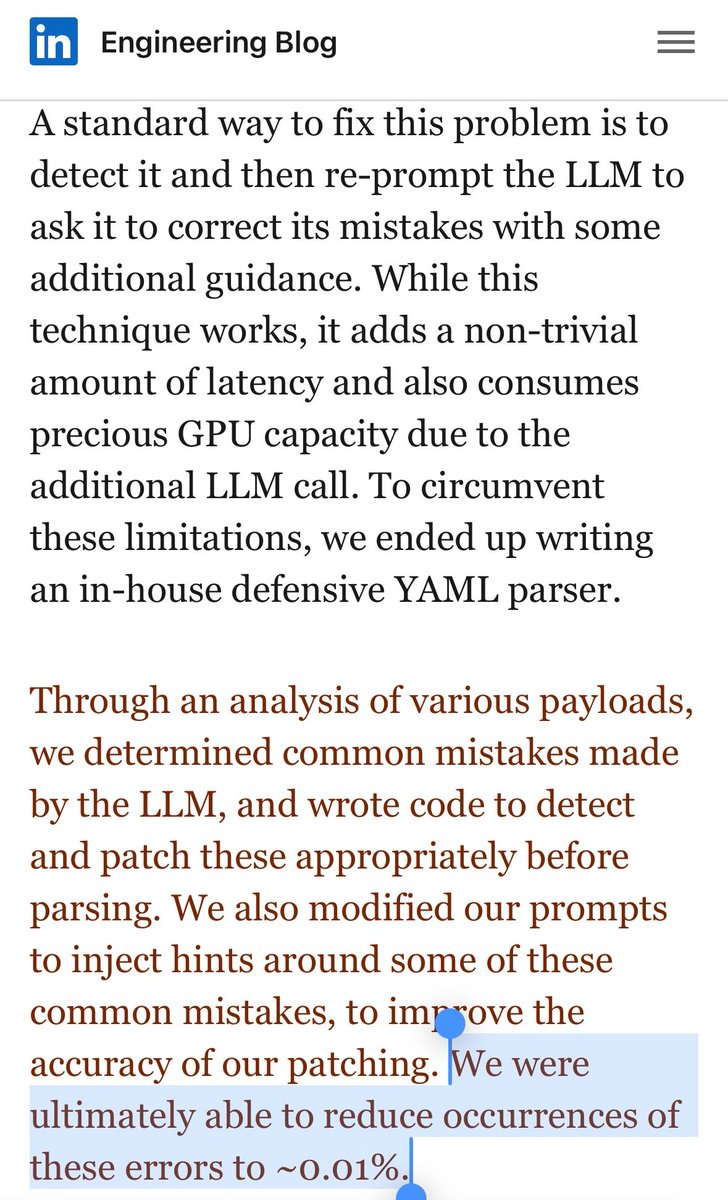
Here’s how the LinkedIn Engineering team reduced the error rate from ~10% to ~0.01% when generating structured outputs with LLMs.
Turning natural text into structured outputs is a cool use case for LLMs.
But getting LLMs to do this reliably is quite challenging.