go Brazil!! (and usa!)
But strangely, people think "society is getting worse", even though most people in society think their lives are going to be better.
Travel learning: immersive, multi-sensory, emotionally connected.
It isn't better because it's fun. It's better because your brain encodes it differently.
Study abroad isn’t just about visiting multiple cities. The key is helping students connect the dots—seeing how culture, business, and innovation shift from one hub to the next. That’s where the learning sticks. 🌍✈️
You are not too old to change your mind, make new friends, learn something new, travel to places above the clouds, forgive first, find work that brings you joy and fall in love again.
Because the moment you leave, things you never questioned—your assumptions about time, trust, work, even friendship—become visible.
Contrast reveals the invisible. And once you see it, you can’t unsee it
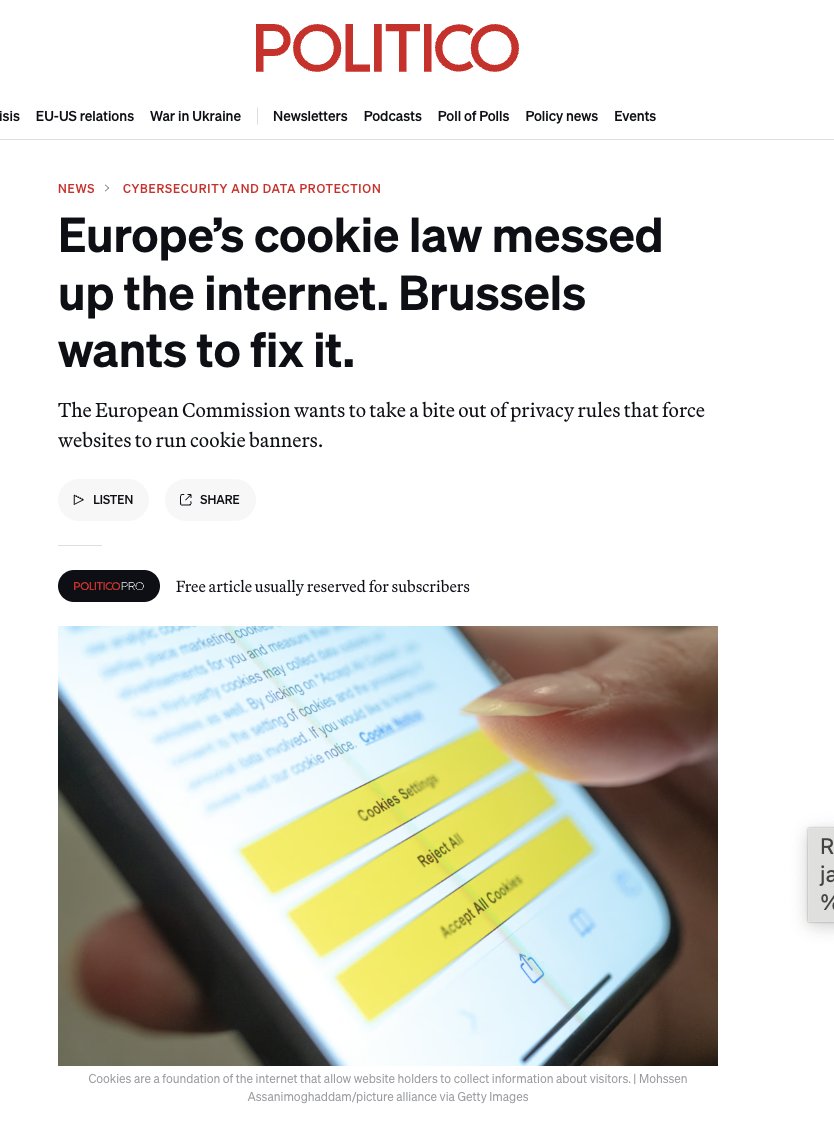
Europe might finally scrap the cookie banners they foisted on the entire world
Trillions of wasted clicks and they actually make us LESS safe. Killing the dumb regulation would be a huge online quality-of-life upgrade.
🇪🇺 eu/acc
A few weeks ago Mario Draghi asked my recommendations for his report that came out today about European competitiveness
I had a call with him and summarized my problems with doing business in the EU
I wrote this which is included in the report presented to the European Union today:
1. Minimum revenue cut offs for current and new regulation
Exempt small businesses with annual revenues below €10 million from complex regulations like VATMOSS, GDPR, the EU AI Act, and certain labor laws. This approach encourages innovation and growth by allowing startups to focus on product development and market validation without the heavy burden of regulatory compliance. Once these businesses surpass €10 million, they will have the resources to comply with regulations, ensuring that growth is not stifled.
2. Simplify starting a pan-EU business with an EU-wide Incorporation (Inc.) business form
Currently, starting and operating a business across the EU is complex due to 27 member states, each with its own company registration requirements. To streamline this process and make it easier for entrepreneurs to operate across Europe, there should be a single, standardized business entity that applies uniformly across all EU countries. I call this the European Inc.
3. Start an EU business fully online, no physical offices, notaries, lawyers etc
To continue, right now starting a business in most EU member states it’s complicated, very time and resource intensive, and often involves lawyers and notaries. Instead, it should be as simple as going online to a centralized EU website, where entrepreneurs can register their business and details in just a few clicks. The entire process should be streamlined and efficient, allowing businesses to start operating immediately.
The EU government taxes and bookkeeping of this business should also be fully online in an EU portal/dashboard.
4. 0% corporate tax for first 3 years of any new business
Countries like Singapore have successfully attracted new businesses from around the world by giving them a massive tax discount during the first 3 years of business. Because they know that’s the most difficult time of a business: figuring out what product it makes and if there’s a market for it. That takes pressure off startups and business founders that they can focus on creating a great product and innovating.
5. Change tax on stock options: don't tax when a stock option is exercised, but tax it when the stock is sold
The current tax policy in the EU taxes stock options at the time they are exercised, creating a significant financial burden on employees who have not yet realized any tangible financial gain. This approach stifles innovation, discourages entrepreneurship, and places the EU at a competitive disadvantage compared to other regions like the United States.
I propose a simple change: Tax stock options when the stock is sold, not when the option is exercised.
6. Don’t see tech or AI as an enemy, but as a burgeoning and essential industry
The most popular companies in tech are focused on AI right now for a reason. It’s the next frontier of computing. The European Union seems to consider AI the enemy. Any technology can be used for good or bad. By regulating it even before Europe has made much contributions (Europe has almost no tech companies leading in AI), it has stifled any potential innovation in AI from the start.
Apart from the regulation itself, the optics of it make the EU look bad on a global scale. Why would tech founders move to Europe to start a business if the EU is actively positioning itself as Anti-AI?
AI has gigantic potential to be used for good: think of the medical field for diagnosis of diseases, generally in programming (it helps programmers to create software faster/better), etc.
This goes further than AI. The same applies to tech in general. It seems the EU is on a crusade against technology while not being able to compete in it itself. It feels a case of sour grapes: if we can’t build great technology in EU, nobody is allowed to do so!
7. Teach tech/coding/AI topics in all schools and unis
It would help a lot if the EU has a focus on teaching AI and tech in schools and universities. Making the new generation competitive in this field instead. To secure the future prosperity of the European Union, we must prioritize education in technology, coding, and AI across all levels of schooling, from primary education to universities. This strategic focus is not just an educational reform—it’s a critical investment in the future competitiveness, innovation, and economic resilience of the EU.
It's time to start the European version of e/acc:
🇪🇺 eu/acc
"Innovate, don't regulate"
As a counter to the now rampant degrowth anti-tech anti-capitalist mind virus that's taken over most Europeans in 2024
Technology can change the world in ways that are unimaginable until they happen.
Switching on an electric light would have been unimaginable for our medieval ancestors. In their childhood, our grandparents would have struggled to imagine a world connected by smartphones and the Internet.
Similarly, it is hard for us to imagine the arrival of all those technologies that will fundamentally change the world we are used to.
We can remind ourselves that our own future might look very different from the world today by looking back at how rapidly technology has changed our world in the past.
One insight to take away from this long-term perspective is how unusual our time is.
Technological change was extremely slow in the past — the technologies that our ancestors got used to in their childhood were still central to their lives in their old age.
In stark contrast to those days, we live in a time of extraordinarily fast technological change. For recent generations, it was common for technologies that were unimaginable in their youth to become common later in life.
Why Europe Still Matters in Global Business Education. In the global conversation about business education, attention often drifts eastward. Asia’s rapid growth, Latin America’s emerging talent, Africa’s demographic dynamism, and the scale of American innovation ecosystems...
The eurozone adds another layer still: a shared currency without a shared fiscal policy. It’s an economic puzzle that no textbook can flatten into neat theories.
From a teaching standpoint, this is gold.